
Every January, a wave of "top AI startups to watch" listicles appears — and by June they read like time capsules. Companies pivot, get acquired, or quietly stall, and the list never finds out. This page takes a different approach: the ranking below is generated from live data, re-computed continuously from the signals our pipeline extracts out of more than 25 podcasts, 15+ industry newsletters, and daily AI research papers.
Key takeaways
- The ranking below reflects the trailing 7 days of detected activity — funding, product launches, M&A, executive hires, and substantive expert mentions.
- It is computed from Teahose's analysis of 1,150+ expert summaries (1,158 and counting) drawn from 25+ podcasts, 15+ industry newsletters, and daily AI research — roughly 1M+ words of expert analysis covering 1,800+ operators and thousands of companies.
- It updates continuously. Bookmark this page and it will be different — and current — next month.
- Use it as a discovery surface, not a verdict: high signal volume means "look here now," and each company links to a full profile with its signal history.
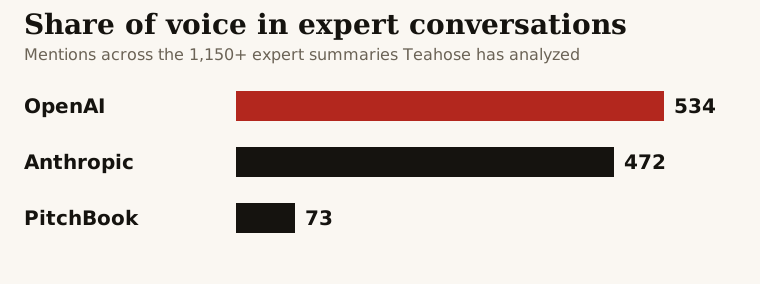
Each bar counts how many of Teahose's 1,150+ expert summaries mention it (word-boundary match across our podcast, newsletter, and paper corpus, June 2026).
Track the field: find the companies most similar to OpenAI and get their latest funding and product signals by email — Teahose Lookalikes.
Signal and mention counts are derived from Teahose's analysis of 1,150+ expert podcast, newsletter & research summaries, June 2026.
How We Rank AI Startups
Teahose runs an extraction pipeline over primary industry conversation: investor and founder podcasts (20VC, No Priors, BG2, Dwarkesh and others), the newsletters VCs actually read (StrictlyVC, Axios Pro Rata, PitchBook News and more), and daily AI research papers. Every mention of a company gets classified into a signal — funding, product, M&A, hire, or expert mention — and lands in a live company graph that currently tracks well over a thousand AI companies.
The list below is the simplest possible view of that graph: who generated the most signals in the last 7 days. No editorial weighting, no pay-to-play, no annual refresh cycle.
What the Top of This List Tends to Look Like
A few patterns we see consistently in the data:
- Frontier labs dominate raw volume. Companies like Anthropic and OpenAI generate signals daily — every model release, enterprise deal, and podcast debate counts. Treat their presence as a baseline.
- Funding weeks spike companies hard. A startup announcing a large round will jump from invisible to top-10 in a day or two, then decay over the following weeks. That decay is informative: companies that stay ranked after a raise are converting money into momentum.
- Physical AI is the fastest-growing cluster. Humanoid robotics, manipulation, and world-model startups now produce a steady share of top signals — we track that segment separately in our robotics startups guide and the physical AI theme.
- Vertical AI compounds quietly. AI-native companies in legal, healthcare, defense, and finance produce fewer but higher-value signals (enterprise deals, regulatory wins). Browse all tracked themes to follow a specific vertical.
The Top AI Startups Right Now
Ranked by signal volume over the trailing 7 days · funding, launches, M&A, hires, expert mentions
- 01OpenAI41 signals · 7d
- 02Anthropic39 signals · 7d
- 03Yahoo28 signals · 7d
- 04Bessemer17 signals · 7d
- 05Vanta14 signals · 7d
- 06Ropedia14 signals · 7d
- 07Google12 signals · 7d
- 08Nvidia12 signals · 7d
- 09Mecka11 signals · 7d
- 10Tesla10 signals · 7d
- 11a16z10 signals · 7d
- 12Meta10 signals · 7d
- 13SpaceX10 signals · 7d
- 14General Catalyst9 signals · 7d
- 15Microsoft9 signals · 7d
- 16Mercedes-AMG Petronas F1 Team8 signals · 7d
- 17Reducto7 signals · 7d
- 18Y Combinator7 signals · 7d
- 19Stripe7 signals · 7d
- 20Amazon7 signals · 7d
- 21Town7 signals · 7d
- 22NBC7 signals · 7d
- 23Tenstorrent6 signals · 7d
- 24科沃斯6 signals · 7d
- 25Evercore6 signals · 7d
How to Use This Ranking
- Scan for unfamiliar names. The known frontier labs will always chart; the alpha is in the companies you haven't heard of yet sitting unusually high.
- Click through to the signal history. Each profile shows why a company is ranked — one big funding event reads very differently from a steady drumbeat of product launches and hires.
- Watch the companies you care about. Every company page has a Watch button that emails you when new signals land — no need to re-check this page.
- Map a company's neighborhood. Paste any startup's website into our lookalikes tool to find its closest competitors by what they actually do, ranked by vector similarity.
Where the Signals Come From
Unlike databases that rely on self-reported profiles or web scraping, every signal here traces back to a primary conversation: an investor explaining a deal on a podcast, a newsletter breaking a round, a research paper from a startup's lab. That means coverage skews toward companies the industry is genuinely engaging with — which is exactly the bias a "top startups" list should have. You can audit the raw feed yourself on the live signals page, or get the daily distillation by subscribing to the free digest.
If you're researching a specific segment, these guides go deeper: robotics startups, physical AI companies, AI chip companies, defense tech startups, OpenAI's competitive map, and Anthropic's competitive map. For the frontier-hardware adjacencies AI capital keeps flowing into, see quantum computing companies and neurotech companies.
Bottom line: The top AI startups in 2026 are best identified not by a static annual list but by live signal volume — funding, launches, M&A, and hires from the trailing 7 days — so treat the continuously updated ranking above as a discovery surface for where capital, talent, and attention are flowing this week.
Frequently Asked Questions
How is this list of top AI startups ranked?
Companies are ranked by signal volume over the trailing 7 days: the number of funding rounds, product launches, acquisitions, executive hires, and substantive mentions our pipeline extracts from podcasts, newsletters, and research papers. A company at the top of the list is the one the industry is actually talking about and transacting around right now — not the one that raised the biggest round last year.
How often does the ranking update?
Continuously. Our pipeline processes new podcast episodes, newsletter issues, and papers multiple times per day, and the ranking reflects a rolling 7-day window. A startup that announces a major round or launch typically appears within a day.
What counts as an AI startup here?
Private companies building AI products or infrastructure — frontier model labs, AI application companies, developer tooling, AI infrastructure, and physical AI (robotics). Large public companies appear in our broader company graph but the interesting movement is almost always in the private set.
Why do rankings by signal volume beat static "top startups" lists?
Static lists encode one editor's view at one moment, and AI moves too fast for that to stay useful — half the companies on a January list are old news by June. Signal volume is a behavioral measure: it captures where capital, talent, and attention are actually flowing this week.
How can I track a specific AI startup from this list?
Click through to any company's profile and hit Watch to get an email digest when new signals land for it. You can also paste any company's website into our lookalikes tool to find and follow similar startups.
What data does this top AI startups ranking actually use?
The ranking is computed from Teahose's analysis of more than 1,150 expert summaries — 1,158 as of June 2026 — distilled from 25+ founder and investor podcasts, 15+ industry newsletters, and daily AI research papers. Every company mention is classified into a signal (funding, product, M&A, hire, or expert mention), so the list reflects what operators and investors are actually discussing, not a one-time editorial pick.
Which AI startups show up at the top most often?
Frontier labs generate the most raw volume — across the corpus, OpenAI is referenced in 533 summaries and Anthropic in 481, so they sit near the top as a baseline. The more useful movement is in companies that spike on a fresh funding round or product launch and then keep ranking, which signals real momentum rather than a one-off announcement.
Is this a better source than a VC firm's annual top startups list?
For a point-in-time prestige snapshot, curated lists are fine. But they go stale within months because AI moves faster than an annual refresh. A signal-volume ranking is a behavioral measure rebuilt continuously from live conversation, so it surfaces where capital, talent, and attention are flowing this week — useful for discovery rather than as a final verdict.