
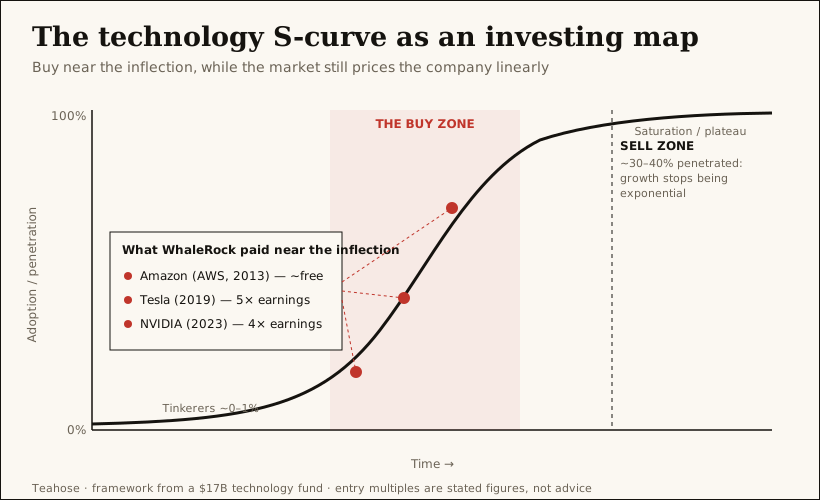
To invest through technology cycles, you buy the company with a durable moat at the moment its technology crosses from the flat part of the adoption S-curve into exponential growth — while the market is still pricing it linearly. That single idea is how the $17B technology fund WhaleRock bought NVIDIA at about 4x earnings in 2023 and Tesla at roughly 5x in 2019. It is not stock-picking by gut; it is a repeatable three-part framework.
Key takeaways:
- The framework has three legs: an adoption S-curve near its inflection, a durable competitive advantage (one of five moats), and underappreciated earnings power. Miss any one and you lose — "you can be in the best S-curve of all time and still lose out" if you own the wrong company.
- The edge is exponential math. The market prices next quarter; S-curves grow earnings "from $1 to $10." That gap is why elite tech investors keep buying world-class companies at single-digit multiples.
- This is rarer than it sounds. Across the 1,175 expert investor and operator conversations our pipeline has analyzed, explicit S-curve thinking appears in just 16 of them. (Methodology: a case-insensitive match for "S-curve" across our summary corpus, June 2026 — a measure of how rarely the lens is named, not a market statistic.)
- Where AI sits in 2026: the infrastructure layer is ~10% penetrated and enterprise apps are under 1% — early enough that the runway is measured in years, not quarters.
- The contrarian read nobody else is making: "decommoditization" — the money in a maturing cycle flows to the layer that builds a moat (AI hardware), not the layer that commoditizes. It came up in exactly 1 of our 1,175 conversations.
Disclosure: Teahose is an independent information and data service — not a broker-dealer or investment adviser. This guide summarizes a fund manager's publicly described framework for educational purposes. Nothing here is investment advice, and the entry multiples cited are that manager's stated figures, not recommendations. Investing in technology is risky; you can lose money.
At a glance: what a tech investor paid near the inflection
These are the real entry multiples WhaleRock has cited for buying into a technology S-curve early — the practical proof that "the world doesn't think exponentially."
| Company | Cycle (S-curve) | Year bought | Entry valuation | Why it was cheap |
|---|---|---|---|---|
| ★ Track today's cycles on Teahose | AI infra, robotics, fusion… | Live | Free signal feed | See which companies are mid-curve right now |
| Amazon | Cloud (AWS) | 2013 | AWS "essentially free" | AWS was a hidden line item buried inside retail |
| Tesla | Electric vehicles | 2019 | ~5x earnings | Range + price barriers had just fallen |
| NVIDIA | AI compute | 2023 | ~4x earnings | "It's got to be a bubble" priced the next year only |
| Apple | Smartphones | early | ~4x earnings | Pre-mass-adoption, pre-ecosystem |
★ Teahose is our own service — listed first because it is what we make; the rest are a fund manager's stated historical figures, included to illustrate the framework, not rated.
What is the technology S-curve? (and why it beats "just buy tech stocks")
Every technology follows the same shape. It comes out years before anyone notices, sits flat while only tinkerers use it, then rockets the moment the barriers to mass adoption fall — before flattening again at saturation. Plotted as cumulative adoption over time, it looks like an "S."
The lag is the part investors underestimate. As Sacerdote puts it: "The smartphones were out 10 years before the iPhone. The internet was out 20 years before Netscape." AI is the same — neural networks lived inside research labs for decades until ChatGPT "took it public" in November 2022.
The curve has four adoption phases, the same ones Everett Rogers described in Diffusion of Innovations (later popularized as "Crossing the Chasm"):
- Tinkerers / innovators — the flat start, ~0-1% adoption.
- Early adopters — the inflection begins.
- Early mainstream — the steep, exponential middle.
- Mainstream / laggards — the plateau toward saturation.
The reason this beats a generic "invest in technology" or "best tech stocks" screen is that the S-curve is a map of the future, not the past. It tells you how tall the curve is (how big the market gets) and how long the growth lasts (how long to hold) — the two things a price chart can never show you.
The investor's framework: S-curve + moat + underappreciated earnings power
The S-curve alone is not enough. WhaleRock's full framework is three independent tests, and a company has to pass all three:
| Test | The question it answers | What goes wrong without it |
|---|---|---|
| 1. The S-curve | Is this technology near the inflection, and how tall is the curve? | You buy a real trend years too early — or too late, after the growth is gone. |
| 2. Competitive advantage | Does one company have a durable moat? | You own a doomed competitor in a great market (RIM, Nokia, Motorola — "zero, zero, zero"). |
| 3. Underappreciated earnings power | Is the long-run earnings power mispriced? | You pay up for growth everyone already sees — no asymmetry left. |
When all three line up, the payoff is non-linear: "the earnings can grow from $1 to $10, and it happens way more than you think." A strong tech business does not grow earnings linearly with revenue — operating leverage makes them grow exponentially. That is why you can buy "some of the best companies in the world for extremely low PEs."
This is the gap the rest of the internet leaves open. Generic guides explain the S-curve as a strategy-consulting idea (R&D budgets, product roadmaps). Almost none translate it into a public-market playbook: which stock, at what multiple, held for how long. That translation is the whole game.
When to buy: spotting the inflection before the market does
When to buy: at the inflection — the moment the barriers to mass adoption fall and demand is about to go vertical, but before the multiple has re-rated. The inflection happens when the barriers to adoption get removed all at once. That is the "tornado of demand" — the moment everyone realizes they need the thing immediately:
- iPhone: Steve Jobs cut the price from ~$600 to ~$200, AT&T added a 3G network, the touchscreen made it so easy "your grandmother could do it," and the App Store ecosystem locked it in. Every barrier fell, and adoption went vertical.
- Tesla: Elon got the price to ~$40,000, the range to ~300 miles, and the supply chain in place to build millions. Inflection.
Spotting it early is hard because, as Andy Grove said, "at strategic inflection points, you can't trust the data" — the numbers lag. So practitioners lean on intuition and anecdote:
- Visual/anecdotal signals. Sacerdote saw a 12-year-old in China playing a console-grade game on a giant phone and knew mobile gaming had inflected — years before the financials showed it.
- The Gartner IT Symposium (30,000 CIOs). When a vendor's session is standing-room-only at 9am, 10am, and 11am, enterprise demand is about to explode — it worked for AWS, Splunk, and VMware.
- The slope matters as much as the height. WhaleRock commissioned Horace Dediu (a longtime collaborator of The Innovator's Dilemma author Clayton Christensen) to chart 100 years of S-curves. The lesson: consumer technologies adopt fast (radio hit near-saturation in ~7 years); anything that must "plug into" existing systems — B2B software, the dishwasher — is slow.
Crucially, you do not have to be first. "It's okay to miss the first 100%." If the top of the curve is half a trillion dollars, the growth runs for years. Peter Lynch's advice to a young Sacerdote at Fidelity: "White out the chart. It's all about the future."
The second-derivative rule: the buy and sell decisions hinge on the rate of change of adoption, not its level. "You go from 10% to 30% and your growth rate accelerates and your margins accelerate. Rate of change is very important."
The five moats that separate a winner from a dead S-curve
A great S-curve attracts a crowd; only a moat keeps the returns. "If your name was RIM, Pong, Nokia, HTC, LG, Motorola — zero, zero, zero, negative, negative." WhaleRock looks for one or more of five durable advantages, which in the digital world are often stronger than offline moats:
| Moat | How it works | Examples |
|---|---|---|
| Network effect | Each user makes the product more valuable | LinkedIn, Facebook, Alibaba |
| Industry standard | Everything is built to work with you | Oracle (databases), Bloomberg |
| Scale | S-curves let you reach Walmart-size scale in ~5 years, not 40 | Amazon, the hyperscalers |
| Critical IP | You literally cannot build the product without them | Qualcomm (modems), ASML (lithography) |
| Brand | You never have to pay to acquire customers | Google, Amazon, Tesla — "Elon's never had to advertise" |
The strongest companies stack several at once. And on the internet, the leader usually "grows bigger, faster, and wins" — the lead compounds on itself. The exceptions come at paradigm shifts (AOL missed broadband; Netscape had a weak business model), which is exactly why you re-test the moat every time the curve moves.
When to sell: where exponential growth ends
When to sell: as the technology nears ~30-40% penetration, when growth stops being exponential and the sell-side finally catches up. The sell signal is penetration, not price. "When something gets to sort of 30-40% penetrated, you stop having exponential growth, which means the sell side catches up and there are no longer big beats."
But two nuances separate good sellers from great ones:
- The stock can peak before the technology. Expectations get priced in early, so a name can top out while adoption is still climbing. Watch the change in the growth rate, not the absolute level of adoption.
- A real moat changes the math. Sacerdote calls selling Apple in 2012 — at ~50% US smartphone penetration — a "mistake." The hyper-growth was over, but Apple's ecosystem (it took a 30% cut of every app) let it keep compounding ~20% for years. The big years are the 0-to-50% part of the curve; the moat decides whether the rest is still worth owning.
Electric vehicles are the cautionary tale on the upside: WhaleRock expected ~40-50% adoption, but the EV curve "hit a big wall at 10-15%." S-curves usually run most of the way — but not always, so you stay on top of it and adjust.
Where AI sits on the S-curve right now (2026)
AI is, in Sacerdote's words, "by far the most complex and fastest-changing S-curve we've ever done" — and still extremely early. The AI stack has five layers (power → chips → clouds → foundational models → applications), and each is on its own sub-curve:
- Infrastructure (~10% penetrated) — "still one of the best ways to play AI." Demand is so far ahead of supply that Sacerdote calls it a "backwards L-curve" — close to straight up — and notes the world is already "30% short" of DRAM, NAND, and PCBs before the real demand arrives.
- Foundational models — consolidated from 60+ contenders into a "three-horse race": Anthropic (enterprise and code), OpenAI (consumer), and Google/Gemini. The single biggest unlock is coding: ~20 million developers each potentially spending $20-30k a year on tokens is "a half-a-trillion-dollar market just from coding alone."
- Applications (under 1% penetrated) — "still kind of unclear and a little bit dangerous," because the moats are unproven. WhaleRock watches Brett Taylor's Sierra as the bellwether but mostly stays out.
Our corpus is a live read on where the discussion sits. Across 1,175 expert conversations, AI's named leaders dominate the share of voice — a rough proxy for which companies are mid-curve in expert attention right now:
| Company | Mentions across 1,175 expert summaries |
|---|---|
| OpenAI | 541 |
| Anthropic | 488 |
| 437 | |
| NVIDIA | 330 |
| Amazon | 181 |
| Tesla | 175 |
| Stripe | 95 |
Methodology: case-insensitive name matches across our 1,175 expert summaries (June 2026). This is share of expert discussion, not market share or a ranking of investment quality.
For comparison, the concept "moat" appears in 511 of those summaries and "AI infrastructure" in 360 — the vocabulary of durable advantage is everywhere; the specific contrarian frame below is almost nowhere.
Three contrarian reads most investors miss
The framework only pays when it tells you something the consensus does not. Three live calls from the 2026 AI cycle:
1. The "decommoditization" of hardware (the most important theme almost no one is playing)
For 40 years, data-center hardware was a shrinking, commoditizing business — memory, circuit boards, networking, contract manufacturing all raced to zero margin. AI changed the physics. Workloads growing ~10x a year push "every single aspect of this hardware to the physical limits," which requires constant innovation and hands durable IP back to former commodity suppliers:
- Celestica — a contract manufacturer trading at 8x earnings, turned out to be the sole supplier of Google's TPU server, with 50-60% share of the cloud Ethernet-switch market and rare liquid-cooling skill.
- Corning — fiber demand so large that a single new Microsoft data center reportedly held enough fiber to "circle the world four and a half times."
- Copper-clad-laminate and PCB makers — 40-layer AI boards versus 10-layer commodity ones, with "50-60% CAGR just in the units" and rising prices and rising margins and four-year visibility.
"Decommoditization" appeared in exactly 1 of our 1,175 expert conversations — this very episode. That rarity is the signal.
2. Enterprise software is structurally short, not a free AI winner
The consensus says incumbents will "bolt on AI" and win. WhaleRock went from 40-50% software five years ago to net short entering 2025, on a stack of headwinds: AI budget priority pulls spend toward tokens, seat-based pricing is at risk as headcount freezes, annual price increases get harder, and AI-native replacements are coming. Their tell: a company can have $40B in revenue and only $0.5-0.7B of AI ARR — "their AI is 1% or 2% at this stage."
3. The application layer is too early to chase
Conventional wisdom says apps capture most of the value. True — eventually. "It always comes later… it usually doesn't start in the first three or four years." The boundary between "foundational model" and "application" is still moving, so the moats are unproven. The framework says: watch, don't chase.
Want the modified screen WhaleRock uses for the AI cycle? Their "AI Rule of 40": percent of revenue that is genuinely AI plus market share in that AI category. A company at 30% AI revenue and 30% share scores 60 — "a great place to look, because you've got exposure and a strong market position."
How to actually get exposure (routes for a normal investor)
You do not need a hedge fund to apply the framework. From lowest to highest effort:
- Broad technology / Nasdaq-100 index ETFs. Own the whole sector and let the winners compound inside the index. Cheapest, most diversified, no stock-picking.
- Large-cap platform companies, bought directly. A deliberately "boring" way to own several S-curves at once. Sacerdote argues mega-cap tech is structurally under-owned — endowments are heavy in privates and international, and "it takes 100 diversified PMs to realize Google's a winner," so the mispricing persists.
- Thematic / picks-and-shovels ETFs. Target one S-curve — AI, semiconductors, robotics — at the cost of higher fees and concentration. The "infrastructure first" logic: you get the demand first and you know who the winners are, no matter who wins the layer above.
- Individual S-curve stocks. The highest-effort, highest-conviction route — run the full three-part framework yourself, and use the "tripod" conviction test before sizing up: your view, your analyst's view, and a respected outside investor's view.
- Pre-IPO and public proxies. Many of the biggest AI S-curve names (Anthropic, Databricks, Stripe) are still private. See how to invest in pre-IPO companies for the routes — including buying a public parent that holds a private stake.
Track the cycles before you buy: the hardest part of S-curve investing is seeing the inflection early. Paste any company's website into the Teahose lookalikes tool to find the companies riding the same wave and get their funding, product, and hiring signals by email — the real-world demand signals that show up before the financials.
The mistakes that wreck S-curve investing
- Linear thinking. Anchoring on next quarter and refusing to underwrite two-to-five years out. The whole edge is that "very few people believe you can accurately predict" that far — and with the S-curve, you can.
- Buying the curve without the moat. A great market with no durable advantage is a value trap with a story. Demand the moat.
- Selling too early. Dumping a compounder the moment growth decelerates, even when the moat keeps it compounding (the Apple 2012 lesson).
- Chasing the app layer too soon. The most exciting demos are often the least investable — the moats have not formed yet.
- Trusting the chart over the future. "White out the chart." A stock that has already tripled can still be early if the curve is half a trillion dollars tall.
Bottom line
Investing through technology cycles is not about predicting the next gadget — it is a disciplined three-part bet: a technology near the inflection of a tall adoption S-curve, a company with one of five durable moats, and a price that still reflects linear, not exponential, earnings. Get all three and the payoff is asymmetric, because the world prices next quarter while great tech earnings go "from $1 to $10." In 2026 the framework points at the AI infrastructure layer (early, supply-constrained, and quietly decommoditizing) far more than at the crowded application layer. The companies below are the ones our pipeline sees riding that infrastructure curve right now.
AI Infrastructure Companies Riding the Current S-Curve
Live membership of the AI-infrastructure themes, ranked by extracted signals across our expert corpus — the "infrastructure first" layer Sacerdote calls one of the best ways to play AI.
- 01Anthropiclast seen SEP 231465 signals
- 02OpenAIlast seen SEP 231348 signals
- 03Nvidialast seen SEP 23812 signals
- 04Googlelast seen SEP 23523 signals
- 05SpaceXlast seen SEP 22502 signals
- 06Metalast seen SEP 23401 signals
- 07Microsoftlast seen SEP 23272 signals
- 08Amazonlast seen SEP 23250 signals
- 09Applelast seen SEP 21214 signals
- 10Hugging Facelast seen SEP 21173 signals
- 11xAIlast seen SEP 23158 signals
- 12Cursorlast seen SEP 22142 signals
- 13PitchBooklast seen SEP 22135 signals
- 14Databrickslast seen SEP 22118 signals
- 15DeepSeeklast seen SEP 23115 signals
- 16OpenRouterlast seen SEP 23109 signals
- 17Moonshot AIlast seen SEP 23109 signals
- 18Palantirlast seen SEP 22108 signals
- 19Uberlast seen SEP 1796 signals
- 20Google DeepMindlast seen SEP 2186 signals
- 21Bending Spoonslast seen SEP 2085 signals
- 22Intellast seen SEP 2376 signals
- 23Replitlast seen SEP 2364 signals
- 24Fireworkslast seen SEP 2163 signals
What Teahose adds that a stock screener can't
A screener shows you last quarter's numbers. The S-curve framework needs the opposite of last quarter's numbers — it needs the early, pre-financial demand signals: the funding round, the new product, the key hire, the offhand mention by a smart investor on a podcast. Teahose extracts exactly those signals from 1,175+ expert conversations (podcasts, newsletters, research) and surfaces them as a live feed for every tracked company.
- Map today's cycles with the lookalikes tool — paste a company and find the rest of its S-curve.
- Browse the raw signal feed the rankings are built from.
- Go deeper on the AI cycle: AI infrastructure companies · AI chip companies · NVIDIA competitors · physical AI companies.
Related guides: Anthropic valuation · Top AI startups · AI unicorns, live-ranked · How to invest in pre-IPO companies · Best AI & investing podcasts
Framework distilled from Alex Sacerdote (WhaleRock) on Invest Like the Best, EP.477. Editorial figures as of June 25, 2026; entry multiples are the manager's stated historical figures. Not investment advice — verify against primary sources before investing.
Frequently Asked Questions
What is the technology S-curve in investing?
The technology S-curve maps how a new technology gets adopted over time: a long, flat start while only tinkerers use it, a steep inflection once the barriers to adoption fall, exponential growth through the mainstream, then a plateau at saturation. For investors it is a map of the future — it tells you roughly how big a market will get and how long the growth will last, so you can buy a company before the market prices in the exponential phase. It is the lens fund manager Alex Sacerdote (WhaleRock) has used for 20 years, paired with two other tests: a durable competitive advantage and underappreciated long-run earnings power.
How do you invest in technology cycles?
Use a three-part filter. (1) Find a technology near the inflection of its adoption S-curve — where barriers like price, infrastructure, or usability have just fallen and demand is about to go vertical. (2) Inside that wave, identify the one or two companies with a durable moat (network effect, industry standard, scale, critical IP, or brand) so a great market does not just attract competitors who compete the returns away. (3) Buy only when the long-run earnings power is underappreciated — when the market is still pricing next quarter, not the next five years. Then size the position to your conviction and hold through the exponential part of the curve.
When should you buy a tech stock on the S-curve?
Near the inflection point — when the barriers to mass adoption have just been removed and demand is about to accelerate, but before the company has compounded for years and the multiple has re-rated. WhaleRock bought NVIDIA at about 4x earnings in 2023, Tesla at roughly 5x in 2019, and Amazon for its AWS option "essentially free" in 2013, because the market does not think exponentially. You do not have to catch the absolute bottom: if a market tops out at hundreds of billions, the growth runs for years, so it is fine to be "late" by the first 100%. Sacerdote quotes his mentor Peter Lynch: "white out the chart — it is all about the future."
When should you sell a technology stock?
Generally when the technology gets to roughly 30-40% penetration of its addressable market. That is when growth stops being exponential, the Wall Street sell-side finally catches up, and the big earnings "beats" end. One caution: a stock can peak before the technology does, because expectations get priced in early — so the sell signal is the change in the growth rate, not the absolute level. Sacerdote calls selling Apple in 2012 (at ~50% US smartphone penetration) a "mistake," because its moats let it keep compounding ~20% even after the hyper-growth phase ended.
Where is AI on the S-curve right now (2026)?
Very early. By WhaleRock's read, the AI infrastructure layer is roughly 10% penetrated and the enterprise application layer is under 1% penetrated — Google has estimated genuine AI usage at about 10 basis points of the world's knowledge workers. Sacerdote argues AI is adopting so fast (you just open a browser) that the early phase looks less like a gentle S and more like a "backwards L-curve" — close to straight up. The practical implication: the curve still has years of runway from 10 basis points toward single-digit and then double-digit penetration.
Is AI on an S-curve?
Yes — AI is following the same adoption S-curve every major technology has, just unusually fast. The pattern is identical: a long hidden phase (neural networks existed for decades inside research labs), then a public ignition (ChatGPT in November 2022), then the barriers to adoption falling one by one (cost, latency, the jump to agentic coding). Because AI requires almost no installation — you open a browser and it is there — its early slope is steeper than slow-to-plumb technologies like enterprise SaaS or the dishwasher, which is why practitioners describe the current phase as nearly vertical.
What is the difference between the S-curve and the technology adoption life cycle?
They describe the same phenomenon from two angles. The S-curve plots cumulative adoption (or performance) against time and is shaped like an "S": flat, steep, flat. The technology adoption life cycle (Everett Rogers, later popularized as "Crossing the Chasm") slices that same curve into the groups who adopt at each stage — innovators and early adopters at the start, the early and late majority through the steep middle, laggards at the end. Investors use the S-curve to size the market and time entry, and the adoption life cycle to judge which group is buying right now.
What is "decommoditization" in technology investing?
Decommoditization is when a previously commodity business regains pricing power and durable advantage because demand suddenly pushes its product to the physical limits of what is possible. Sacerdote's example is AI data-center hardware: for 40 years, memory, circuit boards, networking, and contract manufacturing were low-margin commodities. AI workloads growing ~10x a year now require constant innovation in every component, so suppliers like Corning (fiber), Celestica (servers and switches), and copper-clad-laminate makers have rising units, rising prices, rising margins, and multi-year visibility. It is the contrarian core of the framework — the money accrues to the layer that builds a moat as the curve matures, not the layer that commoditizes.
How do you invest in technology cycles without picking individual stocks?
Several lower-effort routes. Broad technology or Nasdaq-100 index ETFs give you the whole sector and let the winners compound within the index. Thematic ETFs target a single S-curve (AI, semiconductors, robotics) at the cost of higher fees and concentration. Buying the largest, most-moated platform companies directly is a deliberately "boring" way to own multiple S-curves at once — Sacerdote argues large-cap tech is structurally under-owned and therefore underpriced. And for pre-IPO names, public proxies (owning a listed parent that holds a private stake) give indirect exposure without accreditation.
Who is Alex Sacerdote and what is WhaleRock?
Alex Sacerdote is the founder of WhaleRock Capital Management, a technology-focused investment firm managing more than $17 billion across hedge fund, long-only, and hybrid strategies. Over the three years to mid-2026 it was one of the best-performing funds, compounding roughly 44% a year. Sacerdote has invested through a single lens for 20 years — technology S-curves, durable competitive advantages, and underappreciated earnings power — which he detailed on the Invest Like the Best podcast (EP.477, June 2026). This guide distills that framework.