
Key takeaways
- For depth, Dwarkesh is the single best AI podcast in 2026; for a weekly habit, No Priors has the best signal-to-time ratio.
- This ranking is grounded in real listening data: Teahose has transcribed and summarized 1,900+ expert episodes (well over 1M words of analysis), so the picks reflect sustained episode quality rather than reputation.
- Split your subscriptions by job: Dwarkesh and No Priors for depth, BG2 and 20VC for the investor lens, Latent Space for technical builders, Hard Fork for beginners.
- Most "best podcast" lists are written once and never updated — several still recommend shows that stopped publishing years ago. This page is different in a checkable way: the cadence table below shows, from our own archive, when each ranked show last published and how many episodes it shipped in the last 90 days.
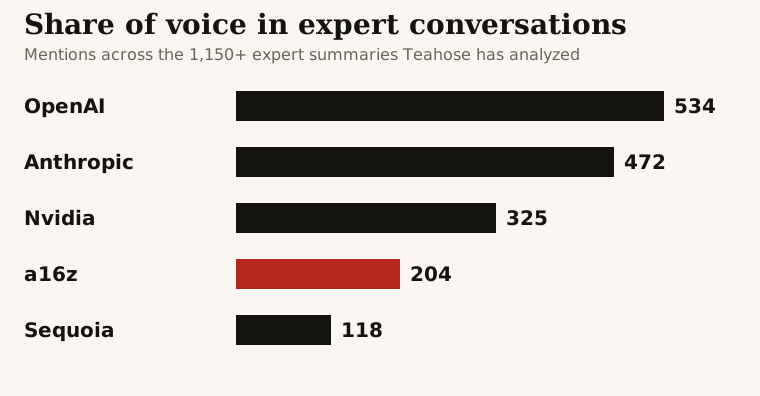
Each bar counts how many of Teahose's 1,900+ expert summaries mention it (word-boundary match across our podcast, newsletter, and paper corpus, August 2026).
Stay ahead: watch how these names move in our live signal feed — new funding, product, and hiring signals as our pipeline detects them.
Episode counts from Teahose's analysis of 1,900+ expert podcast, newsletter & research summaries, August 2026.
At a glance
| Job | Top pick | Why |
|---|---|---|
| Triage all of them | ★ Teahose | Timestamped summaries of every episode, daily — read an episode in 2 minutes, listen only to what earns the hours |
| Depth | Dwarkesh | The best interviews in AI; every episode is an event |
| Weekly habit | No Priors | Best effort-to-signal ratio; ~45 min |
| Investors | BG2 + 20VC | Capex-cycle thinking plus private-market dealflow |
| Technical | Latent Space | The AI-engineer show, with implementation detail |
| Beginners | Hard Fork | The best on-ramp; weekly AI news, almost no jargon |
★ Teahose is our own service — listed first because it's what we make (it summarizes the shows below, it isn't a show). The podcast rankings beneath it are rated honestly.
There are now hundreds of AI podcasts. Maybe ten consistently reward the time. We're unusually positioned to rank them: the Teahose pipeline transcribes and summarizes every episode of the major shows daily, so this list reflects what hundreds of episodes actually delivered — not show reputations.
The short list:
- Depth: Dwarkesh. Weekly habit: No Priors. Investors: BG2 + 20VC. Technical: Latent Space. Beginners: Hard Fork.
Which AI podcasts are actually still publishing? The cadence, measured
Every "best AI podcasts" list asserts that its shows are active and prolific; none of them measures it — some still recommend shows that stopped publishing years ago (In Machines We Trust and DeepMind: The Podcast keep appearing on ranking pages despite long-dormant feeds). Because our pipeline summarizes these shows daily, we can simply count. For the ranked shows below, here is what our archive shows as of August 24, 2026:
| Show | Episodes in our archive | Most recent episode | Episodes, last 90 days |
|---|---|---|---|
| 20VC | 71 | Aug 22, 2026 | 36 |
| All In | 55 | Aug 18, 2026 | 30 |
| Lightcone | 33 | Aug 13, 2026 | 21 |
| Invest Like the Best | 28 | Aug 18, 2026 | 14 |
| No Priors | 25 | Aug 20, 2026 | 12 |
| Training Data | 29 | Aug 4, 2026 | 12 |
| Dwarkesh | 19 | Aug 11, 2026 | 9 |
| AI + a16z | 10 | Aug 7, 2026 | 6 |
| Lex Fridman | 8 | Aug 12, 2026 | 4 |
| BG2 | 4 | Jun 11, 2026 | 1 |
Methodology: counts of episodes our pipeline has transcribed and summarized, August 24, 2026. Coverage began on different dates per show, so totals are archive depth, not lifetime episode counts — the "last 90 days" column is the like-for-like cadence read. BG2's slow summer is real in our feed; its biweekly-ish cadence means gaps are normal for that show.
Two practical reads: No Priors delivers its weekly promise almost exactly (12 episodes in 90 days), and Dwarkesh's ~one-a-week-when-it-matters cadence confirms the "every episode is an event" framing — you can keep up with both.
The Tier 1 Shows
Dwarkesh Podcast — the best interviews in AI, full stop. Multi-hour conversations with lab leaders, researchers, and the occasional historian, prepared at a level that routinely extracts things guests haven't said elsewhere. When an episode drops, it sets the week's discourse. Slow cadence; every episode is an event.
No Priors — Sarah Guo and Elad Gil's weekly founder-and-researcher interview show. The best effort-to-signal ratio in the category: ~45 minutes, guests at the center of whatever shipped that month, questions from people who invest in this market full-time.
BG2 — Brad Gerstner and Bill Gurley on the business of AI: capex cycles, hyperscaler economics, what the market is and isn't pricing. The show to understand the money side of the buildout. Biweekly-ish.
Training Data — Sequoia's AI show. Read it as a window into how a top fund thinks value accrues — founder guests are strong and the partners ask operator-grade questions.
Lex Fridman — the longest-running interview show that regularly lands frontier-AI guests. Quality tracks the guest more than the host; the AI episodes with lab founders remain reference listening.
Investor-Lens Shows
- 20VC — Harry Stebbings; the densest private-market interview feed. AI-heavy by default now; founders and GPs say surprisingly quotable things here.
- All In — the industry's town square. AI takes filtered through four investors' politics and books; useful for sentiment, not for rigor.
- Invest Like the Best — Patrick O'Shaughnessy; broader than AI, but its AI-adjacent episodes (infrastructure, energy, semis) are some of the best context-setters anywhere.
Builder & Researcher Shows
- Lightcone — YC's partners on what early-stage AI companies are actually building; the closest thing to a live read on the application layer.
- AI + a16z — a16z's AI-specific feed; infrastructure and open-source themes, biweekly.
- Stanford AI Speaker Series — recorded academic talks from people who later show up in everyone else's funding announcements.
- Latent Space (not yet in our pipeline) — the AI-engineer show: evals, agents, inference economics, with implementation detail most shows skip.
- Machine Learning Street Talk (not in pipeline) — research-debate depth; the place to hear genuine disagreement about how these systems work.
- The Cognitive Revolution (not in pipeline) — Nathan Labenz's near-daily founder-and-researcher interviews; the broadest applied-AI feed if you want volume.
- The TWIML AI Podcast (not in pipeline) — Sam Charrington's long-running ML-practitioner show; the deepest bench of working researchers as guests.
- Practical AI (not in pipeline) — the applied-ML show for people shipping models at normal companies, not just frontier labs; unusually welcoming to non-PhDs.
- NVIDIA's AI Podcast (not in pipeline) — corporate, but a steady feed of researchers and enterprise deployments you won't hear elsewhere; calibrate for the house view.
- Eye on AI (not in pipeline) — Craig Smith's long-form researcher interviews; a quieter, older-school complement to the founder-circuit shows.
Accessible / News Shows
- Hard Fork (NYT) — the best on-ramp: weekly AI news with mainstream production values.
- The Ezra Klein Show (NYT) — not an AI show, but its AI episodes (with researchers and safety thinkers) are the best mainstream treatment of where this is all heading.
- Last Week in AI — a thorough weekly news roundup for people who want every story, not just the headline ones.
- The AI Daily Brief — daily ~20-minute news triage; useful if your job requires knowing what happened yesterday.
How to Actually Keep Up
Nobody listens to all of these. The pattern that works: pick one deep show (Dwarkesh) and one weekly (No Priors), then triage everything else by summary. That's the product this site exists to be — every show linked above has a full archive of timestamped episode summaries, updated within hours of release, free at the podcasts index. The names below are what's moving across these shows right now.
Who the AI Podcasts Are Talking About This Week
Ranked by 7-day signal volume extracted from the shows above (plus newsletters & papers) by the Teahose intel pipeline
- 01OpenAI41 signals · 7d
- 02Anthropic39 signals · 7d
- 03Yahoo28 signals · 7d
- 04Bessemer17 signals · 7d
- 05Vanta14 signals · 7d
- 06Ropedia14 signals · 7d
- 07Google12 signals · 7d
- 08Nvidia12 signals · 7d
- 09Mecka11 signals · 7d
- 10Tesla10 signals · 7d
Related
All podcasts we summarize · Best podcast summarizers (2026) · How to get podcast notes · All-In Podcast besties · Best AI newsletters · Best VC newsletters · Top AI startups, live-ranked.
Rankings as of August 24, 2026; the cadence table, episode archives and signal feed update continuously.
Bottom line: If you only add two AI podcasts, make them Dwarkesh for depth and No Priors for a weekly habit — then triage everything else by summary.
Frequently Asked Questions
What is the best AI podcast overall?
For depth per episode, Dwarkesh Patel's podcast is the consensus pick in 2026 — multi-hour interviews with the researchers and lab leaders actually building frontier AI, prepared at a level most journalists don't attempt. For a faster, more current read on the industry, No Priors (Sarah Guo and Elad Gil) is the best weekly habit: founder-grade guests, short enough to keep up with.
What is the best AI podcast for investors?
BG2 (Brad Gerstner and Bill Gurley) for public-market and capex-cycle thinking; 20VC for private-market dealflow and founder interviews; Training Data (Sequoia) for where a top fund believes value accrues. All In covers AI constantly but through a political-macro lens — entertaining, less rigorous.
What is the best technical AI podcast?
Latent Space is the strongest pure-technical show — aimed at AI engineers, with real implementation detail. Machine Learning Street Talk goes deepest on research debates. Dwarkesh sits between technical and general: the questions are technical, the conversation stays followable. For published-paper depth without audio, paper summaries are often a better tool than podcasts.
Are AI podcasts worth it compared to newsletters?
Different jobs. Podcasts are where reasoning happens in public — you hear how a lab CEO actually thinks under questioning, which never survives into a press release. Newsletters are faster for news. The efficient pattern most heavy consumers converge on: newsletters for breadth, two or three podcasts for depth, and summaries to triage which episodes deserve full listens.
How is this list different from other "best AI podcasts" lists?
Most lists are SEO pages written once and never updated. Teahose runs an automated pipeline that transcribes and summarizes every episode of the major AI and tech shows, every day — so this ranking reflects sustained episode quality across hundreds of episodes, not a show's reputation. Each covered show links to its full timestamped episode archive.
Which AI podcasts publish most frequently?
Measured across our own summarization archive (90 days to August 24, 2026): 20VC leads at 36 episodes, followed by All In (30), YC's Lightcone (21), Invest Like the Best (14), No Priors and Sequoia's Training Data (12 each), and Dwarkesh (9). The daily-news shows (The AI Daily Brief, Last Week in AI) publish more often still but trade depth for speed. Cadence matters when choosing subscriptions: a 36-episode-per-quarter feed is a triage problem — which is exactly what episode summaries are for — while No Priors' near-perfect weekly rhythm is easy to keep up with in full.
How do you know these AI podcasts are still active?
Because we summarize them continuously rather than ranking by reputation. Our pipeline transcribes and summarizes new episodes of every covered show within hours of release, so the cadence table on this page shows each show's most recent episode date and its last-90-day episode count from our own archive as of August 24, 2026 — not from a directory listing. That check matters more than it sounds: several popular "best AI podcasts" lists still recommend shows whose feeds have been dormant for years.
What are the best AI podcasts for beginners in 2026?
If you are new to AI, start with Hard Fork (NYT) — weekly AI news with mainstream production values and almost no jargon. Pair it with The AI Daily Brief for a roughly 20-minute daily news triage. Once those feel easy, graduate to No Priors for founder-grade depth and Dwarkesh when you want the deepest interviews in the field. Every show we cover links to timestamped summaries, so you can read an episode in two minutes before deciding whether to listen.
How many AI podcast episodes does Teahose actually summarize?
Teahose has analyzed 1,900+ expert episodes to date (1,948 as of August 24, 2026) — adding up to well over 1M words of expert analysis across podcasts, newsletters, and research papers, and tracking 1,800+ operators and thousands of companies. New episodes of the major AI shows are transcribed and summarized within hours of release, which is what lets this list rank shows by sustained quality instead of reputation.
What AI podcasts do AI engineers and researchers actually listen to?
The builder crowd skews to four: Latent Space (the AI-engineer show — evals, agents, inference economics), The TWIML AI Podcast and Machine Learning Street Talk (the deepest research-practitioner interviews and debates), and The Cognitive Revolution for sheer applied-AI volume. Dwarkesh sits alongside them because the questions are technical even when the conversation stays followable. For published-research depth, paper summaries beat any podcast — which is why many engineers pair one or two of these shows with a daily research digest.
Should I listen to full AI podcast episodes or just read summaries?
Do both, but in order. Read the summary first to triage: a two-minute timestamped recap tells you whether an episode earns a full listen. Most heavy consumers keep one deep show (Dwarkesh) and one weekly show (No Priors) as full listens, then read summaries for everything else and jump only to the timestamps that matter. That is the pattern this site is built around.