
Key takeaways
- Unitree is now trading. It priced its IPO at ¥150.80 a share (≈¥60.99 billion / ≈$9.0 billion) and debuted on the Shanghai STAR Market as 688836 on August 19, 2026 — opening at ¥1,100 (+629%) and closing +460% at ¥845 (≈$47.7 billion). Four straight down sessions later it closed August 24 at ¥603.08 (≈¥244 billion / ≈$34 billion) — down 45% from the high, still ~4x the offer price. The scarcity math behind the whipsaw: an initial free float of just 7.44% of capital, and no daily price limit for a STAR listing's first five sessions (the ±20% band applies from ~August 26).
- H1 2026 results are out (disclosed August 17): revenue ¥1.152 billion, up 48.5% — above the company's own guided range — while profit excluding one-offs fell 19.3% on surging R&D and sales spend. The 2026 story is margin compression under heavy investment, not a growth collapse; the formal interim report is due by August 31.
- No Western retail investor can legally buy it directly. Two rules stack: STAR shares only reach Northbound Stock Connect once they are SSE 180/380 constituents or A+H, and even then only institutional professional investors may trade them — a category that excludes individuals entirely, however wealthy. That, not broker preference, is why "how to buy Unitree stock" has no clean answer.
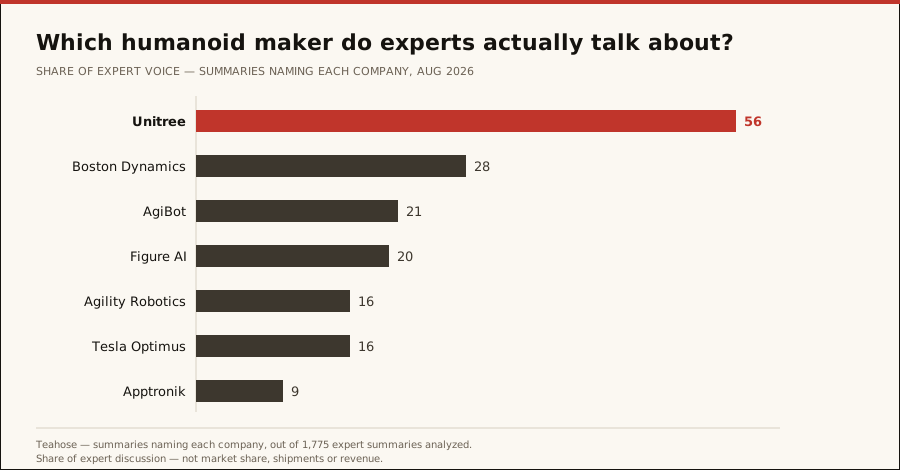
- Across the 1,948 expert podcast, newsletter and research summaries we have analyzed, Unitree is named in 59 — more than any other humanoid maker we track, and nearly twice as often as Boston Dynamics (31). Methodology: a count of how many of our expert summaries name each company, August 24, 2026. It measures share of expert discussion, not market share, shipments or revenue.
- The honest routes are indirect and lagged — and all of them are open to US investors, at three friction levels. Buyable in any US brokerage today: KOID (Nasdaq), KSTR (NYSE Arca) and Meituan’s OTC ADR MPNGY. Buyable with Hong Kong market access (which most US Interactive Brokers accounts include): Meituan (3690.HK, ≈9.65% of Unitree), Shoucheng Holdings (0697.HK, ≈3.83%) and the CSOP STAR 50 ETF 3109.HK. UK/EU retail can’t buy the US-listed funds at all (PRIIPs) and must use the UCITS STAR 50 clone instead. Timing caveat: the STAR 50 funds only pick Unitree up at a quarterly index review — December 2026 at the very earliest, March 2027 on the base case — while KOID’s index is not on that clock, which makes it the likeliest first holder.
- The pre-IPO marketplaces are quoting a multiple of what the company itself just sold stock for, on thin, fast-moving order books. In February 2025, during an earlier retail frenzy, Unitree publicly stated that "almost all" third-party share offers are fake and that it uses "no middleman, middle shareholder or middle company."
- The numbers cut both ways. 2025 revenue ¥1.70bn (+333%), attributable net profit ¥278m, 60.13% gross margin — genuinely profitable, unlike almost every humanoid peer. But that is 219x 2025 attributable earnings (the official issue P/E; about 103x profit excluding non-recurring items), and Unitree’s own H1 2026 guidance shows revenue growth falling to +36% to +45% with ex-one-off profit down 6% to 22%.
- Our verdict, in one line: the best humanoid business in the world at a price that still assumes it even after a 45% drawdown, behind two layers of access friction — for most Western investors the rational move is unchanged: wait for the ETF route (December 2026 at the earliest), or take the Hong Kong proxy, and let the scarcity premium finish clearing — which, four sessions in, it is visibly doing.
Want to keep tracking the robotics field after this listing? Paste any robotics company’s website into Teahose Lookalikes and we’ll show you its closest peers in our graph — and email you when new funding, product and partnership signals land on them.
Every headline about Unitree’s IPO answers a question Western investors are not asking. They are asking can I buy this, and should I? The search results answer neither honestly: private-share marketplaces are selling their own inventory, and the news wires are reporting a deal on an exchange most readers cannot access. So here is the version nobody is writing — the mechanics of access, broker by broker and rule by rule, and then a real two-sided case on whether the price makes sense. It is research, not investment advice.
At a glance: the Unitree IPO in one table
| Item | Detail |
|---|---|
| Company | Unitree Technology (宇树科技), Hangzhou |
| Ticker | 688836 (Shanghai Stock Exchange, STAR Market) |
| Subscription code (mainland retail only) | 787836 |
| IPO price | ¥150.80 per share (≈$22.34), priced August 6, 2026 |
| Valuation at offer | ¥60.99 billion (≈$9.04 billion) |
| Shares offered | 40,446,434 new shares = 10% of post-issue capital (the minimum float; no secondary selldown) |
| Gross proceeds | ≈¥6.10 billion (≈$904 million) — vs ≈¥4.20bn originally sought |
| Implied multiple | ≈219x 2025 attributable earnings (the official issue P/E) — ≈103x excluding non-recurring items; ≈36x 2025 sales |
| Subscription date | August 10, 2026 (payment due August 12) |
| First trading day | August 19, 2026 — opened ¥1,100 (+629%), closed ¥845 (+460%, ≈¥342bn / ≈$47.7bn) |
| Price as of August 24, 2026 | ¥603.08 (−45% from the ¥1,100 high; ≈¥244bn / ≈$34bn; still ~4x the offer) |
| Initial free float | 7.44% of share capital (strategic + insider tranches locked) |
| Sponsor / lead underwriter | CITIC Securities |
| Founder control | Wang Xingxing: ≈31.3% economic, ≈65.3% of voting rights post-IPO (33.4% / 68.8% pre-IPO) |
| Direct access for Western retail | None (see below) |
Deal terms as filed and reported, August 6–10, 2026. USD conversions vary with the rate used: the same ¥6.10bn raise has been reported as both ≈$904 million and ≈$849 million.
Is Unitree publicly traded? The ticker, the board and the dates
Yes — 688836 began trading on August 19, 2026, and the first four sessions told a whole story. Unitree priced its offering on August 6 at ¥150.80 per share, ran subscriptions on August 10, and debuted nine days later. The tape since:
| Session | Close | Move |
|---|---|---|
| August 19 (debut) | ¥845.00 | +460% vs the ¥150.80 offer; opened ¥1,100 (+629%), the all-time high |
| August 20 | ≈¥687 | −18.7% |
| August 21 | ¥672.41 | −2.1% |
| August 24 | ¥603.08 | −10.3% — 45% below the high, ~4x the offer |
Two STAR Market mechanics explain the violence. First, the initial free float was only 7.44% of share capital — the 10% offering minus locked strategic tranches — against retail demand 8,289x the shares available. Second, STAR listings trade with no daily price limit for their first five sessions (only ±30%/±60% intraday circuit breakers); the standard ±20% daily band applies from roughly August 26, which should compress the swings. Nothing fundamental moved in that window — the H1 numbers were already public before the debut.
The board matters as much as the ticker. Unitree is listing on the STAR Market — the Shanghai Stock Exchange’s Nasdaq-style science and technology board — not the Main Board. That is what makes it China’s first mainland-listed pure-play humanoid robot maker (人形机器人第一股), and it is also, as the next section explains, exactly what locks foreign individuals out.
Demand was extraordinary. The online tranche was oversubscribed roughly 8,289 times, with 9.78 million valid retail accounts bidding for 53.6 billion shares against the shares available — a final allocation ratio of 0.018%. A 10% clawback moved 3.24 million shares from the institutional tranche to retail. One lot was 500 shares, or ¥75,400.
That demand is why the final price came in about 45% above the ≈¥104 consensus and above bid indications during bookbuilding that implied only ≈¥55 billion of value. Unitree ended up raising ¥6.10 billion against the ¥4.20 billion its prospectus asked for — an over-raise of roughly ¥1.9 billion.
Can US, UK, Canadian or European investors buy Unitree stock? The rule nobody quotes
No — and the reason is exchange rulebook, not a broker’s risk policy. There are two gates, and a freshly listed Unitree fails the first one outright.
Gate one: the stock has to be in the Northbound universe at all. STAR Market shares are not eligible for Northbound Stock Connect simply by being listed. Per the Shanghai Stock Exchange’s eligibility rules, a STAR-listed stock enters the Northbound eligible list only once it is a constituent of the SSE 180 or SSE 380 index, or is the A-share of a company also listed in Hong Kong (A+H). A newly listed Unitree is neither. At listing, therefore, 688836 sits outside Stock Connect entirely — not just for individuals, but for the institutions too.
Gate two: even once eligible, individuals are excluded. The exchange’s eligibility page draws the line explicitly: Northbound Stock Connect is open to "All Hong Kong and overseas institutional and individual investors" for Main Board stocks, but for STAR Board shares only "Hong Kong and overseas Institutional Professional Investors" qualify. Hong Kong Exchanges confirmed the same when the channel opened on February 1, 2021: STAR Market shares "will only be accessible via Northbound Stock Connect trading by institutional professional investors."
The trap is in the definition. "Institutional professional investor" here means paragraphs (a) to (i) of the professional-investor definition in Schedule 1 of Hong Kong’s Securities and Futures Ordinance — banks, insurers, licensed corporations, collective investment schemes, governments. Individuals are not in that list. Upgrading your Hong Kong brokerage account to individual professional-investor status (the HK$8 million portfolio test) does not unlock STAR. There is no wealth threshold that gets a person in.
The practical evidence lines up. Interactive Brokers offers Shanghai–Hong Kong Stock Connect to international clients with no mainland account required, but the eligible-security list is HKEX’s and the SSE’s, not the broker’s — and 688836 is not on it. The older institutional channels do not help a private investor either: the merged Qualified Foreign Investor (QFI) regime, which absorbed QFII and RQFII in November 2020, is institution-only by construction, open to foreign funds, insurers and securities firms approved by the CSRC.
So the honest answer to "how do I buy Unitree stock" is: you do not buy the stock. You buy something that owns it.
How to invest in Unitree today: every route, ranked honest-first
Here is the complete map, ordered from most legitimate to most dangerous.
| # | Route | Who can use it | What you actually own | Timing |
|---|---|---|---|---|
| 1 | KOID (Nasdaq) — global humanoid & physical-AI ETF | US retail | Index exposure; KraneShares says Unitree "may be eligible for inclusion" | Likeliest first US fund to hold it |
| 2 | KSTR (NYSE Arca) — STAR 50 index ETF | US retail | Direct STAR A-shares via a QFI designation | Gated by index rules + quarterly reviews: Dec 2026 review at the earliest, Mar 2027 base case |
| 3 | KSTR LN / KSTP LN / KSTR IM — UCITS version | UK & EU retail | Same STAR 50 index, PRIIPs-compliant wrapper | Same index lag |
| 4 | 3109.HK — CSOP STAR 50 ETF | Anyone with HK market access | Same STAR 50 index, HKD-traded | Same index lag; no professional-investor test |
| 5 | Meituan (3690.HK / MPNGY) | Anyone | ≈9.65% of Unitree, inside a mega-cap | Available today |
| 6 | Shoucheng Holdings (0697.HK) | Anyone | ≈3.83% of Unitree, in a much smaller vehicle | Available today |
| 7 | Pre-IPO marketplaces | Accredited only | Unclear — direct equity, SPV interest or forward is not stated | Company says most offers are fake |
| 8 | Crypto "pre-IPO" perpetual futures | Anyone with an offshore exchange account | Not stock. A derivative with no ownership, no vote, no dividend | Live, and priced off estimates |
Route 1 and 2 — the KraneShares funds. KSTR tracks the SSE STAR 50 index, holds 688-coded STAR names directly (Cambricon, Hygon, AMEC are its largest positions), runs about $400.6 million in assets at a 0.65% net expense ratio, and — importantly — reaches A-shares through a Qualified Foreign Investor (QFI) designation rather than Stock Connect (KraneShares’ own wording: "the ETF manager must have a Qualified Foreign Institutional Investor (QFII) designation"). So the Stock Connect professional-investor rule does not bind it. The catch is index mechanics, and they are stricter than usually reported. There are three inclusion channels for a new listing: after one month if the stock ranks top three on the STAR Market by market value and the index committee approves; after three months if it ranks top five; otherwise only after six months. And inclusion never happens on the anniversary — it takes effect only at a quarterly sample review, on the trading day after the second Friday of March, June, September and December.
At roughly ¥61 billion, Unitree is not a plausible top-three or top-five STAR name (SMIC, Cambricon and Hygon are far larger), so the six-month channel is the honest base case. A mid-to-late-August 2026 debut means six months lands in February 2027 — after the December 2026 review — so the March 2027 review is the realistic first opportunity, with December 2026 possible only if the fast-track channels somehow apply. KOID, the humanoid and physical-AI index fund, already holds China A-shares such as Inovance and Hengli Hydraulic, and its index is not on the STAR 50 clock at all — which is why KraneShares itself flags KOID as the likelier first vehicle.
Route 3 — the European wall. EU and UK retail investors cannot buy KSTR or KOID at all. The PRIIPs regulation requires a Key Information Document, US ETF issuers do not produce one, and every mainstream European broker enforces the block. The UCITS clone (ISIN IE00BKPJY434) is the workaround: same index, 0.82% total expense ratio, ≈$64 million in assets, listed in London, Milan and Frankfurt.
Route 4 — the underrated one. CSOP’s STAR 50 ETF (3109.HK) is a Hong Kong-listed fund, not a Northbound trade, so it carries no professional-investor test at all. Any retail client with Hong Kong market access — including most US and Canadian Interactive Brokers accounts — can buy it. Management fee 0.99%, HKD-traded, 100-unit lots.
Routes 5 and 6 — the listed shareholders. Meituan is the largest external holder at ≈9.65%, assembled through Hanhai Information (7.61%), Chengdu Longzhu (1.02%) and Galaxy Z (1.02%) acting in concert, from a cumulative ¥400 million outlay. It trades as 3690.HK and as ADR MPNGY. Shoucheng Holdings (0697.HK) holds ≈3.83% via the Beijing Robotics Industry Development Investment Fund, worth roughly ¥2.3 billion — the largest Unitree stake held by any Hong Kong-listed company, and inside a far smaller market cap, so it moves more per unit of Unitree news. Tencent (≈0.60%), Alibaba and Ant (≈0.80% and ≈0.22%) and CITIC Securities (≈0.90%) are also on the register, but at those weights they are noise.
One practical note before the warnings: since no route gives you the shares today, the highest-value move an interested investor can make right now is to watch the company, not the ticker. Teahose tracks Unitree live — every funding, product, partnership and policy signal our system extracts from expert coverage, with an email alert when something new lands — so you'll know if the picture changes before the ETF window opens.
A warning on the mainland "Unitree concept" stocks that rallied on the IPO news: most are indirect to the point of meaningless. Kingfa Science & Technology, for example, holds 6.58% of a fund that owns 4.15% of Unitree — a ≈0.27% look-through. No A-share listed company appears among Unitree’s 46 direct pre-IPO shareholders, and Leo Group, Topband, Changying Precision, Allwinner and Great Star Industrial have all publicly denied equity or supply relationships.
The routes that look like access but aren’t
The pre-IPO marketplaces. On August 10, 2026, Hiive displayed a "Hiive Price" of $61.63 per Unitree share with 11 live orders. Set that against what the company itself sold stock for four days earlier: ¥150.80, about $22.34 — roughly 2.8x on a per-share basis. On the ≈364 million shares outstanding before the offering (404.5 million post-issue minus the 40.4 million new shares), $61.63 implies roughly $22.4 billion of value, about 2.5x the $9.04 billion IPO print on a whole-company basis. (The two multiples are different cuts of the same gap, not a contradiction.) Postscript, now that the stock trades: the public market blew straight past those quotes — the August 19 debut closed at 5.6x the offer price, and even after the four-session unwind 688836 sits around 4x. The marketplaces weren't wrong about the direction; they were selling paper of unverifiable substance at a price the real market briefly made look conservative.
Treat all of that as directional, not precise. The quote is a single point-in-time reading from a live marketplace order book that we could not independently verify or archive, and it can move materially within days; the honest takeaway is the order of magnitude, not the decimal. What a marketplace "share" actually represents is not disclosed — it could be direct equity, an SPV interest or a forward contract, and Hiive’s own language hedges deliverability: whether a transfer completes "depends on applicable securities laws, the company’s transfer restrictions, and other requirements outlined in the company’s governing documents," with company approval potentially required. The conversion between a marketplace unit and a 688836 A-share is not public. What is public is Unitree’s own statement on the whole category, made in February 2025 as retail interest in the company spiked — long before this IPO priced, but never withdrawn: "there is now a lot of false information in the market, and almost all of it is fake… all new Unitree shares and old equity belonging to shareholders are directly managed by the company’s financing head and communicated through official email. There is no middleman, middle shareholder or middle company." That is the issuer repudiating third-party share marketing in plain language.
UpMarket, for its part, requires a $50,000 minimum and Rule 501 accreditation, discloses no share price at all (it models value from comparables rather than quoting a market), and repeatedly qualifies offerings as "subject to availability" — indications of interest, not committed allocation. EquityZen offers exposure through its own funds sourced from existing shareholders, also accredited-only.
The crypto contract. On July 31, 2026 the offshore exchange MEXC listed a "UNITREE" pre-IPO perpetual futures contract. Read the venue’s own disclosure: holding it "does not provide ownership, voting rights, dividends or any other shareholder rights," the reference price "comes from estimates, not an observable market in the shares," and the exchange reserves the right to revise notional, leverage limits and other terms. It is a leveraged bet on a number someone else computes, on thin books with gap risk. It is not Unitree stock in any sense.
What Unitree actually is — and how Wang Xingxing built it
Unitree is a hardware company that got very good at making motors cheaply, and then pointed that capability at humanoids.
The founder story is not decoration; it explains the cost structure. Wang Xingxing, born 1990 in Ningbo, built a biped for about ¥200 as a university freshman, then developed a sub-¥20,000 direct-drive electric quadruped called XDog during his master’s at Shanghai University. He joined DJI as an engineer; XDog went viral before his probation ended, drawing buyers and investors, and he left to found Unitree in Hangzhou in August 2016 at 26, on roughly ¥2 million (≈$275,000) of angel funding.
The product line today spans two categories and a very wide price band:
| Product | Type | Price (as listed, mid-2026) |
|---|---|---|
| Go2 | Quadruped | $1,600 (Air) to ≈$4,500 |
| R1 | Humanoid | Launched July 2025 at $5,900; now from ≈$4,900 |
| G1 | Humanoid | $13,500 direct; ≈$17,990 via US dealers |
| G1 EDU | Humanoid (research configs) | $43,900 – $73,900 |
| A2 / A2-W Pro | Industrial quadruped | $52,000 – $88,000 |
| H1 / H1-2 | Full-size humanoid | H1 from ≈$90,000; H1-2 configuration pricing not published |
| H2 / H2 Plus | Full-size humanoid | H2 from $29,900; H2 Plus (announced June 1, 2026) price not announced |
Real transacted money buys a Go2, G1 or R1; the full-size machines are largely sales conversations, and several of these figures are list prices rather than confirmed transaction prices.
Two 2026 product facts matter for the investment case. Unitree launched commercially in Europe on July 22, 2026 — the first Chinese-made humanoid to enter Western commercial markets — roughly six weeks after the June 8 Pentagon designation, with Asia following on August 5 and North America on August 12, days after the FCC action discussed below. That collision of a three-continent rollout with a closing US regulatory perimeter makes geographic mix a live question rather than an abstract one. And in June 2026, NVIDIA selected the H2 Plus as an Isaac GR00T reference platform (75 degrees of freedom, tactile five-finger hands, onboard Jetson AGX Thor compute). Being the reference body for the dominant robotics software stack is a real distribution asset.
Against Western peers the price gap is the whole story: Unitree ships $5,000–$74,000 humanoids today, while Agility Robotics’ Digit runs roughly $250,000 to buy or ≈$8,500 a month as a service, and Tesla’s Optimus targets ≈$30,000 at mass production but is currently estimated at $50,000–$100,000 a unit. The honest counter-argument, though, is that the most expensive humanoid is the one actually earning commercial revenue from real work — capability, not price, is today’s binding constraint on deployment.
Unitree’s financials: profitable, and decelerating fast
This is the single most important section for anyone deciding what 219x earnings buys — and the first thing to know is that 219x is one of two defensible numbers. The ¥60.99 billion market cap is 219x the ¥278 million attributable profit (the regulatory "lower-of" convention that produces the official 219.23x issue P/E) and about 103x the ¥591 million profit excluding non-recurring items. The gap is not accounting exotica; it is one large non-cash charge, explained below.
The record through 2025 is genuinely extraordinary — accelerating every year. Hold that thought, because the deceleration in this section’s title arrives in the 2026 guidance table just below it:
| Metric | 2023 | 2024 | 2025 |
|---|---|---|---|
| Revenue | ¥159m | ¥392m (+147%) | ¥1.70bn (+333%) |
| Attributable net profit | –¥11m | ¥95m | ¥278m |
| Core gross margin | 44.22% | 56.74% | 60.13% |
| Humanoids as % of revenue | ≈2% | ≈27% | ≈52% |
Three-year revenue CAGR is roughly 227%. Humanoid robots generated ¥867.8 million in 2025 — about 51.8% of revenue, overtaking quadrupeds — on 5,500+ humanoid units shipped, reportedly the global number one, plus 33,000+ cumulative quadrupeds. Overseas revenue exceeded 40% of 2025 sales, with the US alone at 13.3%.
Now the part the celebratory coverage buries. Unitree’s own H1 2026 guidance shows the curve breaking:
| Period | Revenue growth | Profit (ex-one-offs) |
|---|---|---|
| FY2025 | +333% | ¥591m |
| Q1 2026 | +68.5% (¥422.8m) | –52.6% YoY (¥40.3m) |
| H1 2026 (guided) | +35.6% to +45.4% (¥1.052–1.128bn) | –6.4% to –22.0% (¥236–283m) |
| H1 2026 (ACTUAL, disclosed Aug 17) | +48.5% (¥1.152bn — above the guided range) | –19.3% (¥244m — near the bottom of it) |
The actual print, disclosed in the listing announcement on August 17, 2026, sharpens the picture: revenue beat the company's own guidance while ex-one-off profit fell 19.3% (attributable profit was ¥274m, swinging from a prior-year loss). Growth decelerated from 333% to roughly 48% — a factor of seven, not the feared eight — and the profit decline is an investment choice, driven by surging R&D and sales spend (R&D alone rose ≈¥82m year over year). The formal interim report, due by August 31, adds the segment detail. The spend-through-the-P&L posture is a defensible choice — the IPO prospectus commits about 85% of the ¥4.2 billion planned use of proceeds to R&D, with no working-capital line at all — but it means the market is paying a multiple struck at 219x (and now trading near 4x that price) on a decelerating earnings base, not an accelerating one.
One more caveat on the profit figure itself: the prospectus reports ¥278 million attributable net profit and ¥591 million excluding non-recurring items, and at least one major outlet quoted the ¥591 million number simply as "2025 net profit." The gap is mainly ¥349 million of share-based payment recognized in 2025 for employee equity incentives — a non-cash charge that reduces reported net profit without touching cash flow, and which is added back in the ex-non-recurring figure. The 219x multiple is struck on the ¥278 million figure; the same market cap is ≈103x on the ¥591 million one. Know which a headline is using before you compare multiples, and note that the cash-earnings multiple is less than half the number the bear case usually quotes.
Unitree valuation: what 219x earnings buys you
Inside the humanoid category Unitree looks like the only sane price; against any normal earnings standard it looks like a bubble. Both are true.
The bull framing, on the comparables:
| Company | How to own | Profitable? | Valuation reference |
|---|---|---|---|
| Unitree (688836) | STAR Market — not Stock Connect-eligible at listing | Yes (¥278m attributable, ¥591m ex-non-recurring, 2025) | ≈$9.0B at IPO; ≈219x P/E (≈103x ex-non-recurring), ≈36x P/S |
| Figure AI | Private | No revenue disclosed | ≈$39B private mark |
| UBTech (9880.HK) | HK retail | No (loses ≈¥700m/yr) | ≈19.4x price-to-sales |
| Dobot | HK retail | No | ≈20.1x price-to-sales |
| Agility Robotics | US SPAC (CCXI → AGLT) | No | ≈$2.5B pre-money |
| Tesla Optimus | Inside TSLA | n/a | Analyst marks ≈$30B (BofA) to ≈$180B (Morgan Stanley) |
Multiples as reported around the pricing date, August 2026; private marks are point-in-time and not comparable to public market caps.
Read the table honestly and you get two opposite conclusions. Unitree is the only company in it that is both profitable and publicly priced — Figure carries a $39 billion private mark with no disclosed revenue, and the listed Hong Kong names trade at 19–20x sales while losing money. Against that field, paying 36x sales for a business with 60% gross margins and real profit is arguably the most defensible trade in the category.
But 219x earnings is not a robotics multiple; it is a story multiple. Even on the friendlier cash-earnings basis — ≈103x excluding the ¥349 million non-cash share-based payment — the implied P/E sits far above the general equipment manufacturing industry average, and it is being paid at exactly the moment growth decelerates by 8x. The forward math is unforgiving: at guided H1 2026 growth of ≈40% with profit flat-to-down, the multiple does not compress on its own — it needs a re-acceleration that management’s own guidance does not promise.
There is also a structural quirk worth naming — and the debut proved it. The offering was 10% of post-issue capital, the regulatory minimum, and 20% of that went to nine strategic investors with lock-ups — including DeepSeek’s parent, on a 36-month lock, alongside Tencent’s Shanghai Qishan, CNPC’s Kunlun Capital, China Southern Power Grid’s finance arm, China Telecom’s Tianyi Capital and the National Council for Social Security Fund. Management and core employees took up to ¥271.5 million more through two asset-management plans, with Wang Xingxing personally subscribing ¥15 million. The result was an initial tradable float of just 7.44% of capital against 8,289x retail demand — and exactly the violent, information-free debut that setup predicts: +629% at the open, −45% inside four sessions. The lock-up calendar is the flip side: the February 19, 2027 six-month unlock is tiny (~0.56% of capital — 10% of the offline institutional tranche), while August 19, 2027 is the real supply cliff, when essentially all pre-IPO holders (Meituan, HongShan/Sequoia China, Tencent, Alibaba) come free; Wang Xingxing and DeepSeek stay locked to August 2029.
Finally, control: post-issue, Wang Xingxing and his control platforms hold ≈31.3% of the economics but ≈65.3% of the voting rights through a weighted-voting (AB-share) structure, in which each special-voting share carries ten votes — down from 33.4% and 68.8% before the offering. Minority holders are along for the ride on his decisions.
Why researchers build on Unitree — the moat the multiple isn’t about
The strongest argument for Unitree has nothing to do with the robots it sells this year, and it barely appears in English-language coverage.
Unitree runs a genuinely open developer ecosystem: 53 public GitHub repositories, mostly BSD-3 or Apache-2.0 licensed — unitree_rl_gym (3.5k stars), xr_teleoperate (1.6k), unitree_ros (1.5k), unitree_sdk2 (1.3k), unitree_rl_lab (1.3k), unitree_mujoco (1.1k), unifolm-world-model-action (1.1k), unitree_lerobot (738), plus LiDAR SDKs. That is distribution the FCC import ban does not directly touch, because code is not an imported device.
The consequence is that the G1 became the default research body. Twenty months after its launch, no competitor has meaningfully displaced it — and once the world’s robotics labs standardize on your hardware, every advance in embodied AI runs through your platform, whoever invents it.
Even a US investor with no China exposure sees it. On The a16z Show, Ben Horowitz was asked why America has no equivalent open-source robotics flywheel, and answered on the underlying logic:
"Open source is kind of a way that the ecosystem gets built. So if you're building robots, for example, if you were to build your robot on [a proprietary frontier model], then at some point that company is going to go into the robot business and put you out of business just by either cutting you off or overcharging you."
The other half of the moat is manufacturing, and it is more concrete than the software. Before Unitree shipped a single G1, it had already sold tens of thousands of quadrupeds — each carrying at least 12 motors. Run the arithmetic and you get the number a Chinese investor cites in the next section as the real barrier to entry: on the order of a million motors designed, built and shipped before most Western rivals had produced their hundredth robot. Anyone can prototype a humanoid; almost nobody has already made a million of its hardest component.
What the experts actually say — including the coverage English readers miss
Unitree is the most-discussed humanoid maker in our corpus: 59 of 1,948 expert summaries name it, against 31 for Boston Dynamics and 25 for AgiBot. A large share of the most substantive analysis is in Mandarin, on shows Western investors don’t read. Here is what it says. (Quotes below are translated from Mandarin; timestamps are from our transcripts.)
On the real moat — a million motors, not a robot design. From LateTalk’s Q1 2026 embodied-AI review, Chen Zhe (陈哲), founding partner at AlphaEast:
"Today it's easy to build one or two prototypes as good as the G1, or even better than the G1. But to achieve G1-level RELIABLE production of thousands or even tens of thousands of units, you have to go through the process Unitree already went through… Unitree has genuinely completed the design, production and mass-manufacture of a million motors. That barrier in hardware and supply chain is a hurdle every new entrant has to cross… This is why you see foundation-model companies whose lead is only three to six months, while for hardware companies the lead may be 12 or even 24 months." [00:22:19–00:22:49]
On the margin — the contrarian read that reframes "China means cheap." Same conversation, same investor:
"Their humanoid gross margin is over 60%, around 63%… For an integrated software-plus-hardware product, that counts as a very high gross margin… I think that's mainly because humanoids today aren't a real commercial use case. Most humanoids are still sold into the research market, and in the research market 60% gross margin is arguably LOW — traditional research-and-teaching equipment markets running 70-80% margins is completely normal. For Unitree, today's pricing is partly because the market lacks competition, and partly because the research market just isn't very price-sensitive. This is still only a market of roughly 1 billion RMB." [00:15:58–00:17:23]
That is the most important sentence in this guide for a valuation exercise. Unitree’s 60% margin is not proof of pricing power in a commercial market; it is the margin of a research-equipment vendor in a category where nobody else showed up. The ¥1 billion framing is a market-size ceiling, not a floor.
On why it is profitable at all — a forced adaptation, not a strategy.
"Investors have never liked the fact that Unitree serves the research-and-education market — Zhu Xiaohu has said so publicly; he thinks it isn't a durable market… Why is Unitree a profitable company? Because it HAD to be profitable. If it hadn't been profitable, I would never have gotten to meet them in 2019 — because it was never a company investors liked. You have to sell something people are actually willing to pay for." [00:20:21]
Compare that to the capital-soaked Western model. In LateTalk’s Q2 2026 review, the same investor is blunt about the peer set:
"Basically ALL the American companies have this problem now. Except Figure seems to talk about it more — and Figure today still doesn't have a single confirmed, genuinely validated deployment revenue contract. But at least they publicly project the POSTURE of going to deploy… Posture and fact are quite different things." [01:43:49–01:44:19]
The underwriting logic of Unitree’s largest external shareholder. On LateTalk episode 168, Wang Xinyu of Meituan Longzhu — an investor in Unitree since 2016, from the Meituan ecosystem that owns ≈9.65% — explained his thesis, and it is an NVIDIA analogy, not a Tesla one:
"My investment thesis was: I saw Huang Renxun [Jensen Huang] giving gaming GPUs to labs for AI training. If the world's best robotics PhD students are all using Unitree's humanoid for development and frontier research — will AI capability remain a problem?" [01:04:03]
And the bear case, which is also Chinese. The threat to Unitree in the Mandarin analysis is not Figure or Tesla — it is Chinese consumer-electronics and auto OEMs with vastly deeper manufacturing scale. In the Q2 2026 review, the trigger was the Beijing Humanoid Marathon, where Honor — a smartphone maker whose robotics division is roughly two years old and 100–200 people — swept gold, silver and bronze in autonomous navigation, beating both Unitree and the Beijing Humanoid Robot Innovation Center:
"Honor's victory in the marathon is a harbinger of what the future competitive landscape of this market may look like." [00:11:07] … "If you can't achieve this [IPO], then by next year — 2027 — large manufacturers like Honor with more resources, along with smartphone and auto OEMs, will have their robot bodies entering the market. And these companies have much more experience in large-scale manufacturing, reliability, and consistency." [00:09:43]
Read that way, the IPO is not a victory lap. It is a defensive capital raise ahead of an OEM wave — which is exactly consistent with 85% of proceeds going to R&D and a factory sized for 75,000 humanoids and 115,000 quadrupeds a year.
The Western institutional view agrees on the shape. Via Sourcery Newsletter, BlackRock’s head of technology investing Tony Kim described a market that has already split into layers — China dominating the robot body, the West leading on brains — and noted that the layers are being recombined: "You can mix and match Chinese physical robot with a Western brain, and I know that's happening." On his numbers, Barclays estimates Chinese firms shipped 85% of all humanoids in 2025.
And a Chinese founder confirms the division of labour from the inside. On 张小珺’s interview show, AI-data expert Xie Chen (谢晨): "Unitree's differentiation is the clearest. It's firmly committed to building its hardware body well. I don't think Unitree will compete with brain companies… Knowing your boundary is key." [02:22:36]
The risk ledger: the US import ban, the Go1 backdoor, and AgiBot
Four risks, roughly in order of how much they should change your price.
1. The US regulatory perimeter — and the one that could reach your brokerage account. On July 28, 2026 the FCC added foreign-made advanced robotic devices — humanoids and quadrupeds — plus connected power inverters to its Covered List, blocking equipment authorization for new or previously unauthorized models, including Unitree’s G1. Already-authorized devices are exempt, as are certain federal purchases and conditional approvals. Unitree was the primary company cited. On June 8, 2026 the Pentagon had already added it to the Section 1260H list of Chinese military companies (188 entities).
Here is the part that matters for a shareholder rather than a customer: 1260H itself only bars Department of Defense contracting — it does not prohibit US persons from owning securities. But it materially raises the odds of a Treasury NS-CMIC designation under Executive Orders 13959/14032, which would prohibit US persons from purchasing or selling the shares "or any securities that derive from or provide investment exposure to such securities." In plain terms: a designation would not just block the stock, it would block the KSTR/KOID route as well, with a 60-day effective date and a 365-day divestment window. That is the single largest structural risk in this trade, and it is entirely political.
Two bills are pending: the bipartisan GUARD Act (Moolenaar/Obernolte/McClellan, June 2026), which would prohibit importing adversary-made robots deemed a security threat and explicitly cites Unitree’s "generous state subsidies," and the Cotton–Schumer American Security Robotics Act, which would bar federal government use of adversary-made robots.
2. The security findings underneath the ban are real. CVE-2025-2894 (disclosed March 2025, classified as hidden functionality) documented a CloudSail service that auto-started on boot on Go1 quadrupeds and opened a NAT-traversing P2P tunnel — anyone holding the API key could fully remote-control affected robots or pivot into the connected network. Vulnerable units were confirmed running at MIT, Princeton, Carnegie Mellon and Waterloo. Unitree rotated the key on March 24, 2025 and shut the tunnel down five days later. The later flaw is worse: "UniPwn" is a Bluetooth Low Energy vulnerability yielding root access to Unitree quadrupeds and humanoids, and it is wormable — an infected robot can scan for and automatically compromise nearby units. Unitree says the remote-code-execution flaw was patched over the air.
Industry reaction to the ban split. Some called it one of the strongest US tech-security actions in modern history; analysts warned it cuts US startups and researchers off from the low-cost platforms they build on and could slow US humanoid commercialization — and might sweep in Canadian and European robots too. Both readings are bad for Unitree’s US revenue line, which was 13.3% of 2025 sales.
3. It is no longer the volume leader. In H1 2026, AgiBot shipped ≈8,400 humanoids (44% global share) against Unitree’s ≈5,900 (31%). TrendForce puts AgiBot and Unitree together at nearly 80% of Chinese humanoid shipments, with roughly 15,000 and 11,000 units respectively for 2026 — a duopoly, and a strong position. (China’s MIIT separately projects national humanoid output above 100,000 units in 2026 on a much broader definition; the two figures use different bases and should not be combined.) Either way, "number one humanoid maker" is a 2025 claim, not a 2026 one.
4. Thin IP and price-war exposure. The prospectus discloses 262 registered patents globally as of January 31, 2026 but only 20 domestic invention patents — a modest portfolio for defending against infringement claims. It also names rising competition from Tesla Optimus and from Chinese automotive and consumer-electronics entrants, plus price-war margin erosion, as explicit risks. Unitree’s own quadruped market-share claim (above 60%) is a company self-report, not independently audited.
Bull vs bear: should you own Unitree stock?
The bull case
- The only profitable, publicly-priced humanoid pure-play in the world. ¥278 million of attributable profit, 60% gross margins, real shipments. Figure carries a $39 billion private mark with no disclosed revenue; UBTech loses ≈¥700 million a year.
- A platform, not a robot vendor. 53 open-source repos, the default research body, and NVIDIA’s Isaac GR00T reference platform. If the world’s labs build on your hardware, you capture some of every advance — including advances made by rivals.
- A manufacturing lead measured in years, not months. A million motors designed, produced and mass-manufactured before the G1 shipped; hardware leads compress far more slowly than model leads.
- Scarcity and an anchor role. As Chinese investors put it, the listing "establishes a valuation anchor point for all leading embodied AI companies" — and the tradable float is only 10% of capital, 20% of which is locked up.
- A world-class strategic register: DeepSeek’s parent, Tencent, PetroChina’s Kunlun Capital, China Southern Power Grid, China Telecom and the National Social Security Fund on the cornerstone list; Meituan, HongShan, Matrix China and Shunwei on the pre-IPO one.
The bear case
- 219x attributable earnings — ≈103x even excluding one-offs — into a growth cliff. Revenue growth guided from +333% to +36–45%; ex-one-off profit guided down 6–22%; Q1 2026 adjusted profit already fell 52%.
- The margin may be an artifact of no competition. Sixty percent gross margin in a research-equipment market that a credentialed investor sizes at roughly ¥1 billion is not the same as pricing power in a commercial one.
- US market access is being closed, and could extend to shareholders. FCC Covered List, 1260H designation, two pending bills — and a future Treasury NS-CMIC designation would bar US persons from the stock and from funds providing exposure to it.
- It already lost the volume crown to AgiBot, and the identified 2027 threat is Chinese OEMs (Honor, smartphone and auto makers) with far deeper manufacturing scale.
- Western retail cannot express the view cleanly anyway. Every accessible route is either lagged (ETFs), diluted (Meituan), or not the security at all (marketplaces, perps).
- A 7.44% initial float against 8,289x demand set the opening price by scarcity, not fundamentals — and the −45% four-session unwind that followed shows how little the debut prints meant.
How the scenarios could play out (illustrative framing, not a forecast — the stock has not traded):
| Scenario | What happens | What it looks like |
|---|---|---|
| Bull | The unwind stabilizes well above the offer price; H2 2026 reaccelerates on Europe and GR00T-driven demand; index inclusion (the STAR 50 three-month test lands ~November 2026) pulls passive flows | Multiple stays elevated, ETF routes finally open, Western exposure gets easier |
| Base | The violent debut and 45% four-session unwind — both already delivered — extend into a long de-rating as the margin compression is confirmed; Unitree grows into a smaller multiple over years | Fine business, poor entry price |
| Bear | A Treasury designation closes US exposure entirely; AgiBot and the OEM wave compress price and share; the 219x re-rates toward listed-peer sales multiples | Structural loss of access on top of a de-rating |
The synthesis: Unitree is the most operationally credible humanoid company on earth and the hardest one for a Western investor to actually own — and the price already assumes it stays both. The right question is not "is Unitree good" (it plainly is), but "am I being paid for the margin compression, the political risk and the two layers of access friction between me and the shares." As of August 24, 2026 — with the stock at ~4x its 219x-earnings offer price even after a 45% drawdown — the answer for most people is: wait for the ETF route, or take the Hong Kong proxy, and let the scarcity premium finish clearing.
Waiting only works if you’ll know when the picture changes. Watch Unitree on Teahose and the debut, the index reviews and every US-policy move land in your inbox as our system extracts them from expert coverage.
Unitree Robotics — Live Signal Feed
Funding, product and partnership signals extracted live from expert podcasts, newsletters and research coverage — updates as new material lands. Note: the company profile counts extracted signals, not summaries that name Unitree, so its number is smaller than the 56 above.
- 01PAPERUnitree G1edu and Franka and UR5 are robot types referenced in the training data.SEP 8 · arXiv Physical AISEP 8
- 02PAPERA task-agnostic safety layer trained once per robot platform transfers across behaviors without retraining, achieving 96.4% stop success on 179,650 out-of-distribution motion-captuSEP 2 · arXiv Physical AISEP 2
- 03PAPERThe training and evaluation pipeline runs entirely in NVIDIA Isaac Lab with 4,096 parallel environments, signaling compatibility with the dominant sim-to-real toolchain used acrossSEP 2 · arXiv Physical AISEP 2
- 04PAPERBONES-SEED dataset contains 142,220 annotated human motion animations at 120 Hz, used as the out-of-distribution test set.SEP 2 · arXiv Physical AISEP 2
- 05PAPERJunfeng Long is the lead author of the paper at UC Berkeley, previously published on humanoid locomotion with perceptive internal models (ICRA 2025) and H-Infinity locomotion contrSEP 2 · arXiv Physical AISEP 2
- 06PAPERKoushil Sreenath is a leading researcher in bipedal locomotion control at UC Berkeley, co-authored the Science Robotics paper on real-world humanoid locomotion with RL (RadosavovicSEP 2 · arXiv Physical AISEP 2
- 07PAPERGuanya Shi is a rising researcher in learning-based control at Carnegie Mellon University, previously worked on agile but safe legged locomotion (RSS 2024); brings reach-avoid RL eSEP 2 · arXiv Physical AISEP 2
- 08PAPERC. Karen Liu is an expert in physics-based simulation and character animation at Stanford University; her group's work on contact planning for humanoid falls (IROS 2015) is directlSEP 2 · arXiv Physical AISEP 2
- 09PAPERRoberto Horowitz is a control systems veteran at UC Berkeley who brings classical control rigor to the reach-avoid formulation.SEP 2 · arXiv Physical AISEP 2
- 10MENTIONUnitree Robotics IPO surged 629% in Shanghai trading debut, briefly reaching $66 billion market valueAUG 19 · StrictlyVCAUG 19
Related
AgiBot stock (the Hong Kong IPO US investors can actually buy) · Agility Robotics stock (CCXI → AGLT) · Humanoid robot companies · Physical AI companies · Robotics startups · Robotics investors & VC firms · Figure AI valuation · How to invest in pre-IPO companies · Live humanoid robots theme.
Bottom line: Unitree completed the first pure-play humanoid robot IPO in mainland China — priced August 6, 2026 at ¥150.80 (≈$9.0 billion, ticker 688836), debuted August 19 at +460%, and closed August 24 at ¥603.08 (≈$34 billion), down 45% from its high and still ~4x the offer. No Western retail investor can buy the shares directly — a newly listed STAR stock is outside Stock Connect entirely until it joins the SSE 180/380, and even then only institutional professional investors may trade it — so the honest routes are lagged index ETFs (KOID, KSTR, and 3109.HK in Hong Kong) and listed shareholders like Meituan; the German "UNITREE AKTIE" listing (DE000SL0P4B6) is an index certificate, not the stock, and the pre-IPO marketplaces were quoting paper the company itself called mostly fake. The H1 2026 print shows a company beating its own revenue guidance (+48.5%) while spending its ex-items profit down 19.3% — and a market cap that values that at hundreds of times earnings. Great company, extreme price, hostile access. None of this is investment advice.
IPO terms as filed and reported August 6–19, 2026; market data through the August 24, 2026 Shanghai close; product prices as listed mid-2026. Access rules per the Shanghai Stock Exchange and Hong Kong Exchanges Stock Connect eligibility documentation. Corpus figures from Teahose’s analysis of 1,948 expert summaries, August 24, 2026 — share of expert discussion, not financial advice.
Sources
- Unitree debut day: opened ¥1,100 (+629%), closed ¥845 (+460%), ≈¥342bn market cap — Sina Finance
- Unitree down 44% from its debut high — Beijing Daily, August 24, 2026
- H1 2026 results in the listing announcement: revenue ¥1.152bn +48.5%, ex-items profit −19.3% — The Paper
- H1 pre-announcement guidance range the actuals beat — Cailian Press
- STAR Market first-5-days no-price-limit rules and circuit breakers — Sina Finance
- Initial free float 7.44%; strategic tranche lock-ups — Securities Times
- Lock-up calendar: the August 2027 pre-IPO holder cliff — Sina Finance
- Unitree Robotics Ecosystem Index (DE000SL0P4B6) — the German certificate that is not the stock — onvista
- Unitree prices Shanghai IPO — KFGO / Reuters wire
- Chinese humanoid robot maker Unitree prices IPO at $9 billion valuation — CNBC
- Unitree Robotics prices Shanghai IPO at ¥61 billion valuation — Caixin Global
- Nine strategic investors including DeepSeek and Tencent — Global Times
- Inside Unitree's landmark IPO — South China Morning Post
- Unitree IPO turns 36-year-old founder into China's first humanoid robot billionaire — Forbes
- Stock Connect eligibility: STAR Board is institutional-professional-investor only — Shanghai Stock Exchange
- STAR Market shares accessible only to institutional professional investors — HKEX news release
- A complete guide to the Unitree IPO and what it means for KSTR and KOID — KraneShares
- How the STAR 50 index admits new listings: one-month top-3, three-month top-5, six-month standard, at quarterly reviews — Sina Finance
- Unitree's issue price and 219.23x issue P/E — IT之家
- ¥349 million of 2025 share-based payment reconciles ¥278m attributable to ¥591m ex-non-recurring profit — prospectus analysis, Zhihu
- Unitree warns investors that "almost all" third-party share offers are fake — South China Morning Post
- Meituan-backed group emerges as top external shareholder — TechNode
- AgiBot overtakes Unitree as top global humanoid vendor in H1 2026 — South China Morning Post
- Industry reacts to the FCC ban on US imports of new humanoid and quadruped robots — The Robot Report
- Pentagon adds new entities to the 1260H list of Chinese military companies — WilmerHale
- Legislation to ban adversary-made robots (GUARD Act) — House Select Committee on China
- Undocumented remote access backdoor found in the Unitree Go1 robot dog — SecurityWeek
- The UniPwn Unitree robot exploit — IEEE Spectrum
- NVIDIA and Unitree's humanoid research platform — CNBC
- Unitree Robotics open-source repositories — GitHub
- KraneShares STAR 50 ETF (KSTR) fund page · KraneShares Global Humanoid Robotics ETF (KOID) fund page
Frequently Asked Questions
Is Unitree publicly traded?
Yes — since August 19, 2026. Unitree Technology (宇树科技) priced its initial public offering on August 6, 2026 at ¥150.80 per share and began trading on the Shanghai STAR Market under ticker 688836 on August 19. The debut was violent: the stock opened at ¥1,100 (+629% versus the offer price) and closed its first day at ¥845, up 460%, for a market capitalization around ¥342 billion (≈$47.7 billion). It then fell for four straight sessions — closing August 24 at ¥603.08 (≈¥244 billion, about $34 billion), down 45% from the debut high but still roughly 4x the IPO price.
What is the Unitree stock symbol or ticker?
Unitree’s stock code is 688836 on the Shanghai Stock Exchange STAR Market, usually written 688836.SH. The separate code 787836 was used only for the online retail subscription in mainland China and is not the trading ticker. There is no US ticker, no ADR and no London or Frankfurt listing — anyone quoting you a "UNTR" or similar Western symbol for Unitree is not describing the real security.
Can I buy Unitree stock in the US?
Not directly, and not through any normal US brokerage — and there are two separate gates, not one. First, STAR Market shares only enter the Northbound Stock Connect eligible universe once they are SSE 180 or SSE 380 index constituents, or are the A-shares of an A+H company; a newly listed Unitree is none of those, so at listing it sits outside Stock Connect entirely, for everyone. Second, even after a STAR stock becomes eligible, the Shanghai Stock Exchange restricts Northbound access to STAR Board shares to Hong Kong and overseas institutional professional investors only — a definition covering banks, insurers, licensed corporations and funds, and specifically excluding individuals, including wealthy ones who qualify as professional investors under Hong Kong’s separate individual test. The realistic US routes are indirect: index ETFs that will pick Unitree up on a lag, or Hong Kong-listed shareholders such as Meituan.
How do I invest in Unitree from the UK or Europe?
The same access rule blocks the direct route, and a second rule blocks the obvious workaround: under the EU/UK PRIIPs regulation, retail investors cannot buy US-listed ETFs such as KSTR or KOID because US issuers do not publish a Key Information Document, and brokers including Interactive Brokers, DEGIRO, Trade Republic and Trading 212 enforce that block. Europeans have to use a UCITS wrapper instead — KraneShares runs a UCITS version of its STAR 50 fund (ISIN IE00BKPJY434), listed in London, Milan and Frankfurt across USD, GBP and EUR lines, with a 0.82% total expense ratio. Check the line and currency on your own broker before dealing; the ticker-to-currency mapping differs by venue.
Can I buy Unitree stock on Trade Republic?
No — and the "Unitree" security German brokers show you is a trap worth understanding. No German broker (Trade Republic, Scalable Capital, comdirect) offers Shanghai STAR Market A-shares, so 688836 itself is not buyable. What searchers find instead is ISIN DE000SL0P4B6, labeled "UNITREE AKTIE" on finance portals — but that is not Unitree stock. It is the Unitree Robotics Ecosystem Index, a German-domiciled thematic index of Unitree-adjacent listed suppliers and peers, tradeable via certificates on Börse Stuttgart. The DE prefix is the tell: a German ISIN cannot be a Shanghai-listed A-share. For real (if lagged and indirect) exposure, EU retail routes run through the UCITS STAR 50 tracker (ISIN IE00BKPJY434) or Hong Kong-listed shareholders like Meituan.
What is Unitree’s ISIN or stock code?
The identifiers that are verifiable: Shanghai Stock Exchange ticker 688836 (written 688836.SH, or 688836.SS on Yahoo Finance), exchange short name C宇树-W, FIGI BBG0216J9J97, legal name Yushu Technology Co., Ltd. (宇树科技股份有限公司). The A-share ISIN is not exposed by consumer finance sites — largely because the security is not distributable to foreign retail investors — and the German ISIN DE000SL0P4B6 that surfaces under "Unitree Aktie" searches belongs to a thematic index certificate, not the stock. The "-W" suffix in the exchange name flags weighted voting rights: founder Wang Xingxing’s special-voting shares carry ten votes each.
Why is Unitree stock falling after its IPO?
Mechanics more than news. The initial free float was only about 7.44% of share capital — 8,289x-oversubscribed retail demand chasing a sliver of stock produced the ¥1,100 open (+629%) — and STAR Market listings trade with no daily price limit for their first five sessions, so the unwind was equally unconstrained: −18.7%, −2.1%, then −10.3% to ¥603.08 by August 24, 45% off the high. From roughly August 26 the standard ±20% daily band applies, which should damp the swings. Nothing fundamental changed in that window: the H1 2026 numbers (revenue +48.5%, ex-items profit −19.3%) were disclosed on August 17, before the debut. The stock is finding a price between an IPO struck at 219x earnings and a first print that valued it near ¥342 billion.
When is the Unitree IPO date?
The pricing date was August 6, 2026, the subscription date was August 10 (payment due August 12), and the shares began trading on August 19, 2026 — inside the August 17–21 window secondary reporting had expected. Regulatory review was unusually fast: the application was accepted in March 2026 and cleared registration roughly 104 days later, a STAR Market record. The first trading day opened at ¥1,100 against the ¥150.80 offer price before closing at ¥845.
What is Unitree’s valuation?
Two numbers now matter. At the ¥150.80 offer price on roughly 404.5 million post-issue shares, the IPO valued Unitree at about ¥60.99 billion (roughly $9.0 billion) — 219 times 2025 attributable profit, the official issue P/E, against a disclosed industry average of 38.56x. The market then repriced it violently: the August 19 debut closed at ¥845 (≈¥342 billion, about $47.7 billion), and after a four-session slide the August 24 close of ¥603.08 puts the market cap near ¥244 billion (about $34 billion) — still roughly 4x the offer price, which scales every IPO multiple accordingly (on 2025 attributable earnings, arithmetic puts the current multiple in the high 800s).
Is Unitree profitable?
Yes, which makes it the rare exception among humanoid makers. Unitree reported 2025 revenue of about ¥1.70 billion, up 333% year over year, with attributable net profit of ¥278 million and a core gross margin of 60.13%. Its own prospectus also shows ¥591 million of profit excluding non-recurring items — the gap is mainly ¥349 million of non-cash share-based payment for employee equity incentives. And the first half-year print is now in: H1 2026 revenue came in at ¥1.152 billion, up 48.5% and above the company's own guided range, with attributable net profit of ¥274 million — but profit excluding one-offs fell 19.3% year over year, on sharply higher R&D and sales spending. So the honest 2026 story is a revenue beat with margin compression, not a growth collapse. It made a small loss (¥11 million) as recently as 2023.
Can I buy Unitree pre-IPO shares on Hiive, EquityZen or UpMarket?
You can see quotes; whether you can own real Unitree equity through them is a separate question, and Unitree itself has publicly warned about the category. In February 2025, as retail interest in the company spiked, Unitree said that "there is now a lot of false information in the market, and almost all of it is fake," and that all new shares and existing shareholders’ equity are handled directly by its own financing head, with "no middleman, middle shareholder or middle company." That statement predates this IPO but still describes how the company says its equity moves. Marketplace quotes we saw on August 10, 2026 implied a multiple of the ¥150.80 (≈$22.34) IPO price, though those are thin, live order books we could not independently verify or archive, and they move within days. UpMarket requires a $50,000 minimum and accreditation and publishes no share price at all. Read the fine print on what you would actually be buying: an SPV interest, a forward, or nothing.
Which ETFs will hold Unitree stock?
Two KraneShares funds are the most likely first holders. KSTR (KraneShares China Technology & Semiconductor STAR 50 Index ETF, NYSE Arca, about $400 million in assets, 0.65% net expense ratio) tracks the SSE STAR 50 index and reaches A-shares through a Qualified Foreign Investor (QFI, the merged QFII/RQFII regime) designation rather than Stock Connect — KraneShares’ own framing is that "the ETF manager must have a Qualified Foreign Institutional Investor (QFII) designation." But index rules gate the timing three ways: a new listing can enter after one month only if it ranks top three on the STAR Market by market value and the index committee approves, after three months if it ranks top five, and otherwise only after six months — and inclusion takes effect only at a quarterly sample review (the trading day after the second Friday of March, June, September and December). At roughly ¥61 billion Unitree is unlikely to rank top three or top five against names like SMIC, Cambricon and Hygon, so the six-month channel is the honest base case: the December 2026 review at the very earliest, March 2027 as the realistic date. KOID (KraneShares Global Humanoid Robotics and Physical AI Index ETF, Nasdaq) already holds China A-shares and KraneShares says Unitree "may be eligible for inclusion" in its index, which makes it the likelier first mover. Hong Kong’s CSOP STAR 50 ETF (3109.HK) tracks the same index and is retail-accessible to anyone with Hong Kong market access.
Which listed companies own a stake in Unitree?
The cleanest listed proxy is Meituan (3690.HK, ADR MPNGY), which holds about 9.65% of Unitree through Hanhai Information, Chengdu Longzhu and Galaxy Z acting in concert — the largest external institutional shareholder. Shoucheng Holdings (0697.HK) holds roughly 3.83% via a Beijing robotics industry fund, the largest disclosed stake held by any Hong Kong-listed company. Smaller holders include Tencent (about 0.60%), Alibaba and Ant (about 0.80% and 0.22%) and CITIC Securities (about 0.90%). Note that a stake this size moves a mega-cap’s share price very little: Meituan is a proxy, not a pure-play.
Why did the US ban Unitree robots?
On July 28, 2026 the FCC added foreign-made advanced robotic devices — humanoids and quadrupeds — to its Covered List, blocking new equipment authorizations for covered models including Unitree’s G1. Unitree was the primary company cited, for a discovered backdoor and for transmitting user data to Chinese servers without authorization. The technical backdrop is real: CVE-2025-2894 documented an undocumented CloudSail tunnel that auto-started on Go1 robot dogs and let anyone with the API key take remote control, with affected units confirmed at MIT, Princeton, Carnegie Mellon and Waterloo; a later Bluetooth flaw known as UniPwn gave root access to both quadrupeds and humanoids and could spread robot-to-robot. Already-authorized models are exempt, and the Pentagon separately added Unitree to its Section 1260H list of alleged Chinese military companies on June 8, 2026.
What is the Unitree stock price today?
Unitree closed at ¥603.08 on August 24, 2026, down 10.3% on the day — the fourth straight decline since the August 19 debut (¥845 close, ¥1,100 intraday high). That leaves the stock down about 45% from its high, still roughly 4x the ¥150.80 IPO price, at a market cap near ¥244 billion (about $34 billion). The scarcity mechanics behind the whipsaw: the initial free float was just 7.44% of share capital, and STAR Market new listings trade with no daily price limit for their first five sessions — the standard ±20% band kicks in from about August 26, which should compress the volatility. Live quotes are under 688836.SH on major finance portals; this page tracks Unitree with a live signal feed below.
Is Unitree stock a good investment?
It is the only profitable, publicly-traded humanoid pure-play in the world, which is a genuinely scarce asset — and the market is paying up for it even after the post-debut slide: at the August 24 close of ¥603.08 the stock sits around 4x its IPO price, where the 219x issue P/E scales toward the high 800s on 2025 attributable earnings. The H1 2026 print softened one bear point and confirmed another: revenue grew 48.5%, beating the company's own guidance, but profit excluding one-offs fell 19.3% as R&D and sales spend surged. AgiBot also overtook it on H1 2026 humanoid shipments. Add a US import ban on new models, a Pentagon military-company designation and the live risk of a future Treasury designation that would bar US persons from holding the stock or funds providing exposure to it, and you have a strong company inside an extreme price and a hostile regulatory perimeter. This guide lays out both sides; it is research, not investment advice.