
Key takeaways
- Agility Robotics is going public via a $2.5 billion SPAC merger with Churchill Capital Corp XI (Nasdaq: CCXI), announced June 24, 2026. After the deal closes — the companies guide to during 2026, with no vote date set as of August 24, 2026 — the company is set to trade under the ticker AGLT.
- You cannot buy "AGLT" yet. Today the public-market route is to buy CCXI shares, which convert into the combined company at close. No accredited-investor status needed — any brokerage works.
- Deal status, late August 2026: on track, not closed — and the first hard numbers just landed. The draft Form S-4 (submitted confidentially July 14, 2026) is still not public, and there is no proxy, redemption deadline, vote date or ticker-change date. But Churchill XI's August 13 10-Q put real figures on the structure: trust of $420.9M (≈$10.17/share), a PIPE of $201.0M, a management-assumed 90% likelihood of completing the combination, and a practical deal deadline of January 31, 2027 (when the PIPE agreements auto-terminate).
- CCXI has cooled from its August peak. It closed at $14.57 on August 21, 2026 — down ~12% from $16.62 on August 7, still roughly 43% above the ≈$10.17 trust value (52-week range $10.07–$19.69). That cuts both ways: the redemption floor still doesn't cushion a new buyer, but the premium keeps heavy redemptions — the deal's biggest cash risk — unlikely.
- Digit v5 now has a ship date: early-customer deployments begin December 2026 — the first concrete product catalyst on the calendar, ahead of the expected close.
- The deal raises ≈$620M (≈$420M from the SPAC trust + a $200M PIPE priced at $10/share), with strategic backers NVIDIA, Amazon, SoftBank, Schaeffler and Foxconn already on the cap table.
- Valuation is modest for the sector: $2.5B vs. Figure AI (≈$39B) and Apptronik (≈$5.3B) — but Agility is taking the riskier SPAC path, and over 90% of recently de-SPAC’d companies trade below their $10 reference price.
- What multiple are you paying? Agility discloses no current revenue. Annualized, its single "$300M+" order book is ≈$100M/yr of potential contract value if fully deployed ($300M ÷ 3 years) — pricing the deal at roughly 25–34x that best-case figure (on a ≈$3.36B post-money equity value). That's actually low next to listed robotics pure-plays — UBTech ≈24x, Doosan ≈165x, Rainbow Robotics ≈360x on real revenue — but the whole category trades on a software-margin future that isn't proven yet.
- The first US-listed pure-play humanoid stock. Tesla’s Optimus is only ≈6–20% of TSLA and Boston Dynamics is buried inside Hyundai; the only listed humanoid pure-plays today are Asian (UBTech in Hong Kong, Samsung-backed Rainbow Robotics in Korea) — so AGLT fills a real gap for US public-market humanoid exposure.
- Across Teahose's 1,750+ expert podcast, newsletter and research summaries, Agility Robotics is named in 16 of the 613 conversations that touch robotics, humanoids and physical AI (August 2026) — a read on how much expert mindshare it holds, not a market-share or stock signal.
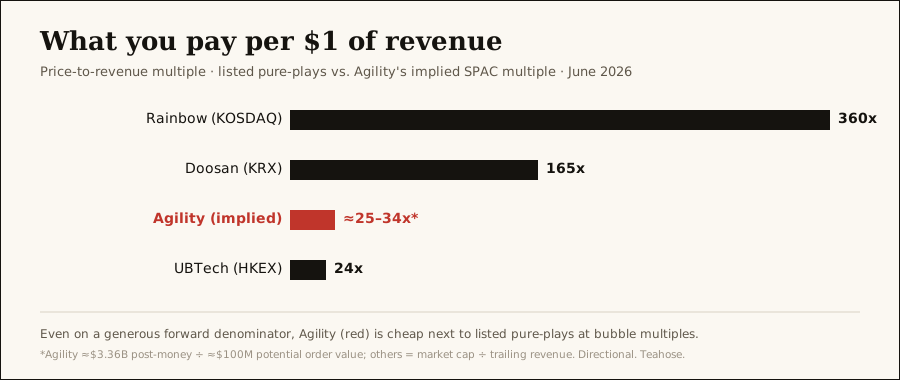
Price-to-revenue (price/sales) multiples, June 2026: listed names (UBTech HK:9880 ≈24x, Doosan KRX:454910 ≈165x, Samsung-backed Rainbow Robotics KOSDAQ:277810 ≈360x) on actual trailing revenue; Agility's ≈25–34x is implied — its ≈$3.36B post-money equity value over the ≈$100M/yr its "$300M+" order book would represent if fully deployed (potential, not booked revenue). Directional, not a like-for-like comparison.
Considering a position? You can track Agility Robotics and the companies most like it and get new funding, product and partnership signals by email as the deal moves toward close.
Agility Robotics just became the most direct way for public-market investors to bet on humanoid robots. On June 24, 2026 it agreed to merge with Churchill Capital Corp XI, a Nasdaq-listed SPAC, in a deal that values the company at $2.5 billion and would make it — in the company’s own words — the only U.S.-listed pure-play humanoid robotics company with proven commercial deployments. This guide is the investor’s version of that news: what you can actually buy today, what you’d be buying, how the valuation stacks up, and the real risks to weigh before you do anything. It is research, not investment advice.
Is Agility Robotics publicly traded? The $2.5B Churchill Capital XI SPAC deal
Not yet — but it is on a clear path to public markets. Agility Robotics is still a private company. What changed on June 24, 2026 is that it signed a merger agreement with Churchill Capital Corp XI (CCXI), a publicly traded "blank-check" company whose only purpose is to take a private business public. When that merger closes, Agility becomes the public company and CCXI ceases to exist as a shell.
A SPAC merger is an alternative to a traditional IPO. Instead of pricing new shares through underwriters, the private company reverse-merges into a cash-rich shell that’s already listed. For Agility, the deal delivers:
| Deal at a glance | Detail |
|---|---|
| Transaction | Merger with Churchill Capital Corp XI (a SPAC) |
| Pre-money equity value | $2.5 billion |
| Total expected proceeds | ≈$620 million |
| Cash in SPAC trust | ≈$420 million (as of May 29, 2026, assuming no redemptions) |
| PIPE financing | $200 million of common stock priced at $10.00/share |
| Current ticker | CCXI (Nasdaq) |
| Ticker after close | AGLT (Nasdaq, expected) |
| Expected close | During 2026 (company guidance; no vote date set as of August 10, 2026) |
| Insider rollover | 100% of existing Agility equity rolls into the combined company |
| Lock-up | 180 days for insiders (early release if shares trade ≥ $12.00 for 15 of any 180 trading days) |
Source: Agility Robotics / Churchill Capital Corp XI investor presentation filed with the SEC, June 2026. Figures are subject to redemptions and closing conditions.
The headline to remember: the deal is announced, not closed. It still needs SEC review of the S-4 registration statement, a CCXI shareholder vote, and regulatory clearance before AGLT trades.
Deal status: where the AGLT merger stands (August 2026)
As of August 24, 2026 the merger is progressing but has not closed — and no ticker-change date exists yet. The only formal registration milestone since the June announcement is a confidential draft S-4 submission; checking SEC EDGAR directly (CIK 0002074973) through August 24 shows no public S-4, no proxy and no merger 8-K. The public filing, the audited financials, the redemption deadline and the shareholder vote are all still ahead. The dated timeline:
| Date | Milestone | Status |
|---|---|---|
| June 24, 2026 | Definitive business combination agreement announced — $2.5B pre-money, ≈$620M gross proceeds, ticker AGLT reserved | ✅ Done |
| July 14, 2026 | Confidential submission of a draft Form S-4 registration statement to the SEC | ✅ Done |
| July 16, 2026 | Agility opens a Fremont, California software and physical-AI hub; discloses a pipeline of 30+ customers and a fourth named deployment customer, Mercado Libre | ✅ Done |
| August 7, 2026 | Sponsor extends a second $1.5M working-capital note to the SPAC (after a first on July 2) — the sponsor funding a longer-than-planned pre-close runway | ✅ Done |
| August 10, 2026 | Digit v5 unveiled: 20-hour operating days, cage-free operation, early-customer deployments December 2026 | ✅ Done |
| August 13, 2026 | Churchill XI files its Q2 10-Q — first hard numbers on trust, PIPE and deal odds (detailed below) | ✅ Done |
| — | Public S-4 filing (audited financials + proxy statement) | ⏳ Not yet, as of August 24, 2026 |
| — | SEC review completed, S-4 declared effective | ⏳ Pending |
| — | Redemption deadline — CCXI holders elect ≈$10 cash instead of shares | ⏳ Not yet set |
| — | Churchill XI shareholder vote | ⏳ Not yet scheduled |
| — | Close, then the CCXI → AGLT ticker change | ⏳ Guided "during 2026" |
Sources: Agility Robotics / Churchill Capital Corp XI press releases of June 24, July 14 and July 16, 2026. Both companies' language is that the transaction "is expected to close in 2026," subject to shareholder approval, SEC review of the Form S-4, regulatory approvals and exchange listing approval.
The number that changed most: CCXI is no longer a $10 stock
CCXI closed at $14.57 on August 21, 2026 — roughly 43% above the ≈$10.17 trust value, inside a 52-week range of $10.07 to $19.69, and down about 12% from its $16.62 close on August 7. The premium rewires two of this guide's conclusions, in opposite directions:
- Redemption risk stays muted — and redemptions were the deal's biggest cash risk. SPAC holders redeem when the trust is worth more than the market price. At $14.57, redeeming destroys about 30% of value, so rational holders should overwhelmingly stay in. The $420.9M trust contribution is far likelier to survive to close than the "redemptions often top 90%" base rate implies. One caveat from the August 14 filings: the visible holder base (Empyrean, MMCAP, Magnetar, Fort Baker — classic SPAC-arbitrage funds, per their Schedule 13G filings) is the kind that redeems mechanically at the vote regardless of price when the premium is thin; at today's premium they have no reason to.
- The downside cushion is still gone for new buyers. A redemption right is worth ≈$10.17 no matter what you paid. Buy at $14.57 and there is no trust floor underneath you — just an ordinary, unhedged, pre-revenue equity trading at a premium to the deal price.
And the market is still not paying the $2.5 billion headline. On roughly 336 million pro-forma shares, a $14.57 price implies an equity value near $4.9 billion — about 1.5x the ≈$3.36B post-money value implied by the $10 deal price, and roughly 49x the ≈$100M a year that the "$300M+" order book would represent if fully deployed (versus ≈25–34x at the deal price). The pro-forma share count is not final — redemptions, sponsor promote and warrants will move it — so treat that as directional. The practical takeaway is blunt: the "cheap versus Figure AI" framing was priced off the deal terms, not off what the market now charges.
What the August 13 10-Q actually disclosed
Churchill XI's first quarterly report as a deal-signed SPAC is the closest thing to primary-source deal math until the S-4 goes public. The load-bearing numbers, verbatim from the filing:
- Trust: $420,879,831 as of June 30, 2026, against 41,400,000 public shares — a redemption value of ≈$10.17 per share, accreting with interest. The flat "$10.00 floor" quoted everywhere is the IPO price, not the current trust value.
- PIPE: $201,025,000 (20,102,500 shares at $10.00), signed June 24, Citi lead placement agent — and the subscription agreements auto-terminate January 31, 2027 unless the merger agreement is extended. That, not the SPAC's charter deadline (March 18, 2028), is the deal's practical clock.
- A 90% completion assumption, in management's own valuation model. The PIPE derivative is valued using a disclosed "likelihood of completing a business combination" of 90% — a rare, management-blessed probability you will not find in the press releases.
- A scary-looking, non-cash loss. The SPAC reported a $134.7 million Q2 net loss — almost entirely PIPE-derivative fair-value accounting, not operations (actual G&A was $693,551). It says nothing about Agility's business; don't let a screener headline spook you.
What changed at the company since the announcement
- A Fremont, California facility (July 16, 2026) — a dedicated software and physical-AI hub where Agility trains and tests the models that give Digit new skills, separate from RoboFab manufacturing in Oregon.
- A fourth named customer, Mercado Libre, joining Schaeffler, GXO and Toyota Motor Manufacturing Canada — with the company now describing a pipeline of more than 30 customers and deployments across nine customer facilities.
- Digit v5 got a date (August 10, 2026): early-customer deployments begin December 2026. The new generation is built for 20-hour operating days, works outside the safety cage alongside people, and moves toward standardized, eventually self-swapping end-effectors — the product the $300M+ order book is written against.
- The spending side is now partly visible. The initial filings show operating expenses rising to roughly $111 million in 2025 from about $71 million in 2024, with roughly $100 million of cash burned in 2025 — while current revenue stays undisclosed. Against ≈$620M of gross proceeds (before fees, and assuming no redemptions), that burn implies several years of runway — but the burn is scaling fast, and audited revenue still waits on the public S-4.
What is the Agility Robotics stock ticker — CCXI or AGLT?
Both, at different stages. Right now, the only ticker that exists is CCXI — Churchill Capital Corp XI, trading on Nasdaq. Buying CCXI today means buying the SPAC shares that are designed to convert into Agility Robotics stock when the merger closes. After close, the combined company is expected to re-list under AGLT.
So if you search for "AGLT stock" and find nothing tradable, that’s expected — the symbol is reserved for after the de-SPAC. The mechanical path is: buy CCXI now → it converts to AGLT at close, or simply wait and buy AGLT after it lists. Each choice carries different risk, covered below.
How to invest in Agility Robotics stock today
There are three routes, in rising order of risk and access:
- Buy CCXI shares through any brokerage (public, retail-friendly). Because Churchill Capital XI is already listed, you don’t need to be an accredited investor. You buy CCXI like any stock. Near the SPAC’s ≈$10.17 trust value, downside is partly cushioned by redemption rights before the merger votes; after the merger, it’s an ordinary equity with full risk. Check the price before you assume that cushion exists: CCXI closed at $14.57 on August 21, 2026, roughly 43% above the ≈$10.17 redemption floor — so at current prices the trust protection is gone.
- Wait for AGLT to list, then buy it. The simplest, lowest-complexity route. You skip the pre-merger uncertainty (the vote, redemptions, possible deal collapse) and buy the operating company once it’s trading. The trade-off is you may pay more if the stock pops on listing.
- Buy private shares on a secondary marketplace (accredited only). Platforms such as Forge, Hiive, EquityZen and Nasdaq Private Market list pre-IPO Agility shares. These require accredited-investor status, carry high minimums, and were the only route before the SPAC deal. With a public path now available, they’re mostly relevant to those seeking shares ahead of close — and their quoted secondary prices predate and don’t reflect the $2.5B deal terms.
For most investors, route 1 or 2 is the practical answer. Buying CCXI is the only way to own the shares before the deal closes; waiting for AGLT is the way to avoid SPAC-process risk entirely.
Humanoid robot stocks: Tesla vs. AGLT vs. the global field
If your real thesis is "humanoid robots," AGLT is one option among several — and it’s worth knowing the whole map before you choose. Who builds humanoids, and how (or whether) you can own them:
| Company | Robot | Ticker / how to own | Publicly listed? |
|---|---|---|---|
| Tesla | Optimus | TSLA (Nasdaq) | ✅ but heavily diluted (≈6–20% of value) |
| ★ Agility Robotics | Digit | CCXI → AGLT (Nasdaq) | ◑ via SPAC, closing 2026 |
| UBTech Robotics | Walker | 9880 (Hong Kong) | ✅ listed humanoid pure-play (China) |
| Rainbow Robotics | HUBO / humanoid | 277810 (KOSDAQ; Samsung owns ≈35%) | ✅ listed pure-play (Korea) |
| Boston Dynamics | Atlas | inside Hyundai Motor (005380, Korea) | ✅ but diluted |
| Doosan Robotics | cobots | 454910 (KRX) | ✅ (cobots, not humanoid) |
| Figure AI | Figure 03 | private (≈$39B) | ❌ secondary only |
| Apptronik | Apollo | private (≈$5.3B, Google-backed) | ❌ secondary only |
| Unitree | G1 / H1 | Shanghai STAR Market (IPO priced Aug 6, 2026, ≈$9.0B) | ✅ listed pure-play (China) |
| 1X | NEO | private; consumer preorders (≈$20k) | ❌ |
The correction to the usual take: AGLT would be the first US-listed pure-play humanoid stock — but not the first in the world. Three Asian names now trade as listed humanoid pure-plays: UBTech (Hong Kong: 9880), which makes the Walker robot and carries Wall Street "buy" ratings; Rainbow Robotics (Korea, KOSDAQ: 277810), a KAIST/HUBO-pedigree humanoid firm in which Samsung holds ≈35%; and, newest, Unitree, which priced its Shanghai STAR Market IPO on August 6, 2026 at 150.8 yuan a share — a ≈$9.0 billion valuation, ≈$904 million raised, and China’s first listed humanoid maker. If you can trade foreign exchanges, those are live humanoid bets today; AGLT’s edge is being the accessible US one.
Tesla vs. Agility (AGLT): which is the better humanoid bet?
Tesla is the obvious "humanoid stock," so this is the comparison most investors actually need — and the answer depends on what you want.
With Tesla, Optimus is a small slice of a huge, profitable company. Wall Street currently assigns Optimus roughly 6–20% of Tesla’s value (≈$29/share at Stifel, ≈$60/share at Morgan Stanley; Piper Sandler treats it as "free" upside on a ≈$400 core business). Elon Musk claims Optimus will eventually be ≈80% of Tesla’s value — but that’s the bull dream, not today’s math. So buying TSLA for humanoid exposure means ≈80–94% of your money is buying cars, energy and robotaxi, with Optimus as a call option on top.
With AGLT, ≈100% of the value is the humanoid bet — no car business to dilute it, and no profitable core to cushion it. That’s the trade:
| Tesla (TSLA) | Agility (AGLT) | |
|---|---|---|
| Humanoid purity | Low (≈6–20% of value) | ≈100% |
| Downside cushion | High (profitable core) | Low (pre-profit, SPAC) |
| Liquidity | Very high (mega-cap) | Lower (post-SPAC small-cap) |
| Real humanoid revenue today | ≈None (Optimus in R&D) | Yes (Digit deployments) |
| If humanoids boom | Moves the needle modestly | Could re-rate hard |
| If humanoids disappoint | Barely dents TSLA | Can crater |
Bottom line: Want a safe, diluted way to ride the theme inside a profitable company (with robotaxi optionality thrown in)? Tesla is the lower-risk vehicle. Want a concentrated, high-beta pure-play and can stomach the SPAC math? AGLT is the more direct bet — and, ironically, Agility has more real humanoid revenue today than Tesla’s Optimus, which is still gathering training data inside Tesla’s own factories. Many investors split it: Tesla as the core, a small AGLT (or UBTech / Rainbow Robotics) sleeve for pure-play upside. (Full rosters: humanoid robot companies and the live Humanoid Robots theme.)
What Agility Robotics actually does: Digit, RaaS and the order book
Strip away the deal mechanics and the tickers, and here’s the company you’d actually own: a warehouse-robot maker with real, if still early, commercial traction. Agility’s product is Digit, a bipedal, human-sized robot built for warehouse and logistics work — moving totes, bins and packages. It’s sold mainly as Robots-as-a-Service (RaaS): customers pay a subscription rather than buying the robot outright. Agility also offers an outright ownership model. The unit economics the company pitches (illustrative, management estimates):
| Model | Customer pays | vs. human labor | Customer ROI |
|---|---|---|---|
| RaaS (subscription) | ≈$100k/yr (≈$8,500/mo per robot) | replaces ≈$200k/yr fully-burdened worker | ≈2.0x |
| Ownership | ≈$400k lifetime (upfront + software/maintenance) | ≈1.1-year payback | ≈2.5x |
Digit v4’s bill of materials is ≈$125k today and is projected to fall as RoboFab scales from 1,000 toward 10,000 units a year — the entire margin story hinges on that cost curve and on attaching software (Agility’s "Arc" platform) on top of the hardware. Industry reality check: robotics-hardware businesses typically run thin gross margins early (often 20–30%) and burn cash for years before scale and software attach lift margins toward software-like levels — so treat the 50–70% margin targets as a destination, not a starting point.
The commercial proof points the company emphasizes:
- Named blue-chip customers: Schaeffler, Toyota Motor Manufacturing Canada, Amazon and logistics giant GXO — with strategic partners NVIDIA, Google DeepMind and Manhattan Associates. That's a credible roster for warehouse automation.
- $300M+ in multi-year Digit v5 orders as of May 2026, with a pipeline it describes as several times larger.
- RoboFab — a factory in Salem, Oregon with capacity for up to 10,000 Digits per year and ≈75% U.S.-sourced parts.
- 65,000+ hours of real operations and the claim of being the first NRTL-certified humanoid (a workplace-safety milestone).
- A new Digit v5 (planned 2026 release) designed to work outside the safety cage, alongside people.
Read the fine print on that "$300M+" — it matters. Per the company's own SEC footnote, the figure is "potential multi-year value... subject to the realization of certain contractual milestones," not booked revenue. It relates to a single contract for 1,000 Digit v5 robots on a three-year RaaS term — so the headline order book is essentially one anchor customer, not a broad book of business. And the order "includes warrants issued to the purchaser, vesting proportionately to robots deployed" — meaning Agility gave the customer equity to land the deal, and the value is only realized as robots actually get deployed. It's a real, encouraging signal; it is not $300M of revenue in hand.
Crucially, Agility plays in the one humanoid niche that actually works in 2026. Independent reporting is blunt that general-purpose humanoids remain limited — short battery life, weak dexterity, no settled safety regulation — and that the only productive deployments today are repetitive material handling in warehouses. That’s Agility’s home turf, which is both its strength (real revenue now) and its ceiling (a narrower market than the "robot for everything" pitch).
Who owns Agility Robotics? Investors and cap table
Agility’s backer list reads like a who’s-who of strategic robotics capital — and that’s a genuine differentiator:
- NVIDIA — invested September 2025; Agility is the first launch partner for NVIDIA’s Halos for Robotics safety platform.
- Amazon — an early customer and investor; Digit ran warehouse pilots in Amazon facilities.
- SoftBank, Schaeffler and Foxconn — industrial and capital partners; Foxconn-led investors are reported to anchor the $200M PIPE.
- Founders and venture backers — including Playground Global, the deep-tech fund whose portfolio names Agility and whose thesis ("when software ate the world, Silicon Valley forgot about silicon") captures the physical-AI bet.
The company reports more than $390 million in equity raised since inception (as of May 2026; some third-party trackers list higher all-in totals that include debt). In the merger, no existing shareholder takes cash off the table — all roll into AGLT.
Who runs Agility Robotics? The CEO and leadership
Agility is run by a commercialization operator, not a roboticist — by design. CEO Peggy Johnson (since March 2024) previously ran Magic Leap and, before that, was EVP of business development at Microsoft, where she reported to Satya Nadella and launched the M12 venture fund; she was named to the TIME100 AI list in 2025. The read for investors: a company moving from R&D to scaled sales, partnerships and a public listing hired a sales-and-capital-markets leader, not another robotics PhD — exactly the profile a de-SPAC needs to execute.
The technical founders remain in place: Jonathan Hurst (co-founder and Chief Robot Officer, the bipedal-locomotion pioneer behind Cassie and Digit) and Damion Shelton (co-founder and chairman, the long-time prior CEO). All existing shareholders — founders included — are rolling 100% of their equity into the public company rather than cashing out, a genuine alignment signal. On the deal side, the SPAC sponsor is financier Michael Klein’s Churchill Capital — a capable serial sponsor whose record runs from the durable Clarivate listing to the cautionary Lucid round-trip (more on the deal structure below).
What’s Agility Robotics’ moat — and where it’s vulnerable
Agility’s edge is real but early — the kind that must be defended every year, not a permanent franchise. Where the moat is genuine:
- Cornered resources / strategic access. NVIDIA (investor + Halos safety partner), Amazon (investor + customer), Foxconn, Schaeffler and Google DeepMind aren’t passive — they’re compute, distribution, supply chain and AI. Hard for a new entrant to replicate.
- Regulatory head start. Digit v4 is, per the company, the first NRTL-certified humanoid — a safety credential that takes years and is a real barrier in regulated workplaces.
- Manufacturing. RoboFab (10,000 units/yr capacity) is one of the only full-scale humanoid factories; scale economics (falling bill-of-materials) accrue to whoever ships volume first.
- Emerging switching costs. Once Digit is integrated into a customer’s workflow and safety setup, ripping it out for a rival is costly.
Where it’s vulnerable:
- No network effects. More Digit deployments don’t directly make Digit more valuable to the next customer (beyond fleet-learning data).
- Out-capitalized. Figure (≈$39B) and Tesla can outspend Agility’s ≈$620M many times over on R&D and talent.
- Chinese cost pressure. Unitree and peers are driving hardware prices down fast; a logistics buyer may not pay a premium.
Durability verdict: medium — a defensible niche leader with strong partners, not yet an unassailable monopoly.
Agility Robotics valuation: $2.5B in context
You’ve seen what Agility does, who backs it and who runs it. Now the money question: is $2.5 billion a fair price? On its own it sounds steep for a company that is still scaling revenue; against its private peers it’s one of the cheaper ways to own a frontier humanoid maker. Here’s the comparison that matters:
| Company | Last valuation | How public | Notable |
|---|---|---|---|
| Figure AI | ≈$39 billion | Private (raised ≈$1.75B) | Valuation alone exceeds Goldman’s entire 2035 humanoid TAM estimate |
| Unitree | ≈$9.0 billion | Public — Shanghai STAR Market, IPO priced Aug 6, 2026 | China’s first listed humanoid maker; ≈$904M raised; ≈1.7B yuan (≈$240M) 2025 revenue |
| Apptronik | ≈$5.3 billion | Private (raised ≈$1B; Feb 2026) | Backed by Google; Apollo robot |
| Agility Robotics | $2.5 billion | SPAC (CCXI → AGLT) | Only one with a public-market path + paying deployments |
| Agility (prior round) | ≈$2.1 billion (reported) | Private (2024) | The SPAC marks a modest step-up |
Valuations as last reported, June–August 2026; private rounds are point-in-time and not directly comparable to public market caps. Unitree is the exception in this table — its figure is a priced public IPO valuation (August 6, 2026), not a private round.
Two honest reads of this table:
- Bullish: Agility is the only one of the three you can soon own in a brokerage account, it has real customers and a $300M+ order book, and its valuation is a fraction of Figure’s — so if humanoids deliver, there’s more room to re-rate.
- Bearish: The lower valuation partly reflects the lower-prestige financing route. Private mega-rounds (Figure, Apptronik) signal that top-tier VCs were willing to fund those companies privately; a SPAC is often where companies go when a traditional IPO or private round is harder to land. Don’t read "cheaper" as "safer."
For deeper company-level context, see our profiles on Figure AI’s valuation and Physical Intelligence, and the broader robotics investors landscape.
Price-to-revenue: what multiple are you actually paying?
This is the question the "$2.5B vs. Figure’s $39B" headline skips — and it’s the one that should drive your decision. A valuation only means something against the revenue underneath it. Two things to fix before you can compare:
- The real "market cap" is bigger than $2.5B. That figure is the pre-money equity value. At the $10 deal price on roughly 336 million pro-forma shares, the post-money equity value is closer to ≈$3.36 billion — the number to anchor a multiple on, before any sponsor-promote or warrant dilution.
- You have to annualize the only revenue-like figure there is. Agility discloses no historical revenue in the deck. The closest anchor is the "$300M+" order book — and annualized, that single 1,000-robot, three-year RaaS contract is worth ≈$100 million a year, if it fully deploys ($300M ÷ 3 years). That is potential contract value, not booked revenue, and it rides on one customer hitting milestones.
So the most charitable honest denominator — best-case, fully-deployed, annualized order value — puts Agility at roughly 25x its pre-money equity value, or ≈34x post-money. On actual current revenue the multiple isn’t calculable, because Agility hasn’t disclosed a current revenue number (read: it’s small).
How does that compare to the humanoid and robotics names you can already buy on public exchanges? (Market data via public exchanges, June 2026; revenue converted to USD at June-2026 rates.)
| Company | Market cap (≈USD) | Revenue (trailing) | Price-to-revenue |
|---|---|---|---|
| Agility Robotics (implied, at the $10 deal price) | ≈$3.4B post-money | ≈$100M annualized order value (potential) | ≈25–34x (forward, best-case) |
| Agility Robotics (implied, at the CCXI market price) | ≈$4.9B (336M pro-forma shares × $14.57, Aug 21, 2026) | ≈$100M annualized order value (potential) | ≈49x (forward, best-case) |
| UBTech Robotics (HK: 9880) | ≈$6.9B | ≈$280M (2025) | ≈24x |
| Doosan Robotics (KRX: 454910) | ≈$3.9B | ≈$24M (2025) | ≈165x |
| Rainbow Robotics (KOSDAQ: 277810) | ≈$9.0B | ≈$25M (2025) | ≈360x |
Apples-to-oranges warning: Agility’s multiple uses a forward, best-case annualized order value; the listed names use actual trailing revenue. The comparison is directional, not precise — but it frames the category.
Two reads, both true:
- It doesn’t look expensive inside its category. Even on a generous denominator, Agility’s ≈25–34x sits at the low end of the listed pure-plays. UBTech, Doosan and especially Samsung-backed Rainbow Robotics trade at far higher revenue multiples. If you already believe humanoid and robotics stocks are worth owning, Agility is not the priciest door in.
- But the whole category is priced on the future, not the present. Robotics hardware businesses, historically, earn low single-digit revenue multiples (roughly 2–5x). Everything above that — the 24x, 165x, 360x on these exchanges — is the market paying forward for a re-rate toward software economics (SaaS businesses can fetch 20–40x revenue), which depends on attaching high-margin software to the installed base. For Agility that bet is its "Arc" platform; for every name in this table, that software-margin future is a thesis, not yet proven at scale. "Cheap vs. peers" when the peers sit at 165–360x revenue is relative positioning, not a margin of safety. Analysts widely treat the Asian-exchange robotics multiples as bubble territory — a warning that travels with Agility into the same trade.
Sizing Agility against the field? Paste any robotics company’s website into Teahose Lookalikes — we’ll map its closest peers in our graph and email you when new funding or product signals land on them.
How big is the humanoid robot market? The TAM bull case (and the reality check)
The number that makes humanoid bulls excited is enormous — and the range between forecasters is itself the story. Wall Street’s two headline estimates:
- Goldman Sachs: ≈$38 billion humanoid market by 2035, with 250,000+ units shipped a year by 2030 (≈70% CAGR); a "blue-sky" scenario reaches $154 billion.
- Morgan Stanley: ≈$5 trillion by 2050 — 13 million humanoids in service by 2035, scaling toward 1 billion by 2050, ≈90% in industrial and commercial roles.
That spread (a 100x+ gap by mid-century) tells you how speculative the category still is. The reality check matters as much as the TAM: as of 2026, the number of humanoids doing genuinely productive work globally is in the hundreds to low thousands, not millions. Battery life (2–4 hours), dexterity, and the absence of settled safety regulation cap general-purpose use — and the one application that actually works at scale today is repetitive warehouse and logistics handling. That happens to be exactly Agility’s wedge, which is both the bull case (real revenue in the working niche now) and the ceiling (a narrower near-term market than the "robot for everything" pitch).
The SPAC deal explained: proceeds, PIPE, dilution and redemptions
The structure is where SPAC investing gets technical — and where the risk lives. The essentials:
- Where the money comes from. Of the ≈$620M in expected proceeds, roughly $420M sits in the Churchill trust (cash raised in the SPAC’s own IPO) and $200M is a PIPE — a private placement of common stock at $10/share from new and existing investors that closes alongside the merger.
- Redemptions are the wildcard. Before the merger vote, CCXI shareholders can redeem their shares for ≈$10 from the trust. If many redeem, the $420M trust contribution shrinks — sometimes dramatically. Across recent SPACs, redemption rates have often topped 90%, leaving deals with far less cash than advertised. The $200M PIPE is "committed," which provides a floor, but the trust cash is not guaranteed.
- Dilution and lock-up. Existing Agility holders roll 100% of their equity into the deal (a sign of alignment — they’re not cashing out) and accept a 180-day lock-up, with early release only if the stock holds above $12. SPAC sponsor shares and warrants add dilution that ordinary buyers should model.
- The sponsor matters. This is Michael Klein’s eleventh Churchill SPAC. His franchise has done marquee deals (Clarivate) and infamous ones — Churchill Capital IV’s Lucid Motors merger saw the stock collapse ≈87% from its hype peak. A credible serial sponsor improves the odds versus a no-name SPAC, but it is not a guarantee.
What to watch before the CCXI shareholder vote
A de-SPAC’s outcome is often decided in the filings between announcement and close — not in the pitch deck. Four numbers will tell you more than any slide:
- The redemption rate at the vote. The single biggest variable. Heavy redemptions shrink the ≈$420M trust contribution and can force a dilutive follow-on raise. Watch the de-SPAC 8-K and proxy as the vote nears.
- The buyer-warrant terms in the S-4. The "$300M+" anchor order includes AGLT warrants for the customer, vesting as robots deploy. The deck doesn’t disclose the strike, share count or vesting curve — the S-4 should. Those terms reveal the real dilution and how much of the "demand" was bought with equity.
- Agility’s actual audited revenue. The initial filings do show the spending side — operating expenses of roughly $111 million in 2025, up from about $71 million in 2024, and roughly $100 million of cash burned in 2025 — but no current revenue figure at all. The S-4 carries audited financials for the first time; the real current revenue, set against a burn rate that is already scaling fast, is what decides whether ≈$574M is years of runway or a single raise away from dilution.
- The pro-forma fully-diluted share count. Including sponsor promote and warrants — the true denominator under every per-share figure and the valuation multiple above.
Until those land, the deck is a forward story. The S-4 is where the story meets audited numbers — re-underwrite then.
Don’t want to poll SEC filings yourself? Watch Agility Robotics on Teahose — when the S-4, vote date or redemption numbers hit expert coverage, the signal lands in your inbox.
Bull vs. bear: should you consider Agility Robotics stock?
This is the question the marketplace pages skip. Here’s the honest two-sided case.
The bull case
- Real deployments, real orders. Unlike most humanoid makers showing demo videos, Agility has paying customers and a $300M+ book in the use case that works.
- Strategic cap table. NVIDIA, Amazon, SoftBank and Foxconn aren’t passive checks — they’re supply chain, compute and distribution.
- Public-market scarcity. If it lists, AGLT becomes one of the only pure-play humanoid stocks retail investors can own — scarcity value in a hot theme.
- The working niche + a safety lead. Logistics handling is the one humanoid use case that pays today, and Digit’s NRTL certification + NVIDIA Halos partnership are real credentials there.
- Relatively modest entry valuation versus Figure (≈$39B) and Apptronik (≈$5.3B), with TAM optionality if humanoids inflect.
The bear case
- The de-SPAC base rate is brutal. More than 90% of recently de-SPAC’d companies trade below their $10 reference price; SPACs as a class have underperformed the market nearly every year. Klein’s own Lucid deal (LCID, down ≈87% from its peak) is the cautionary tale.
- Redemption risk. If CCXI holders redeem heavily, the deal closes with far less cash than the headline ≈$620M suggests, pressuring the balance sheet and raising the odds of a dilutive follow-on.
- Out-capitalized. Agility raises ≈$620M; Tesla and Figure can outspend it many times over. In a capital-intensive race, that gap compounds.
- Chinese cost competition. Unitree shipped 5,500+ units in 2025 and is driving prices down — hardware margin pressure is real.
- Humanoid hype cycle. The market is early; productive humanoids globally still number in the hundreds-to-low-thousands. Timelines historically slip (see Tesla’s Optimus delays).
- Projection-based story, concentrated in one incentivized order. Much of the deck is illustrative unit economics, not audited recurring revenue. The marquee "$300M+" book is a single 1,000-robot contract that converts only as milestones are met — and it carries warrants in AGLT for the buyer that vest as robots deploy. That’s smart alignment (the customer is now a shareholder motivated to roll robots out), but it also means the headline demand was partly secured with equity, and those warrants dilute other shareholders.
How the scenarios could play out (illustrative framing, not a forecast — there’s no audited financial history to model precisely):
| Scenario | What happens | Rough outcome on a ≈$10 entry |
|---|---|---|
| Bull | Digit v5 ships, orders convert, RoboFab ramps, AGLT becomes the humanoid stock and re-rates toward peer multiples | Multi-bagger over 2–4 years |
| Base | Real but slower commercialization; trades like a volatile pre-revenue hardware story with periodic dilution | Range-bound, high volatility |
| Bear | Heavy redemptions + slipping timeline + a sector de-rate; follows the de-SPAC base rate | -50% to -85% (a Lucid-style round-trip) |
The synthesis: Agility is one of the more defensible humanoid bets because it’s anchored in a working use case — but it’s being delivered through one of the least forgiving public-market structures. The return distribution is asymmetric and fat-tailed: a real shot at a large win, a meaningful chance of a large loss, and a thin middle. That makes position sizing — not a point-estimate price target — the right tool. One structural cushion exists, but only at the right price: buying CCXI near its ≈$10 trust value before the merger vote gives you a redemption option (you can redeem for ≈$10 before the deal closes), which partly floors the downside until you choose to convert into AGLT. That cushion has largely evaporated. CCXI closed at $14.57 on August 21, 2026, so redeeming would return roughly $10.17 against a $14.57 cost — a ≈30% loss, not a floor. At today’s price this is an unhedged equity bet, not a trust-protected one.
What experts are saying — Agility across 613 robotics conversations
One thing a brokerage listing can’t tell you is how much real expert attention a company commands. Across Teahose’s 1,750+ expert podcast, newsletter and research summaries, Agility Robotics shows up in 16 of the 613 conversations touching robotics, humanoids and physical AI (August 2026) — placing it among the most-discussed humanoid makers: behind Unitree (56 summaries), Boston Dynamics (28) and Figure AI (20), but ahead of Apptronik (9) and 1X (5).
Methodology: a count of how many of our expert summaries name each company, August 2026. It measures share of expert discussion, not market share, revenue, or any signal about the stock.
In their own words — what operators and researchers are actually saying:
"One of the last investments we did was Agility Robotics…" — a venture investor recounting recent portfolio bets at the F50 Physical AI Summit.
"When software ate the world, Silicon Valley forgot about silicon." — Peter Barrett, co-founder of Playground Global (an Agility Robotics backer), framing the physical-AI thesis, via Axios Pro Rata.
"We attempted to apply our framework… on the Agility Robotics Digit humanoid robot. However… our baseline Digit locomotion policy failed outright for backwards walking." — a 2026 robotics-research paper (arXiv 2604.11090) — a candid reminder that even the best humanoid locomotion is still hard.
And in a tell about Agility’s standing, in a conversation with Sundar Pichai Google DeepMind was described as relying on Boston Dynamics and Agility Robotics as key hardware partners for deploying its Gemini robotics models — consistent with the Google DeepMind partnership on Agility’s own roster.
That puts Agility squarely in the conversation operators are already having about the physical-AI wave — see the live rosters on our Humanoid Robots and Physical AI theme pages, and the broader robotics startups and robotics investors guides.
Humanoid & Physical-AI Companies Teahose Is Tracking
Live roster across the Humanoid Robots & Physical AI themes, ranked by recent signal volume — auto-updates as the pipeline tags new deals and companies
- 01Physical Intelligencelast seen SEP 13146 signals
- 02Teslalast seen SEP 21101 signals
- 03Physical Intelligencelast seen SEP 2174 signals
- 04Waymolast seen SEP 2159 signals
- 05Figurelast seen SEP 1552 signals
- 06Unitree Roboticslast seen SEP 836 signals
- 07Unitreelast seen SEP 1434 signals
- 08Xiaomi Roboticslast seen SEP 1529 signals
- 09Agility Roboticslast seen SEP 1527 signals
- 10AgiBotlast seen SEP 1725 signals
- 11Boston Dynamicslast seen SEP 1817 signals
- 12Boom Supersoniclast seen SEP 2217 signals
Related
Figure AI valuation · Physical Intelligence valuation · Skild AI valuation · Robotics investors & VC firms · Robotics startups · Humanoid robot companies.
Bottom line: Agility Robotics goes public the moment its $2.5B merger with Churchill Capital Corp XI closes — guided for sometime in 2026, with a confidential draft S-4 submitted July 14, 2026, no vote or ticker-change date announced as of August 24, 2026, and a practical deal deadline of January 31, 2027 (when the PIPE agreements auto-terminate). Until then, CCXI is the only way to buy in, with AGLT arriving after close — and CCXI itself trades at $14.57 (August 21, 2026 close), well above the ≈$10.17 trust value, so the trust floor doesn't protect new buyers. The company has the strongest commercial footing of any pure-play humanoid maker (paying Digit deployments, a $300M+ order book, an NVIDIA-anchored cap table) at a valuation well below Figure or Apptronik. But it’s riding a hype-prone market into one of the harshest financing structures in public markets, where more than 90% of de-SPACs trade below $10. Strong company, demanding vehicle — weigh both. None of this is investment advice.
Deal figures from the Agility Robotics / Churchill Capital Corp XI investor presentation, the companies’ press releases of June 24, July 14 and July 16, 2026, and Churchill XI’s Form 10-Q filed August 13, 2026 (SEC EDGAR, CIK 0002074973). CCXI market data as of the August 21, 2026 close. Peer valuations and market data as last reported, June–August 2026. Corpus figures from Teahose’s analysis of 1,750+ expert summaries (613 touching robotics), August 2026 — share of expert discussion, not financial advice.
Frequently Asked Questions
Is Agility Robotics publicly traded?
Not yet directly. As of August 24, 2026 the deal is signed but not closed. Agility agreed on June 24, 2026 to go public through a merger with Churchill Capital Corp XI, a special-purpose acquisition company (SPAC) that already trades on Nasdaq under the ticker CCXI. The two companies confidentially submitted a draft Form S-4 registration statement to the SEC on July 14, 2026 and guide to a close during 2026; as of August 24, 2026 no public S-4, proxy statement, redemption deadline or shareholder-vote date had been announced — verified directly against SEC EDGAR. Until the merger closes, the only public-market way to get exposure is to buy CCXI shares, which closed at $14.57 on August 21, 2026, down from $16.62 on August 7. Once the deal closes, the combined company is expected to trade under the new ticker AGLT.
What is the Agility Robotics stock ticker?
There are two tickers to know. Today, the SPAC that is taking Agility public trades as CCXI (Churchill Capital Corp XI) on Nasdaq. After the merger closes, the company is expected to re-list under the ticker AGLT. So "AGLT" is not yet tradable — buying CCXI is the way to hold the shares that convert into AGLT at close.
Can I buy Agility Robotics stock right now?
Yes, indirectly. Because the merger is with a publicly traded SPAC, any retail brokerage account can buy CCXI shares today — no accredited-investor status required. Those shares are designed to convert into the combined Agility Robotics company at the deal’s close. Before the SPAC announcement, the only route was buying private shares on accredited-investor marketplaces such as Forge, Hiive or EquityZen; the public SPAC route is now the simpler path for most investors.
How much is Agility Robotics worth?
The SPAC deal values Agility Robotics at a $2.5 billion pre-money equity value, up from a reported ≈$2.1 billion private valuation in its prior round. That is modest relative to humanoid peers: Figure AI was last valued around $39 billion and Apptronik around $5.3 billion in early 2026. Agility’s lower number partly reflects that it is taking the riskier SPAC route to public markets rather than raising a private mega-round.
Who owns Agility Robotics?
Agility Robotics is backed by a strategic roster that includes NVIDIA (which invested in September 2025), Amazon, SoftBank, Schaeffler and Foxconn, plus its founders and earlier venture investors. The company says it has raised more than $390 million in equity since inception (as of May 2026). In the SPAC merger, all existing Agility shareholders are rolling 100% of their equity into the combined company rather than cashing out.
When will Agility Robotics go public?
The merger with Churchill Capital Corp XI was announced June 24, 2026, and both companies guide to a close during 2026 — subject to SEC review of the Form S-4 registration statement, a Churchill XI shareholder vote, exchange listing approval and customary closing conditions. The most recent milestone was the confidential submission of a draft S-4 on July 14, 2026. As of August 10, 2026 the S-4 had not been publicly filed and no shareholder-vote date had been set, so there is no firm listing date yet. The combined company is expected to begin trading as AGLT shortly after the deal closes.
Is Agility Robotics a good investment?
That depends on your view of two things: the humanoid-robot market and the SPAC structure. The bull case is that Agility is one of the few humanoid makers with real paying deployments (Digit in warehouses) and a $300M+ order book, in the one humanoid use case — repetitive logistics — that actually works today. The bear case is that de-SPAC stocks have a brutal track record (over 90% trade below their $10 reference price), the humanoid market is early and hype-prone, and Agility’s valuation already prices in a lot of future growth. This guide lays out both sides; it is not investment advice.
Who is Churchill Capital Corp XI?
Churchill Capital Corp XI (Nasdaq: CCXI) is the eleventh SPAC from financier Michael Klein, the former Citigroup banker behind the Churchill Capital franchise. Klein’s SPACs have a mixed record: Churchill Capital I took Clarivate public, but his best-known deal — Churchill Capital IV’s merger with Lucid Motors — saw the stock crash roughly 87% from its peak. Agility is his latest target.
What does Agility Robotics make?
Agility Robotics makes Digit, a human-sized, bipedal warehouse robot built to move totes, containers and packages alongside people. It is sold mostly as Robots-as-a-Service (RaaS) — a subscription rather than an outright purchase. The company builds Digit at RoboFab, a factory in Oregon it describes as the world’s first full-scale humanoid plant, with capacity for up to 10,000 robots a year.
Who are Agility Robotics’ customers?
Agility’s named customers include Schaeffler, Toyota Motor Manufacturing Canada, Amazon and the contract-logistics giant GXO, with strategic partners NVIDIA, Google DeepMind and Manhattan Associates. One important caveat: the company’s headline "$300M+ in orders" is, per its own SEC footnote, a single contract for 1,000 Digit v5 robots on a three-year RaaS term — so the marquee order book is concentrated in one anchor customer, and it includes warrants in the new public company (AGLT) that vest as robots are deployed.
How is Agility Robotics different from Figure AI?
Both build humanoid robots, but they’re near-opposites in strategy and price. Figure AI pursues a general-purpose robot and was last valued around $39 billion in private rounds. Agility Robotics is a logistics specialist — its Digit robot does warehouse material handling, the one humanoid use case with real paying demand today — and is going public at a $2.5 billion SPAC valuation. So Agility is far cheaper and more commercially proven in its niche, but narrower in ambition and taking the riskier SPAC route to public markets while Figure raises private mega-rounds.
Is there a Tesla Optimus stock?
There’s no separate Optimus stock — the only way to own Tesla’s humanoid program is to buy Tesla (TSLA) itself, where Optimus is a tiny fraction of a $1T+ car and energy company and still in R&D (Optimus units mostly gather training data inside Tesla factories rather than doing productive labor). That makes TSLA a heavily diluted way to bet on humanoids. Agility Robotics (CCXI → AGLT) is closer to a pure-play: a company whose entire value is its humanoid robot.
What are the best humanoid robot stocks to buy?
As of 2026 the public options are limited. Tesla (TSLA) gives diluted exposure via Optimus (≈6–20% of its value); Boston Dynamics is buried inside Hyundai Motor; and the listed humanoid pure-plays are all Asian — UBTech (Hong Kong: 9880), Samsung-backed Rainbow Robotics (Korea: 277810) and, since August 2026, Unitree, which priced a Shanghai STAR Market IPO on August 6, 2026 at roughly a $9.0 billion valuation to become China’s first listed humanoid maker. Figure AI, Apptronik and 1X remain private (accredited-investor secondaries only). Agility Robotics, going public via the Churchill Capital XI SPAC (CCXI → AGLT), is set to become the first US-listed pure-play humanoid stock a retail investor can buy directly — a large part of its appeal and its risk.
Is Tesla or Agility Robotics the better way to bet on humanoid robots?
It depends what you want. With Tesla, the Optimus humanoid is only about 6–20% of the company’s value (analysts assign roughly $29–$60 a share to it), so ≈80–94% of your investment is cars, energy and robotaxi — a safer, diluted way to ride the theme with a profitable core underneath. With Agility Robotics (AGLT), close to 100% of the value is the humanoid bet: a concentrated, higher-risk pure-play with no car business to cushion it but far more upside if humanoids inflect. Notably, Agility has more real humanoid revenue today than Tesla’s Optimus, which is still gathering data inside Tesla’s factories. Many investors hold Tesla as a core position and add a small AGLT (or UBTech / Rainbow Robotics) sleeve for pure-play exposure.
What is Agility Robotics’ revenue?
Agility Robotics has not disclosed a current revenue figure in its SPAC investor presentation — a sign that, like most humanoid makers in 2026, its booked revenue is still small. The number it does highlight is a "$300M+" order book, but per its own SEC footnote that is potential multi-year value subject to milestones, not booked revenue, and it is tied to a single 1,000-robot, three-year contract. Annualized, that one contract is worth roughly $100 million a year if it fully deploys ($300M ÷ 3 years). Audited revenue will appear for the first time in the S-4 registration statement filed for the merger.
What valuation multiple is the Agility Robotics SPAC?
The deal values Agility at a $2.5 billion pre-money equity value, or roughly $3.36 billion post-money (about 336 million pro-forma shares at the $10 deal price). Because Agility discloses no current revenue, the only way to frame a multiple is against its annualized "$300M+" order book — about $100 million a year of potential contract value if fully deployed — which puts the deal at roughly 25–34x that best-case figure. For context, the listed robotics pure-plays trade at wide multiples on actual revenue: UBTech around 24x, Doosan Robotics around 165x, and Samsung-backed Rainbow Robotics around 360x (June 2026). Agility looks inexpensive within that group, but the entire category is priced on a software-margin future that none of them has proven at scale.
Who is the CEO of Agility Robotics?
Agility Robotics has been led by CEO Peggy Johnson since March 2024. Before Agility she was CEO of Magic Leap and, earlier, executive vice president of business development at Microsoft, where she reported to Satya Nadella and launched the M12 venture fund; she was named to the TIME100 AI list in 2025. She is a commercialization and business-development leader rather than a roboticist — the profile a company needs as it shifts from R&D to scaled sales and a public listing. The technical co-founders remain involved: Jonathan Hurst as Chief Robot Officer and Damion Shelton as chairman.
When does CCXI change to AGLT — what is the ticker change date?
There is no announced ticker-change date. CCXI becomes AGLT only when the merger legally closes, and the close depends on a sequence that is still unfinished: a public Form S-4 filing, SEC review and effectiveness, a proxy mailing, a redemption deadline, and a Churchill XI shareholder vote. As of August 24, 2026 only a confidential draft S-4 had been submitted (July 14, 2026) — the public filing, the proxy and the vote date had all not been announced. Both companies guide to a close during 2026, which would put the ticker change in late 2026 at the earliest — and the PIPE subscription agreements auto-terminate on January 31, 2027 unless the merger agreement is extended, which makes that the deal's practical deadline. The concrete thing to watch is the S-4 being publicly filed and then declared effective; the vote date, the redemption deadline and the expected listing date are set out in the proxy that follows.
What happens to my CCXI shares when the Agility Robotics merger closes?
If you hold CCXI through the close, your shares automatically become shares of the combined company and the ticker changes from CCXI to AGLT — there is nothing to buy and no separate AGLT purchase to make. Before the vote you also hold a redemption right: you can instead hand the shares back for your pro-rata slice of the trust — $420.9 million against 41.4 million public shares as of June 30, 2026, or about $10.17 a share, per Churchill XI's August 13 10-Q, and accreting with interest. That right is worth about $10.17 regardless of what you paid, which matters at August 2026 prices — CCXI closed at $14.57 on August 21, 2026, so redeeming would return roughly 30% less than the market price. Churchill XI units (CCXIU) and public warrants (CCXIW, $11.50 strike) are separate securities with their own mechanics, so check what you actually hold.
Why is CCXI stock trading above $10, and what does that imply for AGLT?
CCXI closed at $14.57 on August 21, 2026 against a trust value of about $10.17 a share and a $10.00 PIPE price, with a 52-week range of $10.07 to $19.69 — the stock re-rated after the June 24 Agility announcement, peaked near $19.69, and has drifted about 12% lower since its August 7 close of $16.62. Two implications follow. First, redemption risk stays muted: SPAC holders redeem when the trust beats the market price, and at $14.57 redeeming would still destroy roughly 30% of value, so the $420.9 million trust remains likelier to survive to close than the usual de-SPAC base rate suggests. Second, the entry price is still well above the deal price: on roughly 336 million pro-forma shares, $14.57 implies an equity value near $4.9 billion rather than the roughly $3.36 billion the $10 deal price implies. Anyone buying today pays a meaningful premium to the terms Agility negotiated, and AGLT will open from wherever CCXI trades at close — not at $10.
What is the real deadline for the Agility Robotics SPAC to close?
Two dates matter, and neither is the one usually quoted. The practical deadline is January 31, 2027: Churchill XI's August 13, 2026 10-Q discloses that the $201 million PIPE subscription agreements automatically terminate on that date unless the merger agreement is extended — and a de-SPAC without its PIPE is a different, weaker deal. The formal backstop is March 18, 2028, the SPAC's charter deadline to complete a combination before liquidating. The companies' own guidance of "during 2026" sits comfortably inside both, and the same 10-Q shows management's valuation model assumes a 90% likelihood of completing the combination.
When does Digit v5 ship?
December 2026, per Agility's August 10, 2026 announcement — early-customer deployments of Digit v5 begin then, ahead of the SPAC's expected close. The v5 generation is designed for 20-hour operating days, cage-free operation alongside human workers, and standardized (eventually self-swapping) end-effectors. It is also the robot the "$300M+" order book is written against: that contract is for 1,000 Digit v5 units on a three-year RaaS term, so the December rollout is the first evidence of whether the marquee order converts into deployed robots and revenue.
Is the Agility Robotics SPAC deal still on track?
Yes, as of August 24, 2026, with no announced setback — but also no new formal milestone. The definitive agreement was signed June 24, 2026 and a confidential draft Form S-4 was submitted to the SEC on July 14, 2026; checking SEC EDGAR directly through August 24 shows no public S-4, no proxy, no redemption deadline and no vote date yet. What did land: Churchill XI filed its Q2 10-Q on August 13, 2026 (disclosing a trust of $420.9 million, about $10.17 per public share, and a management-assumed 90% likelihood of completing the combination), the sponsor extended a second $1.5 million working-capital note on August 7 (a mild signal the pre-close runway is running longer than planned), and Agility announced that Digit v5 ships to early customers in December 2026. Both companies still guide to a close during 2026, and the PIPE agreements give the deal a practical backstop deadline of January 31, 2027.