
Key takeaways
- The top AI VC firms in 2026 are the generalist mega-platforms — Andreessen Horowitz (a16z), Sequoia, Founders Fund, General Catalyst, Thrive Capital and Khosla Ventures — backed by a fast-rising tier of AI-native specialists (Conviction, Radical Ventures, Air Street Capital, Lux Capital).
- We rank them by something no other list has: how often AI operators actually name each firm. Across the 1,160 expert podcast, newsletter and research summaries Teahose has analyzed, a16z leads with 204 mentions, then Sequoia (118), Founders Fund (67) and General Catalyst (66).
- Share of discussion is not share of capital. Some firms writing the biggest AI checks (Thrive, Lightspeed) are discussed far less than their dollars would suggest — and AI-native funds punch above their size in influence.
- Most "AI VC firm" lists are static directories that go stale in weeks. The useful question isn't who raised a big fund in 2024 — it's who is writing AI checks this week. That's what we track live, below.
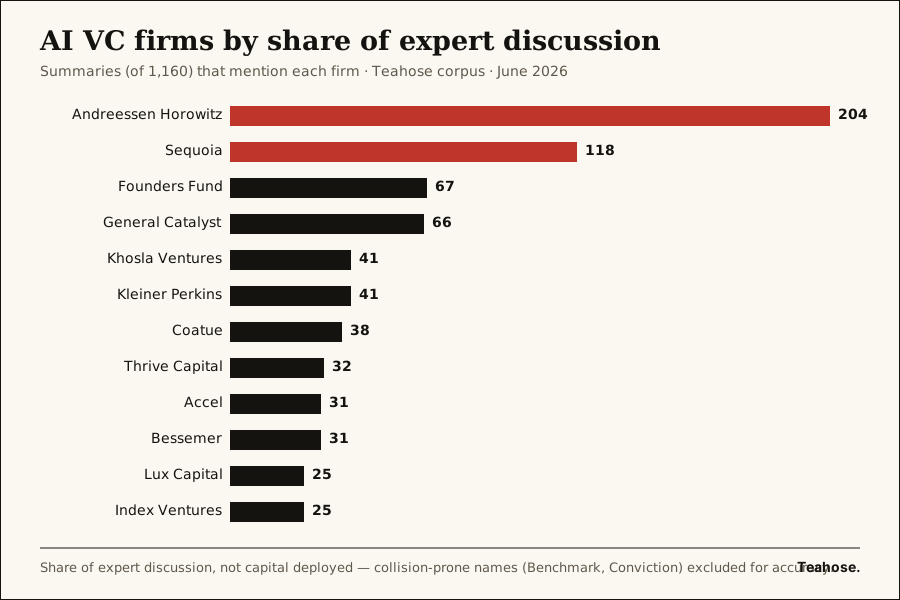
Each firm's bar counts how many of Teahose's 1,160 expert summaries name it (word-boundary match across our podcast, newsletter and research corpus, June 2026). It measures share of expert discussion, not assets or AI deal count.
Track the field, not a snapshot: see which AI companies are raising right now and get their funding signals by email — Teahose's live signal feed.
Every generalist fund now calls itself an AI investor, every AI-only fund claims the best founders, and the directories that try to list them all are out of date the moment they publish. So the real question a searcher has — which AI VC firms actually matter, and how would I know? — goes mostly unanswered. The honest answer has two layers: a roster of the firms leading AI rounds today, and a live read on which ones operators are actually talking about. This guide gives both.
The top AI VC firms in 2026 (at a glance)
The platforms below lead the majority of significant AI rounds. The "expert mentions" column is our proprietary read — the number of Teahose summaries that name each firm — and it's the column you won't find anywhere else.
| Firm | What it backs in AI | Expert mentions* | Typical stage |
|---|---|---|---|
| Andreessen Horowitz (a16z) | Foundation models, AI infra, apps, defense (American Dynamism) | 204 | Seed → Growth |
| Sequoia | Broad AI — foundation models + applications | 118 | Seed → Growth |
| Founders Fund | Frontier AI; early OpenAI & Anduril backer | 67 | Seed → Growth |
| General Catalyst | Applied AI, healthcare AI, infra | 66 | Seed → Growth |
| Khosla Ventures | Early OpenAI backer; deep-tech & AI infra | 41 | Seed → Early |
| Kleiner Perkins | AI applications + infrastructure | 41 | Early → Growth |
| Coatue | Late-stage AI (crossover/hedge) | 38 | Growth |
| Thrive Capital | Concentrated late-stage; an OpenAI lead | 32 | Growth |
| Accel | AI apps + infrastructure | 31 | Early → Growth |
| Bessemer | Vertical AI, AI infrastructure | 31 | Early → Growth |
| Lux Capital | Frontier/deep tech — robotics, defense AI | 25 | Seed → Early |
| Index Ventures | AI apps + infrastructure | 25 | Early → Growth |
| Conviction | AI-native seed fund (founded by Sarah Guo) | 14 | Seed |
* Expert mentions = how many of Teahose's 1,160 expert summaries name the firm (June 2026) — a measure of share of expert discussion, not assets under management or AI deal count. Collision-prone names (e.g. "Benchmark", "Conviction") are counted on firm-qualified matches to avoid inflating them with the everyday word.
For the assets-under-management ranking of these same firms — a16z and Insight at $90B+, the mega-fund concentration trend — see the biggest VC firms league table.
Which AI investors operators actually talk about
Here is the insight a static directory can't give you: the league table of capital and the league table of conversation are not the same. a16z and Sequoia top both — they are genuinely the gravitational centers of AI venture. But below them the lists diverge sharply. Thrive Capital is a lead investor in the single most valuable AI company on earth, yet it's named in only 32 of our summaries; some of the largest AI growth checks come from firms operators rarely discuss on the record. Meanwhile AI-native specialists punch far above their fund size in influence — Conviction, Radical Ventures and Air Street Capital shape how the field thinks about AI even when their dollar volume is a fraction of the platforms'.
The pattern is the same one that defines the concentration in venture broadly: a handful of brand names dominate both the dollars and the discussion, and "share of voice" almost always trails "share of capital." If you want to know who is setting the agenda in AI investing — not just who has the most money — the mention count is a better proxy than the fund size.
AI-native funds vs generalist platforms
The single most useful distinction for anyone trying to understand AI venture is specialist vs platform — and most lists flatten it.
- AI-native funds (Conviction, Radical Ventures, Air Street Capital) invest only in AI and are typically run by AI operators or researchers. They win on technical depth, early conviction and founder access. They write smaller, earlier checks and concentrate.
- Generalist platforms (a16z, Sequoia, General Catalyst, Lightspeed) run AI as one strategy among many, backed by multi-billion-dollar funds. They win on check size and staying power — the ability to follow a company from a seed round to its IPO, and to write the nine-figure checks that frontier-model rounds now demand.
Neither is strictly "better." Frontier-model companies need platforms that can fund them for years; a vertical AI startup at the seed stage is often better served by a specialist who has seen fifty companies attack the same problem. The firms that bridge both — a16z's seed practice, Khosla's early deep-tech bets — are why those names sit so high in both columns above.
AI VC firms by sector
AI venture isn't one market. The firms that lead an AI-infrastructure round are often not the ones leading in robotics or defense. Teahose tracks the companies (and the investors behind them) by sector, so you can see which funds cluster where:
- AI infrastructure & compute — a16z, Sequoia, Founders Fund, Lightspeed. See the live roster: AI infrastructure companies and the AI Infrastructure theme.
- Robotics & physical AI — Lux Capital, Founders Fund, Khosla, plus specialists (Eclipse, Playground Global, Construct). See robotics investors, robotics startups and the Humanoid Robots theme.
- Defense tech — Founders Fund, a16z (American Dynamism), Lux. See defense-tech startups and the Defense Tech theme.
Each theme page updates as our discovery pipeline tags new companies — so the sector rosters stay current without a manual rewrite.
How to actually track AI investors (not just list them)
A list is a snapshot; investing moves continuously. The reason every "top AI VC firms" page goes stale is that it's frozen on the day it's published — it can't tell you that a firm led three AI rounds last week, or that a new fund just made its first frontier bet. Teahose is built to close that gap:
- Live funding signals. Every AI round we detect across expert podcasts, newsletters and research is pulled into a searchable signal feed — so you see who's writing checks now.
- Investor and operator profiles. The people behind these firms — partners, founders, the angels who move first — are tracked as profiles with their own mention history.
- Company tracking by email. Pick an AI company and find the ones most like it, then get their funding and product signals delivered as they happen.
That's the difference between reading a list of AI VC firms and actually following the field.
See the field in motion: the chart above is a snapshot of the conversation; the live signal feed is the ongoing record. Track which AI companies are raising — and from whom — by email.
Where AI Venture Money Is Landing This Week
Ranked by 7-day signal volume across the podcasts, newsletters & research the Teahose pipeline reads
- 01OpenAI71 signals · 7d
- 02Anthropic65 signals · 7d
- 03Meta34 signals · 7d
- 04Nvidia34 signals · 7d
- 05Google21 signals · 7d
- 06Bending Spoons21 signals · 7d
- 07Eclipse20 signals · 7d
- 08Databricks17 signals · 7d
- 09Andreessen Horowitz16 signals · 7d
- 10Instinct15 signals · 7d
Related
Biggest VC firms, by AUM · Top AI startups, live-ranked · AI unicorns, counted · AI infrastructure companies · Robotics startups · Defense-tech startups.
Bottom line: The top AI VC firms in 2026 are the generalist mega-platforms — a16z and Sequoia above all — leading AI rounds at every stage, with a rising tier of AI-native specialists (Conviction, Radical Ventures, Air Street Capital) shaping the field's thinking. But the firm that raised the biggest fund isn't always the one operators talk about: across our 1,160 expert summaries, a16z (204) and Sequoia (118) dominate the conversation, while several of the largest AI checks come from firms rarely discussed on the record. Track who's actually writing checks, not who topped a static list.
Mention counts from Teahose's analysis of 1,160 expert podcast, newsletter & research summaries, June 2026. Share of expert discussion, not assets or AI deal count.
Frequently Asked Questions
What are the top AI VC firms in 2026?
The most active AI venture capital firms in 2026 are the mega-platforms — Andreessen Horowitz (a16z), Sequoia, Founders Fund, General Catalyst, Thrive Capital, Khosla Ventures, Kleiner Perkins, Accel, Bessemer and Index Ventures — alongside crossover late-stage investors (Coatue, Greenoaks) and a tier of AI-native specialists (Conviction, Radical Ventures, Air Street Capital, Lux Capital). Ranked by how often they come up in expert podcasts and newsletters, a16z (204 of our 1,160 summaries) and Sequoia (118) dominate the conversation by a wide margin.
Which VC firms invest in AI startups?
Almost every top-tier generalist firm now leads AI rounds — a16z, Sequoia, Founders Fund, General Catalyst, Khosla, Kleiner Perkins, Accel, Bessemer, Index and Lightspeed all back AI startups at seed through growth. The firms most associated with frontier AI are Khosla and Founders Fund (early OpenAI and Anduril backers), Thrive Capital (a lead investor in OpenAI), and a16z (dedicated AI, infrastructure and American Dynamism funds). A separate tier of AI-only funds — Conviction, Radical Ventures, Air Street Capital — invests exclusively in AI.
What is the biggest AI-focused venture capital firm?
By assets, Andreessen Horowitz (a16z) is the largest firm investing heavily in AI, at $90B+ in AUM after its January 2026 raise — though it is a generalist platform, not an AI-only fund. Among AI-native specialists, Conviction (founded by Sarah Guo) is the highest-profile dedicated AI fund. See our biggest VC firms guide for the full AUM league table.
Who are the best AI seed investors and AI angel investors?
For AI at the seed stage, the names that recur most among operators are Conviction (Sarah Guo), Khosla Ventures, Founders Fund, Lux Capital and a16z's seed practice, plus AI-specialist micro-funds like Radical Ventures and Air Street Capital. Many of the most influential AI angels are operators themselves — founders and researchers who invest personally — which is why a generic "angel list" undersells the field. Tracking who actually shows up in deals beats a static directory.
What's the difference between an AI-native VC and a generalist VC?
An AI-native VC (Conviction, Radical Ventures, Air Street Capital) invests only in AI and is usually run by AI operators or researchers, betting on technical depth and concentration. A generalist platform (a16z, Sequoia, General Catalyst) runs AI as one of several strategies, with far larger funds and the ability to follow a company from seed to IPO. AI-native funds tend to win on early conviction and founder access; generalists win on check size and staying power.
How do I find which VCs are investing in AI right now?
Static lists go stale within weeks. Teahose tracks AI funding rounds as they are announced and pulls them into a live signal feed, so you can see which firms are actually writing checks this week rather than which had a good year in 2024. The feed is built from real announcements across the podcasts, newsletters and research the pipeline reads daily — searchable by company and updated continuously.
Which AI investors are mentioned most in expert podcasts?
Across the 1,160 expert podcast, newsletter and research summaries Teahose has analyzed (June 2026), the venture firms named most often are Andreessen Horowitz (204), Sequoia (118), Founders Fund (67), General Catalyst (66), Khosla Ventures (41) and Kleiner Perkins (41). This is share of expert discussion, not capital deployed — and the two often diverge: some of the largest AI checks are written by firms that operators rarely discuss on the record.
Does Andreessen Horowitz (a16z) invest in AI?
Heavily. a16z runs dedicated AI, infrastructure and American Dynamism (defense) practices, has backed foundation-model and AI-application companies across stages, and closed the largest venture raise in history ($15B+ across six funds) in January 2026, much of it earmarked for AI. It is the single most-discussed venture firm in our expert corpus, named in 204 of 1,160 summaries.
Is Y Combinator a VC firm?
Y Combinator is an accelerator and seed-stage investor rather than a traditional venture capital firm — it invests small, standardized checks into large batches of early companies, including a heavy concentration of AI startups. It is one of the most-mentioned investors in our corpus (66 summaries), but it plays a different role from the multi-stage platforms that lead larger AI rounds.