
Key takeaways
- The biggest VC firms in 2026 are a16z and Insight Partners, effectively tied at $90B+ in AUM — but the real story is concentration: nine firms took half of all US VC fundraising in 2024.
- Venture capital is discussed in 216 of the 1,150+ expert podcast, newsletter & research conversations Teahose has analyzed — a live read on which firms and funds operators actually talk about.
- "AUM" is not one number (committed capital vs. net asset value vs. SEC regulatory AUM), so every ranked table — including this one — is directional, not audited.
- Most lists chase the AUM headline; what matters more is where the money lands — the mega-funds' theses increasingly decide which sectors get built.
- Look past the usual US names and the table runs deeper: by Dealroom's 2026 AUM ranking, China's Legend Capital (~$48B) would slot fifth — ahead of most Sand Hill Road firms — while healthcare specialists OrbiMed and Deerfield each out-manage several household venture brands.
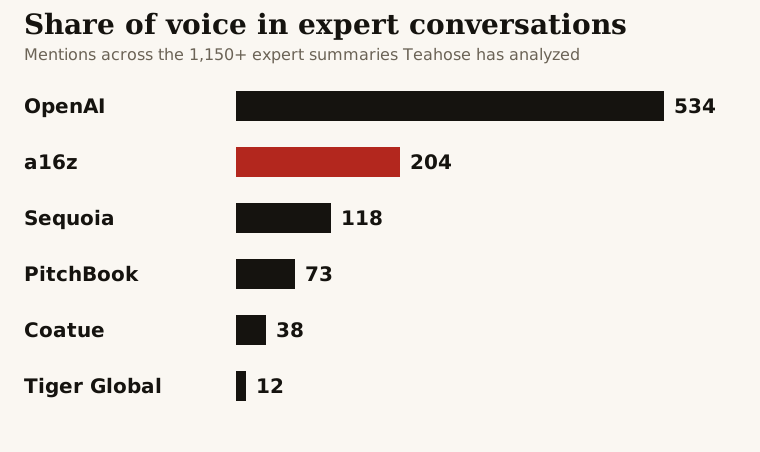
Each bar counts how many of Teahose's 1,150+ expert summaries mention it (word-boundary match across our podcast, newsletter, and paper corpus, June 2026).
Track the field: find the companies most similar to OpenAI and get their latest funding and product signals by email — Teahose Lookalikes.
Mention counts from Teahose's analysis of 1,150+ expert podcast, newsletter & research summaries, June 2026.
The 2026 headline isn't who's biggest — it's how few of them now matter. Nine firms took half of all US VC fundraising in 2024 (PitchBook); a16z's January 2026 close alone equaled ~18% of every US VC dollar raised in 2025 (TechCrunch). Here's the league table, with the honesty caveat first.
The caveat: "AUM" is not one number. RIAs report regulatory AUM; others quote committed capital; crossover firms count hedge-fund books. Treat the table as directional and read the flags.
The League Table (as of Q1–Q2 2026)
| Firm | AUM | Flag |
|---|---|---|
| a16z | $90B+ | post the Jan 2026 $15B+ raise (TechCrunch) |
| Insight Partners | $90B+ | regulatory AUM, firm-confirmed Jan 2025 |
| Coatue | $67B firm-wide | mostly hedge/crossover; venture share unknown |
| Tiger Global | $58.5B | crossover — includes public book |
| Sequoia | $56B | venture entity; "$85B" counts Heritage wealth arm |
| Legend Capital | $48.1B | China (Lenovo-affiliated); Dealroom 2026 — rarely on US lists |
| General Catalyst | ~$40B | firm-claimed; raised $8B in 2024, reportedly seeking $10B more |
| Lightspeed | $40B+ | post the record $9B Dec 2025 close |
| Thrive Capital | $37B | post Thrive X — $10B, its largest fund (Feb 2026) |
| NEA | ~$26–28B | |
| Dragoneer | $21.7B | growth/crossover; Dealroom 2026 |
| Accel | $20B+ | conservative; some lists claim far more |
| Bessemer | ~$20B | |
| TCV | $19.9B | growth equity; Dealroom 2026 |
| OrbiMed | $18.3B | healthcare/biotech specialist; Dealroom 2026 |
| Battery Ventures | $16.8B | Dealroom 2026 |
| Deerfield | $15.1B | healthcare specialist; Dealroom 2026 |
| Khosla Ventures | ~$15B | |
| Index Ventures | ~$13B | last funds $2.3B (2024) |
| Founders Fund | ~$12B | closed $4.6B Growth III (Apr 2025) |
| Benchmark | ~$3.5B | tiny by design — the deliberate counterexample |
Primary ranking source: Dealroom Q1 2026, corrected firm-by-firm against primary announcements (several aggregator figures are stale — a16z still shows "$42B" on some lists). Dealroom's wider universe also surfaces firms most US-tech lists skip — China's Legend Capital (~$48B, Lenovo-affiliated), crossover managers Dragoneer and TCV, and healthcare specialists OrbiMed and Deerfield — several of which out-rank household Sand Hill names by capital even though they barely register in US startup dealflow.
The Mega-Raise Scoreboard (2025–2026)
- a16z — $15B+ across six funds (Jan 2026), the largest venture raise ever
- Insight — $12.5B (Fund XIII + Opportunities II, Jan 2025)
- Thrive — $10B Thrive X (Feb 2026; $1B early-stage, $9B growth)
- Lightspeed — $9B+ across six funds (Dec 2025)
- General Catalyst — $8B (Oct 2024), with more reportedly in motion
What's funding it: AI. The asset class deployed $340B in 2025, and AI took the majority of dollars — rounds at the valuations we track daily require checks only mega-platforms can write. The RIA conversions (a16z 2019, then Sequoia, General Catalyst, Lightspeed) complete the picture: these are no longer venture partnerships but multi-strategy asset managers with venture brands.
SoftBank deserves its own line: the Vision Fund cut ~20% of staff and effectively dissolved into a single concentrated bet — $30B+ already in OpenAI against a >$60B commitment, generating a $46B FY2025 paper gain. The fund era ended; the holding-company era began.
What Concentration Means If You're Not an LP
For founders: the market has a barbell — mega-platforms that can fund you forever (and own you accordingly), and seed specialists, with the middle hollowing. For employees, fee income at scale is reshaping VC pay — partner cash up, junior roles automated thin. For the ecosystem: nine firms' theses increasingly decide which sectors exist. Watch where their money lands:
Where the Mega-Funds' Money Is Landing This Week
Ranked by 7-day signal volume across the podcasts, newsletters & papers the Teahose pipeline reads
- 01OpenAI41 signals · 7d
- 02Anthropic39 signals · 7d
- 03Yahoo28 signals · 7d
- 04Bessemer17 signals · 7d
- 05Vanta14 signals · 7d
- 06Ropedia14 signals · 7d
- 07Google12 signals · 7d
- 08Nvidia12 signals · 7d
- 09Mecka11 signals · 7d
- 10Tesla10 signals · 7d
Related
Top AI VC firms, by expert mentions · VC salary (what the fees pay) · AI unicorns, counted · Top AI startups, live-ranked · ARR meaning.
Bottom line: The biggest VC firms in 2026 are a16z and Insight Partners, effectively tied at $90B+ in AUM — but the real headline isn't who's largest, it's concentration: nine firms took half of all US VC fundraising in 2024, and AUM itself is a directional, not audited, number.
AUM figures as of the dates flagged per row; definitions vary by firm. As of June 11, 2026.
Frequently Asked Questions
What is the biggest VC firm in the world?
By assets under management in 2026, Andreessen Horowitz (a16z) and Insight Partners are effectively tied at $90B+. a16z got there with the largest venture raise in history — $15B+ across six funds, closed January 2026, equal to roughly 18% of all US VC dollars raised in 2025. Insight's $90B+ is regulatory AUM confirmed by the firm itself when it closed $12.5B in new capital in January 2025.
What is the largest venture capital fund ever raised?
a16z's January 2026 raise — $15B+ across six funds — is the largest venture fundraise in history, equal to roughly 18% of all US VC dollars raised in 2025. For a single recent vehicle, Thrive Capital's $10B Thrive X (February 2026) and Lightspeed's $9B+ close (December 2025) are next. SoftBank's original ~$100B Vision Fund (2017) dwarfs all of them, but it was a multi-strategy late-stage vehicle, not a traditional early-stage venture fund — which is why it rarely tops "VC fund" lists.
What about Asian and sector-specialist VC firms?
AUM-ranked lists that draw the circle wider than this US-tech brand-name table surface several more giants. Dealroom's 2026 ranking includes China's Legend Capital (~$48B), crossover managers Dragoneer and TCV, and healthcare specialists OrbiMed and Deerfield — none of which dominate US startup dealflow the way a16z or Sequoia do, but all of which manage more capital than some firms on our table. "Biggest" depends entirely on whether you mean US tech venture or all venture-style AUM globally.
Why are AUM rankings of VC firms unreliable?
"AUM" mixes three different things: committed capital, net asset value, and SEC regulatory AUM (which only registered investment advisers report). Crossover firms like Tiger Global and Coatue count public-market books alongside venture; Sequoia's figure can include or exclude its wealth-management arm ($56B vs "$85B all entities"). Any ranked table — including ours — is directional, not audited. We flag the definition each figure uses.
How concentrated has venture capital become?
Historically so. Nine firms collected half of all money raised by US VC funds in 2024; the top 30 took ~75%; and a16z's January 2026 raise alone equaled ~18% of all 2025 US VC fundraising. The drivers: LPs consolidating into brand names, AI rounds requiring billion-dollar checks, and the RIA platform model (a16z, Sequoia, General Catalyst, Lightspeed) that lets firms hold crypto, secondaries, and public stocks — venture firms becoming asset managers.
What happened to SoftBank's Vision Fund?
It stopped being a fund in any conventional sense. SoftBank cut ~20% of Vision Fund staff in its third round of layoffs and pivoted to concentrated direct AI bets — above all OpenAI, where it has invested $30B+ against a >$60B total commitment (~13% ownership). The strategy paid on paper: a $46B Vision Fund gain in FY2025, driven mainly by OpenAI. SoftBank is now effectively a leveraged AI holding company.
Which VC firms come up most in expert podcasts and newsletters?
We track this directly. Across the 1,150+ expert podcast, newsletter and research summaries Teahose has analyzed, venture capital is discussed in 216 of them, and the firms that recur most in those conversations skew toward the same mega-platforms topping the AUM table — a16z, Sequoia, Thrive, General Catalyst and Lightspeed. The "share of discussion" almost always trails the "share of capital," which is exactly what concentration looks like in practice: a handful of brand names dominate both the dollars and the conversation.
How many billion-dollar VC funds were raised in 2025 and 2026?
The mega-raise scoreboard is unusually crowded for back-to-back years: a16z closed $15B+ across six funds in January 2026 (the largest venture raise ever), Insight closed $12.5B in January 2025, Thrive raised $10B for Thrive X in February 2026, Lightspeed closed $9B+ in December 2025, and General Catalyst raised $8B in October 2024 with more reportedly in motion. The common fuel is AI — rounds at the valuations now being struck require checks only the biggest platforms can write.
Is Sequoia or a16z bigger?
By the cleanest comparison, a16z is larger. a16z sits at $90B+ in AUM after its January 2026 raise, while Sequoia's core venture entity is around $56B. The gap narrows if you count Sequoia's Heritage wealth-management arm (which pushes the "all entities" figure toward $85B), so the honest answer depends on which definition of AUM you use — committed venture capital versus total assets across all of a firm's strategies.