
Key takeaways
- AgiBot (智元机器人 / Zhiyuan Robotics) started its Hong Kong listing process on July 24, 2026, targeting HK$40–50 billion (≈$5.1–6.4 billion), with CICC, CITIC Securities and Morgan Stanley as joint sponsors. There is no ticker, no price and no prospectus: reporting describes a confidential filing, and we checked the Hong Kong exchange’s new-listing index on August 10, 2026 — no AgiBot application document was public.
- This is the humanoid IPO US investors can actually buy — and that is the whole difference from Unitree. Unitree listed on Shanghai’s STAR Market, which is closed to every Western retail investor by exchange rule. Hong Kong is an open market: an Interactive Brokers, Schwab Global or moomoo account buys HKEX shares in HKD, on a currency pegged to the dollar, for roughly 0.08% commission. The one thing a US account generally cannot do is subscribe at the offer price.
- The number that should stop you: AgiBot ships more humanoids than Unitree and is asking for less money. Roughly 5,168 units in 2025 (about 39% of the global general-purpose market, per Omdia) and about 8,400 in the first half of 2026 (44% share, versus Unitree’s 31%) — against an IPO target 30% to 45% below the ≈$9.0 billion Unitree priced at on August 6. The gap is profit: Unitree earns money at a 60% gross margin; AgiBot’s margin and losses have never been disclosed.
- Across the 1,779 expert podcast, newsletter and research summaries we have analyzed, AgiBot is named in 24 — and cited in 20 of our 226 research-paper summaries (8.8%), more often than Figure AI (8) or Agility Robotics (5). Methodology: a count of how many of our published expert summaries name each company, August 2026. It measures share of expert and research discussion, not market share, shipments or revenue.
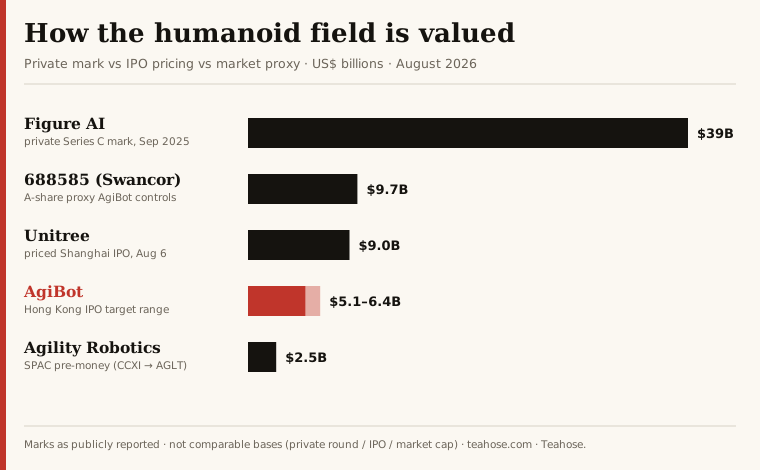
- The unique asset nobody prices: AgiBot already controls a listed company. Its vehicles hold about 63.6% of Shanghai-listed 688585 (Swancor Advanced Materials), bought for roughly RMB 2.1 billion in 2025. At the August 10, 2026 close that stake is worth about RMB 41.7 billion (≈$6.2 billion) — roughly the entire valuation AgiBot is asking for in its own IPO. Either the A-share is wildly overvalued, the Hong Kong deal is cheap, or both.
- The data moat is real in volume and contested in quality. Outside research teams report AgiBot’s dataset as the largest real-robot corpus in the field — and three of them describe having to down-weight or drop it, with one reporting it "consistently degraded performance." That finding will not appear in any IPO coverage.
- Our verdict, in one line: the world’s largest humanoid shipper is listing on the one exchange Western investors can reach, at a discount to a less-productive rival — but it is asking a profitable company’s sales multiple while hiding its losses, so the disciplined move is to get Hong Kong access enabled now, skip the debut, and wait for the first set of audited numbers.
Want to see who else is building in this field before the listing wave hits? Paste any robotics company’s website into Teahose Lookalikes and we will map its closest peers in our graph — then email you when new funding, product and partnership signals land on them.
Every result on this query answers a different question than the one you asked. A pre-IPO marketplace sells you a sign-up form. A CFD broker sells you leverage with a "79.75% of retail accounts lose money" disclaimer attached. The news wires tell you a process started and stop there. Nobody tells you the two things that actually decide this trade: what a US brokerage account can and cannot do about a Hong Kong listing, and whether HK$40–50 billion is a lot of money for a company shipping robots at a loss. So here is that version. It is research, not investment advice, and every number below carries a source.
At a glance: the AgiBot IPO in one table
| Item | Detail |
|---|---|
| Company | AgiBot — 智元机器人 / Zhiyuan Robotics; listing entity branded 智元创新 (Zhiyuan Innovation), Shanghai |
| Founded | February 2023 — three years old at listing |
| Venue | Hong Kong Stock Exchange (HKEX) |
| Ticker | None assigned — no public filing, no stock code |
| Status | Process publicly confirmed July 24, 2026; confidential filing reported; no public application document as of August 10, 2026 (checked) |
| Joint sponsors | CICC, CITIC Securities, Morgan Stanley |
| Deal size | Not disclosed — no proposed fundraising amount or share percentage has been made public |
| Target valuation | HK$40–50 billion (≈$5.1–6.4 billion) |
| Reported ask vs mark | Management reportedly sought ≈HK$80 billion; cornerstone investors marked it at roughly half |
| Last private mark | more than RMB 20 billion (mid-2026); ≈RMB 15 billion after the May 2025 B+ round |
| 2025 revenue | RMB 1.05 billion (≈$155 million) — management-disclosed, not audited in a filing |
| 2025 shipments | 5,168 humanoids, ≈39% global share (Omdia) — number one worldwide |
| Profitability | Not disclosed. No gross margin, no loss figure, no cash burn |
| Implied multiple | ≈33x to 41x trailing 2025 sales (Teahose calculation on the target range) |
| Direct access for US retail | Yes, after listing — HKEX shares via a US broker with Hong Kong access |
| Listing date | Not announced (reporting points to H2 2026) |
Terms as publicly reported, July 24 – August 10, 2026. Every figure here is press-reported or management-disclosed: none of it has been through the audited-disclosure process a listing document requires.
Is AgiBot publicly traded? The ticker, the filing and the dates
No — and the precise status matters, because most pages on this query blur "started the process" into "filed."
On July 24, 2026, AgiBot publicly confirmed it had begun the Hong Kong listing process. That was itself news: the company had denied Hong Kong IPO rumors twice during 2025, telling one outlet in July 2025 that it "currently has no concrete plans for a Hong Kong IPO." Reporting from the South China Morning Post describes a confidential filing with three joint sponsors — CICC, CITIC Securities and Morgan Stanley.
A confidential filing is not a public one. The document that carries audited revenue, gross margin, losses, customer concentration and the cap table is the public application filed on the exchange’s new-listing index. We checked that index on August 10, 2026: no AgiBot entry. Until it appears, every financial number in circulation — including the ones in this guide — is management commentary or press reporting, not audited disclosure.
One legal precondition is already done: AgiBot converted from a limited liability company into a joint-stock limited company during 2025, the standard structural step before a Chinese company can list.
So the honest state of play as of August 10, 2026: process started, sponsors hired, structure converted, valuation targeted, nothing filed publicly, nothing priced, nothing trading.
Can US investors buy AgiBot stock? Yes — and that is the whole difference from Unitree
This is the single most important fact on the page, and no competing result states it.
Two Chinese humanoid champions are going public within months of each other, on two exchanges, with opposite consequences for a Western investor:
| Unitree (688836) | AgiBot | |
|---|---|---|
| Venue | Shanghai STAR Market | Hong Kong (HKEX) |
| Status | Priced August 6, 2026 at ¥150.80 (≈$9.0 billion) | Process started, nothing filed publicly |
| Can US retail buy the shares? | No — a newly listed STAR stock sits outside Stock Connect entirely, and even once eligible, STAR access is restricted to institutional professional investors | Yes, after listing — any US broker with Hong Kong market access |
| Can US retail subscribe at the offer price? | No | No — subscription is a Hong Kong-licensed broker service |
| Currency risk | n/a | HKD, pegged to the dollar (≈7.845) |
The Unitree wall is an exchange rulebook, not a broker preference: STAR Market shares only enter the Northbound Stock Connect universe once they join the SSE 180 or SSE 380 index or become A+H, and even then Shanghai restricts STAR Board access to Hong Kong and overseas institutional professional investors — a category that excludes individuals no matter how wealthy. We laid that out in full in the Unitree stock guide.
Hong Kong has none of that. It is an open international market. A US resident with international trading enabled at Interactive Brokers, a Schwab Global Account or moomoo can buy HKEX-listed shares in Hong Kong dollars on the day they start trading. The Unitree trade is un-actionable for US retail. The AgiBot trade is actionable. That asymmetry is the reason this listing matters more to a Western reader than the bigger one that priced four days earlier.
There is one split to understand before you plan around it.
How to buy AgiBot stock: every route, ranked honest-first
Ranked from most accessible to genuinely impossible.
| # | Route | Can a US retail investor do it? | What you actually own | Timing |
|---|---|---|---|---|
| 1 | Buy AgiBot on HKEX at or after debut — via Interactive Brokers, Schwab Global Account or moomoo | Yes | The shares, 1:1 | From the first trading day |
| 2 | KOID (Nasdaq) — global humanoid and physical-AI ETF | Yes, in any US account | Index exposure; a future add lands at roughly 2% (equal weight) | Quarterly reconstitution plus liquidity screens — likely two-plus quarters after listing |
| 3 | Buy the listed comps now — UBTech 9880.HK, Horizon Robotics 9660.HK, Global X China Robotics 2807.HK | Yes (same Hong Kong access as #1) | Thematic exposure only | Available today; also the cleanest way to test your Hong Kong plumbing before debut night |
| 4 | Subscribe to the Hong Kong IPO at the offer price | Effectively no — subscription runs through Hong Kong-licensed entities US residents are not onboarded to | The shares, at offer | Would require a Hong Kong-domiciled account |
| 5 | Broad China ETFs (MCHI, FXI, KTEC and peers) | Yes to buy; no meaningful exposure | A sub-0.5% weight, eventually | Index inclusion timing varies and is not published in advance |
| 6 | BOTZ (Nasdaq) — Global X Robotics & AI | Yes to buy; unlikely to hold AgiBot | Near-zero exposure | Market-cap weighted, dominated by Keyence, NVIDIA, ABB and FANUC |
| 7 | 688585 (Swancor Advanced Materials) — the A-share AgiBot controls | No | A resin business with an AgiBot controlling shareholder | STAR Market — same wall as Unitree |
| 8 | Pre-IPO marketplaces (Forge, EquityZen, Hiive) | No, in practice | Unclear — direct equity, an SPV interest, or nothing | Onshore transfer restrictions plus pre-listing locks |
Route 1 — the real answer. Interactive Brokers publishes Hong Kong stock commissions of 0.08% of trade value on the Fixed plan (minimum HKD 18), or 0.05% on the Tiered plan at Tier I, with third-party exchange and regulatory fees passed through. Its own worked example: 400 shares at HKD 70 costs HKD 22.40. Schwab lets US clients trade directly in 12 foreign markets in local currency and Hong Kong is one of them, with no fee to open or maintain the Global Account. moomoo publishes a fee schedule for US residents whose sections explicitly include "Hong Kong Stocks."
Three mechanics worth planning around. Currency: HKEX trades in Hong Kong dollars, which are pegged to the US dollar at roughly 7.845 — so unlike a mainland A-share, your FX risk here is structurally small. You still pay a conversion spread each way. Fees: on top of commission, Hong Kong charges an SFC transaction levy of 0.0027%, an AFRC transaction levy of 0.00015% and an HKEX trading fee of 0.00565%, plus stamp duty of 0.1% on each side of the trade — confirm the current rates with your broker. Hours: the exchange runs 09:30–12:00 and 13:00–16:00 Hong Kong time, which is roughly 21:30 to 04:00 US Eastern. A hot Hong Kong debut is a 3 a.m. event on the US East Coast. Use limit orders or you will be filled by someone who is awake.
Route 4 — why you probably cannot subscribe. Hong Kong IPO subscription is offered by broker entities licensed in Hong Kong, not by their US broker-dealer arms. Interactive Brokers states it plainly: to subscribe to a Hong Kong IPO through Interactive Brokers Hong Kong Limited "you need to have opened an IBHK trading account." US residents are onboarded to the US entity instead. The same entity split applies at Futu (moomoo in the US) and Tiger. No broker publishes a sentence saying "US persons may not subscribe" — the exclusion is structural, not a named prohibition. Note too the Hong Kong rule that only one application per beneficial owner is permitted; applying through two brokers gets all of them rejected. And even for Hong Kong residents, hot deals are oversubscribed heavily enough that allocations are token. The edge is not in subscription.
Route 2 — the ETF, and an honest read of the lag. KOID holds about $313.6 million, charges 0.69% net, and tracks an equal-weighted top-50 MerQube index reconstituted quarterly. It already owns UBTech (9880.HK) at about 2.09%, Horizon Robotics (9660.HK) at about 2.23%, and a STAR Market A-share (688017) at about 1.79% — direct evidence the wrapper reaches places US retail cannot. Size is not the obstacle: the prospectus reports the index’s constituents spanning roughly $1.6 billion to $4.3 trillion in market capitalization as of March 31, 2026, so the smallest member sat well under AgiBot’s target (the screening minimum itself is not published). Timing is. The prospectus describes selection screens using one- and six-month average daily traded value, which a stock listed in late 2026 cannot satisfy until well into 2027. That is an inference from the prospectus language, not a stated rule — and the fund’s ability to hold up to 20% off-index is the wildcard that could let the manager buy earlier.
One negative worth stating because competitors hand-wave it: we checked KraneShares’ public-private fund AGIX on August 10, 2026. It holds SpaceX, Anthropic and Polymarket positions — and no AgiBot, and no Chinese private position at all. There is no US-listed fund that already owns this company privately.
Since no route delivers shares today, the highest-value move now is to watch the company rather than the ticker. Teahose tracks AgiBot live — every funding, product, partnership and policy signal our system extracts from expert coverage, with an email alert when something lands — so the filing, the price range and the debut reach you the day they happen.
The routes that look like access but aren’t
The pre-IPO marketplaces. We checked all three on August 10, 2026. EquityZen has an AgiBot company profile page — titled to promise pre-IPO shares — but no visible inventory: valuation, share price and available deals all sit behind an accreditation sign-up gate, and EquityZen auto-generates profile pages across hundreds of companies as lead capture. A profile page is not a deal. Hiive returned no AgiBot company page at all. Forge Global blocked automated retrieval, so we could not verify it either way and will not guess.
The structural point matters more than any single listing. These marketplaces exist to intermediate US-domiciled cap tables — early employees selling common stock in a Delaware C-corp. AgiBot is a mainland Chinese company whose controlling equity sits in RMB-denominated onshore partnerships (you can see them by name in the Shanghai shareholder register of 688585). Moving that equity to a US accredited investor runs into onshore transfer approvals, foreign-exchange rules, and the customary pre-listing lock once a deal is in progress. In practice, US retail secondaries in Chinese pre-IPO names are rare to non-existent, and where they appear they are usually offshore SPV interests with opaque fee stacks and no delivery guarantee.
If you are shown an offer anyway, three questions decide it: what exactly am I buying — shares, or an interest in a vehicle that claims to hold shares; what is the total fee and carry load; and what happens if Hong Kong-listed shares are delivered into a jurisdiction I cannot receive them in. One disclosure worth naming rather than hiding: EquityZen is now part of Morgan Stanley, which is simultaneously one of AgiBot’s three IPO sponsors.
The memecoin. A Solana token trading under the AGIBot name currently ranks on the first page of results for this query with a market cap in the low thousands of dollars. It has no relationship to the company. It is worth one sentence purely so nobody buys it by accident.
The 688585 backdoor: AgiBot already controls a listed company worth more than its own IPO
This is the most under-reported fact in the entire AgiBot story, and it is computable from primary market data rather than press.
In 2025, AgiBot took control of Swancor Advanced Materials (上纬新材), Shanghai STAR Market code 688585 — a maker of wind-turbine blade resins and corrosion-resistant composites that listed in September 2020 at ¥2.49 a share. The purchase ran roughly RMB 2.1 billion, structured as a share transfer followed by a tender offer, and it was the first time a Chinese embodied-AI startup took control of a STAR Market-listed business. AgiBot co-founder Peng Zhihui became its chairman.
The shareholder register tells the story without a press release. As of the March 31, 2026 disclosure:
| Shareholder | Shares | Stake |
|---|---|---|
| Shanghai Zhiyuan Hengyue Technology Partnership (AgiBot’s acquisition vehicle) | 236,463,352 | 58.62% |
| Strategic Capital Holding Limited | 61,287,730 | 15.19% |
| Shanghai Zhiyuan Xinchuang (AgiBot-affiliated) | 20,168,166 | 5.00% |
| SWANCOR IND. CO., LTD. (the original Taiwanese parent) | 19,384,616 | 4.81% |
| (holders 5 through 9 are individuals) | — | — |
| HKSCC Nominees (Stock Connect holdings) — 10th-largest holder | 1,114,609 | 0.28% |
Six months earlier, at September 30, 2025, the original parent still held 38.43% and AgiBot’s vehicle held 24.99%. AgiBot-affiliated entities now hold about 63.6% of a listed company.
Now the arithmetic, using primary market data rather than reporting:
| Item | Figure |
|---|---|
| Shares outstanding (688585) | 403,361,728 |
| Close, August 10, 2026 | ¥162.59 |
| Implied market capitalization | ≈¥65.6 billion (≈$9.7 billion) |
| AgiBot’s ≈63.6% stake | ≈¥41.7 billion (≈$6.2 billion) |
| What AgiBot paid, 2025 | ≈RMB 2.1 billion |
| AgiBot’s entire IPO target | HK$40–50 billion (≈$5.1–6.4 billion) |
Read that last pair again. The A-share stake AgiBot bought for RMB 2.1 billion is worth roughly as much as the entire company is asking for in Hong Kong. Either the resin maker is wildly overvalued on a robot story, or the Hong Kong deal is being marked cheap, or both. No competing page on this query does this calculation.
The price record explains how it got there. 688585 closed at ¥7.78 on July 1, 2025, the last session before it was halted for the deal. It resumed on July 9 and ran nine consecutive 20% limit-ups to ¥40.16 by July 21. It peaked at ¥221.00 on May 26, 2026 — an all-time closing high, more than 27 times the pre-deal price — and closed at ¥162.59 on August 10, 2026, still up about 1,990% (roughly 21 times) but about 26% below that peak. The proxy has been de-rating into the IPO, which is itself a signal.
Three reasons it is a bad way to own AgiBot, even for someone who could buy it:
- AgiBot’s revenue does not sit in it. Holders own a wind-blade resin business with an AgiBot controlling shareholder — not AgiBot’s RMB 1.05 billion of sales.
- AgiBot pledged not to inject itself. After a regulatory query about whether this was a disguised reverse merger, the company said in October 2025 that it has no plan to backdoor-list into 688585 for three years — a pledge running to roughly October 2028. The Hong Kong listing is the resolution of that pledge: AgiBot lists the parent offshore and keeps 688585 as a separately listed, majority-owned subsidiary. Expect a dual structure, not a merger.
- US retail cannot buy it regardless. It is a STAR Market share, behind the same institutional-only wall as Unitree. The 0.28% held by the Stock Connect nominee line is the visible proof that this pipe is institutional, not retail.
One genuinely open question the listing document should answer: whether 688585 sits inside the Hong Kong listing perimeter. If the Hong Kong entity consolidates it, the two valuations partly describe the same assets. If it does not, the A-share is a pure sentiment proxy. Nobody outside the deal knows yet, and any page telling you otherwise is guessing.
What AgiBot actually is: a Huawei org, a Bilibili star, and a data factory
Where Unitree is one founder’s obsession with making motors cheaply, AgiBot is a Huawei engineering organization transplanted into robotics and fronted by China’s most famous engineering creator.
Peng Zhihui (彭志辉), co-founder, president and CTO, was born in 1993 in Jiangxi with a master’s from the University of Electronic Science and Technology of China. He joined Huawei in 2020 through its "Genius Youth" program at the top pay band — a reported ¥2.01 million a year — working on Ascend AI chips. He is also, under the handle 稚晖君 (Zhihui Jun), one of China’s largest hardware-maker creators on Bilibili with more than 2 million followers, known for viral builds including a robot arm that stitches a grape skin back together and a self-balancing autonomous bicycle. He was awarded the 2026 China Youth May Fourth Medal, state-level recognition. Retail investors in China know his face before they know the balance sheet — which is a large part of why 688585 went parabolic.
Deng Taihua (邓泰华), chairman and CEO since March 2025, spent more than twenty years at Huawei as a vice president running first the Wireless and then the Computing product lines — the executive who built out the Kunpeng and Ascend ecosystems. Chinese media describe AgiBot broadly as a "Huawei-lineage" company; ahead of the listing it disclosed a nine-partner leadership bench for the first time, roughly half of it ex-Huawei.
The product line spans five families and a wide price band. Current lineup on the company’s own site: A series (A3, A2 Ultra, A2 Lite, A2-W — the wheeled industrial unit); X series (X1, X2 — the open-source research line); G series (G1, G2 — the commercial and industrial workhorse, launched October 2025 for logistics and assembly); D1 quadrupeds; the C5 commercial cleaning robot; plus the OmniHand dexterous hand and a teleoperation kit for data collection.
| Product | Form factor | Reported starting price |
|---|---|---|
| D1 Pro | Quadruped | ≈$1,800 |
| OmniHand | Dexterous hand | ≈$2,000 |
| D1 Ultra | Quadruped, education and development | ≈$5,000 |
| Lingxi X2 (entry configuration) | 1.3 m / 34 kg humanoid, 27 degrees of freedom | under $14,000 |
| Yuanzheng A2 (entry configuration) | Full-size humanoid | ≈$23,000 |
| C5 | Commercial cleaning robot | ≈$23,000 |
| Genie G1 | Wheeled, 150 kg, 130–180 cm adjustable | more than $60,000 |
| Yuanzheng A2 (flagship) | 1.75 m / 55 kg, 49 degrees of freedom | Enterprise quote |
Prices are list figures from a secondary product roundup rather than confirmed transaction prices, and hardware pricing in this category moves fast. Treat the G-series line in particular as unreliable: a separate secondary source prices a G1 at ¥99,000 (roughly $14,700), a fraction of the figure above, and we could not reconcile the two against a company price list. Verify current pricing with the company before relying on any of these.
Two things distinguish the software story. AgiBot World, an open-sourced large-scale real-robot manipulation dataset released at the end of 2024, and GO-1 (Genie Operator-1), a generalist embodied foundation model released in March 2025 that ships on the robots. AgiBot also sells data-collection and model-training systems as a revenue line — the hardware is partly a substrate for a data business, which is exactly the strategic difference experts draw against Unitree below.
And the publicity engine is real: in November 2025 a Yuanzheng A2 walked 106.286 km over three days and two nights from Suzhou’s Jinji Lake to the Shanghai Bund for a Guinness World Record — notably on a factory-standard commercial unit rather than a custom long-walk rig.
AgiBot’s financials: fastest to RMB 1 billion, and nobody has seen the losses
The revenue ramp is the most extraordinary in Chinese robotics. The absence of everything below the revenue line is the most important thing about it.
| Year | Revenue (RMB) | Growth |
|---|---|---|
| 2023 (first partial year) | ≈300,000 | — |
| 2024 | ≈60 million | ≈200x |
| 2025 | 1.05 billion (≈$155 million) | ≈17x |
| 2026 (management) | "several-fold growth" — no figure given | — |
| 2027 (management target) | more than RMB 10 billion | — |
Three years from three hundred thousand yuan to a billion. Chinese press calls it the fastest any Chinese robotics company has crossed RMB 1 billion in revenue, and that framing is fair. Management has since guided to "several-fold" growth in 2026 on a target of tens of thousands of units; press extrapolations put 2026 revenue somewhere in the RMB 4 billion to RMB 6 billion range, which is a journalist’s arithmetic rather than company guidance.
Shipments corroborate the ramp, with the important caveat that different research houses count different universes:
| Milestone | Figure |
|---|---|
| Units built by December 15, 2024 | 962 |
| 1,000th unit | January 2025 |
| 2025 humanoid shipments | 5,168 units, ≈39% global share (Omdia; total market ≈13,000) |
| 10,000th unit | ≈March 2026 |
| 15,000th unit | June 28, 2026 — less than three months after the 10,000th |
| H1 2026 shipments | ≈8,400 units, 44% share, +562% year over year (Smart Analytics Global) |
Never quote a bare "39%" or "44%" without the house and the denominator. Omdia counts general-purpose embodied robots; Smart Analytics Global counts humanoids; Counterpoint counts installations. Those three universes produce 2025 totals ranging from about 13,000 to 19,000 units for essentially the same year.
Now the void. No gross margin. No net loss. No cash burn. No revenue mix. None of it has ever been disclosed, for any year. Nor has the split between humanoids, quadrupeds, cleaning robots, dexterous hands, data-collection systems and the rental business — and that mix is the whole question, because a company selling data-collection rigs to other robot companies is a different business from one selling robots that do work.
A blended sanity check, clearly labelled as such: RMB 1.05 billion across 5,168 units is roughly RMB 203,000 (≈$30,000) per unit — but revenue includes non-robot lines, so treat that as a ceiling on average selling price, not an actual one. The press-extrapolated 2026 scenario of RMB 4–6 billion on 20,000–30,000 units implies roughly flat blended pricing at four to six times the volume — again an extrapolation, not company guidance.
One widely repeated figure deserves a warning: some English summaries render RMB 10.5亿 as "10.5 billion yuan." It is 1.05 billion. A separate claim that Q1 2026 revenue alone exceeded RMB 1 billion — matching all of 2025 in a single quarter — appears in Sina Finance but, like every other figure here, is unaudited and uncorroborated by a second outlet; we flag it rather than lean on it.
AgiBot valuation: what HK$40–50 billion is actually asking
Inside the humanoid category the ask looks reasonable; measured against what Unitree just got paid for, it looks like a company demanding a profitable business’s multiple without the profits.
At the target range against RMB 1.05 billion of 2025 revenue, the math is roughly 33 to 41 times trailing sales — consistent with the 32–41x price-to-sales range Chinese financial press computed independently. On the press-extrapolated 2026 revenue scenario of about RMB 4 billion, that compresses to roughly 9 to 11 times forward sales, which is how the deal gets defended in Hong Kong meetings. Treat the forward number as an extrapolation, not guidance.
Set against the comparable set:
| Company | How to own it | Profitable? | Valuation reference |
|---|---|---|---|
| AgiBot | HKEX, after listing — buyable by US retail | Not disclosed; assume no | HK$40–50bn (≈$5.1–6.4bn); ≈33–41x 2025 sales |
| Unitree (688836) | STAR Market — closed to Western retail | Yes (RMB 278m attributable, 2025) | ≈$9.0bn at IPO; ≈36x 2025 sales |
| Figure AI | Private | No revenue disclosed | ≈$39bn private mark |
| UBTech (9880.HK) | Hong Kong retail | No | Listed; the closest public Hong Kong comparable |
| Agility Robotics | US SPAC (CCXI → AGLT) | No | ≈$2.5bn pre-money |
Marks as reported around August 2026; private marks are point-in-time and not comparable to public market capitalizations.
Read that table honestly and you get the sharpest finding in this guide. AgiBot is asking for approximately the same sales multiple Unitree just achieved — 33 to 41 times versus about 36 times — while shipping more units, earning less revenue on them, and disclosing no profit at all. The bull reading: AgiBot’s revenue is growing 17x a year against Unitree’s guided deceleration to 36–45%, so the forward multiples diverge fast in AgiBot’s favor. The bear reading: you are paying a profitable company’s multiple for an unprofitable one, on unaudited numbers, and the growth that justifies it has to actually arrive.
Two structural notes on the price. First, the reported negotiation: management sought roughly HK$80 billion and cornerstone investors marked it at HK$40–50 billion. The deal is coming at about half the ask — which is either a discount for the buyer or a signal about how the smartest money in the room views the story. Second, the step-up: from about RMB 15 billion after the May 2025 B+ round to the current target is roughly 2.4 to 3 times in about fifteen months. Real, but modest against the 17x revenue growth beneath it.
AgiBot vs Unitree: who ships more, who earns more
The two companies are running opposite strategies, and an expert on our corpus draws the distinction better than any analyst note.
| AgiBot | Unitree | |
|---|---|---|
| Founded | February 2023 | August 2016 |
| Strategy | Embodied-AI full stack — hardware as the substrate for a data-to-model-to-product flywheel | Hardware cost leader — vertically integrated motors, actuators, ruthless bill-of-materials engineering |
| 2025 revenue | RMB 1.05bn | RMB 1.70bn |
| Profitability | Not disclosed | Profitable, ≈60% core gross margin |
| 2025 shipments | 5,168 units (Omdia) | 5,500+ claimed by the company; ≈4,200 estimated by Omdia |
| H1 2026 shipments | ≈8,400 (44% share) | ≈5,900 (31% share) |
| Funding pace | ≈10 rounds in 3 years | 9 rounds in 9 years |
| Cap table skew | Industrial strategics — Tencent, BYD, JD.com, SAIC, Baidu | Financial and state-adjacent, plus Meituan |
| Listing venue | Hong Kong — open to US retail | Shanghai STAR — closed to US retail |
| Listed vehicles | Two — Hong Kong parent (pending) plus 63.6% of 688585 | One |
Note the live disagreement embedded in that table: Omdia ranked AgiBot number one for 2025 at 5,168 units and put Unitree at roughly 4,200, and Unitree publicly disputed the ranking, saying it had delivered more than 5,500 humanoids to end customers in 2025 (per EqualOcean, which reports the counterclaim alongside the Omdia estimate). Two companies listing months apart are arguing on the record about who shipped more robots. Neither number is audited. By the first half of 2026 the gap had widened in AgiBot’s favor on a different research house’s count (44% versus 31%), which is the more durable read.
Together the two are forecast at roughly 80% of 2026 shipments. This is a duopoly with a long tail, not a fragmented market.
What the experts actually say, including the Chinese coverage English readers miss
AgiBot appears in 24 of the 1,779 expert summaries we have published — a footprint above both Figure AI (20) and Agility Robotics (16), though under half of Unitree’s 56. Much of the most substantive analysis is in Mandarin, on shows Western investors do not read. Here is what it says. (Quotes below are translated from Mandarin; timestamps are from our transcripts.)
The cleanest statement of the two strategies — from one neutral expert, in one sitting. On 张小珺’s interview show, episode 134, Xie Chen (谢晨), founder and CEO of robot-data company Guanglun Intelligence — a supplier and observer, not an AgiBot employee or investor — characterized both IPO candidates back to back:
"Zhiyuan's commercialization is going very well. From day one they thought clearly: to do this systematically, they needed to fully integrate the upstream and downstream. I think their mass production capability is very strong." [02:24:01]
"Unitree's differentiation is the clearest. It's firmly committed to building its hardware body well. I don't think Unitree will compete with brain companies. They're a very pragmatic company that knows where they have advantages and where they don't want to develop. Knowing your boundary is key." [02:22:36]
That is the entire investment distinction in two sentences from a disinterested party: AgiBot is deliberately full-stack, Unitree is deliberately bounded. Everything else in this guide is downstream of it.
Mass production is the recognized gate, and only two Chinese firms have cleared it. On episode 147 of the same show, published two days before the listing news broke, Shen Yujun (沈宇军), who runs Ant Group’s Lingbo embodied-AI unit — a potential customer rather than an investor:
"At least companies like Unitree and Zhiyuan have already gotten mass production running — the supply chain is also maturing as the industry develops." [00:19:05]
Why Hong Kong and not Shanghai — the answer nobody in English coverage supplies. On LateTalk episode 173, Yao Song (姚颂) — founder of Deephi (sold to Xilinx), founder of Orienspace, now founder of Striding AI:
"For example, Zhiyuan has been very actively building out international operations since the second half of last year." [01:46:16]
Hong Kong is the offshore-capital venue. A company that started building overseas operations in H2 2025, a year before filing, is raising where the international money and the international currency are. Unitree, selling primarily into a domestic research and consumer base, had no such reason to leave Shanghai.
The structural bear case, from the same expert who praised the commercialization. Xie Chen’s data-pyramid argument cuts directly against any full-stack hardware valuation:
"I think the data architecture will conform to the data pyramid. The smallest data volume will be from real deployed robots... The middle portion will be simulation-generated data. And at the bottom will be internet and human first-person perspective data. These bottom two — simulation and human first-person data — don't require a hardware body to generate, and their scalability is far superior." [00:51:19]
And on how early the whole field is:
"If 1 million deployed robots providing data is a starting point — and that starting point might not even be 100 points, maybe 60 — right now there aren't even 10,000 robots, whether in real or simulated or human data form, providing this type of data. So if you look at it from this angle, it might not even be 0.6 points." [01:03:20]
One more from that conversation, carefully attributed: the same guest argues that Chinese robot hardware companies operating data-collection centers have a commercial incentive to advocate for real-machine data, since "it's essentially the rear end determining the head" [01:24:00], and that visiting such centers reveals heavy use of simulation and staged props — "fake bananas, fake apples... the scene variation is minimal" [01:25:31]. He does not name AgiBot in those two remarks; he describes the category. AgiBot is the category’s most prominent operator, which is why it belongs in a risk section — but it is not what he said.
And the macro frame. In a Sourcery Newsletter issue we summarized, BlackRock’s head of technology investing Tony Kim placed AgiBot’s HK$40–50 billion listing inside a pipeline of 30 to 40 Chinese robotics IPOs. Three independent counts land in the same range: Caixin reports AgiBot is the first of an expected 30 to 50 Chinese embodied-AI startups to disclose listing plans, and Reuters Breakingviews counts at least 46 robotics IPO candidates in Hong Kong’s pipeline alone. AgiBot is not a one-off. It is the first name out of a queue.
The research evidence: a data moat that is real in volume and contested in quality
This is the section no IPO coverage can write, and it cuts both ways.
Across the 226 research-paper summaries in our corpus, AgiBot is cited in 20 (8.8%) — more often than Figure AI (8) or Agility Robotics (5), and behind only Unitree (39) and Stanford’s DROID dataset (26) among robot-data sources. That converts a marketing claim ("we have the largest real-robot dataset") into a measured one: independent research groups worldwide are training on AgiBot data and reporting its size in their own tables.
The scale, as third parties describe it. A technical report we summarized records that AgiBot World "contributes over 1M trajectories from 100+ homogeneous AgiBot G1 mobile base humanoid robots across 217 tasks and 106 scenes" — the RLDX-1 report. That is the best available quantification of AgiBot’s physical data-collection capacity, and it is the thing an IPO investor should actually care about: not the dataset, the factory that produces it.
AgiBot’s own research arm is also in the corpus. Learning while Deploying, authored by AgiBot with the Shanghai Innovation Institute, closes the loop between deployment and training across 16 physical dual-arm robots on 8 real manipulation tasks, lifting average success from 76% to 95%, with long-horizon tasks (three-to-five-minute cocktail making, tea service, juicing) going from 0.68 to 0.91. That is hard evidence against the bear claim that AgiBot is a contract manufacturer with a data-labeling side business — and simultaneously a reality check on fleet scale. Sixteen robots in the reinforcement-learning loop, not thousands.
Now the part that will not appear in a prospectus. Three independent teams report having to down-weight or drop AgiBot’s data, and one reports it made results worse.
- Rethinking Visual-Language-Action Model Scaling finds that "naively pooling structurally disparate robot datasets induces destructive interference rather than improved transfer," and that adding AgiBot data on top of an open dataset "consistently degraded performance." The AgiBot gripper set had to be aggressively downsampled to stop it dominating training.
- ABot-M0 reports that the dominant dataset "simply drowns out rare robot morphologies... we deliberately reduce its sampling ratio during training to mitigate embodiment bias."
- A separate benchmark paper describes AgiBot World as built on "staged scenes" and argues such datasets may overfit to specific execution patterns.
And a concrete product limitation found by outside researchers rather than reviewers: MobileManiBench reports that "AgiBot does not provide access to the wrist cameras’ depth sensors, and the depth quality of the head camera is severely degraded," forcing the team to fall back to RGB-only inference on the G1 — with performance falling below 15% on most tasks. That is a specific, sourced, near-term deployment bottleneck that nobody is advertising.
The balanced reading: AgiBot’s data moat is the largest in the world and its marginal value is genuinely disputed by the people using it. Volume is not the same as usefulness, and the market is currently paying for volume.
The risk ledger: no audited numbers, a state-led order book, and a sector its own regulator called a bubble
Seven risks, roughly ordered by how much they should change your price.
1. There are no audited financials, and the missing numbers are the important ones. Revenue is management commentary. Gross margin, net loss, cash burn, customer concentration, related-party revenue and overseas revenue share are all undisclosed. Every one of those is a mandatory disclosure in a Hong Kong listing document, which is exactly why the filing — not the debut — is the date that matters. Buying before you can read it is buying a press release.
2. Demonstrated demand is state-led and small relative to the valuation. The largest humanoid robot order in Chinese history, as of its July 2025 announcement, was RMB 124.05 million for about 400 robots from a wholly-owned subsidiary of China Mobile — split roughly RMB 78 million to AgiBot and RMB 46 million to Unitree, delivering across 2025 to 2027. Three readings, all uncomfortable: the buyer is a state-owned telco rather than a company with a P&L reason to buy; AgiBot’s slice is about 7% of its 2025 revenue spread over three years; and against the target market capitalization it is roughly 0.2% of the valuation. If that is the ceiling on demonstrated demand, the price is discounting a market that does not exist yet.
3. The sector’s own regulator called it a bubble before anyone listed. On November 27, 2025, Li Chao (李超), spokesman and deputy director of the Policy Research Office at China’s National Development and Reform Commission — the institution actively promoting embodied AI — publicly flagged bubble risk: "'Speed' and 'bubbles' have always been issues that must be grasped and balanced in the development of frontier industries," citing more than 150 humanoid robot enterprises, high product homogeneity, disorderly competition and capital overheating. Beijing warned in November 2025. The IPOs started eight months later. The listings are not evidence the warning was wrong — they are the mechanism by which the risk transfers to public shareholders.
4. Key-man risk is concentrating, not diversifying. AgiBot lost a striking number of senior technical leaders in the run-up to the filing: co-founder Yan Weixin (闫维新), an associate professor at Shanghai Jiao Tong University, and Wei Qiang, president of the Lingxi compact-humanoid division, both departed in what reporting dates to August 2025 (one search summary renders it 2026; the article body and its internal references support 2025). Earlier departures included the motion-control lead, the embodiment team head, two core developers, a former algorithm director and a former manufacturing general manager. Both departing executives’ duties were reassigned to Peng Zhihui — who is simultaneously chairman of a separate listed company. Staff also told KrASIA that "our work is packed with demos. We're mentally overloaded, working 14-hour days," with insufficient time for technical refinement. A company whose engineers describe their job as demo production is telling you where the revenue is not.
5. A price war is already visible in the numbers. Unitree’s Q1 2026 adjusted net profit fell 53% year over year to RMB 40 million even as revenue grew 68% to RMB 423 million, driven by rising R&D and price cuts as rivals crowded in. Unitree now has IPO cash and a stated capacity plan of 75,000 humanoids and 115,000 quadrupeds a year. AgiBot is floating into a market where its largest domestic rival has a war chest specifically useful for cutting prices — and where Morgan Stanley expects competitive pressure to persist as more robot companies list.
6. The lockup cliff, not the debut, is the risk date. The precedent shelf is unkind. SenseTime listed in Hong Kong in December 2021 at HK$3.85; on lockup expiry on June 30, 2022 the stock plunged to a record low, closing far below its IPO price as pre-IPO investors exited. (We could not re-verify the precise intraday and closing percentages against a reachable primary archive, so we state the direction rather than a number.) AgiBot’s pre-IPO investors bought in far below HK$40–50 billion. A listing in the second half of 2026 puts a cliff roughly six months later.
7. US policy — small today, structural if it moves. On July 28, 2026 the FCC added foreign-made advanced robotic devices, explicitly humanoids and quadrupeds, to its Covered List, blocking new equipment authorizations and therefore US import, marketing and sale of covered new models. Unitree was the primary company cited and disclosed the exposure in its own listing materials. AgiBot is not on the Pentagon’s Section 1260H list of Chinese military companies (Unitree was added on June 8, 2026) — an absence worth stating as a finding, and worth re-checking. The escalation path a shareholder should price is not 1260H, which only bars Defense Department contracting; it is a Treasury NS-CMIC designation, which would bar US persons from buying or selling the securities, or funds providing exposure to them, with a forced divestment window. No humanoid maker is on that list today. The tail risk is not "the stock falls" — it is "your broker forces a sale into a bid-less market on a Treasury deadline." Low probability, high consequence, entirely political.
One credibility note that belongs here rather than in the bull case: AgiBot denied Hong Kong IPO plans in July 2025 and started the process in July 2026. Not fraud — but it means public statements about strategy have a short shelf life, and the deal terms are explicitly subject to change.
Bull vs bear: should you buy AgiBot stock?
The bull case
- The world’s number-one humanoid shipper, and pulling away. About 5,168 units and 39% share in 2025; roughly 8,400 units and 44% share in H1 2026 against Unitree’s 31%.
- A revenue ramp with almost no precedent. RMB 300,000 to RMB 60 million to RMB 1.05 billion in three years, with management guiding to several-fold growth again in 2026 and more than RMB 10 billion in 2027.
- It is cheaper than the comparable that just priced. Roughly 33 to 41 times trailing sales against Unitree’s ≈36 times — on a revenue base growing several times faster, and coming to market at about half the valuation management reportedly wanted.
- A cap table of customers, not just cheques. Tencent, BYD, JD.com, SAIC, Baidu, Hillhouse and HongShan are channels and industrial partners as much as investors.
- A second listed currency already in hand. AgiBot vehicles hold about 63.6% of Shanghai-listed 688585, a stake worth roughly the entire IPO target at current prices.
- In-house AI capability, evidenced rather than asserted. Its own fleet reinforcement-learning system lifted task success from 76% to 95% across 16 physical robots — and outside labs cite its data in nearly 9% of the research papers we summarize.
- And you can actually buy it. For a Western investor, an accessible number-one is worth more than an inaccessible one.
The bear case
- You are being asked to pay a profitable company’s multiple for a company that has never disclosed a profit, a margin, or a loss.
- The order book is thin and state-led. The largest humanoid order in Chinese history gave AgiBot RMB 78 million over three years — about 0.2% of the target valuation.
- The data moat is contested by the people using it. Three independent teams down-weighted or dropped AgiBot data; one reported it degraded results; another called the scenes staged; a fourth found the G1’s depth sensors unusable.
- Senior technical talent has been leaving, and the replacements are the co-founder taking on more jobs.
- China’s own economic planner called the sector a bubble eight months before the listing wave began, citing 150+ firms and capital overheating.
- A price war is already compressing the profitable competitor’s earnings, and 30 to 50 more Chinese embodied-AI companies are queued to list.
- The lockup cliff lands roughly six months after any debut, and the SenseTime precedent says that is when pre-IPO holders leave.
How the scenarios could play out (illustrative framing, not a forecast — nothing has priced):
| Scenario | What happens | What it looks like |
|---|---|---|
| Bull | The filing shows a credible gross margin and a shrinking loss; 2026 revenue lands near management’s several-fold guide; Hong Kong prices at the top of the range and index inclusion follows in 2027 | The number-one shipper re-rates toward and past Unitree; the accessible name becomes the sector proxy |
| Base | The filing shows heavy losses and concentrated customers; the deal prices mid-range, pops on scarcity, then de-rates through the lockup expiry | Good company, wrong entry point — the shares are cheaper in mid-2027 |
| Bear | Price war compresses the revenue ramp; the IPO queue floods Hong Kong; a US policy escalation reaches the sector’s securities | A de-rating on top of a structural loss of access |
The synthesis: AgiBot is the world’s most productive humanoid manufacturer, listing on the one exchange Western investors can reach, at a discount to a rival it out-ships — and it is asking you to underwrite all of that before a single audited number is public. The right question is not "is AgiBot good" (on units, it is plainly the leader), but "am I being paid to buy a growth story sight-unseen, into a bubble its own regulator named." As of August 2026, the disciplined answer for most people is: enable Hong Kong access now so you are ready, read the filing when it lands, skip the debut, and let the lockup clear.
The verdict above expires the day the filing drops. Watch AgiBot on Teahose and the public filing, the price range and the debut land in your inbox as our system extracts them from expert coverage.
AgiBot — Live Signal Feed
Funding, product and partnership signals extracted live from expert podcasts, newsletters and research coverage — updates as new material lands. Note: the company profile counts extracted signals, not summaries that name AgiBot, so its number is smaller than the 24 above.
- 01PAPERAgiBot World dataset is cited as a major advance in robot data but also evidence of the massive infrastructure needed to create physical data substratesSEP 13 · arXiv Physical AISEP 13
- 02PAPERAgibot: Creators of Agibot-G1 and G2. Referenced as a major data source in the real-robot corpus.SEP 8 · arXiv Physical AISEP 8
- 03PAPERUnder standard action-loss supervision, action models exploit optimization shortcuts, prioritizing semantic cues over structurally critical 3D spatial cues - they find it easier toAUG 26 · arXiv Physical AIAUG 26
- 04PAPERV-Link outperforms Physical Intelligence π0.5 significantly on robustness benchmarks like LIBERO-PlusAUG 26 · arXiv Physical AIAUG 26
- 05PAPERV-Link outperforms Xiaomi Robotics-0 on RoboTwin 2.0 benchmark with 56.8% success rate vs 50.8%AUG 26 · arXiv Physical AIAUG 26
- 06PAPERWork done as a research intern at AGIBOT. Yehao Lu, Lead author, affiliated with Zhejiang University and AGIBOT.AUG 26 · arXiv Physical AIAUG 26
- 07PAPERJiarui Yang, Co-author, affiliated with HKUST (Guangzhou) and AGIBOT.AUG 26 · arXiv Physical AIAUG 26
- 08PAPERV-Link: Recovering Lost Visual Representations in Action DiT for Vision-Language-Action ModelsAUG 26 · arXiv Physical AIAUG 26
- 09PAPERSpatial Queries provide dedicated geometric conditioning for spatially grounded action generation, ensuring the robot actually understands the physical space it is operating inAUG 26 · arXiv Physical AIAUG 26
- 10PAPERWe conduct experiments to validate real-world deployment performance—particularly the effectiveness of the heterogeneous-frequency architecture and the Guide Action mechanism on AgAUG 24 · arXiv Physical AIAUG 24
Related
Unitree stock (688836) · Agility Robotics stock (CCXI → AGLT) · Humanoid robot companies · Physical AI companies · AgiBot on Teahose · Robotics startups · Robotics investors & VC firms · Figure AI valuation · VLA models explained · How to invest in pre-IPO companies · Live humanoid robots theme.
Bottom line: AgiBot (智元机器人 / Zhiyuan Robotics) started its Hong Kong listing process on July 24, 2026 targeting HK$40–50 billion (≈$5.1–6.4 billion) with CICC, CITIC Securities and Morgan Stanley as sponsors — and as of August 10, 2026 there is no public filing, no price and no ticker. Unlike Unitree’s Shanghai listing, this one is genuinely buyable by US investors: any Interactive Brokers, Schwab Global or moomoo account can buy HKEX shares in dollar-pegged HKD from the first trading day, though subscribing at the offer price is effectively closed to US residents. The company ships more humanoids than Unitree (about 8,400 versus 5,900 in H1 2026), grew revenue from RMB 300,000 to RMB 1.05 billion in three years, and controls a Shanghai-listed vehicle whose stake alone is worth roughly its entire IPO target — but it is asking about 33 to 41 times trailing sales, the same multiple the profitable rival just got, while never having disclosed a gross margin or a loss. Great operator, unaudited numbers, real access. None of this is investment advice.
Deal terms, valuations and market data as publicly reported or measured on August 10, 2026; product prices are list figures from secondary sources. Corpus figures from Teahose’s analysis of 1,779 expert summaries, August 2026 — share of expert discussion, not financial advice.
Sources
- AgiBot begins Hong Kong IPO process as China's embodied-AI startups race to list — Caixin Global
- Chinese robot maker AgiBot pursues Hong Kong IPO, hiring three sponsors — South China Morning Post
- AgiBot starts Hong Kong IPO process — TechNode
- AgiBot starts HK IPO process after reporting RMB 1.05 billion 2025 revenue — EqualOcean
- Target valuation HK$40–50bn, cornerstone marks and the 32–41x price-to-sales math — Sina Finance
- Investor roster, the Swancor deal and the revenue ramp — Sina Finance
- 2025 revenue of RMB 1.05 billion — fastest Chinese robotics company to RMB 1bn — Sina Tech
- Founder profiles, product families, shipments and the 15,000th unit — Sina Finance
- More than 5,000 units in 2025 and more than 15,000 cumulative by June 2026 — 10jqka
- AgiBot overtakes Unitree as top global humanoid robot vendor in H1 2026 — South China Morning Post
- AgiBot and Unitree forecast at roughly 80% of 2026 humanoid shipments — TrendForce
- AgiBot chases Unitree with a Hong Kong IPO — RobotBelt
- Peng Zhihui profile and the 2026 China Youth May Fourth Medal — People's Daily
- Yuanzheng A2's 106.286 km Guinness World Record walk — Tencent News
- Company product lineup — AgiBot
- Company history, product timeline and early investors — Wikipedia
- 688585 Swancor Advanced Materials shareholder register (Zhiyuan Hengyue 58.62%, Zhiyuan Xinchuang 5.00%) — Sina Finance
- 688585 company profile: 2020 listing at ¥2.49, 403,361,728 shares, resin and composites business — Sina Finance
- Hong Kong exchange new listing applications index (checked August 10, 2026 — no AgiBot entry)
- Hong Kong IPO subscription requires a Hong Kong-licensed account; one application per beneficial owner; fee schedule — Interactive Brokers Hong Kong
- Hong Kong stock commissions: 0.08% Fixed / 0.05% Tiered, minimum HKD 18 — Interactive Brokers
- Schwab Global Account: direct trading in 12 foreign markets including Hong Kong
- Fee schedule for US residents, including Hong Kong stocks — moomoo
- KOID fund page: net assets, expense ratio and holdings including UBTech, Horizon Robotics and a STAR A-share — KraneShares
- KOID summary prospectus, August 1, 2026: equal-weighted top-50 index, quarterly reconstitution, liquidity screens, 20% off-index latitude — KraneShares
- AGIX holdings (checked August 10, 2026 — no AgiBot position) — KraneShares
- BOTZ fund page: market-cap weighted, top holdings Keyence, NVIDIA, ABB, FANUC — Global X
- China warns of bubble risks in the booming humanoid robots arena — Fortune
- NDRC press conference on speed, bubbles and 150+ humanoid enterprises, November 27, 2025 — China National Radio
- "Listing is a must" — Chinese humanoid startups rush to launch IPOs — CNBC
- Unitree previews China's bleak robot reality: Q1 2026 profit down 53% on revenue up 68%; at least 46 Hong Kong robotics IPO candidates — Reuters Breakingviews
- AgiBot loses two top execs as the robotics race heats up — KrASIA
- AgiBot's nine-partner core leadership team disclosed pre-IPO — 36Kr
- Pentagon adds 65 new entities to the Section 1260H list of Chinese military companies (Unitree added; AgiBot not listed) — WilmerHale
- Notice of availability of designation of Chinese military companies, June 10, 2026 — Federal Register
- Industry reacts to the FCC ban on US imports of new humanoid and quadruped robots — The Robot Report
- Unitree sets August 10 subscription for its Shanghai IPO and flags US sales risk — Reuters
Frequently Asked Questions
Is AgiBot a public company?
Not yet. AgiBot (legal entity 智元创新, "Zhiyuan Innovation"; also written Zhiyuan Robotics) publicly confirmed on July 24, 2026 that it had started the Hong Kong listing process, with CICC, CITIC Securities and Morgan Stanley as joint sponsors. Reporting describes a confidential filing, and as of August 10, 2026 no public application document had appeared on the Hong Kong exchange’s new-listing index — we checked that day. So there is no prospectus, no offer price, no ticker and no trading. AgiBot does, however, already control a separately listed Shanghai company, 688585, which is a different security and not a way to own AgiBot itself.
What is the AgiBot stock symbol or ticker?
There is none. A Hong Kong stock code is assigned as part of the listing process, and AgiBot has not reached that stage — no public filing means no code. Anyone quoting you an "AGIBOT" ticker today is describing something else: the Shanghai-listed company AgiBot controls trades as 688585 (Swancor Advanced Materials, a resin and composites maker), and there is an unrelated Solana memecoin using the AGIBot name that has appeared in search results for this query. Neither is AgiBot equity.
How do I buy AgiBot stock in the US?
You wait for the listing, then buy the shares on the Hong Kong exchange through a US brokerage account that supports Hong Kong trading — Interactive Brokers, a Schwab Global Account and moomoo all do. This is the crucial difference from Unitree: Unitree listed on Shanghai’s STAR Market, which US retail investors cannot reach at all, while Hong Kong is an open market where any US investor with international trading enabled can buy in HKD. What a US account generally cannot do is subscribe to the Hong Kong IPO itself at the offer price — subscription is a service of Hong Kong-licensed broker entities that US residents are not onboarded to. The realistic plan is: enable Hong Kong trading before the listing, then buy in the open market with limit orders.
When is the AgiBot IPO date?
No date has been announced. The process publicly started on July 24, 2026; secondary reporting points to a listing in the second half of 2026, and one investor quoted in Chinese financial press suggested it could come as early as August 2026. Those are inferences, not company guidance — Reuters, Caixin and the South China Morning Post all say only "2026." The sequence to watch is: public application document on the Hong Kong exchange, then a price range and offer period, then listing. None of those had happened as of August 10, 2026.
What is AgiBot’s valuation?
The reported IPO target is HK$40–50 billion, roughly $5.1–6.4 billion. No deal size has been disclosed: EqualOcean reports that AgiBot "has not publicly disclosed a submission date, proposed fundraising amount or listing timetable," so any specific share percentage or dollar raise you see quoted is not company-sourced. The target is a step up from earlier private marks — around RMB 15 billion after the May 2025 B+ round (the B round, led by Tencent, closed in March 2025), and more than RMB 20 billion by mid-2026 — but a step down from what management reportedly wanted: Chinese financial press says AgiBot sought roughly HK$80 billion and cornerstone investors marked it at half that. Beware the numbers floating around search results: figures like "$20 billion" and "HK$360–430 billion" are almost certainly unit-conversion errors on the Chinese 亿 figures.
Who are the shareholders of AgiBot?
AgiBot has completed roughly ten funding rounds in three years. Named backers confirmed in Chinese primary press include Tencent (which led the B round in March 2025), JD.com and the Shanghai Embodied AI Fund (which led the B+ round in May 2025), SAIC Motor, BYD, Baidu, Hillhouse/GL Ventures, HongShan (Sequoia China), BlueRun Ventures and Matrix Partners China. No stake percentages are public for any investor — those appear in the listing document, which has not been published. Two names that circulate in English coverage, LG Electronics and BAIC, could not be confirmed in any source we reviewed; treat them as unverified.
Is AgiBot profitable?
Almost certainly not, and this is the single biggest hole in the story: no gross margin, no net loss and no cash-burn figure has ever been disclosed. What is public is revenue, disclosed by management rather than audited in a filing: roughly RMB 300,000 in 2023, about RMB 60 million in 2024 and RMB 1.05 billion (≈$155 million) in 2025 — described in Chinese press as the fastest a Chinese robotics company has ever reached RMB 1 billion. Contrast that with Unitree, which reported RMB 1.70 billion of 2025 revenue with a 60% core gross margin and real attributable profit. AgiBot ships more robots and earns less money on them.
What is Zhiyuan Robotics, and is it the same company as AgiBot?
Yes. AgiBot is the English brand; 智元机器人 (Zhiyuan Robotics) is the Chinese name most coverage used until 2025, and the listing entity is branded 智元创新 (Zhiyuan Innovation). One warning worth stating plainly, because it trips up search: 智源 (Zhiyuan Research Institute, better known as BAAI) is a completely different organization — a Beijing non-profit AI research institute with no relationship to AgiBot. The two names are homophones in English transliteration and different characters in Chinese.
Can I buy AgiBot pre-IPO shares on EquityZen, Forge or Hiive?
Treat this as a non-route. On August 10, 2026 we checked all three: EquityZen has an auto-generated AgiBot profile page with no visible inventory — valuation, share price and deals all sit behind an accreditation sign-up gate; Hiive returned no AgiBot company page at all; Forge Global blocked automated checking, so we could not verify it either way. The structural reason matters more than any single listing: these marketplaces exist to intermediate US-domiciled cap tables, and AgiBot’s equity sits in RMB-denominated onshore Chinese partnerships subject to transfer approvals and pre-listing locks. Also worth naming: EquityZen is now part of Morgan Stanley, one of AgiBot’s own IPO sponsors.
Which ETFs will hold AgiBot stock?
The most likely first holder is KOID, the KraneShares Global Humanoid Robotics and Physical AI Index ETF on Nasdaq — about $314 million in assets at a 0.69% net expense ratio, tracking an equal-weighted top-50 index. It already owns the closest listed comparables, UBTech (9880.HK) at about 2.09% and Horizon Robotics (9660.HK) at about 2.23%, plus a Shanghai STAR-listed A-share at 1.79%, which proves the wrapper reaches exchanges US retail cannot. The catch is timing: the index reconstitutes quarterly and screens on one- and six-month average traded value, so on a strict reading a stock listing in late 2026 would not qualify until well into 2027. The fund can hold up to 20% off-index, which gives the manager discretion to buy earlier. We also checked KraneShares’ public-private fund AGIX on August 10, 2026: it holds no AgiBot position and no Chinese private position at all.
What is 688585, and is it an AgiBot stock?
It is the closest thing that exists today, and it is a poor substitute. 688585 is Swancor Advanced Materials, a Shanghai STAR Market-listed maker of wind-blade resins and composites. In 2025 AgiBot vehicles bought control for roughly RMB 2.1 billion, and AgiBot co-founder Peng Zhihui became its chairman. The stock went from RMB 7.78 before the deal to RMB 162.59 on August 10, 2026 — about 21 times. But AgiBot’s RMB 1.05 billion of revenue does not sit inside that company, AgiBot pledged in October 2025 not to inject itself into it for three years, and it is a STAR Market share, so US retail investors cannot buy it anyway.
Is AgiBot stock a good investment?
The honest framing is a trade-off, not a verdict. On one side: AgiBot is the world’s number-one humanoid shipper by units (roughly 5,168 in 2025 and about 8,400 in the first half of 2026), grew revenue from RMB 300,000 to RMB 1.05 billion in three years, and is asking roughly 33 to 41 times trailing sales — about the same multiple Unitree just got in Shanghai. On the other: it is asking for that multiple while losing an undisclosed amount of money, into a sector China’s own economic planner publicly called a bubble in November 2025, with a customer base skewed toward state-linked buyers and a lockup cliff roughly six months after any listing. This guide lays out both sides with sources; it is research, not investment advice.