
Investing in a pre-IPO company means buying shares of a private business before it lists on a public exchange — and in 2026 there are five real ways to do it: secondary marketplaces, SPVs, pre-IPO funds, direct/employee purchases, and public proxies. Most direct routes require you to be an accredited investor, carry 3–5%+ in layered fees, and lock your money up for years.
Key takeaways:
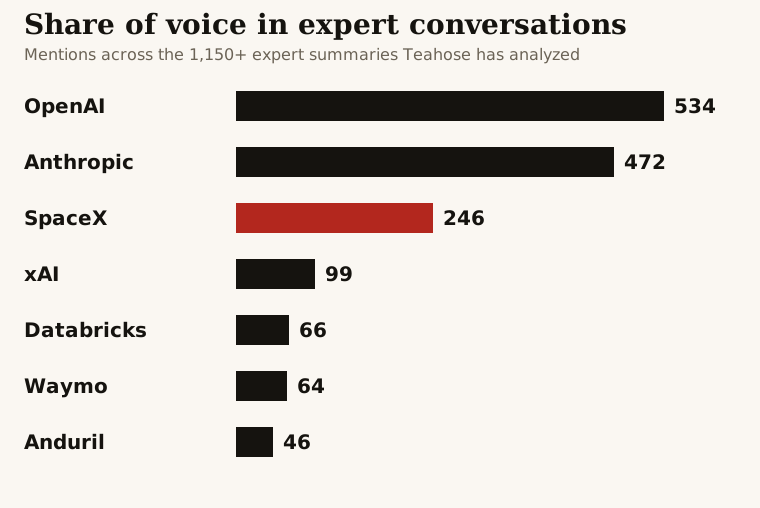
- The traffic to private-company "stock" pages is enormous and the demand is real: IPOs and pre-IPO investing came up in 335 of the 1,150+ expert conversations (podcasts, newsletters, research) our pipeline has analyzed — more than one in four. (Methodology: a case-insensitive match for "IPO" across our summary corpus; reproducible, not a vanity number.)
- Accredited-investor status is the gate for marketplaces, SPVs, and most direct deals. If you don't qualify, your real options are publicly traded venture funds, equity crowdfunding, or public proxies.
- Fees stack: platform fee + SPV management/carry + the share premium or discount. Price the all-in load, not the headline.
- The list of "pre-IPO AI companies" changes constantly. SpaceX, xAI (inside SpaceX), Cerebras, and Chime all went public in 2026 — buying them as "pre-IPO" is no longer possible. The companies that are actually still private are the only ones worth a page.
- Most "how to invest in X" guides are written by the marketplaces selling the trade. This one isn't — we don't broker anything, so the comparison is neutral.
Disclosure: Teahose is an independent information and data service — not a broker-dealer, investment adviser, or securities marketplace. We don't facilitate, solicit, or execute securities transactions, and nothing here is investment advice. Pre-IPO investing is high-risk, illiquid, and generally restricted to accredited investors; you can lose your entire investment.
The 5 Ways to Invest in Pre-IPO Companies
| Route | What you actually own | Who can use it | Typical minimum | Fee shape |
|---|---|---|---|---|
| Secondary marketplace | Existing private shares (direct or via platform entity) | Accredited only | ~$5K–$50K | ~3–5% transaction |
| SPV | A unit of a fund that holds the shares | Accredited only | ~$10K–$100K | Mgmt fee + carry |
| Pre-IPO / venture fund | Fund units; some trade publicly | Some open to all | Share price (public funds) | Expense ratio |
| Direct / employee / tender | The shares themselves | Accredited / invited | Negotiated | Legal + transfer |
| Public proxy | Stock of a public parent that owns a stake | Everyone | One share | Standard brokerage |
1. Secondary marketplaces
Platforms such as Forge Global, Hiive, EquityZen, and Nasdaq Private Market match buyers with employees and early investors who want to sell. You browse listed companies, place a bid (or accept an order-book price on Hiive's live model), and the platform handles the company's right-of-first-refusal and transfer paperwork. These are the most common on-ramp — and the most competitive, with consolidation underway (Charles Schwab completed its acquisition of Forge in 2026; Morgan Stanley's platform cut EquityZen's minimum to $5,000 in February 2026). All require accreditation.
2. SPVs (special-purpose vehicles)
An SPV is a single legal entity that pools many investors into one position in one company. It lowers the per-investor minimum and consolidates the cap-table footprint to a single line, which is why founders often prefer them. The cost is a management fee plus carried interest on gains, and an extra counterparty between you and the stock. Read the SPV's fee waterfall carefully — our pre-IPO investing risks and SPVs guide breaks down where the returns leak.
3. Pre-IPO and venture funds (the non-accredited route)
A growing set of closed-end and interval funds hold baskets of private companies and trade on public exchanges, so anyone with a brokerage account can buy in. They offer diversification and liquidity the direct routes don't — but you're buying a manager's whole portfolio (and sometimes a premium to net asset value), not a clean bet on one name.
4. Direct, employee, and tender-offer purchases
If you have a relationship with an employee or early shareholder, you can buy their shares directly, subject to the company's transfer restrictions and right of first refusal. Companies also run periodic tender offers that let employees sell to approved buyers at a set price — the cleanest direct path when it's available. The flip side of this market is covered in our how to sell pre-IPO shares guide.
5. Public proxies
The simplest, most liquid route: buy a public company that owns a big chunk of the private one. Microsoft for partial OpenAI exposure; Alphabet (GOOGL) for Waymo; Hyundai for Boston Dynamics. You get exposure without accreditation or lockups — but diluted, because the stake is small relative to the parent.
Who Qualifies: Accredited Investor Rules
Most direct routes are gated by SEC Regulation D. You generally qualify as an accredited investor if you meet any one of these:
- Income: over $200,000 individually (or $300,000 with a spouse) in each of the last two years, with the same expected this year.
- Net worth: over $1,000,000, excluding the value of your primary residence.
- Licensing: you hold an active Series 7, 65, or 82 license.
Platforms verify this before you can transact. If none applies, focus on the publicly traded funds and public-proxy routes above.
Which Companies Are Still Worth a Pre-IPO Page
The single biggest mistake in this category is targeting companies that already went public. As of mid-2026:
- Still private (investable as pre-IPO): Anduril (~$61B), Databricks, Scale AI, Groq, Stripe, Canva, Kalshi, Polymarket, Figure AI, Perplexity.
- Closing fast: Anthropic filed a confidential S-1 in June 2026 — the pre-IPO window is nearly shut.
- No longer pre-IPO (went public in 2026): SpaceX (Nasdaq: SPCX), xAI (absorbed into SpaceX), Cerebras (CBRS), Chime (CHYM).
We keep the live ranking current automatically — see pre-IPO companies to watch in 2026, which re-sorts itself from real funding and product signals.
What Teahose Adds That a Marketplace Can't
A marketplace tells you the share price. It can't tell you whether the company is gaining or losing momentum, because that's not its job — and a sales-funnel education page can't write a neutral comparison of its own competitors. Teahose extracts funding rounds, product launches, hires, and expert mentions for every tracked company daily and surfaces them as a live signal feed. Before you wire money into an illiquid private position, the most useful thing isn't last week's price — it's what the smartest people in the industry said about the company this month.
- Track any company's live activity on its company profile and hit Watch for email alerts.
- Find adjacent private companies by pasting a website into the lookalikes tool.
- Browse the raw signal feed the rankings are built from.
Pre-IPO Investing: The Honest Summary
Pre-IPO investing can deliver outsized returns, but it concentrates risk in exactly the places retail investors are least equipped to evaluate: liquidity, information, and fees. Use it as a small, long-horizon allocation; insist on accreditation-grade diligence; price the full fee stack; and never confuse a high private mark with a guaranteed IPO. Start with the route that matches your status, then read the risks and SPV mechanics before you commit a dollar.
Related guides: How to become an accredited investor · What is a secondary market for private shares? · How to sell pre-IPO shares · Pre-IPO companies to watch in 2026 · AI unicorns, live-ranked
Editorial figures as of June 23, 2026. Valuations and IPO statuses change — verify against primary sources before investing.
Frequently Asked Questions
How do you invest in pre-IPO companies?
There are five real routes. (1) Secondary marketplaces (Forge Global, Hiive, EquityZen, Nasdaq Private Market) where you buy existing shares from employees or early investors. (2) SPVs — a special-purpose vehicle pools investors into a single position. (3) Pre-IPO and venture funds, some of which now trade on public exchanges (e.g. closed-end funds and interval funds) so non-accredited investors can get indirect exposure. (4) Direct purchases from employees or in a company tender offer. (5) Public proxies — buying a listed company that owns a large stake (e.g. Alphabet for Waymo exposure). Routes 1, 2, and 4 generally require you to be an accredited investor.
Can a normal (non-accredited) person invest in pre-IPO stock?
Mostly indirectly. The marketplaces and SPVs are restricted to accredited investors under SEC Regulation D — broadly, $200K+ income ($300K joint) for two years, or $1M+ net worth excluding your home, or holding a Series 7/65/82 license. If you do not qualify, the realistic paths are publicly traded pre-IPO/venture funds and equity crowdfunding platforms (Reg CF/Reg A+), or buying a public company that holds the private stake. None of these is the same as owning the shares directly.
What does it cost to buy pre-IPO shares?
Expect three layers. Platform/transaction fees of roughly 3–5% are common; SPVs add a management fee plus carried interest (often a "2 and 20"-style cut of gains); and the shares themselves usually trade at a markup or discount to the last primary round. Minimums vary widely — some marketplaces start in the low-five-figure range (EquityZen cut its minimum to $5,000 in early 2026), while SPVs and direct deals often want $25K–$100K+. Always price the all-in fee load before the headline share price.
Which AI companies are still private (pre-IPO) in 2026?
As of mid-2026, still private: Anduril (~$61B), Databricks, Scale AI, Groq, Stripe, Canva, Kalshi, Polymarket, Figure AI, and Perplexity, among others. Anthropic filed a confidential S-1 in June 2026 and is expected to list around late 2026, so its pre-IPO window is closing. Recently gone public and therefore no longer pre-IPO: SpaceX (Nasdaq: SPCX, June 2026, with xAI absorbed inside it), Cerebras (CBRS), and Chime (CHYM). The live ranking on our pre-IPO companies to watch guide stays current automatically.
Are pre-IPO investments risky?
Yes — materially more than public stocks. Private shares are illiquid (you may not be able to sell for years), information is limited and unaudited, valuations can be stale or marked at the last round, and many companies that raise at high marks never IPO at all or do so far below their private peak. SPV fee layering and dilution from later down-rounds can quietly erode returns. Treat pre-IPO as a small, long-horizon slice of a portfolio you can afford to lock up. See our pre-IPO investing risks and SPVs guide for the full breakdown.
How do you get exposure to OpenAI or Waymo without buying private shares?
Through public proxies. Microsoft holds a large economic interest in OpenAI, so MSFT gives you partial, diluted exposure. Waymo is owned by Alphabet, so GOOGL is the direct proxy. Boston Dynamics is owned by Hyundai. This route is liquid and open to everyone, but the stake is small relative to the parent's market cap, so the private company barely moves the parent's price — it is exposure, not a pure-play bet.
What is the difference between a secondary marketplace and an SPV?
A secondary marketplace matches buyers and sellers of existing private shares — you end up holding (directly or via the platform's entity) shares of the company. An SPV is a fund-like wrapper: a sponsor raises a pool of capital into one legal entity that holds the position, and you own a unit of the SPV, not the shares themselves. SPVs lower the minimum and handle the company's transfer paperwork, but add a management layer, fees, and another counterparty between you and the stock.