
Key takeaways
- As of June 2026, Scale AI's last priced mark is ~$29 billion, implied by Meta's $14.3B investment for a 49% non-voting stake in June 2025 — no new round or secondary has printed since.
- Scale AI is mentioned in 44 of the 1,150+ expert conversations we've analyzed, and the discussion has shifted from "frontier-lab data leader" to "what is it worth after the customer exodus."
- The same deal that set the ~$29B number triggered the customer losses (Google, OpenAI, xAI) that make a clean re-mark hard.
- Most coverage quotes the ~$29B headline; what actually matters is the next market-cleared print — a round, tender, or secondary — which is still pending.
Mention counts from Teahose's analysis of 1,150+ expert podcast, newsletter & research summaries, June 2026.
As of June 2026, Scale AI's valuation is ~$29 billion — implied by Meta's $14.3B purchase of a 49% non-voting stake in June 2025 (TechCrunch). That is still the most recent mark a year later, and the year in between is why this page reads differently from our other valuation guides: the deal that set the number also broke the business model it was pricing.
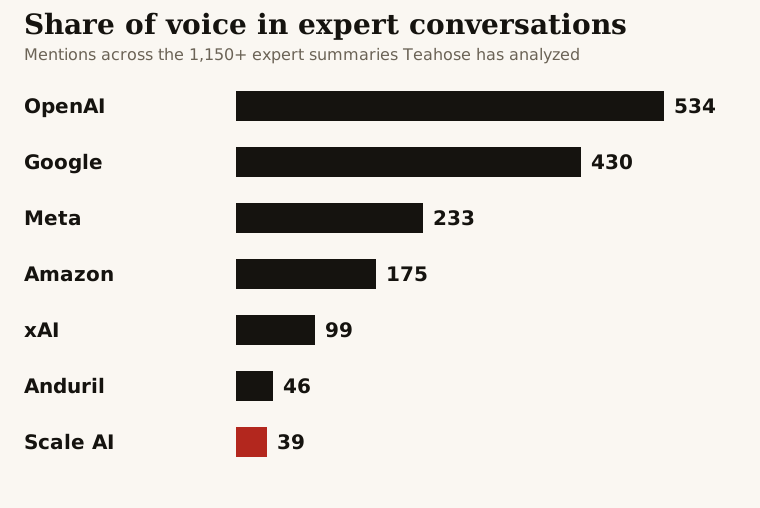
Each bar counts how many of Teahose's 1,150+ expert summaries mention it (word-boundary match across our podcast, newsletter, and paper corpus, June 2026).
Track the field: find the companies most similar to Scale AI and get their latest funding and product signals by email — Teahose Lookalikes.
Valuation History
| Date | Event | Raised | Valuation |
|---|---|---|---|
| Jun 2025 | Meta strategic investment (49%, non-voting) | $14.3B | ~$29B implied |
| May 2024 | Series F (Accel; Amazon & Meta participated) | $1B | $13.8B |
| Apr 2021 | Series E (Dragoneer, Greenoaks, Tiger) | $325M | $7.3B |
| Dec 2020 | Series D (Tiger Global) | $155M | ~$3.5B |
| Aug 2019 | Series C (Founders Fund) | $100M | >$1B |
Sources: Meta deal — TechCrunch · Series F — Sacra · history — Wikipedia.
What Happened After the Print
The Meta deal is the cleanest case study anywhere of a valuation event destroying the revenue it priced:
- The neutrality collapse (June 2025). Within days, Reuters reported Google — Scale's largest customer at ~$200M planned 2025 spend — moving to cut ties (CNBC); OpenAI phased out Scale work; xAI headed for the exit. Frontier labs wouldn't route training data through a vendor half-owned by a competitor.
- The layoffs (July 2025). 200 employees (~14%) plus 500 contractors; 16 GenAI teams consolidated to 5. New CEO Jason Droege — ex-Uber Eats founder, initially interim — called the prior GenAI expansion too fast (Yahoo Finance).
- The pivot (late 2025 → 2026). Government and defense became the strategic core — the DoD Thunderforge military-planning contract, the Qatar government partnership — plus enterprise deployments and a research division, Scale Labs (March 2026). The reported $450M+/year Meta contract replaced a chunk of the lost lab revenue with a single concentrated customer.
The displaced frontier-lab spend didn't vanish — it re-routed to neutral rivals. Bootstrapped Surge AI reportedly out-earned Scale in 2024 ($1B+ vs $870M) and drew reported term sheets at $25–30B; expert-data marketplace Mercor reached $10B (October 2025). The full landscape is mapped in our Scale AI competitors guide.
What ~$29B Is Pricing Now
The bull case: a defensible government franchise (the kind of moat that re-rated Anduril to $61B and Palantir to ~$325B), a guaranteed Meta revenue floor, and an option on Scale Labs. The bear case: the original high-growth business migrated to competitors, the remaining book is customer-concentrated, and the 49% holder's interests aren't the other 51%'s. A strategic premium set this price; only a new round or secondary tells us what clears today.
Latest Scale AI Signals, Live
Scale AI Funding & Deal Signals
Extracted live from podcasts, newsletters & primary coverage by the Teahose intel pipeline
- 01M&AMeta bought a large stake in Scale AI for around $15 billion (Sam called it a $14 billion company), largely to bring in founder Alexandr Wang; Meta was also one of Scale's big custOCT 19 · My First MillionOCT 19
- 02M&AScale AI... acquired in the Meta deal... the next WhatsApp or InstagramOCT 15 · 20VCOCT 15
- 03FUNDINGNamespace Labs raised $42M in Series B funding... to expand its AI-focused developer infrastructure.OCT 11 · The VC CornerSERIES B · $42M
- 04FUNDINGDan Levine led into Scale AI a couple months (weeks really) after Alex and Lucy founded it.OCT 5 · Aaron HarrisSERIES A
- 05M&AThey bought Scale AI for like $18 billion. There's a really weird deal where it was like basically an acqui-hire.SEP 30 · My First Million$18B
- 06M&AMeta has been on a spree since paying billions in a deal with Scale AI that allowed Wang, its former CEO, to join the company.AUG 24 · Axios AI+AUG 24
- 07M&AEventually entered a licensing/agreement with Meta valued around $30 billion.JUL 31 · No Priors$30B
- 08M&AAlexandr Wang — who sold his data-labeling startup Scale AI to Meta for $14.3 billion before taking the role of chief AI officer and heading up Meta Superintelligence Labs.JUN 13 · StrictlyVC$14.3B
- 09M&AIt's been one year since Mark Zuckerberg appointed Alex Wang Meta's chief AI officer as part of a $14 billion acquihire as Meta invested in Wang's company, Scale AI.JUN 13 · CNBC$14B
- 10M&AMeta paid $14.3 billion for a 49% non-voting stake in Scale AI, which is the data labeling and AI infrastructure company that Wang co-founded and was running as CEO.MAY 13 · Core Memory$14.3B
What to Watch Next
- Any new mark. A round, a tender, or a secondary print — the first market price since Meta's strategic one is the single most informative event possible here.
- Government contract flow. If Scale's defense franchise compounds the way Anduril's and Palantir's did, the pivot worked; the signal feed above catches each award.
- Surge's round closing. If Surge prints $25–30B, a bootstrapped rival will have matched Scale's valuation in half the time — a verdict on where the data market's value went.
Hit Watch on Scale AI's company profile for new signals by email. Related: Scale AI competitors · Anduril valuation · top AI startups, live-ranked · pre-IPO investing risks & SPVs · how to sell pre-IPO shares.
Editorial figures as of June 10, 2026. The signal feed above updates continuously.
Bottom line: Scale AI is worth ~$29B on paper, but that's a year-old strategic mark from Meta — not a market-cleared price — and the same deal that set it drove away the frontier-lab customers it was pricing, so the real answer waits on the next round, tender, or secondary.
Frequently Asked Questions
What is Scale AI worth in 2026?
The last mark is ~$29 billion, implied by Meta's $14.3B investment for a 49% non-voting stake in June 2025 — more than double the $13.8B Series F from May 2024. No new round or major secondary pricing has printed since, so a year later that number is best read as a high-water mark from a strategic buyer, not a market-cleared price: the deal itself triggered the customer losses that make a clean re-mark hard.
Who owns Scale AI?
Meta holds 49% in non-voting shares. The rest sits with founders, employees, and the venture investors from earlier rounds (Accel, Founders Fund, Tiger Global, Dragoneer, and others — Amazon and Meta both participated in the 2024 Series F). Co-founder Alexandr Wang left to run Meta Superintelligence Labs but stayed on Scale's board; Jason Droege took over as CEO.
Why did Google and OpenAI leave Scale AI?
Neutrality. Scale's core business was training data for frontier labs — and after Meta, a direct competitor, took 49%, those labs feared visibility into their research priorities. Within days of the deal, Reuters reported Google (Scale's largest customer, ~$200M planned 2025 spend) moving to cut ties; OpenAI phased out work; xAI looked to exit. That revenue walked straight to neutral rivals like Surge, Mercor, and Handshake.
What does Scale AI do now?
Less frontier-lab labeling, more government and enterprise. After July 2025 layoffs (200 employees, ~14%, plus 500 contractors), Scale consolidated around defense work (the DoD Thunderforge program, and the Qatar government partnership), enterprise GenAI deployments, a reported five-year Meta contract worth at least $450M/year, and a new research division, Scale Labs, launched March 2026.
Is Scale AI still growing?
Unclear — and that's the honest answer. The firmest figure is $870M revenue in 2024; trackers put 2025 around $2B but that's estimate territory for a private company in mid-pivot. Meanwhile bootstrapped rival Surge reportedly passed Scale in revenue ($1B+ in 2024, ~$1.4B run-rate by late 2025). The growth story in data labeling moved to the neutral players.
How often does Scale AI come up in expert AI discussions?
Scale AI shows up in 44 of the 1,150+ expert podcast, newsletter, and research summaries Teahose has analyzed as of June 2026. That puts it in steady rotation among investors and operators, but the framing has changed: most recent mentions are less about its data-labeling lead and more about what the company is worth after the Meta deal reshuffled its customer base. The live signal feed on this page tracks each new funding or deal mention as it surfaces.
Did the Meta deal increase or decrease Scale AI's value?
Both, depending on the timeframe. On paper the June 2025 Meta investment set the highest mark in Scale's history at roughly $29 billion implied — more than double the $13.8B Series F. But because Meta is a direct competitor to Scale's frontier-lab customers, the same deal prompted Google, OpenAI, and xAI to cut or reduce ties within weeks, eroding the revenue that mark was pricing. The headline number went up while the underlying business it valued got harder to clear at that price.
Is Scale AI valued at $29 billion or $14.8 billion?
Both numbers are real and describe different things — which is why trackers disagree. Meta paid roughly $14.3 billion for a 49% non-voting stake in June 2025; dividing that purchase price by the stake implies a total company valuation of about $29 billion, which is the figure most coverage (and this guide) quotes. Some early reports cited ~$14.8 billion as the deal size, and a few conflated that with the valuation, producing the "$14.8B vs $30.2B" confusion you'll see debated. The cleanest way to read it: ~$14.3B invested, ~$29B implied valuation — and even that is a strategic mark from a single buyer, not a market-cleared price.
Is Scale AI going to IPO?
There's no announced IPO and no public timeline as of June 2026. A public offering is structurally harder here than for most decacorns: Meta already holds 49% in non-voting shares, the original frontier-lab revenue migrated to neutral rivals after the deal, and the remaining book leans on government contracts plus a single concentrated Meta agreement. A new private round, a tender, or a secondary is far more likely than an IPO to set Scale's next mark — and that next print, whenever it comes, is the most informative event possible for this valuation.
Is Scale AI a good acquisition target after the customer exodus?
It depends entirely on what a buyer is paying for. Meta already holds 49% non-voting, which complicates any clean acquisition, and the original high-growth labeling book has migrated to neutral rivals like Surge and Mercor. What remains is a government and defense franchise (the DoD Thunderforge work, the Qatar partnership) plus a reported $450M-plus per year Meta contract — concentrated, but defensible. A buyer betting on the defense-franchise thesis sees value; a buyer wanting the old data-labeling growth engine is looking at the wrong company now.