
Key takeaways
- After Meta took 49% of Scale AI in June 2025, frontier labs fled to neutral vendors — Surge AI took the frontier-lab crown, Mercor took expert data, and Handshake, Turing, Invisible, Snorkel and Micro1 split the rest.
- Scale AI surfaces in 44 of the 1,150+ expert podcast, newsletter and research conversations we've analyzed; Mercor appears in 18, a signal of how fast the expert-data challenger has entered the discourse.
- The decisive variable is neutrality, not headcount or price: labs won't route unreleased-model data through a competitor-owned pipeline, which is why a bootstrapped 110-person Surge out-positioned a far larger Scale.
- Most lists rank these companies by valuation; what actually matters is whether the revenue is expert data (compounding) or commodity labeling (being eaten by synthetic data).
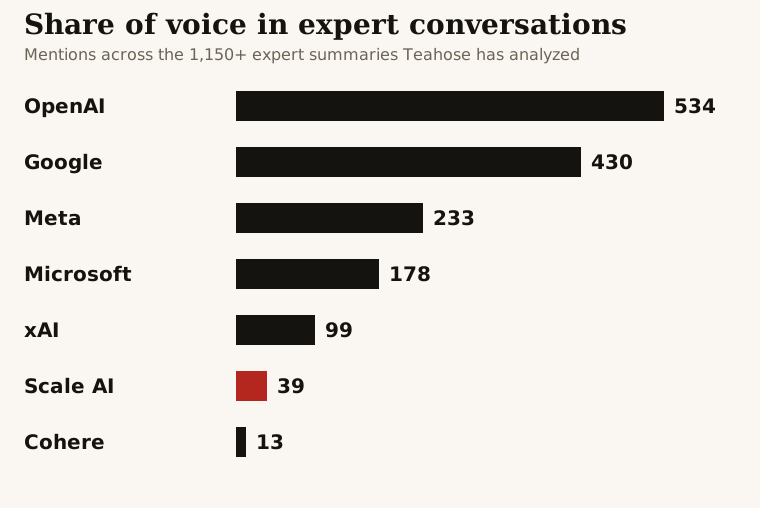
Each bar counts how many of Teahose's 1,150+ expert summaries mention it (word-boundary match across our podcast, newsletter, and paper corpus, June 2026).
Track the field: find the companies most similar to OpenAI and get their latest funding and product signals by email — Teahose Lookalikes.
Mention counts from Teahose's analysis of 1,150+ expert podcast, newsletter & research summaries, June 2026.
The Scale AI competitor map redrew itself in one week. When Meta bought 49% of Scale in June 2025 and its founder left to run Meta Superintelligence Labs, the frontier labs — Google, OpenAI, xAI — pulled work rather than share their training-data pipeline with a rival. That revenue had to go somewhere. This page maps where it went.
The market also changed shape underneath: the work shifted from commodity labeling toward expert data — PhD- and professional-grade reasoning traces, domain evals, red-teaming, agentic-task data. Ranking the field by that lens:
The Neutrality Winners
- Surge AI — the big one. Bootstrapped since 2020 by Edwin Chen, ~110 people, no sales team, premium human-feedback data — and reportedly $1B+ revenue in 2024 (vs Scale's $870M), at a ~$1.4B run-rate by late 2025 (Inc.). In July 2025, Bloomberg reported its first outside round in talks at $25B+ — unconfirmed as closed as of June 2026, but the number alone says who inherited Scale's seat.
- Mercor — the expert-data marketplace: 30,000+ vetted doctors, lawyers, and PhDs (~$95/hr) supplying frontier labs. $350M Series C at $10B (October 2025, led by Felicis — TechCrunch), 5x its February 2025 mark; run-rate $450M (Sep 2025) → $760M (end 2025), with later reports as high as $1.5B (unverified).
- Handshake AI — the unlikeliest entrant: the college-recruiting network pivoted its 18M-student reach into PhD annotator recruiting. ~$1.1B annualized gross revenue by April 2026 (+349% YoY) — though net of contractor payouts it's ~$450M (Sacra); its $3.3B valuation is a stale pre-pivot 2022 mark.
The Established Rivals
- Turing — LLM post-training via a 4M-engineer network; profitable, ~$300M ARR; $111M Series E at $2.2B (March 2025, led by Khazanah Nasional — Businesswire).
- Invisible Technologies — AI training + operations outsourcing for Microsoft, Cohere, AWS; $134M 2024 revenue, $100M raise at >$2B (September 2025 — SiliconAngle).
- Labelbox — the software-platform play (labeling tools + the Alignerr expert service); last priced ~$1B (SoftBank, 2022), revenue undisclosed.
- Snorkel AI — Stanford-spinout programmatic labeling, pivoting to expert data-as-a-service; $100M Series D at $1.3B (May 2025 — Businesswire).
The Challenger
- Micro1 — an AI recruiter ("Zara") that sources vetted experts; explicitly gunning for Scale. $35M Series A at $500M (September 2025 — TechCrunch); run-rate ~$50M (Sep 2025) → ~$300M annualized by April 2026 per Sacra — definitionally fuzzy, directionally explosive.
Scorecard (as of June 2026)
| Company | Latest valuation | Revenue signal | Status vs Scale |
|---|---|---|---|
| Scale AI | ~$29B (Meta, Jun 2025) | $870M 2024 firm; ~$2B 2025 est. | Pivoted to gov/enterprise |
| Surge AI | $25–30B reported talks | $1B+ 2024; ~$1.4B RR | Took the frontier-lab crown |
| Mercor | $10B (Oct 2025) | $760M RR end-2025 | Owns expert-data marketplace |
| Handshake AI | $3.3B (stale, 2022) | ~$1.1B gross / $450M net | Fastest pivot in the field |
| Turing | $2.2B (Mar 2025) | ~$300M ARR | Profitable, steady |
| Invisible | >$2B (Sep 2025) | $134M 2024 | Enterprise ops niche |
| Snorkel | $1.3B (May 2025) | undisclosed | Mid-pivot |
| Micro1 | $500M (Sep 2025) | ~$300M RR (reported) | The insurgent |
Mind the definitions: these mix audited-ish revenue, run-rates, and gross-vs-net marketplace numbers — the gap between Handshake's $1.1B gross and $450M net is the cautionary example (our ARR guide covers exactly this trap).
The Live Map: Scale's Nearest Neighbors
Companies Most Similar to Scale AI
Vector similarity against the Teahose company graph · same engine as the /similar lookalikes tool
- 01Micro1AI80% match
- 02SurgeAI79% match
- 03ProtegeAI Infrastructure / Data & Training78% match
- 04COMPANYnull77% match
- 05Micro1AI Data Infrastructure77% match
- 06Flapping Airplanes75% match
- 07Training DataMedia75% match
- 08Protege AIAI Data Collection / Robotics74% match
- 09TuringAI74% match
- 10Nous Researchai-infrastructure73% match
- 11PleiasAI72% match
- 12LuelAI Training Data / Human Data Marketplace72% match
- 13RadixArkAI72% match
- 14LMArenaAI reliability infrastructure / human preference data72% match
- 15AfterQueryAI72% match
How to Read This Market
- Neutrality is the product. The entire 2025 reshuffle was labs refusing to share data pipelines with a competitor-owned vendor. Any acquirer of Surge or Mercor inherits the same trap Meta sprang on Scale.
- Expert data is the growth; commodity labeling is the trap. Synthetic data eats the bottom of the market while PhD-grade demand compounds at the top.
- Watch for Surge's print. A closed round at $25–30B would confirm the crown changed heads — the live feed above will catch it.
Related: Scale AI valuation · top AI startups, live-ranked · ARR meaning (and why run-rates mislead).
Bottom line: There is no single Scale AI replacement — Meta's stake broke Scale's neutrality and the work split in two, so Surge AI inherited the frontier-lab human-feedback crown while Mercor owns the expert-data marketplace, with Handshake, Turing, Invisible, Snorkel and Micro1 taking the rest.
Editorial figures as of June 10, 2026. The live ranking above updates continuously.
Frequently Asked Questions
Who is Scale AI's biggest competitor?
Surge AI. Bootstrapped, ~110 employees, no sales team — and it reportedly out-earned Scale in 2024 ($1B+ revenue vs Scale's $870M), reaching a ~$1.4B run-rate by late 2025. After Meta's stake made Scale a competitor-owned vendor, Surge became the default neutral choice for frontier-lab human-feedback data, drawing reported funding talks at a $25–30B valuation.
Why did labs switch away from Scale AI?
Meta's June 2025 purchase of 49% of Scale destroyed its neutrality. Frontier labs send their most sensitive asset — the data that shapes unreleased models — through their data vendor, and none wanted a direct competitor holding half of it. Google (Scale's largest customer), OpenAI, and xAI all cut or reduced ties within weeks.
What is the difference between Scale AI and Mercor?
Generation gap. Scale industrialized commodity labeling and RLHF at massive contractor scale. Mercor runs a marketplace of vetted professionals — doctors, lawyers, PhDs, paid ~$95/hour — for frontier "expert data": reasoning traces, domain evals, agentic tasks. As models stopped needing bounding boxes and started needing expert judgment, Mercor's model went from niche to a $10B valuation (October 2025) in under three years.
Is data labeling still a good business?
The commodity end is brutal — margins compress and synthetic data eats the simplest tasks. The expert end is one of the fastest-growing markets in AI: Surge, Mercor, Handshake AI, and Micro1 all multiplied run-rates in 2025–2026 on PhD-grade data demand. The business didn't shrink; it moved up-market, and the winners are the ones who made that turn early.
How is the live list on this page generated?
We embed a description of Scale's business with the same vector pipeline that powers our company lookalikes tool, then rank companies in the Teahose intel graph by cosine similarity. It updates as new companies and funding signals enter the graph — so emerging data-market entrants surface here before editorial lists catch them.
What is the best Scale AI alternative for frontier model training data?
It depends on the work. For premium human-feedback and RLHF data, Surge AI is the default neutral choice the frontier labs moved to after Meta's stake. For expert reasoning traces and domain evals from vetted doctors, lawyers and PhDs, Mercor leads. For platform tooling you run in-house, Labelbox and Snorkel fit. The reason there is no single winner is that the work split into commodity labeling and expert data, and different vendors own each end.
Did Meta acquire Scale AI?
Not outright. In June 2025 Meta bought roughly 49% of Scale AI (a stake valuing it near 29 billion dollars) and hired its founder to run Meta Superintelligence Labs, rather than taking full ownership. The structure still broke Scale's neutrality, because rival labs would not route their most sensitive training data through a vendor nearly half-owned by a direct competitor — which is what triggered the customer exodus to Surge, Mercor and others.
How much are Scale AI competitors talked about by AI experts?
Across the 1,150-plus expert summaries Teahose has analyzed, Scale AI itself comes up in 44 conversations and Mercor in 18 — a useful proxy for which data-market players the people building and funding AI actually discuss. These are counts of mentions in expert podcasts, newsletters and research, not market share, so treat them as a share-of-discussion signal that tends to lead editorial coverage of emerging vendors.