
ARR — annual recurring revenue — is the yearly value of a company's active subscription base. It's the single number startups are measured by, the input to nearly every private-market valuation, and a metric with no official accounting definition at all. That combination is why it's both indispensable and routinely gamed. (One disambiguation up front: in SaaS and venture capital ARR means annual recurring revenue — the subject of this guide — but the same three letters mean annualized run-rate on the AI frontier and accounting rate of return in corporate-finance courses; both are covered below.)
Key takeaways
- ARR = the annualized value of active recurring contracts. Simplest form: MRR × 12.
- It is not GAAP revenue — it's a forward-looking operating metric, self-reported and unaudited.
- Valuations quote it constantly: "raised at 30x ARR" means price ÷ current ARR.
- The AI era bent the definition: most "AI ARR" is annualized usage revenue, not contracted subscriptions.
- The multiples below are grounded in real coverage: ARR-driven valuations surface constantly across the 1,150+ expert summaries the Teahose pipeline has analyzed.
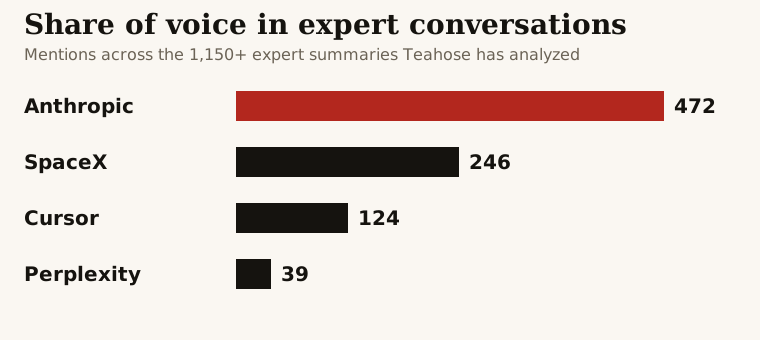
Each bar counts how many of Teahose's 1,150+ expert summaries mention it (word-boundary match across our podcast, newsletter, and paper corpus, June 2026).
Track the field: find the companies most similar to Anthropic and get their latest funding and product signals by email — Teahose Lookalikes.
Mention and multiple context drawn from Teahose's analysis of 1,150+ expert podcast, newsletter & research summaries, June 2026.
The Definition and the Formula
ARR captures revenue that is recurring by contract — subscriptions that renew unless cancelled. The canonical calculation:
| Component | Effect on ARR |
|---|---|
| New subscription bookings (annualized) | + |
| Expansion (upgrades, seat growth) | + |
| Contraction (downgrades) | − |
| Churn (cancellations) | − |
| One-time fees: setup, services, training | excluded |
| Usage/overage beyond contracted commitment | excluded (strictly) |
A $36,000 contract over three years = $12,000 of ARR. Ten customers paying $1,000/month = $120,000 of ARR. The point of the discipline is comparability: two companies' ARR should mean the same thing. (It often doesn't — see below.)
ARR vs MRR is just zoom level: MRR for early-stage and month-to-month motion, ARR once contracts are annual and sales are enterprise. Below roughly $1M ARR, sophisticated investors mostly talk MRR.
Why VCs Price Everything Off It
Startup valuations are quoted as a multiple of ARR because nothing else about a young company is stable enough to price. The multiple compresses three judgments into one number: growth rate, retention (net revenue retention — expansion minus churn), and gross margin.
The 2026 reality of that math, from our valuation coverage:
- Cursor hit ~$4B annualized revenue by June 2026 — $500M → $1B → $2B → $4B in about a year, the fastest revenue ramp in software history — and SpaceX's $60B acquisition option prices it at ~15x.
- Anthropic's $965B valuation sits at ~21x a $47B run-rate that grew from ~$9B in five months.
- A solid-but-ordinary SaaS business growing 30–40% trades in the 5–10x range; public SaaS medians sit lower still.
Same metric, 6x spread in multiple. The multiple is a price on the derivative of ARR, not the level. That's also why the classic growth benchmark — T2D3 (triple, triple, double, double, double from $1–2M ARR, the old gold standard for a fund-returning company) — has been replaced in AI by curves that compress five years into one.
Where ARR Lies to You
ARR's lack of a GAAP definition is a feature for founders and a trap for everyone else. The standard inflations:
- Annualized best month. Take the strongest month, multiply by 12. One conference-driven spike becomes "ARR growth."
- CARR smuggling. "Contracted ARR" counts signed deals not yet live or paying. Legitimate as a separate line; misleading when reported as just "ARR."
- Services in the subscription line. Implementation fees recur exactly once.
- Usage rebranded as recurring. The big one in AI: API and consumption revenue annualized and called ARR. It can vanish as fast as it appeared — model switching is one config change. The honest term is annualized run-rate revenue, which is why careful reporting on the frontier labs says "run-rate," not ARR.
- Pilot inflation. Counting proof-of-concepts that churn at the 90-day mark.
Diligence rebuilds ARR from the billing system for exactly these reasons. As a reader of funding news, the discount heuristic is simple: contracted-subscription ARR ≈ face value; usage-annualized "ARR" ≈ apply a haircut and ask about month-over-month retention.
The Terms That Travel With It
- NRR (net revenue retention): this year's revenue from last year's customers ÷ last year's. Above 120% means the base grows with zero new sales — the strongest predictor of a durable multiple.
- Run-rate: any revenue × 12 annualization, recurring or not. All ARR is a run-rate; not all run-rates are ARR.
- Burn multiple: net burn ÷ net new ARR. Under 1x is elite; over 2–3x means growth is being bought expensively. Pairs with burn rate in every board deck.
- Magic number: new ARR per dollar of sales & marketing spend — the sales-efficiency cousin.
- Rule of 40: revenue growth rate % + profit margin % (free-cash-flow or operating). At or above 40 signals a healthy growth-versus-efficiency balance — the single most-cited SaaS health check after ARR itself, and the bar public-market investors increasingly hold AI companies to as the growth-at-all-costs era fades.
Watch It in the Wild
Every funding signal below carries an implied ARR multiple — that's the lens this metric gives you.
Companies Moving This Week
Ranked by 7-day signal volume across the podcasts, newsletters & papers the Teahose pipeline reads — the rounds being priced on ARR multiples right now
- 01OpenAI41 signals · 7d
- 02Anthropic39 signals · 7d
- 03Yahoo28 signals · 7d
- 04Bessemer17 signals · 7d
- 05Vanta14 signals · 7d
- 06Ropedia14 signals · 7d
- 07Google12 signals · 7d
- 08Nvidia12 signals · 7d
- 09Mecka11 signals · 7d
- 10Tesla10 signals · 7d
Keep Going
The valuation pages apply this metric to real cap tables: Anthropic ($965B, ~21x) · Cursor ($29.3B confirmed, ~15x at the option) · Perplexity (~40x) · the full top-AI-startups ranking. For the deals being priced this week, watch the live signal feed.
Definitions are stable; the examples and multiples are as of June 10, 2026.
Bottom line: ARR is the annualized value of a company's active recurring contracts (MRR × 12) and the multiple every startup valuation hangs on — but it has no GAAP definition, so always check whether a quoted "ARR" is contracted subscriptions or usage revenue annualized as run-rate.
Frequently Asked Questions
What does ARR mean?
ARR stands for annual recurring revenue: the yearly value of a company's active subscription contracts. The simplest form is monthly recurring revenue (MRR) × 12. It measures the revenue a business would generate over the next year if it signed nothing new and lost nothing — the cleanest single read on a subscription company's size.
Does ARR mean annual recurring revenue or accounting rate of return?
Both are real acronyms — context decides. In startups, SaaS, and venture capital, ARR almost always means annual recurring revenue (the subject of this guide): the annualized value of active subscription contracts. In corporate finance and capital budgeting, ARR can instead mean accounting rate of return — average annual accounting profit divided by the initial investment, shown as a percentage to screen capital projects. Reading funding news or a software company's metrics? It's annual recurring revenue. Comparing project returns in a finance course? It's accounting rate of return.
How is ARR different from revenue?
Revenue (the GAAP kind) is what was actually earned and recognized in a period, audited and backward-looking. ARR is a forward-looking operating metric with no accounting standard behind it — it annualizes the current subscription base. A company that signs a $1.2M annual contract on December 31 adds $1.2M to ARR that day but almost nothing to that year's recognized revenue. When a press release says "$100M ARR," recognized revenue is usually meaningfully lower.
What counts as a good ARR multiple in 2026?
Public SaaS has settled around mid-single-digit multiples of forward revenue, with top-decile growers near 10–15x. Private AI companies broke the scale: Cursor's $60B acquisition option prices ~15x its ~$4B annualized revenue (June 2026), and Anthropic's $965B round priced ~21x a $47B run-rate. Those multiples are paid for growth rate, not the ARR number itself — a $10M-ARR company doubling yearly commands a far higher multiple than a $50M one growing 20%.
Does usage-based revenue count as ARR?
Strictly, no — usage revenue isn't contractually recurring, which is the R in ARR. In practice, most AI companies report "ARR" by annualizing a recent month of usage-heavy revenue, and investors have largely accepted the shorthand while privately discounting it. The honest term is annualized run-rate revenue. When you see an AI company's "ARR," your first question should be: is this contracted subscriptions, or last month × 12?
How do startups inflate ARR?
The classics: annualizing the single best month; counting signed-but-not-live contracts ("contracted ARR" or CARR); bundling one-time implementation or services fees into the recurring line; counting pilots and free-trial conversions before they renew; and quietly including committed-spend deals that can churn at renewal. None of this is illegal — ARR has no GAAP definition — which is exactly why diligence always rebuilds it from invoices.
What does it mean when a company hits 100 million ARR?
Crossing 100M ARR is the traditional signal that a SaaS company has product-market fit at scale and a credible path to IPO — historically it took the best software companies 7 to 10 years to get there. In the AI era that clock collapsed: companies like Cursor went 500M to 1B to 2B to 4B of annualized revenue in roughly a year. But the headline number rarely equals recognized revenue. A 100M ARR claim annualizes the current subscription base on a single day, so the GAAP revenue a company actually books that year is usually meaningfully lower, especially for a fast grower whose base was a fraction of that size twelve months earlier.
Why do AI startups report run-rate revenue instead of ARR?
Because most AI revenue is usage-based — API calls and token consumption — which is not contractually recurring, so it fails the strict definition of the R in ARR. The honest label is annualized run-rate revenue: a recent month of consumption multiplied by 12. Careful reporting on the frontier labs says run-rate, not ARR, for exactly this reason. Usage revenue can evaporate as quickly as it appeared, since switching models is one config change, so when you see an AI company quote ARR your first question should be whether it is contracted subscriptions or last month times twelve.
How do you calculate an ARR multiple from a funding round?
Divide the valuation by current ARR. A 965B valuation on a 47B run-rate is roughly 21x; a 60B price on ~4B of annualized revenue is about 15x. The multiple is a price on the growth rate and retention of that ARR, not on the level — a 10M-ARR company doubling every year commands a far higher multiple than a 50M-ARR company growing 20 percent. Public SaaS has settled into mid-single-digit multiples of forward revenue, with the top-decile growers near 10 to 15x, which is why private AI multiples look so extreme by comparison.