
A secondary market for private shares is where existing shareholders of a private company — typically employees and early investors — sell their stock to new buyers before the company goes public. No new shares are created and the company receives no money; ownership transfers from one holder to another, subject to the company's approval. It exists because startups now stay private far longer, leaving years of paper wealth locked up.
Key takeaways:
- Secondary ≠ primary. A primary round issues new shares and funds the company; a secondary sells existing shares and funds the seller. This single distinction explains almost everything else.
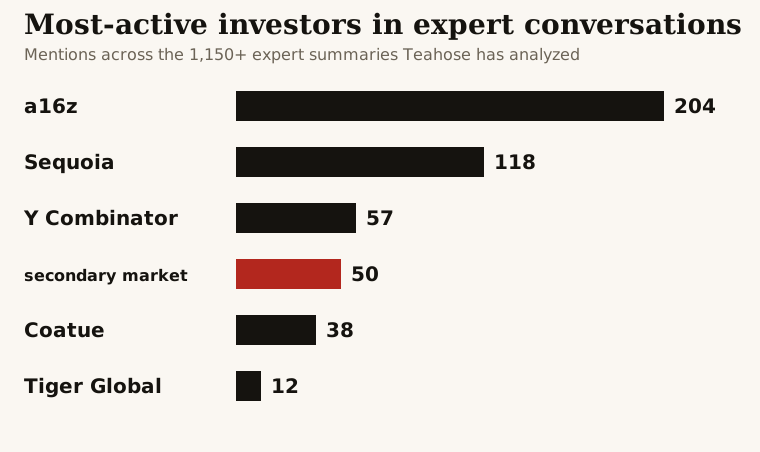
- The demand is real: secondary-market activity surfaced in 122 of the 1,150+ expert conversations we've analyzed. (Methodology: a case-insensitive match for "secondary" across our summary corpus; reproducible, not invented.)
- Pricing is negotiated, not quoted — usually referenced to the last round, often at a discount because common stock lacks preferred-stock protections.
- You need accreditation and the company's cooperation — transfer restrictions and rights of first refusal mean a company can block a sale.
- Four platforms run the market (Forge, Hiive, EquityZen, Nasdaq Private Market), and it's consolidating fast.
Disclosure: Teahose is an independent information and data service — not a broker-dealer, investment adviser, or securities marketplace. We don't facilitate or execute trades, and nothing here is investment advice. Pre-IPO and secondary investing is high-risk, illiquid, and generally restricted to accredited investors.
Primary vs. Secondary, in One Table
| Primary market | Secondary market | |
|---|---|---|
| What's sold | Newly issued shares | Existing shares |
| Who gets the cash | The company | The selling shareholder |
| Typical participants | VCs, the company | Employees, early investors, new buyers |
| Example | A Series C round | An employee selling vested stock pre-IPO |
| Effect on cap table | Dilutes existing holders | Transfers ownership, no dilution |
How a Private Secondary Sale Actually Works
- A shareholder wants liquidity. An employee with vested stock, or an early investor, decides to sell before an IPO.
- A price is found. Via negotiation, a marketplace order book, or reference to the last primary round — usually at a discount to that round.
- The company gets a say. Most private companies have a right of first refusal and transfer restrictions; the sale can only close if the company waives ROFR and approves the buyer.
- The structure is chosen. Either a direct transfer of the shares, or an SPV that pools buyers into one entity holding the position (lower minimum, extra fees).
- It settles. Paperwork, transfer-agent updates, and funds to the seller. There's no instant clearing like a public exchange.
Tender Offers: The Orderly Version
The cleanest secondary is a company-sponsored tender offer — the company sets a price and window and buys back a fixed amount of stock from employees and early investors. Because the company controls who sells and at what price, it avoids the messiness of ad-hoc marketplace listings. Large late-stage companies run these periodically to give long-tenured employees liquidity without forcing an IPO.
Why Discounts (and Sometimes Premiums) Happen
What trades on secondaries is usually common stock, which lacks the liquidation preferences and protections that VCs' preferred stock carries — so it's worth less per share than the headline round price implies. Add seller motivation (employees wanting cash) and buyer caution (illiquidity, limited information), and 10–40% discounts to the last round are common. The exception: scarce, hot names with more buyers than sellers can flip to a premium.
The Platforms That Run the Market
The private secondary market is intermediated by a handful of marketplaces — Forge Global, Hiive, EquityZen, and Nasdaq Private Market — that differ mainly in mechanism. Hiive runs a live order book; others negotiate matches. The sector is consolidating: Charles Schwab completed its acquisition of Forge in 2026, and Morgan Stanley's platform cut EquityZen's minimum to $5,000 in February 2026. To compare the routes and fees in full, see our how to invest in pre-IPO companies guide.
Where the Risk Lives
Liquidity is the headline risk — you may not be able to resell for years — but information asymmetry and SPV fee-layering quietly do as much damage to returns. The pre-IPO investing risks and SPVs guide covers the failure modes; if you're on the other side of the trade, the how to sell pre-IPO shares guide walks through your options as a seller.
The Teahose Angle
A marketplace shows you a price and an order book. What it can't show you is whether a private company is gaining or losing momentum — the thing that actually determines whether today's discount is a bargain or a warning. Teahose tracks funding, product, hiring, and expert-mention signals for over a thousand private companies daily. Check any name on its company profile, watch the live signal feed, or find comparable private companies via lookalikes.
Related: How to invest in pre-IPO companies · How to sell pre-IPO shares · Pre-IPO investing risks & SPVs · Pre-IPO companies to watch in 2026
Editorial as of June 23, 2026. Platform terms and minimums change — verify before acting.
Frequently Asked Questions
What is a secondary market for private company shares?
It is the market where existing shareholders of a private company — usually employees and early investors — sell their stock to new buyers before the company goes public. No new shares are created and the company gets no money; ownership simply transfers from one holder to another, subject to the company's approval. This is the opposite of a primary transaction, where the company issues new shares to raise capital.
How is the secondary market different from the primary market?
In the primary market the company sells newly issued shares and keeps the proceeds (this is what a Series A, B, or C round is). In the secondary market an existing shareholder sells shares they already own to another investor, and the cash goes to the seller, not the company. Secondaries provide liquidity to early stakeholders; primary rounds provide growth capital to the business.
How are private secondary shares priced?
There is no continuous public quote, so price is set by negotiation, an order book, or reference to the last primary round. Secondary shares frequently trade at a discount to the last round (common stock lacks the preferences of preferred stock, and sellers often want liquidity), though hot names can trade at a premium. Marketplaces publish indicative bid/ask data, and SPV-wrapped deals add fees on top, so the "price" you pay and the mark you see can differ meaningfully.
What is a tender offer?
A tender offer is a company-sponsored liquidity event: the company (or an approved investor) offers to buy back a set amount of stock from employees and early investors at a fixed price during a window. It is the most orderly form of secondary because the company controls who can sell, how much, and at what price — unlike ad-hoc marketplace sales, which still require the company to waive its right of first refusal.
Who can buy on a private secondary market?
Generally only accredited investors, because these transactions rely on SEC private-placement exemptions (Regulation D). Buyers also need the company's cooperation — most private companies have transfer restrictions and a right of first refusal, so a sale that the company blocks simply cannot close. That gatekeeping is a core difference from public stock exchanges.
Which platforms run the private secondary market?
The largest are Forge Global, Hiive, EquityZen, and Nasdaq Private Market. They differ in model — Hiive runs a live order book, others negotiate matches — and the space is consolidating: Charles Schwab completed its acquisition of Forge in 2026, and Morgan Stanley's platform cut EquityZen's minimum to $5,000 in February 2026. We reference them neutrally and don't broker any trades.
Why do private secondary shares often trade at a discount?
Three reasons. First, what trades on secondaries is usually common stock, which lacks the liquidation preferences and protections of the preferred stock VCs buy in primary rounds. Second, sellers are often employees who want cash and will accept a haircut for it. Third, illiquidity and information gaps make buyers demand a margin of safety. Discounts of 10–40% to the last round are common, though scarce, high-demand names can flip to a premium.