
You become an accredited investor the moment you meet any one of the SEC's tests — there is no application to submit, no exam to sit, and no certificate to collect. In 2026 the three individual paths are: $200,000 in income ($300,000 with a spouse) for the last two years, $1 million in net worth excluding your home, or an active Series 7, 65, or 82 license. Meet one and you qualify; an issuer simply verifies it when you invest.
Key takeaways:
- It's a status, not a credential. Accreditation is conferred automatically by meeting a threshold — the SEC never "approves" you, and no registry of accredited investors exists. The only step is per-deal verification (a CPA/attorney/broker letter, or your tax and asset documents).
- You don't need $1 million. Net worth is just one of three doors. Two years of $200K+ income, or a single FINRA license, qualifies you with zero net-worth test.
- Demand for what it unlocks is real and growing: pre-IPO and IPO investing came up in 335 of the 1,150+ expert conversations — podcasts, newsletters, and research — that our pipeline has analyzed, more than one in four. (Methodology: a case-insensitive match for "IPO" across our summary corpus, June 2026; reproducible, not a vanity number.) Accreditation is the gate to that private-market access.
- The bar may finally move. The thresholds haven't been inflation-adjusted since 1982. The INVEST Act (House-passed December 2025, now in the Senate) would index them and add knowledge-based pathways — but it is not law yet.
- Accredited is the entry gate, not the top tier. "Qualified purchaser" ($5M+ in investments) and "qualified client" (raised to $1.4M AUM / $2.7M net worth for 2026) are higher bars that unlock additional fund types.
Disclosure: Teahose is an independent information and data service — not a broker-dealer, investment adviser, law firm, or securities marketplace. This guide explains the rules in plain English; it is not legal, tax, or investment advice. Accreditation rules are set by the SEC and change over time — confirm your own status with a qualified professional before investing. Private-market investing is high-risk and illiquid; you can lose your entire investment.
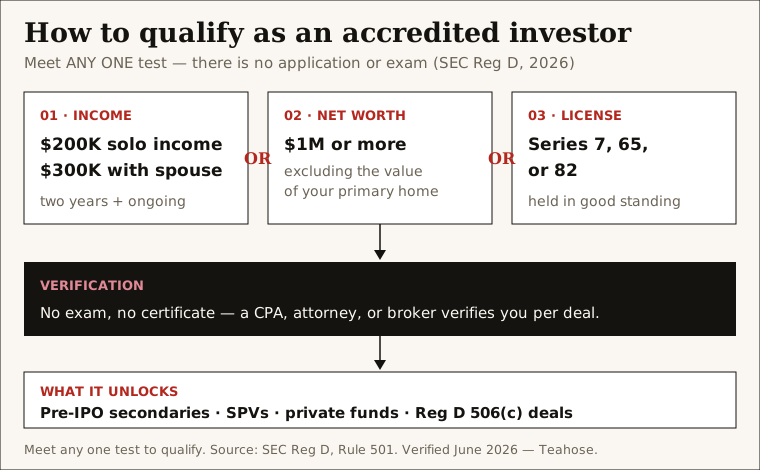
How to become an accredited investor: the three ways to qualify
There is no single "how to become an accredited investor" checklist because you don't do anything to become one — you simply already are one if you meet a test, or you're not. Under SEC Regulation D, Rule 501, an individual qualifies through any one of these:
At a glance — the 2026 accredited investor tests
| Path | Requirement (2026) | Key detail |
|---|---|---|
| Income | $200,000 individual, or $300,000 joint with a spouse/partner | Must hold for the two most recent years with a reasonable expectation of the same this year |
| Net worth | Over $1 million, alone or jointly | Excludes your primary residence; certain mortgage debt counts as a liability |
| Professional license | Active FINRA Series 7, 65, or 82 | No income or net-worth test — qualify on knowledge (added 2020) |
| Knowledgeable employee | Of the private fund you're investing in | Director, executive officer, or employee involved in investing |
| Entity | $5M+ in assets, or all owners accredited | Includes LLCs, trusts, family offices, and registered advisers (see FAQ) |
Verified against SEC Regulation D, Rule 501, June 2026.
Meeting any one row makes you accredited. You do not need to satisfy income and net worth — and the license path deliberately has no wealth requirement at all, because the 2020 amendments recognized that a licensed professional understands the risks regardless of personal balance sheet.
There is no application — how verification actually works
This is the part most explainers gloss over: becoming accredited and proving it are two different things. You become accredited by meeting a test. You prove it at the moment you invest, and how rigorous that proof is depends on the offering type:
- Rule 506(b) offerings — you self-certify. You check a box and represent that you're accredited; the issuer can rely on that unless they have reason to doubt it. No documents required.
- Rule 506(c) offerings (the ones that can be publicly advertised) — the issuer must take "reasonable steps to verify" your status. In practice that means one of: your last two years of tax returns / W-2s (income path), a statement of assets and liabilities plus a credit report (net-worth path), or a letter from a CPA, attorney, registered investment adviser, or broker-dealer confirming you qualify.
Third-party services exist solely to issue that letter, and most marketplaces cache a valid verification for 90 days so you don't re-verify for every deal in that window. There is no government-issued accredited investor card — anyone who offers to sell you one is running a scam.
Accredited investor vs qualified purchaser vs qualified client
These three terms get used interchangeably and they are not the same. They're stacking tiers, each unlocking different fund structures:
| Standard | 2026 threshold (individual) | What it unlocks |
|---|---|---|
| Accredited investor | $200K/$300K income, or $1M net worth, or a Series 7/65/82 license | Reg D private placements (506(b)/506(c)), most VC/PE funds, pre-IPO secondaries, SPVs |
| Qualified client | $1.4M managed by the adviser, or $2.7M net worth (raised for 2026) | Lets a fund manager charge you performance fees (carried interest) |
| Qualified purchaser | Generally $5M+ in investments | Lets a fund use the 3(c)(7) exemption to admit unlimited large investors |
So accreditation is the entry gate. If you ever see a fund described as "3(c)(7)" or "qualified-purchaser only," that's a higher bar than accredited. The 2026 qualified-client figures ($1.4M / $2.7M) reflect the SEC's standard five-year inflation adjustment, effective mid-2026 — the accredited-investor thresholds, notably, did not get the same treatment.
What's changing in 2026 — the INVEST Act
The accredited-investor definition has been a moving target in Congress, and 2026 is the closest it has come to changing in over a decade. In December 2025 the House passed the INVEST Act (H.R. 3383), which would direct the SEC to:
- Add knowledge-based pathways — accreditation based on licensure, education, and demonstrated financial experience, not just wealth, broadening who can qualify.
- Index the thresholds to inflation — adjusting the income and net-worth bars every five years to the nearest $10,000. The current $200K/$300K/$1M figures have sat unchanged since 1982, which is why the pool of accredited investors has quietly ballooned as wages and asset prices rose.
As of mid-2026 the bill is in the Senate and is not yet law — the existing thresholds still govern. But the direction is clear: more pathways, and figures that finally move. We track the legislative and market signals around private-market access as they develop.
What accreditation unlocks — and why most people want it
Accreditation changes nothing about public-market investing; anyone can buy stocks and ETFs. What it opens is the private market: pre-IPO secondary marketplaces, single-company SPVs, venture and private-equity funds, private real-estate syndications, hedge funds, and Reg D placements generally. For most people, the real motivation is straightforward — access to private companies before they go public.
That's where this guide connects to the rest of the pre-IPO toolkit:
- Start with the overview: how to invest in pre-IPO companies — the five real routes, what each costs, and who qualifies.
- Understand the venue: what is a secondary market for private shares.
- Know the downside before you commit: pre-IPO investing risks and SPVs.
- See what's actually still private: pre-IPO companies to watch in 2026, a live-ranked list.
- If you already hold private shares, the other side: how to sell pre-IPO shares.
Want to find the private companies worth your accreditation? Paste any company's website into the Teahose lookalikes tool to surface similar private startups and get their funding and product signals by email — the same intel feed our pipeline builds from those 1,150+ expert conversations.
Bottom line
You don't apply to become an accredited investor — you qualify by meeting one of three SEC tests (income, net worth, or a professional license) and prove it per deal when you invest. You don't need $1 million if your income or a FINRA license clears the bar, your home doesn't count toward net worth, and the rules may broaden if the INVEST Act becomes law. Accreditation is simply the key that unlocks the private, pre-IPO market — the place where most of the demand, and most of the risk, actually lives.
Related guides: QSBS for angel investors · How to invest in pre-IPO companies · What is a secondary market for private shares? · Pre-IPO investing risks & SPVs · Pre-IPO companies to watch in 2026
Frequently Asked Questions
How do you become an accredited investor?
You become an accredited investor automatically the moment you meet any one of the SEC's tests — there is no application to file, no exam to pass, and no certificate to earn. The individual tests are: (1) earned income above $200,000 (or $300,000 jointly with a spouse or domestic partner) in each of the last two years, with a reasonable expectation of the same this year; (2) a net worth over $1 million, alone or with a spouse, excluding the value of your primary residence; or (3) holding a FINRA Series 7, Series 65, or Series 82 license in good standing. When you go to invest, the issuer (or a third party like a CPA, attorney, or broker) verifies that you meet one of these — that is the only "process" involved.
What are the accredited investor requirements for 2026?
As of 2026 the financial thresholds are unchanged from prior years: $200,000 individual income / $300,000 joint income across the two most recent years, OR $1 million net worth excluding your primary home. Since the 2020 SEC amendments you can also qualify by professional credential — an active Series 7, 65, or 82 license — or as a "knowledgeable employee" of a private fund. These income and net-worth figures have not been indexed to inflation since 1982, though the pending INVEST Act would change that (see below).
Do you need $1 million to be an accredited investor?
No. The $1 million figure is the net-worth path, and it is only one of three ways to qualify. You can be accredited with far less than $1 million in net worth if your income clears $200,000 (single) or $300,000 (joint) for two consecutive years, or if you hold a Series 7, 65, or 82 license — a route that has no income or net-worth requirement at all. The license path was added specifically so that financial professionals who understand the risks could qualify on knowledge rather than wealth.
Does my primary residence count toward the $1 million net worth?
No — your primary residence is excluded from the $1 million net-worth calculation. This has been the rule since the Dodd-Frank Act in 2010. Two nuances: any mortgage debt on your home up to its fair market value is also excluded (so it does not count against you), but mortgage debt above the home's value, and any increase in your mortgage in the 60 days before you invest, is counted as a liability. The goal is to stop people from qualifying purely on home equity.
Is there an accredited investor certificate or registry?
There is no government certificate, license card, or central registry of accredited investors. The SEC does not "approve" individuals. Instead, accreditation is verified at the point of investment: under Rule 506(c) offerings, the issuer must take "reasonable steps" to verify your status, which in practice means you provide tax returns and W-2s (income), a statement of assets and liabilities plus a credit report (net worth), or a letter from a CPA, attorney, registered investment adviser, or broker-dealer confirming you qualify. Services like VerifyInvestor exist purely to issue these letters. You typically re-verify periodically or per deal.
What is the difference between an accredited investor and a qualified purchaser?
They are two different (and stacking) bars. An accredited investor meets the Reg D thresholds above and can invest in most private placements, including 506(b) and 506(c) offerings and many funds. A qualified purchaser is a much higher bar — generally an individual with at least $5 million in investments — and is what lets a fund use the 3(c)(7) exemption to take an unlimited number of large investors. There is also a "qualified client" standard (for paying a fund manager performance fees), which the SEC raised for 2026 to $1.4 million in assets managed by the adviser or $2.7 million in net worth. In short: accredited is the entry gate; qualified purchaser and qualified client are tiers above it.
How long does accredited investor verification take?
For a 506(c) deal, third-party verification usually takes anywhere from a few minutes to a few business days, depending on the method. A letter from your CPA, attorney, or broker is the fastest if they already have your financials; uploading tax returns or asset statements to a verification service is next; a full review of complex assets takes longest. Many platforms cache a verification letter for 90 days so you do not re-verify for every deal in that window. For 506(b) offerings, no formal third-party verification is required — you simply self-certify as accredited.
Are the accredited investor rules changing in 2026?
Possibly. In December 2025 the U.S. House passed the INVEST Act (H.R. 3383), which would direct the SEC to (1) add new pathways to accreditation based on licensure, education, and demonstrated financial experience — not just wealth — and (2) index the income and net-worth thresholds to inflation, adjusting them every five years to the nearest $10,000. As of mid-2026 the bill is in the Senate and is not law; the current $200K/$300K/$1M thresholds still apply. If it passes, the financial bars would finally move after sitting still since 1982, and more people could qualify on knowledge rather than money.
What can you invest in once you are accredited?
Accreditation unlocks the private markets that are closed to most investors: pre-IPO secondary marketplaces (buying shares of still-private companies), single-company SPVs, venture and private-equity funds, private real estate syndications, hedge funds, and Reg D 506(c) private placements generally. It does not change anything about public-market investing — anyone can buy public stocks and ETFs. The practical reason most people pursue accreditation is access to private, pre-IPO companies before they list.
Can I become an accredited investor through my LLC or trust?
Yes. An entity can qualify as accredited if it has more than $5 million in assets and was not formed solely to make the investment, or if every equity owner of the entity is themselves an accredited investor. The 2020 amendments also extended entity accreditation to SEC- and state-registered investment advisers, exempt reporting advisers, rural business investment companies, LLCs with $5 million in assets, and family offices managing at least $5 million. Trusts with over $5 million in assets, not formed for the specific investment and directed by a sophisticated person, also qualify. Using an entity is common for pooling family capital or investing through an existing fund structure.