
QSBS — Qualified Small Business Stock — is the most valuable tax break an angel investor can get: it can erase federal tax on up to $15 million (or 10× your cost basis) of gain from a single startup bet. Under Section 1202, if you buy qualifying C-corporation stock at original issuance and hold it long enough, you exclude that gain from federal income tax entirely. The 2025 One Big Beautiful Bill made it dramatically better for angels — you no longer have to wait a full five years to benefit.
Key takeaways:
- The benefit is enormous and specific to early-stage investors. Hold qualifying QSBS five years and pay $0 federal tax on up to $15M of gain per company. The "10× basis" alternative cap means a $2M check can shelter up to $20M of gain.
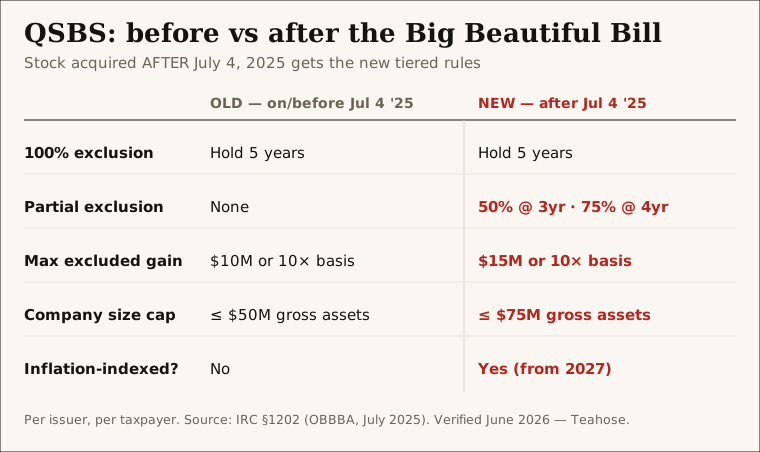
- The Big Beautiful Bill (July 2025) added a tiered holding period: for stock acquired after July 4, 2025, you get a 50% exclusion at 3 years, 75% at 4 years, 100% at 5 years — plus the cap rose from $10M to $15M and the company-size limit from $50M to $75M. Older stock keeps the old all-or-nothing 5-year rules.
- This is the world we cover. Angel investing came up in 34 of the 1,150+ expert conversations our pipeline has analyzed, and startup founders in 838 of them — QSBS is the tax mechanic running underneath that entire ecosystem. (Methodology: case-insensitive matches across our summary corpus, June 2026; reproducible, not vanity figures.)
- The biggest angel trap is the SAFE. Your QSBS clock starts when a SAFE or convertible note converts to stock — not when you wire the money. Track conversion dates.
- Most explainers are written for founders. This one is written for the angel writing the checks — stacking the cap, navigating SAFEs, and the state-tax catch.
Disclosure: Teahose is an independent information and data service — not a tax adviser, law firm, broker-dealer, or accounting firm. This guide explains Section 1202 in plain English; it is not tax, legal, or investment advice. QSBS rules are technical, fact-specific, and changed materially in 2025 — confirm your own eligibility and state treatment with a qualified tax professional before relying on the exclusion. Investing in startups is high-risk; most angel investments lose money.
What is QSBS, and why it's an angel investor's best tax break
QSBS is stock in a small C-corporation that qualifies for the gain exclusion in Internal Revenue Code Section 1202. The deal Congress offers is simple: take the risk of funding a small, active business at its earliest and most fragile stage, hold the stock for years, and if it works, keep the gain federal-tax-free up to a generous cap.
For an angel investor, that changes the math on a winning bet completely. A normal long-term capital gain is taxed at 20% federal (plus the 3.8% net investment income tax). On a $10 million gain, that's roughly $2.38 million to the IRS. If the same stock is QSBS held five years, that federal tax can be zero. The exclusion is per company and per taxpayer, so every qualifying position in your angel portfolio gets its own cap.
QSBS requirements: does your angel investment qualify?
Five tests must all be satisfied. Miss any one and the stock isn't QSBS.
At a glance — the Section 1202 eligibility tests
| # | Requirement | What it means for an angel |
|---|---|---|
| 1 | C-corporation | Must be a domestic C-corp. LLCs and S-corps don't qualify unless they convert before issuing your shares. |
| 2 | Gross assets ≤ $75M | The company's total assets must be at/under the limit when your stock is issued (was $50M; $75M for stock acquired after July 4, 2025). |
| 3 | Original issuance | You must buy the stock directly from the company, not from another shareholder on a secondary market. |
| 4 | Active qualified business | ≥80% of assets used in an active trade or business. Excludes services — health, law, consulting, finance, hospitality, farming. Most tech startups qualify. |
| 5 | Holding period | 3/4/5-year tiers for new stock; a full 5 years for older stock (see next section). |
Verified against IRC §1202 as amended by the OBBBA, June 2026.
The original-issuance rule is the one angels trip on after the fact: shares bought from a founder or early employee on a secondary marketplace are not QSBS, because they weren't issued to you by the company. If you want the exclusion, you generally need to be in the priced round, buying newly-issued stock.
The holding period: 3, 4, or 5 years after the Big Beautiful Bill
Before the 2025 changes, QSBS was all-or-nothing: hold five years for a 100% exclusion, or get nothing. The One Big Beautiful Bill Act introduced a tiered schedule for stock acquired after July 4, 2025:
- 3-year hold → 50% of the gain excluded
- 4-year hold → 75% excluded
- 5-year hold → 100% excluded
The unexcluded portion of a 3- or 4-year sale is taxed at a 28% federal capital-gains rate, not the standard 20%. Stock acquired on or before July 4, 2025 keeps the old rules: a full five-year hold for any exclusion, a $10 million cap, and the $50 million gross-assets test. The practical upshot for angels: an exit at year three or four — common in M&A — now delivers a real tax break instead of nothing.
How much you can exclude: the $15 million cap
The per-company, per-taxpayer cap is the greater of $15 million or 10× your adjusted cost basis (the floor is $10 million for pre-July-2025 stock). The 10×-basis prong is what makes QSBS so powerful for angels who write larger checks at original issuance: invest $3 million and your ceiling is $30 million of excluded gain, double the $15 million floor. Gain above the cap is taxed normally.
QSBS stacking: how angels multiply the cap
Because the cap is per taxpayer, sophisticated angels multiply it by spreading QSBS across multiple taxpayers before a sale — a technique called QSBS stacking or "packing." Gift shares to your children, or to non-grantor trusts you establish, and each recipient gets a fresh $15 million cap. A position headed for a $45 million gain could, split across three qualifying taxpayers, be excluded in full.
Stacking is legitimate and common, but it is genuinely technical: it must be done before a sale or signed term sheet, it interacts with gift and estate tax, and the trusts must be structured correctly to be separate taxpayers. This is a "hire the tax attorney early" move, not a DIY one.
The angel-specific trap: SAFEs, convertible notes, and when the clock starts
Most angels today invest through SAFEs or convertible notes, and both are QSBS landmines. A SAFE or note is not stock — it is a right to receive stock later. That means:
- Your holding clock starts at conversion, not at funding. Fund a SAFE in 2026, see it convert at the next priced round in 2028, and your 5-year (or tiered) clock starts in 2028.
- The $75M asset test is applied at conversion. If the startup has raised past the gross-assets limit by the time your SAFE converts, the stock you receive may not qualify at all — even though the company was tiny when you funded it.
The defensive move is to track conversion dates, push for priced equity where QSBS matters, and ask whether the company will still be under the asset cap at conversion. None of the founder-oriented QSBS explainers foreground this, but it's the issue most likely to cost an angel the benefit.
State taxes: where QSBS doesn't apply
Section 1202 is federal. Most income-tax states conform, but California does not recognize QSBS at all — a California angel pays full state tax on the gain even when federal tax is zero. A few other states (historically New Jersey, Pennsylvania, Alabama, Mississippi) also diverge. Conformity can change and depends on your residency at the time of sale, so confirm your state's treatment before you count on the exclusion.
Where this fits in your angel toolkit
QSBS is the tax layer; getting into qualifying deals is the access layer. To make a QSBS-eligible investment you almost always need to clear the SEC's accredited-investor bar first — see how to become an accredited investor. And if you're weighing private, pre-IPO bets more broadly, start with how to invest in pre-IPO companies, understand the venue in what is a secondary market for private shares (note: secondary purchases generally are not QSBS), and size the downside with pre-IPO investing risks and SPVs.
Sourcing your next angel bet? Paste a startup's website into the Teahose lookalikes tool to surface similar private companies and get their funding and product signals by email — the live intel feed built from the 1,150+ expert conversations behind this guide.
Bottom line
QSBS is the closest thing to a free lunch in the tax code for angel investors: hold qualifying C-corp stock long enough and pay no federal tax on up to $15 million — or 10× your basis — of gain per company. The 2025 Big Beautiful Bill made it materially better, rewarding 3- and 4-year exits for the first time. The catches are specific and avoidable: buy at original issuance, watch your SAFE conversion dates, mind the state-conformity gap, and bring in a tax attorney before any sale if you want to stack the cap. Get those right and a single winning angel check can come back entirely federal-tax-free.
Related guides: How to become an accredited investor · How to invest in pre-IPO companies · What is a secondary market for private shares? · Pre-IPO investing risks & SPVs
Frequently Asked Questions
What is QSBS for angel investors?
QSBS — Qualified Small Business Stock under Internal Revenue Code Section 1202 — is a federal tax break that lets an angel investor exclude a large share of the capital gain on a startup investment from federal income tax. For stock acquired after July 4, 2025, you can exclude 50% of the gain after a 3-year hold, 75% after 4 years, and 100% after 5 years, up to the greater of $15 million or 10× your cost basis per company. It is one of the most valuable tax provisions available to early-stage investors: a qualifying angel check that returns, say, $10 million can come back completely federal-tax-free.
What are the QSBS requirements?
Five core tests must all be met. (1) The company must be a domestic C-corporation. (2) It must have had $75 million or less in aggregate gross assets at and immediately after your stock was issued (the old limit was $50 million; the increase applies to stock acquired after July 4, 2025). (3) You must acquire the stock at original issuance — directly from the company for cash, property, or services, not bought on a secondary market. (4) The company must use at least 80% of its assets in an active qualified trade or business — most tech and product startups qualify; service businesses (law, health, consulting, finance, hospitality, farming) generally do not. (5) You must meet the holding period. Hit all five and your gain is eligible for the Section 1202 exclusion.
How long do you have to hold QSBS?
It depends on when you acquired the stock. For stock acquired after July 4, 2025, the Big Beautiful Bill introduced a tiered holding period: 50% of the gain is excluded at 3 years, 75% at 4 years, and 100% at 5 years. For stock acquired on or before July 4, 2025, the old rule still applies — you must hold for a full 5 years to exclude any gain (it is all-or-nothing, with no partial exclusion). The holding clock starts when you actually receive qualifying C-corp stock, which matters enormously for SAFEs and convertible notes (see below).
How did the One Big Beautiful Bill change QSBS?
The OBBBA, signed in July 2025, made three major upgrades to Section 1202 for stock acquired after July 4, 2025: (1) a tiered holding period — 50% exclusion at 3 years and 75% at 4 years, instead of the old all-or-nothing 5-year wait; (2) the per-issuer exclusion cap rose from $10 million to $15 million, indexed to inflation; and (3) the company-size limit rose from $50 million to $75 million in gross assets, also indexed from 2027. Stock acquired on or before July 4, 2025 keeps the old rules. For angels, the headline is that you no longer have to wait a full five years to get a meaningful tax break — a 3-year exit now shelters half the gain.
What is QSBS stacking?
QSBS stacking (sometimes called "packing") is a planning technique that multiplies the per-issuer exclusion cap. The $15 million (or $10 million for older stock) cap applies per taxpayer, per company — so if you gift QSBS shares to other taxpayers, such as your children or non-grantor trusts you set up, each recipient gets their own separate cap. A single position large enough to generate $45 million of gain could, with three separate taxpayers each under a $15 million cap, be fully excluded. Stacking is legitimate and widely used, but it is technical, must be done before the sale, and requires careful trust and gift-tax structuring — get a tax attorney involved early.
Do SAFEs and convertible notes qualify for QSBS?
Not directly — and this is the single most common angel-investor mistake. A SAFE or a convertible note is not stock; it is a contractual right to receive stock later. The QSBS holding-period clock does not start when you fund the SAFE or note — it starts only when the instrument converts into qualifying C-corp stock, typically at the next priced round. An angel who funds a SAFE in 2026 and sees it convert in 2028 does not start the 5-year (or tiered) clock until 2028. Worse, the company's gross assets are tested at the moment of conversion, so a startup that has since raised past the $75 million asset limit may no longer qualify. Track your conversion dates, not your wire dates.
How much can an angel investor exclude with QSBS?
The cap is the greater of $15 million or 10× your adjusted cost basis in the stock, per company, per taxpayer (for stock acquired after July 4, 2025; the floor is $10 million for older stock). The 10× basis prong is what makes QSBS extraordinary for angels: a $2 million investment supports up to $20 million of excluded gain (10 × $2M), well above the $15 million floor. So the more you invest at original issuance, the larger your potential exclusion. Any gain above the cap is taxed normally, and the unexcluded portion of partially-excluded (3- or 4-year) stock is taxed at a 28% federal capital-gains rate rather than the standard 20%.
Does QSBS apply to state taxes?
Not always. Section 1202 is a federal provision, and most states that have an income tax conform to it — but a handful do not. California, notably, does not recognize the QSBS exclusion at all, so a California resident still owes full California tax on the gain even when the federal tax is zero. A few other states (historically including New Jersey, Pennsylvania, Alabama, and Mississippi) also diverge in whole or part. Because state conformity changes and depends on your residency at sale, confirm your specific state treatment with a tax professional before relying on the exclusion.
Do angel investors need to be accredited to get QSBS?
QSBS itself has no accreditation requirement — the Section 1202 tax benefit depends on the stock and the company, not on the investor's wealth. However, the private placements angels invest in are almost always restricted to accredited investors under SEC Regulation D, so in practice you generally need to be accredited to make the qualifying investment in the first place. The two rules are separate but stack: accreditation gets you into the deal, and QSBS governs how the eventual gain is taxed. See our guide on how to become an accredited investor.
What happens to QSBS if the startup is acquired before 5 years?
It depends on the deal structure and timing. If the company is acquired for cash before you meet any holding tier, the gain is generally taxed as a normal capital gain with no QSBS exclusion. Two tools can help: under Section 1045, you can roll the proceeds of QSBS held more than 6 months into new QSBS within 60 days and carry your holding period forward; and a stock-for-stock acquisition can sometimes preserve QSBS treatment if the acquirer's shares also qualify. With the new tiered rules, an acquisition at 3 or 4 years now at least captures a 50% or 75% exclusion on post-July-2025 stock, where the old rules would have given you nothing short of five years.