
Key takeaways
- In 2026 the most valuable humanoid pure-play is Figure AI ($39B post-money) — but the category now has a real public benchmark: Unitree listed on the Shanghai STAR Market on August 19, 2026 (688836), closed its debut +460%, and trades around a $34B market cap — remarkable context for every private mark on this page.
- The honest ranking is a US–China race: Tesla Optimus on scale, Unitree as the rare profitable (and now public) shipper, AgiBot the volume leader heading to Hong Kong, and Physical Intelligence owning the model layer.
- Humanoid robotics is one of the hottest topics in our corpus: the category came up in 238 of the 1,900+ expert conversations we've analyzed (August 2026), with Unitree alone surfacing in 59 of them.
- Deployment beats demos — Figure's 11-month BMW pilot, Boston Dynamics' committed 2026 Atlas fleet, and 1X's 10,000-unit EQT deal matter more than any keynote video.
- Most guides rank by valuation; what actually predicts the winners is signal slope — funding momentum plus paid-pilot and repeat-order evidence, which is what the live table below tracks.
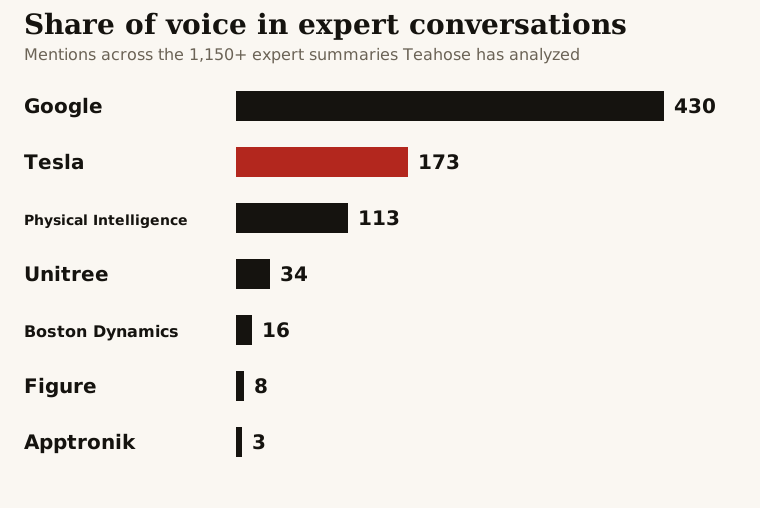
Each bar counts how many of Teahose's 1,900+ expert summaries mention it (word-boundary match across our podcast, newsletter, and paper corpus, August 2026).
Track the field: find the companies most similar to OpenAI and get their latest funding and product signals by email — Teahose Lookalikes.
Mention counts from Teahose's analysis of 1,900+ expert podcast, newsletter & research summaries, August 2026.
At a glance
| Company | Valuation | Status |
|---|---|---|
| Figure AI | $39B post-money | Confirmed (private) |
| Unitree | ≈$34B public market cap (688836, Aug 24, 2026) | Listed Aug 19, 2026 |
| Tesla Optimus | No standalone valuation (inside Tesla) | Confirmed |
| Physical Intelligence | $11B+ (in talks) | Rumored |
| Apptronik | Above $5B | Confirmed (private) |
Who can you actually invest in? The question every other ranking skips — here is the honest map as of August 2026:
| Company | Public status | How to get exposure |
|---|---|---|
| Unitree | Public — Shanghai STAR Market 688836 (listed Aug 19, 2026) | Not directly for Western retail; lagged index ETFs (KOID, KSTR, 3109.HK) or shareholder Meituan (3690.HK) — full routes in our Unitree stock guide |
| Agility Robotics | SPAC signed — CCXI (Nasdaq) converts to AGLT at close, guided 2026 | Buy CCXI in any brokerage today — mechanics in our Agility Robotics stock guide |
| AgiBot | Hong Kong IPO process opened July 2026 | Watch the listing — early state of play in our AgiBot stock guide |
| UBTech / Rainbow Robotics | Public (9880.HK / KOSDAQ 277810) | Direct, with HK/Korea market access |
| Tesla Optimus / Boston Dynamics | Inside Tesla (TSLA) / Hyundai (005380.KS) | Diluted exposure via the parent |
| Figure, Apptronik, 1X, Physical Intelligence, Fourier | Private | Accredited secondaries only |
Humanoid robots crossed a line in the past twelve months: from funding announcements to factory floors. Figure ran a year-long pilot at BMW, Boston Dynamics committed its entire 2026 electric Atlas production to Hyundai and Google DeepMind, Tesla converted a car line to Optimus manufacturing, and Unitree — already profitable — cleared review for China's first pure-play humanoid IPO. The problem with most "top humanoid robot companies" lists is that they were written in January and the league table changed by March.
This one is different: the ranking below is grounded in live signal data from the Teahose intel graph. Teahose tracks 79 humanoid robotics companies live (August 2026 — the theme has quadrupled since June as the pipeline discovers new entrants), with funding, product, and deployment signals extracted daily from 20+ industry podcasts, newsletters, and the day's physical AI research papers — so the live table further down this page stays current even when the editorial ranking ages.
How We Ranked
Three inputs, in order of weight:
- Deployment signals over demos. Paid pilots, repeat orders, committed production, and factory partnerships count; choreographed videos don't.
- Funding momentum. Not just totals — the slope. A round that doubles valuation in months says more than a large but stale war chest.
- Signal volume. How often a company generates substantive funding, product, hiring, and expert-mention signals across the podcasts, newsletters, and research papers we process daily.
One notable omission: Sanctuary AI, a fixture of older lists, stays off this one — leadership churn and a still-prototype-phase platform put it behind the pack on deployment evidence. We drop companies when the signals fade; that's the point of ranking from data.
The Top 10 Humanoid Robot Companies in 2026
1. Figure AI — General-purpose humanoids (Figure 03) plus its own Helix vision-language-action model, after cutting ties with OpenAI. Raised a Series C exceeding $1 billion at a $39 billion post-money valuation in September 2025 — confirmed, and the highest of any humanoid pure-play as of June 2026. Ranked first on the combination of capital, in-house models (Helix 02 shipped January 2026), and real deployment: an 11-month BMW Spartanburg pilot handling 90,000+ parts, now expanding to BMW's Leipzig plant.
2. Tesla Optimus — The scale threat. Tesla began what it calls mass production of Optimus Gen 3 at Fremont in January 2026 and is converting the former Model S line to robot manufacturing, with a V3 reveal expected mid-2026. No standalone valuation — it's a program inside Tesla — and deployed units are still mostly doing internal learning rather than productive work as of June 2026. Ranked second because no one else can credibly talk about millions of units, even if consumer sales remain a 2027-plus story.
3. Unitree Robotics — China's humanoid and quadruped leader, the segment's rarest thing (a profitable company), and now its first true public benchmark. Roughly ¥1.70 billion (~$240M) in 2025 revenue with real net profit, then an H1 2026 print of ¥1.152 billion (+48.5%) disclosed at listing. It priced its Shanghai STAR Market IPO at ¥150.80 (≈$9B) and debuted as 688836 on August 19, 2026, closing +460% before a sharp unwind to a ≈$34 billion market cap by August 24. Ranked third because real revenue and a real listing beat private paper marks — see our Unitree stock guide for the full debut tape, the H1 numbers and what a Western investor can actually buy.
4. Physical Intelligence — Not a robot maker: the model layer. Its π (pi) vision-language-action foundation models aim to be the general policy that runs everyone else's hardware. Confirmed at a $5.6 billion valuation after its $600 million Series B; reportedly in talks for another ~$1 billion at an $11 billion-plus valuation as of March 2026 — rumored, not closed. Ranked this high because if general robot policies work, the model layer captures the margin. Full breakdown in our Physical Intelligence valuation guide.
5. Apptronik — Austin-based maker of the Apollo humanoid, targeting logistics and manufacturing with Mercedes-Benz and GXO pilots. Raised a $520 million extension in February 2026 at a valuation above $5 billion, bringing its (repeatedly reopened) Series A to $935 million — confirmed, with Google and Mercedes-Benz among the leads. Ranked fifth on funding slope plus unusually industrial backers (John Deere, AT&T) that signal customer pull, not just investor FOMO.
6. Boston Dynamics — The 30-year veteran, now Hyundai-owned, finally commercializing: the fully electric Atlas debuted at CES 2026 and its entire 2026 production is committed to Hyundai's Metaplant robotics center and Google DeepMind. Hyundai has announced plans for a US robotics factory capable of 30,000 robots a year. No private valuation to date — it's a subsidiary — but on engineering pedigree and committed deployment it belongs in the top half, as of June 2026.
7. 1X Technologies — The home-robot bet. Its $20,000 NEO humanoid opened US consumer pre-orders in late 2025 with first deliveries promised in 2026, and 1X hedged the consumer timeline with a deal to place up to 10,000 NEO units across EQT's portfolio companies through 2030 — confirmed. Was reportedly seeking around $1 billion in new funding as of late 2025; that round remains unconfirmed as of June 2026. Ranked seventh: the consumer wedge is the boldest strategy on this list, and the least proven.
8. Agility Robotics — Digit, the warehouse bipedal workhorse, with the most pragmatic go-to-market in the segment (robots-as-a-service in logistics, Amazon's fund on the cap table). Raised a reported $400 million round led by WP Global Partners with SoftBank participating, putting its valuation around $2 billion as of 2025 reporting. Ranked eighth: less capital and less hype than the leaders, but among the most hours actually worked by deployed robots.
9. AgiBot (Zhiyuan Robotics) — Shanghai-based humanoid maker founded by ex-Huawei "Genius Youth" engineer Peng Zhihui, with Tencent, BYD, and Hillhouse among its backers. The rumor became a process in July 2026, when AgiBot formally opened its Hong Kong IPO path — and on volume it has already overtaken Unitree, shipping roughly 8,400 humanoids in H1 2026 (about 44% global share) against Unitree's ~5,900. Ranked ninth pending a completed listing; the shipment crown and the strength of its data-collection operation argue it belongs higher — see our AgiBot stock guide for the listing state of play.
10. Fourier — Shanghai's rehab-robotics company turned humanoid maker, which debuted its care-focused GR-3 at CES 2026 — its first major US showing. Roughly $193 million raised in total, including a ~$109 million Series E in January 2025 led by Saudi Aramco-backed Prosperity7 — confirmed, but an order of magnitude less capital than the top five. Ranked tenth: the eldercare and companionship niche is real and underserved, and Fourier's medical-robotics distribution is a genuine moat.
The live table below is the same theme this ranking draws from — pulled fresh from the intel graph, so new entrants and signal spikes show up here before any editorial rewrite.
Humanoid Robot Companies by Signal Volume
Live membership of the humanoid-robots theme · ranked by signals extracted from podcasts, newsletters, and papers
- 01Physical Intelligencelast seen OCT 19201 signals
- 02Unitree Roboticslast seen OCT 1993 signals
- 03Physical Intelligencelast seen OCT 985 signals
- 04Figurelast seen OCT 1556 signals
- 05AgiBotlast seen OCT 1935 signals
- 06Project Prometheuslast seen OCT 1531 signals
- 07Xiaomi Roboticslast seen SEP 2230 signals
- 08Agility Roboticslast seen SEP 1527 signals
- 091X Technologieslast seen OCT 1322 signals
- 10Boston Dynamicslast seen OCT 1519 signals
- 11Mind Roboticslast seen OCT 416 signals
- 12Galaxealast seen OCT 1510 signals
- 13Apptroniklast seen OCT 159 signals
- 14Mondo Roboticslast seen JUN 89 signals
- 15Disney Researchlast seen MAY 148 signals
- 16Waseda Universitylast seen SEP 147 signals
- 17Yuanli Lingji / RoboticXlast seen APR 237 signals
- 18NEURA Roboticslast seen AUG 256 signals
- 19Fourierlast seen OCT 195 signals
- 20LimX Dynamicslast seen OCT 15 signals
How to Evaluate a Humanoid Robot Company
The gap between the demo reel and the deployed fleet is where most of the valuation risk lives. Four tests:
- Deployment over demo. A pilot that converts to a repeat order — like BMW extending Figure from Spartanburg to Leipzig — is worth more than any keynote video. In our signal feed, partnership and product signals are the tell; funding signals are the lagging indicator.
- Data strategy. Humanoid policies are trained on demonstration data: teleoperation hours, simulation scale, fleet learning. Ask where the data advantage compounds — it's why Boston Dynamics is shipping its 2026 fleet to a Hyundai "data factory" and why Physical Intelligence commands a model-layer premium without selling a single robot.
- Unit economics. A $20,000 NEO and a six-figure industrial humanoid imply completely different businesses. Watch hiring signals — manufacturing leads, field-service roles — to see who is actually preparing to support fleets rather than build prototypes.
- Model layer vs. hardware layer. The unresolved structural question of 2026: do robot makers own their intelligence (Figure's Helix, Tesla's FSD lineage) or rent it from foundation-model companies? Whoever is right captures most of the segment's eventual margin.
For the deepest-capitalized name on the list, our Figure AI valuation guide works through what a $39 billion private mark assumes. For the wider field beyond humanoids — manipulation, world models, warehouse automation — see the robotics startups guide, and if you're new to the space, start with what is physical AI.
Keep This List Current Automatically
Static rankings rot; signal feeds don't. Every company above links to a profile with its full signal history, the humanoid robots theme page tracks live membership as new companies emerge, and the Watch button on any profile or theme emails you when something new lands.
Bottom line: There is no single best humanoid robot company in 2026 — Figure AI leads on capital ($39B private), Unitree on proof (profitable, and public since August 19, 2026 at a ≈$34B market cap), Tesla Optimus on scale, AgiBot on H1 shipments, and Physical Intelligence on the model layer; the live table above ranks them by extracted signal volume so you can watch the league table move in real time.
Frequently Asked Questions
What is the most valuable humanoid robot company in 2026?
Among pure-play startups, Figure AI leads at a $39 billion post-money valuation from its September 2025 Series C. Physical Intelligence — which builds the model layer rather than robots — was reportedly in talks at an $11 billion-plus valuation as of March 2026. Tesla’s Optimus program is likely worth more than any of them on paper, but it has no standalone valuation because it lives inside Tesla.
How is this list of humanoid robot companies ranked?
By a blend of funding momentum, deployment evidence, and signal volume from the Teahose intel graph, which extracts funding, product, M&A, and hiring signals daily from industry podcasts, newsletters, and physical AI research papers. Deployment signals — paid pilots, repeat orders, factory partnerships — are weighted over demo videos and raw valuation.
Are any humanoid robot companies publicly traded?
Yes — since August 19, 2026, when Unitree began trading on the Shanghai STAR Market as 688836, the first pure-play humanoid listing anywhere. It priced at ¥150.80 (≈$9B), closed its debut up 460%, and after a sharp four-session unwind trades around a $34 billion market cap (August 24) — though Western retail investors cannot buy STAR shares directly and have to use lagged index ETFs or listed shareholders like Meituan (see our Unitree stock guide). AgiBot opened its Hong Kong IPO process in July 2026, and Agility Robotics is going public via the Churchill Capital XI SPAC (CCXI → AGLT). In the West, Figure, Apptronik and 1X remain private, and Boston Dynamics is owned by Hyundai.
Which humanoid robots are actually deployed, not just demoed?
Figure ran an 11-month pilot on BMW’s Spartanburg X3 line, Boston Dynamics’ electric Atlas fleets are committed to Hyundai and Google DeepMind for 2026, Agility’s Digit works in warehouse pilots, and 1X struck a deal to place up to 10,000 NEO units across EQT portfolio companies through 2030. Tesla’s Optimus units remain mostly internal. Everything else is closer to pilot-or-earlier.
Why are Chinese humanoid robot companies on this list?
Because they’re shipping. Unitree posted roughly ¥1.71 billion ($240M) in 2025 revenue and is profitable — rare in this segment — while AgiBot and Fourier are scaling production and heading to public markets. Any honest ranking of humanoid robot companies in 2026 is a US–China race, not a Silicon Valley listicle.
How can I track these humanoid robot companies over time?
The live table on this page pulls current membership of our humanoid robots theme, ranked by extracted signals. Open any company profile and hit Watch for an email digest when new signals land, or watch the whole theme page to catch new entrants automatically.
Which humanoid robot startup should I watch in 2026?
It depends on the thesis. For raw capital and in-house models, Figure AI at a $39 billion mark is the bellwether. For revenue and a real public listing, Unitree is the one to watch — it is profitable, now trades on the Shanghai STAR Market (688836, since August 19, 2026), and surfaced in 59 of the 1,900+ expert conversations we have analyzed, more than any other humanoid name in our corpus. If you believe intelligence beats hardware, Physical Intelligence is the model-layer bet. The live table above ranks all of them by extracted signal volume so you can see momentum shift in real time.
How many humanoid robot companies are there in 2026?
Far more than any single list can rank well. Teahose tracks 79 humanoid robotics companies live in the humanoid robots theme, and the broader category came up in 238 of the 1,900+ expert podcast, newsletter, and research summaries we have analyzed as of August 2026. The field spans US leaders (Figure, Tesla, Apptronik, Boston Dynamics, 1X, Agility), Chinese shippers (Unitree, AgiBot, Fourier), and model-layer players like Physical Intelligence — and new entrants keep appearing in the live table on this page.
Are humanoid robots actually being used in factories yet?
Yes, but mostly in pilots rather than at full scale. Figure ran an 11-month pilot on BMW's Spartanburg line handling more than 90,000 parts, Agility's Digit is working warehouse pilots, Boston Dynamics has committed its entire 2026 electric Atlas production to Hyundai and Google DeepMind, and 1X struck a deal to place up to 10,000 NEO units across EQT portfolio companies through 2030. Tesla's Optimus units remain mostly internal. In our signal feed, partnership and product signals are the leading indicator of real deployment; funding signals lag behind it.