
Key takeaways
- Physical AI is artificial intelligence that perceives, reasons, and acts in the physical world — robots, vehicles, and machines run by learned foundation models instead of hand-written control code.
- It is a live, fast-moving frontier: physical AI comes up in 218 of the 1,150+ expert podcast, newsletter, and research conversations we have analyzed.
- The category resolves into a four-layer stack — compute and simulation, robot foundation models, bodies, and applications — with Nvidia under most of it and pure-play model labs like Physical Intelligence and Skild betting the brain is worth more than any single body.
- Most guides lead with humanoid valuations; what actually matters is the gap between demo and deployment, because as of mid-2026 nearly all real revenue is still hardware unit sales and pilots.
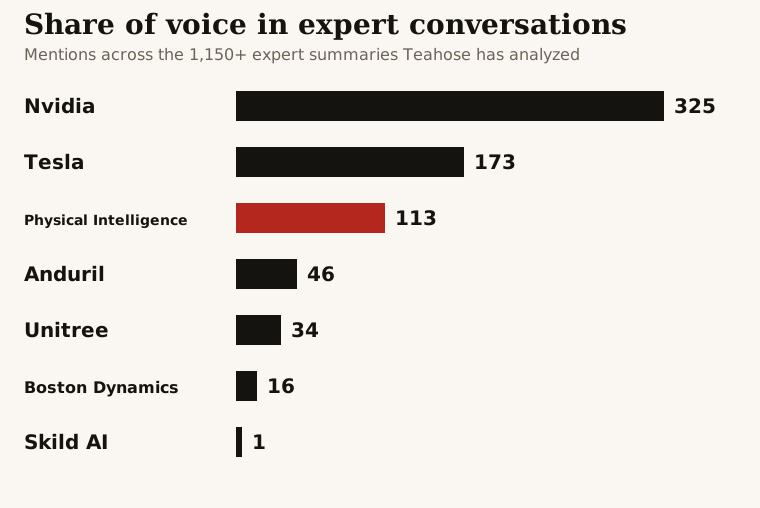
Each bar counts how many of Teahose's 1,150+ expert summaries mention it (word-boundary match across our podcast, newsletter, and paper corpus, June 2026).
Track the field: find the companies most similar to Nvidia and get their latest funding and product signals by email — Teahose Lookalikes.
Mention counts from Teahose's analysis of 1,150+ expert podcast, newsletter & research summaries, June 2026.
Physical AI is artificial intelligence that perceives, reasons, and acts in the physical world — the umbrella term for robots, vehicles, and machines driven by learned models rather than hand-written control code. If the last AI wave put intelligence behind a chat box, this one puts it behind motors.
The term went mainstream around 2024 (Nvidia's framing: AI that "understands the laws of physics"), but the substance is a specific technical bet: the methods that worked for language — big transformers, internet-scale pretraining, fine-tuning — also work for motion. The 2024–2026 results largely vindicated it, which is why this is now one of the most heavily funded frontiers in tech. We track it daily across the physical AI theme, the papers pipeline, and the podcasts where these founders explain themselves.
The Four-Layer Stack
1. Compute & simulation. Nvidia owns this layer the way it owns LLM training — GPUs plus the Isaac/Omniverse simulation stack, where robots rehearse millions of trials before touching reality. World models (learned simulators that predict physics from video) are the research frontier here.
2. Foundation models — the robot brains. Vision-language-action models take camera input plus a language instruction ("fold the towel") and emit motor commands. The pure-play labs: Physical Intelligence (the π series, $5.6B confirmed), Skild AI ($14B+), both betting the brain is worth more than any single body. Track the research at the VLA theme and embodied foundation models.
3. Bodies. Humanoids are the headline form factor — Figure AI (~$39B, 40 robots billing hourly at BMW), Tesla's Optimus, Unitree (5,500+ units shipped in 2025), Agility, Boston Dynamics — but most deployed physical AI is less photogenic: arms, AMRs, drones, and autonomous vehicles (Waymo's 500K+ paid rides a week is the largest physical-AI deployment on Earth).
4. Applications. Manufacturing and logistics first (structured environments, measurable ROI), then defense (Anduril's autonomous systems), agriculture, and — much later than the demos imply — homes.
Why the Money Showed Up
The valuations only make sense against the thesis: labor is the largest market in the economy, and a general robot brain amortizes across all of it. That's why pre-revenue model labs raised at billions (our Physical Intelligence guide walks through the math), why Figure is priced near prime defense contractors, and why Nvidia talks about physical AI as its next compute cycle.
The honest counterweight: as of mid-2026, almost all revenue in the category is hardware unit sales and pilots. The gap between demo and deployment — reliability, cost-per-task, safety certification — is where theses go to die, and it's exactly what the signal feed below is for: tracking which companies convert hype into contracts.
The Live Map
Physical AI Companies by Signal Volume
Live membership of the physical-ai, embodied-foundation-models, and humanoid-robots themes · ranked by extracted signals
- 01Nvidialast seen OCT 211005 signals
- 02Metalast seen OCT 21522 signals
- 03Physical Intelligencelast seen OCT 19201 signals
- 04Teslalast seen OCT 21132 signals
- 05Google DeepMindlast seen SEP 9132 signals
- 06Unitree Roboticslast seen OCT 1993 signals
- 07Physical Intelligencelast seen OCT 985 signals
- 08ByteDancelast seen OCT 1562 signals
- 09Figurelast seen OCT 1556 signals
- 10AgiBotlast seen OCT 1935 signals
- 11Project Prometheuslast seen OCT 1531 signals
- 12Atomslast seen SEP 1130 signals
- 13Xiaomi Roboticslast seen SEP 2230 signals
- 14Agility Roboticslast seen SEP 1527 signals
- 15Generalist AIlast seen AUG 3025 signals
- 16Meckalast seen OCT 2325 signals
- 171X Technologieslast seen OCT 1322 signals
- 18Boston Dynamicslast seen OCT 1519 signals
- 19SenseNovalast seen OCT 1519 signals
- 20arXiv Physical AIlast seen SEP 2318 signals
Going Deeper
- The models: What are VLA models? — the architecture behind the robot brains, with the key papers.
- The valuations: Figure · Skild · Physical Intelligence.
- The rankings: Top physical AI companies · humanoid robot companies · robotics startups, live-ranked · the humanoid robots theme.
- The research: our papers pipeline summarizes the top physical-AI papers daily — the cheapest way to watch the frontier move.
Definitions are stable; figures and the live map are as of June 11, 2026.
Bottom line: Physical AI is intelligence that perceives, reasons, and acts in the real world through learned foundation models instead of hand-written control code — a heavily funded, fast-moving frontier whose central question is still the gap between demo and deployment, since as of mid-2026 nearly all real revenue is hardware unit sales and pilots.
Frequently Asked Questions
What is physical AI?
Physical AI is artificial intelligence that operates in the physical world — systems that perceive an environment through sensors, reason about it with learned models, and act on it through motors, wheels, or arms. It spans humanoid robots, warehouse and manufacturing automation, autonomous vehicles, and drones. The defining shift of the 2024–2026 wave: instead of hand-engineering behavior per task, these systems run foundation models trained on large-scale robot and video data, the way chatbots run on language models.
What is the difference between physical AI and embodied AI?
Mostly emphasis. "Embodied AI" is the older research term: intelligence that learns through having a body and interacting with an environment. "Physical AI" is the broader industry term — popularized by Nvidia around 2024 — covering the whole commercial stack: simulation, robot foundation models, and the machines themselves. In practice the terms overlap heavily, and the companies appear in both conversations.
What are robot foundation models?
Single models trained to control many robots and tasks, rather than one model per task — the "GPT moment" thesis applied to motion. The flagship examples are vision-language-action (VLA) models like Physical Intelligence's π series and Figure's Helix: they take in camera images and a language instruction and output motor actions. Labs betting on hardware-agnostic robot brains (Physical Intelligence, Skild) raised at multi-billion valuations before commercial deployment.
Why did physical AI take off in 2024–2026?
Three curves crossed. Transformer-based models proved they could generalize manipulation from data (the VLA results), simulation got good enough to train in (Isaac, world models), and capital concluded that the labor market is the largest addressable market in the economy. The result: Figure at $39B, Skild at $14B+, Physical Intelligence at $5.6B with a reported round near $11B — valuations priced years ahead of revenue.
What are the biggest physical AI companies?
By 2026 private-market valuation: Figure AI (~$39B, humanoids plus its own Helix models), Skild AI ($14B+, hardware-agnostic robot brains), Physical Intelligence ($5.6B confirmed), plus Tesla's Optimus program, Unitree (the unit-volume leader), Agility, and Boston Dynamics on the hardware side — with Nvidia supplying the simulation-and-compute layer under nearly all of them. The live list below ranks the theme by current signal volume.
Is physical AI actually being discussed by experts, or is it just hype?
It is one of the most-discussed frontiers we track. Physical AI surfaces in 218 of the 1,150-plus expert podcast, newsletter, and research summaries in the Teahose corpus as of June 2026 — a steady drumbeat of founder interviews, funding rounds, and paper breakdowns rather than a one-off spike. That said, expert discussion is a measure of attention, not deployment: the same conversations repeatedly flag that real revenue still lags the demos.
What is an example of physical AI?
The clearest examples: a Waymo robotaxi driving 500K+ paid rides a week, a Figure humanoid running BMW factory tasks on its Helix model, a warehouse arm trained by a vision-language-action model, Tesla's Optimus, and autonomous drones and tractors. The common thread is that each perceives its surroundings through sensors, decides with a learned model, and acts through motors — as opposed to a chatbot, which only produces text. The largest deployed example today is autonomous driving; the most-hyped is humanoid robots; the least visible but most numerous are industrial arms and mobile robots in structured environments.
What are physical AI stocks and how do you invest in physical AI?
Most of the pure-play physical-AI leaders — Figure, Physical Intelligence, Skild — are private, so public exposure is mostly indirect. The cleanest listed proxy is Nvidia, which supplies the simulation-and-compute layer (Isaac, Omniverse, GR00T) under nearly every robot. Beyond it: Tesla (Optimus plus autonomy), the autonomy names (Alphabet via Waymo), and the industrial-automation and sensor suppliers that the robotics buildout pulls along. For private-company exposure, valuations move through venture rounds, which is what the live company map below tracks. This is competitive context, not investment advice.
What is the difference between physical AI and generative AI?
Generative AI produces digital outputs — text, images, code, audio — from a prompt. Physical AI uses many of the same underlying methods (large transformers, internet-scale pretraining) but its output is action in the real world: a motor command, a grasp, a turn of the wheels. The shorthand: generative AI lives behind a chat box, physical AI lives behind motors. The two increasingly converge in vision-language-action models, which read a language instruction and emit physical motion.
How do I keep up with physical AI companies and research?
The field moves week to week, so a static list goes stale fast. Teahose maintains a live physical-AI theme that ranks companies by current signal volume — funding, product launches, hires, and mentions extracted from expert sources — alongside a daily papers pipeline that summarizes the top physical-AI research. The live company map further down this page is the fastest way to see which labs and hardware makers are converting attention into contracts right now.