
Key takeaways
- The top physical AI companies in 2026 span four layers: Nvidia (platform), Figure AI and Physical Intelligence and Skild AI (robot brains and bodies), World Labs (world models), and deployment veterans like Waymo, Agility, and Unitree.
- Physical AI is the densest beat on Teahose: the term appears in 218 of the 1,150+ expert summaries we've analyzed, so the ranking below sits on a live signal graph rather than a one-time press-release roundup.
- Valuations are verified as of June 2026 with confirmed rounds flagged separately from rumored ones — Figure AI ($39B), Skild AI ($14B+), and Physical Intelligence ($5.6B confirmed) lead the new wave; Waymo (~$126B) leads deployed autonomy.
- Most guides rank by funding; what actually matters is the data flywheel and deployment evidence — the live table below re-ranks mechanically by signal volume so it stays current after this analysis ages.
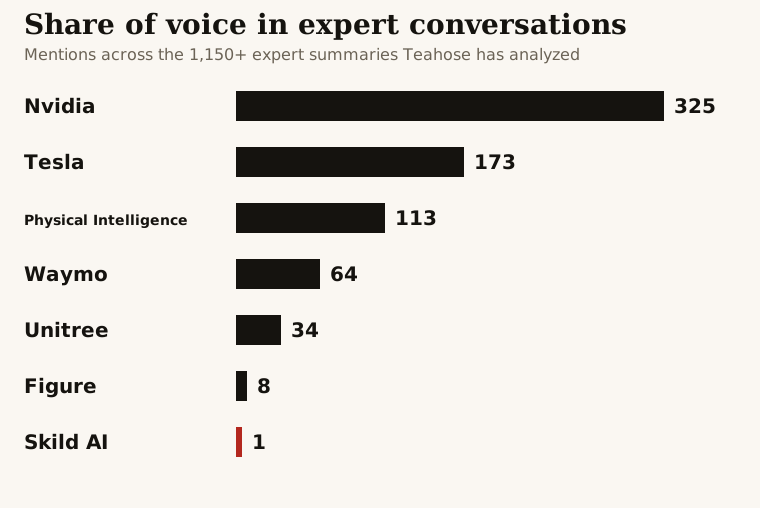
Each bar counts how many of Teahose's 1,150+ expert summaries mention it (word-boundary match across our podcast, newsletter, and paper corpus, June 2026).
Track the field: find the companies most similar to OpenAI and get their latest funding and product signals by email — Teahose Lookalikes.
Mention count from Teahose's analysis of 1,150+ expert podcast, newsletter & research summaries, June 2026.
At a glance
| Company | Valuation (as of June 2026) | Layer |
|---|---|---|
| Waymo | ~$126B | Deployed autonomy |
| Figure AI | $39B | Full stack |
| Skild AI | $14B+ | Robot brain |
| Physical Intelligence | $5.6B confirmed | Robot brain |
| World Labs | ~$5B reported | World models |
Physical AI is the category Teahose exists to track. Every day we extract funding, product, M&A, and hiring signals from industry podcasts, newsletters, and the morning's physical AI research papers — and this market is the core beat. So when we rank the top physical AI companies, it isn't a January listicle assembled from press releases: it's the editorial layer on top of a live intel graph that re-ranks itself daily.
As of June 11, 2026, the Teahose intel graph tracks 30 companies live in the physical AI theme — and the top of the signal leaderboard (Tesla, Google DeepMind, Jeff Bezos's Project Prometheus) shows how fast the category's center of gravity moves.
New to the term? Start with what is physical AI — the definition and the four-layer stack. This page is its companion: who's actually winning each layer.
How We Ranked
- Verified capital, as of June 2026. Every valuation below was re-checked this month. Confirmed rounds are stated as fact; reported-but-unclosed rounds are flagged as rumored. Training-data-stale numbers are the most common error in lists like this — we don't publish them.
- Deployment over demo. Paid pilots, units shipped, and repeat customers outrank choreographed videos.
- Stack position. The list deliberately spans all four layers — platform, foundation models, world models/simulation, and bodies — because the interesting competition is between layers, not just within them.
- The live table below ranks mechanically by signal volume and will diverge from this editorial list over time. That's the point.
The Top 12 Physical AI Companies in 2026
1. Nvidia — the platform everyone else rents. Nvidia owns the compute-and-simulation layer of physical AI the way it owns LLM training: GPUs, the Isaac/Omniverse simulation stack, the open GR00T robot foundation models, and Jetson Thor for onboard inference. In June 2026 it went further down the stack, announcing an open reference humanoid robot — a Unitree H2 chassis with tactile hands and Thor compute, shipping to research labs in late 2026. Jensen Huang calls physical AI a "multitrillion-dollar opportunity"; structurally, Nvidia wins almost regardless of which robot company does.
2. Figure AI — the full-stack flagship. The most valuable pure-play in the category: a Series C exceeding $1B at a $39B post-money valuation (September 2025; Parkway Venture Capital led, with Brookfield, Nvidia, Intel Capital, and Qualcomm Ventures). Figure builds both the body and the brain — its in-house Helix vision-language-action model replaced the OpenAI partnership — and has humanoids billing hourly at BMW. Full breakdown: Figure AI valuation.
3. Physical Intelligence — the robot brain, pure-play. The flagship model-layer lab: the π series of VLA models, hardware-agnostic by design, and the most-cited benchmark reference in recent robotics papers. Confirmed: $5.6B valuation from a $600M round, with over $1B raised to date. Rumored: as of March 2026 the company was reportedly in talks for ~$1B more at a valuation above $11B (Founders Fund and Lightspeed in discussions) — not closed as of this writing. The math behind the price: Physical Intelligence valuation.
4. Skild AI — the other brain, now bigger by paper value. Skild's "omni-bodied" foundation-model bet got the largest confirmed round in the category this year: a $1.4B Series C at a $14B+ valuation (January 2026, SoftBank-led, with NVentures, Bezos Expeditions, and Macquarie), tripling its valuation in seven months to over $2B raised total. Analysis: Skild AI valuation.
5. Tesla (Optimus) — the manufacturing bet. Tesla ranks #1 by signal volume in our theme, and the thesis is unique: nobody else combines a car-scale factory system, an in-house AI training stack, and a captive first customer (its own production lines). Optimus Gen 3 production reportedly began ramping at Fremont in 2026, with commercial availability targeted late 2026 — but Optimus timelines have slipped repeatedly, so treat every date as aspirational until units ship. Context: Tesla competitors.
6. World Labs — the world-model layer. Fei-Fei Li's lab raised $1B in February 2026 (Autodesk anchoring with $200M — its largest startup check ever — plus Nvidia, AMD, and Fidelity), bringing the total to $1.23B at a reported ~$5B valuation. Its first product, Marble, generates persistent, navigable 3D worlds from text or images — the learned-simulation layer that robot training increasingly runs on. Theme: world models.
7. Unitree — the unit-volume leader. While US humanoids raised, Unitree shipped: 5,500+ humanoid robots in 2025 per its own prospectus (the volume crown is contested — Omdia puts rival AgiBot first), a stated target of up to 20,000 units in 2026, and a Shanghai IPO cleared on June 1, 2026 seeking ~$610M — the first embodied-AI listing on China's A-share market. Nvidia choosing the Unitree H2 for its reference humanoid is the co-sign that matters.
8. 1X Technologies — the home bet. The only major lab targeting the household first: its NEO humanoid is priced at $20,000 (or $499/month) with deliveries slated for late 2026, and a deal with EQT to deploy up to 10,000 NEOs across portfolio companies through 2030 hedges the consumer timeline. Confirmed funding is ~$125M through its January 2024 Series B ($820M valuation); a reported ~$1B raise at a $10B+ valuation is rumored, not closed.
9. Apptronik — the industrial partner play. The Austin lab behind Apollo extended its Series A to $935M total with a $520M tranche in February 2026 at a ~$5.3–5.5B valuation — investors include Google, Mercedes-Benz, B Capital, and John Deere, which doubles as a customer pipeline into factories and fields. Apptronik's strategy is the inverse of Tesla's: partner with incumbents who already own the deployment environments.
10. Genesis AI — the synthetic-data dark horse. Emerged from stealth in mid-2025 with a $105M seed co-led by Eclipse and Khosla Ventures — one of the largest robotics seeds ever — betting that a proprietary physics engine can generate the training data real-world fleets collect slowly and expensively. By May 2026 it had gone full-stack, demoing its GENE model on its own dexterous hands. If synthetic data closes the gap, the data-flywheel moat everyone else is building gets cheaper to cross.
11. Agility Robotics — the deployment veteran. Digit was the first humanoid working commercially, and Agility remains the discipline pick: a $400M Series C (2025, WP Global led, with SoftBank and Amazon's Industrial Innovation Fund) at a reported ~$1.75–2.1B valuation, customers including Amazon, and a published cost curve — ~$10–12/hour operating cost today with a path to $2–3. Unsexy numbers, but they're deployment numbers, which most of this list doesn't have yet.
12. Waymo — the proof the category works. The largest deployed physical AI system on Earth: commercial robotaxi operations at a stable ~$126B private valuation. Waymo is on this list as the existence proof — learned driving policies, operating for paying customers at scale — and as the data-flywheel benchmark every robotics company pitches itself against. Adjacent reading: drone companies and defense tech startups cover the autonomy stack's other fronts.
The Live Ranking
Physical AI Companies by Signal Volume
Live membership of the physical-ai and embodied-foundation-models themes · ranked by signals extracted daily from podcasts, newsletters, and papers
- 01Nvidialast seen OCT 211005 signals
- 02Metalast seen OCT 21522 signals
- 03Physical Intelligencelast seen OCT 19201 signals
- 04Teslalast seen OCT 21132 signals
- 05Google DeepMindlast seen SEP 9132 signals
- 06Unitree Roboticslast seen OCT 1993 signals
- 07Physical Intelligencelast seen OCT 985 signals
- 08ByteDancelast seen OCT 1562 signals
- 09Figurelast seen OCT 1556 signals
- 10AgiBotlast seen OCT 1935 signals
- 11Project Prometheuslast seen OCT 1531 signals
- 12Atomslast seen SEP 1130 signals
- 13Xiaomi Roboticslast seen SEP 2230 signals
- 14Agility Roboticslast seen SEP 1527 signals
- 15Generalist AIlast seen AUG 3025 signals
- 16Meckalast seen OCT 2525 signals
- 171X Technologieslast seen OCT 1322 signals
- 18Boston Dynamicslast seen OCT 1519 signals
- 19SenseNovalast seen OCT 1519 signals
- 20arXiv Physical AIlast seen SEP 2318 signals
How to Evaluate a Physical AI Company
Three questions separate the durable companies from the well-funded demos:
- Who owns the data flywheel? Robot policies improve with demonstration data — teleoperation hours, fleet experience, or simulation scale. Ask where a company's data advantage compounds: Tesla and Figure own fleets, Genesis bets on synthetic physics, the model labs rent partners' robots. A company that doesn't control its data source is training on someone else's flywheel.
- Model layer or full stack — and is the strategy honest? The brain-only labs (Physical Intelligence, Skild) and the vertically integrated builders (Figure, 1X, Tesla) can't both be fully right. Watch for strategy drift as a tell: Genesis going full-stack within a year of its seed, and Figure cutting OpenAI to internalize models, both suggest the stack wants to integrate.
- Deployment signal over demo signal. A scripted video is marketing; a repeat order, a published cost-per-hour, or an hourly-billing contract is evidence. In our feed, partnership and product signals are worth more than funding signals for this category — funding measures belief, deployment measures progress. The daily papers feed is the leading indicator on the research side: today's VLA paper is a 12–18-month preview of product capability.
Keep Going
- The concept: What is physical AI? — definition, stack, and why it took off.
- The data layer: Robotics training data — the companies collecting the fuel, ranked by disclosed funding, with real per-hour prices.
- The models: VLA models explained.
- The valuations: Physical Intelligence · Skild AI · Figure AI.
- The segments: humanoid robot companies · robotics startups · industrial automation.
- The live data: the physical AI theme tracks membership and signals continuously — hit Watch on any company profile for an email when something new lands.
Rankings and figures verified as of June 11, 2026; the live table above updates daily.
Bottom line: Figure AI leads the new wave on paper value and Waymo proves the category at scale, but the winners aren't settled — the model-layer-versus-full-stack bet is still open, so track deployment evidence and daily signal volume over headline valuations.
Frequently Asked Questions
What counts as a physical AI company?
Any company whose core product is learned intelligence acting in the physical world: robot foundation models (Physical Intelligence, Skild AI), humanoid and robot hardware running those models (Figure, 1X, Apptronik, Unitree), world models and simulation for training them (World Labs, Genesis AI, Nvidia Isaac), and deployed autonomy (Waymo). Companies doing classical hand-engineered automation without learned policies generally fall outside the category.
What is the most valuable physical AI company in 2026?
Counting deployed autonomy, Waymo — holding a roughly $126B private valuation with commercial robotaxi operations. Among the new wave, Figure AI leads at a $39B post-money valuation from its September 2025 Series C, followed by Skild AI at $14B+ (January 2026 Series C) and Physical Intelligence at $5.6B confirmed, with a reported round in talks near $11B. Nvidia, which supplies the compute and simulation layer under nearly all of them, dwarfs everyone but is not a pure play.
Model layer or full stack — which strategy is winning?
Unresolved, and it is the central strategic question in the category. The model-layer bet (Physical Intelligence, Skild) holds that one hardware-agnostic robot brain amortizes across every body, like an OS. The full-stack bet (Figure, Tesla, 1X) holds that the data flywheel only spins if you control the fleet generating the data — Figure even cut its OpenAI partnership to build Helix in-house. Capital is currently funding both at multi-billion valuations; deployment data over the next two years decides it.
How is this list of physical AI companies ranked?
The editorial top 12 blends verified capital raised (as of June 2026, confirmed rounds flagged separately from rumored ones), deployment evidence, and strategic position in the stack. The live table below it is ranked mechanically by signal volume — funding, product, M&A, and hiring events extracted daily from podcasts, newsletters, and physical AI research papers — so it stays current after this analysis ages.
Do physical AI companies make real revenue yet?
Mostly not at scale. Waymo (paid robotaxi rides) and Unitree (5,500+ humanoid units shipped in 2025, per its IPO prospectus) are the clearest revenue stories; Agility and Figure bill for deployed robot hours in logistics and manufacturing pilots. The foundation-model labs are essentially pre-revenue at multi-billion valuations — priced on the thesis that labor is the largest addressable market in the economy. That gap between valuation and revenue is exactly what deployment signals help you track.
Which physical AI startups should I watch in 2026?
The fastest-moving names to watch are the ones still proving their thesis rather than coasting on a mega-round: Skild AI (largest confirmed round of the year, an omni-bodied robot brain), World Labs (Fei-Fei Li's world-model layer that robot training increasingly runs on), Genesis AI (synthetic-data dark horse betting a proprietary physics engine beats slow real-world data collection), and 1X Technologies (the only major lab targeting the household first with its NEO humanoid). Watching signal volume rather than headline valuation is the better filter — the live table on this page re-ranks daily as funding, product, and hiring events land.
How does Teahose track physical AI companies?
We extract funding, product, M&A, and hiring signals every day from industry podcasts, newsletters, and the morning's physical AI research papers, then map them onto a live company graph. Physical AI is the single densest topic in that corpus — the term shows up in 218 of the 1,150+ expert summaries we've analyzed — so the editorial ranking on this page sits on top of a feed that re-ranks itself mechanically by signal volume, instead of being a static listicle assembled from press releases.
Are robotics and physical AI the same thing?
They overlap but are not identical. Robotics is the broader engineering discipline covering any programmable machine, including classical hand-engineered automation. Physical AI is the narrower category where the intelligence is learned — robot foundation models, vision-language-action policies, and world models that let a system generalize to new tasks and environments rather than follow scripted instructions. A robot arm running fixed code is robotics but not physical AI; a humanoid running a learned policy that adapts on the fly is both.