
Key takeaways
- The top industrial automation companies in 2026 split into two camps: incumbents (Siemens, Rockwell, ABB, Fanuc, Keyence) that own the control layer and installed base, and AI-native challengers (Symbotic, Path Robotics, Bright Machines, Gecko Robotics) winning the variable-part picking, welding, and inspection tasks classical automation never solved.
- Industrial automation surfaces in 10 of the 1,150+ expert conversations we have analyzed, where the recurring pattern is incumbents and hyperscalers acquiring AI capability rather than building it — ABB to SoftBank, Covariant talent to Amazon, Symbotic deepening with Walmart.
- Symbotic is the largest AI-native player by revenue (public, ~$22.5B backlog as of September 2025), while challengers like Path Robotics, Locus, and Agility lead specific brownfield workflows.
- Most guides rank by headline funding; what actually predicts staying power is deployment evidence — paid customers with repeat orders, not demos — which is why the live table below ranks by extracted signal volume.
Mention counts from Teahose's analysis of 1,150+ expert podcast, newsletter and research summaries, June 2026.
At a glance
| AI-native challenger | Focus | Latest confirmed milestone |
|---|---|---|
| Symbotic | Warehouse case-handling | Public (NASDAQ: SYM), ~$22.5B backlog (Sept 2025) |
| Agility Robotics | Humanoid logistics | $400M Series C (2025) |
| Bright Machines | AI-server assembly | $126M Series C (June 2024) |
| Path Robotics | Autonomous welding | $100M Series D (Oct 2024) |
| Gecko Robotics | Inspection robots | $125M Series D at $1.25B (June 2025) |
For fifty years, industrial automation was a settled market: a handful of incumbents — Siemens, Rockwell, ABB, Fanuc, Keyence — sold the controllers, robot arms, and sensors, and a global guild of system integrators bolted them together. What that stack never cracked was variability: parts that differ piece to piece, SKUs that change weekly, weld seams that don’t repeat. That is exactly what learned policies and modern vision models handle, and it is why an AI-native cohort is now taking real revenue in picking, welding, inspection, and assembly while the incumbents reorganize around them — most visibly in SoftBank’s agreement to acquire ABB Robotics.
The Teahose intel graph currently tracks 38 manufacturing companies live — incumbents like Siemens, Fanuc, and Foxconn alongside AI-native entrants like Theker and Layup Parts — with funding, product, and hiring signals extracted daily.
Key takeaways
- The incumbents still own the control layer and the installed base; the challengers own the tasks classical automation never solved.
- The exit pattern is already set: incumbents and hyperscalers buy AI capability (ABB → SoftBank, Covariant → Amazon license-and-hire, Symbotic ↔ Walmart).
- Brownfield retrofit — automation that drops into an existing facility — is where most challenger revenue actually comes from.
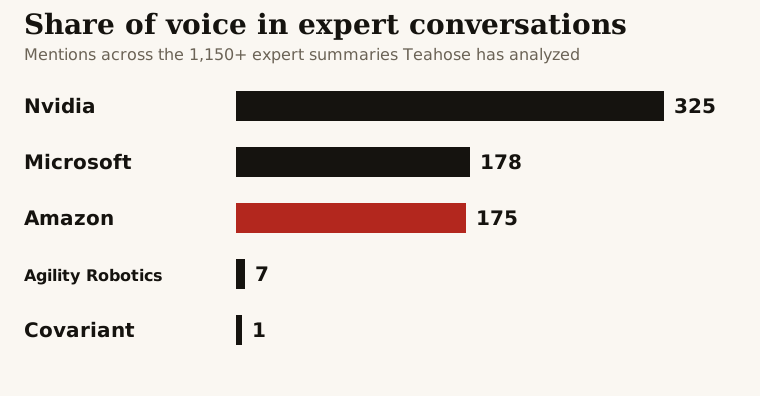
Each bar counts how many of Teahose's 1,150+ expert summaries mention it (word-boundary match across our podcast, newsletter, and paper corpus, June 2026).
Track the field: find the companies most similar to Nvidia and get their latest funding and product signals by email — Teahose Lookalikes.
How We Ranked
This list mixes two kinds of companies on purpose, because buyers compare them on the same purchase orders. Incumbents are ranked on revenue scale and strategic position; AI-native challengers on confirmed funding, deployment evidence (paid customers, repeat orders — not demos), and signal volume in our intel graph. Every funding and valuation figure below is the latest confirmed number as of June 2026, with rumored or source-conflicting figures flagged as such. The live table after the ranking updates daily.
The Top Industrial Automation Companies in 2026
1. Siemens — The broadest incumbent: PLCs, factory software, and the Xcelerator digital-twin stack that increasingly wraps AI around the whole plant. If a factory runs, odds are Siemens controls part of it. Its position in 2026 is less about robots than about owning the software layer every challenger must integrate with.
2. Rockwell Automation — The largest company dedicated purely to industrial automation, and the de facto standard in North American plants via Allen-Bradley controllers and FactoryTalk software. Like Siemens, its moat is the installed base and the integrator ecosystem, not any single product.
3. ABB Robotics — One of the big-four robot-arm makers, and the clearest signal that the old order is repricing: ABB agreed in October 2025 to sell its robotics division to SoftBank for $5.375 billion (2024 division revenue: $2.3 billion), with the deal expected to close in mid-to-late 2026. SoftBank is explicitly buying an AI-robotics platform, not a legacy arm business.
4. Fanuc — The Japanese CNC and robot-arm giant, famous for reliability and for robots building robots in its own lit-out factories. Fanuc is one of the 38 companies tracked live in our manufacturing theme — its partnership and product signals are a good barometer for incumbent AI adoption.
5. Keyence — The machine-vision and sensor leader, and arguably the most profitable company in the sector thanks to a fabless, direct-sales model. Vision is the layer AI is changing fastest, which makes Keyence both the incumbent most exposed to AI-native inspection startups and the best-positioned to absorb the technology.
6. Symbotic — The largest AI-native player by revenue, and public (NASDAQ: SYM). Its case-handling systems automate warehouse distribution end to end, with a backlog of roughly $22.5 billion as of September 2025. The caveat is concentration: more than 84% of fiscal-2025 revenue came from Walmart, a relationship that deepened when Symbotic acquired Walmart’s Advanced Systems and Robotics business in 2025. Confirmed scale, concentrated risk.
7. Agility Robotics — The humanoid company closest to industrial reality: its Digit robot moves totes in logistics facilities, with deployments including a robots-as-a-service arrangement with GXO Logistics. Agility raised a $400 million Series C in 2025 with SoftBank participation; reported valuations for the round range from roughly $1.75 billion pre-money to about $2.1 billion post — treat the precise number as unsettled. For the full segment, see our humanoid robot companies guide.
8. Locus Robotics — The AMR (autonomous mobile robot) category leader for warehouse picking, with bots that work alongside human pickers across hundreds of customer sites and billions of cumulative picks. Last confirmed raise: a $117 million Series F (November 2022) at a valuation near $2 billion; no newer round has been confirmed as of June 2026, though secondary-market estimates run slightly higher.
9. Bright Machines — Software-defined microfactories: modular robotic cells plus vision plus orchestration software, increasingly pointed at the hottest assembly problem of the decade — AI server and data-center hardware. Raised a $126 million Series C in June 2024 led by BlackRock-managed funds with NVIDIA and Microsoft participating, taking total funding past $400 million.
10. Path Robotics — Autonomous welding. Its cells scan a part, find the seam, and weld it without programming — attacking a brutal skilled-labor shortage in metal fabrication. Raised a $100 million Series D in October 2024 led by Matter Venture Partners and Drive Capital.
11. Gecko Robotics — Wall-climbing inspection robots plus an AI platform that turns sensor data into structural-health intelligence for power plants, ships, and heavy manufacturing. Raised a $125 million Series D in June 2025 at a $1.25 billion valuation, led by Cox Enterprises — a unicorn built on inspection, the least glamorous and most contract-rich corner of industrial AI.
12. Covariant — The cautionary structural tale. The AI-picking pioneer’s founders and roughly a quarter of its staff joined Amazon in August 2024, with Amazon taking a non-exclusive license to its robotic foundation models. The remaining company continues serving its picking customers under new leadership. The lesson for the whole cohort: when your model is good enough, the hyperscaler may buy the team rather than the company.
The live table below is the same market, ranked by what is actually happening — extracted signals, updated daily:
Manufacturing & Industrial Automation Companies by Signal Volume
Live membership of the manufacturing theme · ranked by funding, product, M&A, and hiring signals extracted daily
- 01Siemenslast seen OCT 1618 signals
- 02Hadrianlast seen OCT 2014 signals
- 03Chinalast seen OCT 913 signals
- 04BMWlast seen OCT 158 signals
- 05Schneider Electriclast seen OCT 58 signals
- 06Hertha Metalslast seen OCT 67 signals
- 07Multiply Labslast seen OCT 156 signals
- 08Foxconnlast seen SEP 215 signals
- 09U.S. Steellast seen SEP 155 signals
- 10ZETWERKlast seen OCT 204 signals
- 11Nano Dimensionlast seen SEP 294 signals
- 12Scimplifylast seen OCT 203 signals
- 13PlayPowerlast seen OCT 203 signals
- 14Toyotalast seen OCT 73 signals
- 15IPerceptlast seen OCT 53 signals
- 16Augurylast seen OCT 13 signals
- 17KUKAlast seen OCT 13 signals
- 18Caterpillarlast seen SEP 153 signals
- 19Ineoslast seen OCT 202 signals
- 20Machina Labslast seen OCT 192 signals
How to Evaluate an Industrial Automation Company
Industrial automation punishes diligence shortcuts that pure software forgives, so the checklist is its own:
- Brownfield vs. greenfield. Greenfield systems (design the warehouse around the automation) win bigger contracts; brownfield systems (drop into an existing facility without stopping production) win far more of them. Ask which one a company actually sells — a "works anywhere" pitch usually means greenfield economics with brownfield marketing.
- ROI payback period. Industrial buyers approve capital on payback math, and the practical bar is two to three years. Robots-as-a-service pricing (per pick, per weld) exists precisely to delete the capex line — but it moves the risk onto the vendor’s balance sheet, so check gross margins on serviced fleets, not just bookings.
- Services revenue mix. Recurring software and services revenue is what separates an automation company from a machine vendor — it signals systems that stay deployed and customers that renew. The incumbents took decades to build their service arms; challengers that lead with RaaS are trying to start there.
- Deployment over demo. Same rule as the broader robotics startups market: a customer logo with a repeat order beats any video. In our signal feed, partnership and product signals are the tell; funding signals are just fuel.
Keep Watching the Field
Every company above links to a profile with its full signal history — hit Watch on any profile, or on the manufacturing and robotics theme pages, to get new signals by email as they land. For the adjacent segments, see the robotics startups guide and the humanoid robot companies guide.
Bottom line: The top industrial automation companies in 2026 are still the incumbents — Siemens, Rockwell, ABB, Fanuc, and Keyence — who own the control layer and installed base, while AI-native challengers led by Symbotic win the variable picking, welding, and inspection tasks classical automation never solved; the durable winners are the ones with deployment evidence, not the biggest raise.
Frequently Asked Questions
What counts as an industrial automation company?
Any company whose product replaces or augments manual work in factories, warehouses, and industrial facilities: PLCs and control systems, industrial robot arms, machine vision and sensors, warehouse AMRs and picking systems, and the newer AI-native layer — learned manipulation policies, autonomous welding, and inspection AI. The incumbents sell hardware plus decades of integration trust; the challengers sell outcomes, often priced per pick, per weld, or per inspection.
Will AI-native startups displace incumbents like Siemens and Fanuc?
Not soon, and mostly they are not trying to. The incumbents own the control layer (PLCs, safety systems, robot arms) and the installed base; the challengers attack tasks the incumbents never solved — variable-SKU picking, weld seams on one-off parts, visual inspection that previously needed a human. The likelier endgame is the one already visible: incumbents and acquirers buying AI capability, as in SoftBank agreeing to buy ABB Robotics and Amazon licensing Covariant technology.
What are the biggest industrial automation companies in 2026?
By revenue, the incumbents: Siemens, Rockwell Automation, ABB (robotics division sale to SoftBank pending), Fanuc, Keyence, and peers like Mitsubishi Electric and Schneider Electric. Among AI-native players, Symbotic is the largest by revenue — publicly traded with a backlog of roughly $22.5 billion as of late 2025 — followed by private companies like Locus Robotics and Agility Robotics at multi-billion-dollar valuations.
What is the difference between brownfield and greenfield automation?
Greenfield means automating a new facility designed around the system — easier to engineer, and where players like Symbotic shine. Brownfield means retrofitting automation into an existing facility without halting production — harder, but a far larger market, since most of the world’s factories already exist. AMRs (Locus) and standalone robotic cells (Path Robotics) win brownfield deals precisely because they drop into existing workflows.
How is this list ranked and kept current?
The editorial ranking below mixes confirmed revenue scale, funding, and deployment evidence as of June 2026. The live table under it is pulled from the Teahose intel graph: funding rounds, product launches, M&A, and hiring signals extracted daily from industry podcasts, VC newsletters, and research papers, ranked by signal volume across our manufacturing theme.
How can I follow these companies over time?
Open any company profile from the live list and hit Watch for an email digest of its new signals, or watch the manufacturing theme page itself — its membership is live, so newly tracked automation companies sweep in automatically.
Which industrial automation startups are growing fastest in 2026?
By deployment momentum rather than headline funding, the standouts are Symbotic (largest AI-native revenue, public, roughly a 22.5 billion dollar backlog as of September 2025), Path Robotics in autonomous welding, Bright Machines pointed at AI-server assembly, and Gecko Robotics, which crossed a 1.25 billion dollar valuation on inspection robots in mid-2025. The live table below ranks the field by extracted funding, product, and hiring signals so the order reflects what is happening this month, not last year's raise.
Are AI robotics companies a good investment in industrial automation?
The pattern across the conversations we track is that the durable winners attach to a real labor shortage and price by outcome — per pick, per weld, per inspection — rather than selling capex hardware. The risk is concentration and the acquire-the-team exit, as when Amazon licensed Covariant's models and hired its founders instead of buying the company. Diligence the gross margin on serviced fleets and the share of recurring services revenue, not just the bookings number, before treating any single name as a sure thing.
What is the difference between industrial automation incumbents and AI-native challengers?
Incumbents like Siemens, Rockwell, ABB, Fanuc, and Keyence sell the control layer — PLCs, safety systems, robot arms, machine vision — plus decades of integration trust and an installed base every newcomer must interoperate with. AI-native challengers sell learned behavior: manipulation policies, autonomous welding, and inspection models that handle the variable, one-off tasks the classical stack never automated. The likeliest endgame is convergence, with incumbents and hyperscalers buying the AI capability outright.