
Key takeaways
- Tesla has no single competitor — it fights a four-front war (EVs, robotaxis, humanoids, storage), and as of mid-2026 it's behind on three of the four.
- Tesla is mentioned in 173 of the 1,150+ expert conversations we've analyzed, more than any rival on this list — but volume of discussion isn't the same as a competitive lead.
- BYD beats it on EV volume and energy storage; Waymo runs ~500K paid rides/week to Tesla's ~20 active robotaxis; Unitree and Figure both ship humanoids while Optimus isn't commercially available.
- Most "Tesla competitors" lists rank by brand; what actually matters is which front you're scoring — Tesla holds a market cap that assumes leadership in at least two of four it currently doesn't lead.
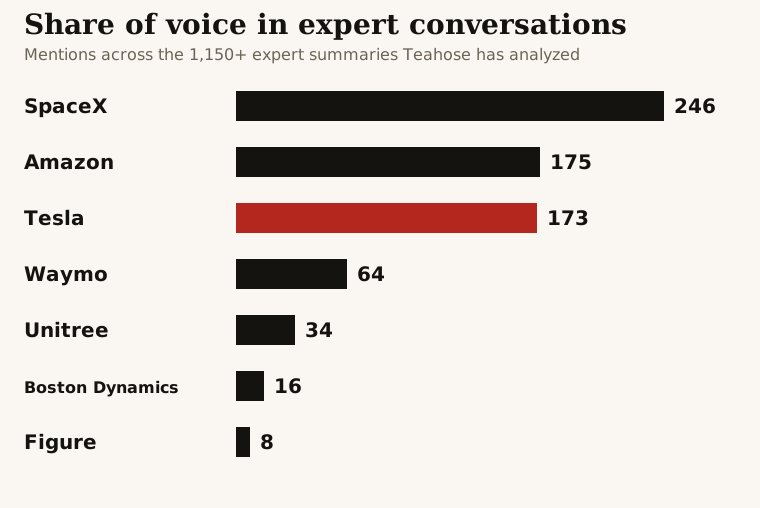
Each bar counts how many of Teahose's 1,150+ expert summaries mention it (word-boundary match across our podcast, newsletter, and paper corpus, June 2026).
Track the field: find the companies most similar to Tesla and get their latest funding and product signals by email — Teahose Lookalikes.
Mention counts from Teahose's analysis of 1,150+ expert podcast, newsletter & research summaries, June 2026.
At a glance
| Front | Tesla's position | Front-leader |
|---|---|---|
| EVs | Contested | BYD (volume) |
| Robotaxis | Behind | Waymo |
| Humanoids | Behind | Unitree / Figure AI |
| Energy storage | Behind | BYD |
Tesla isn't one company competitively — it's four, sharing a ~$1.54 trillion market cap (as of June 8, 2026). Each business has a different rival set, and the scoreboard reads differently on every front. Here's each one, with numbers as of June 10, 2026.
Front 1: EVs — BYD and the Chinese Field
The headline duel flipped twice in six months. Full-year 2025: BYD won decisively — 2.25M battery-EVs to Tesla's 1.64M. Q1 2026: Tesla reclaimed the quarterly crown (358,023 vs 310,389) — but the fine print matters: BYD's 25.5% drop was driven by China subsidy cuts, while Tesla's quarter included a 49% European collapse, a 50,000-car inventory build, and a 14% sequential decline (InsideEVs, Electrek).
The rest of the field, fast:
- Xiaomi — the most important new entrant anywhere: 411K deliveries in 2025 (600K cumulative in 22 months), targeting 550K for 2026 though tracking behind that pace at 150K through May (CnEVPost).
- NIO — mid-2026's momentum story: 37,705 May deliveries, +62% YoY across three brands; with Xpeng (32K, −4%) and Li Auto (33K, −6%), the trio now out-delivers Tesla's China run-rate monthly (CnEVPost).
- The US legacy threat receded: the US EV market fell 27% in Q1 after the tax-credit expiry; Ford Model e lost $777M in the quarter (Ford 8-K), GM has no 2026 EV launches, VW's US sales dropped 20%.
- Rivian & Lucid are niche by comparison — 10,365 and 3,093 Q1 deliveries respectively; Rivian's year rides on the $45K-class R2 ramp.
Score: contested. Tesla holds the quarterly crown on a technicality; the structural volume threat is Chinese and growing.
Front 2: Robotaxis — Waymo's Lead Is the Story
- Waymo: $16B raised at a $126B valuation (February 2026 — Electrek); 500K+ paid rides/week across 10 metros, targeting 1M by year-end; ~577 vehicles in Texas alone.
- Tesla: one year after the Austin launch — ~20 active unsupervised vehicles (42 authorized in Texas filings; 59 total fleet per Bloomberg) across Austin, Dallas, and Houston. The Austin geofence expanded to the full 245-sq-mi metro on June 3 — covered by the same ~20 cars (Electrek). The ramp is explicitly tied to FSD v15 (late 2026/early 2027).
- The rest: Baidu Apollo Go runs one of the world's largest networks (20+ cities, fully driverless in Dubai since April); Pony.ai targets 3,000+ robotaxis in 2026; WeRide is live with Uber in Dubai and Grab in Singapore; Zoox (Amazon) operates Las Vegas and SF, expanding to Austin and Miami.
Score: behind, badly — for now. Tesla's counter-thesis is economics: camera-only hardware plus converting millions of consumer cars via software. If FSD v15 delivers, the fleet math inverts overnight; that's the trade.
Front 3: Humanoids — Optimus Trails Everyone Shipping
Tesla's valuation narrative leans heavily on Optimus, but on June 2026 evidence:
- Unitree shipped 5,500+ units in 2025 — more than everyone else combined — at $14–18K (mostly research/dev buyers).
- Figure AI leads real work: 40 robots billing ~$25/hour at BMW Spartanburg, a factory producing a robot every ~90 minutes — the company our Figure valuation guide marks at $39B.
- Agility (logistics RaaS) and Boston Dynamics (Atlas at Hyundai's Metaplant) own their niches.
- Optimus: not commercially available. Fremont line conversion targets low-volume production late July/August 2026, high volume 2027 — capacity claims are forward-looking Musk statements.
Score: behind on every shipped metric, with the biggest stated ambition (1M units/year designed capacity).
Front 4: Energy Storage — the Quiet Loss
Tesla's fastest-growing, margin-accretive segment lost its crown in 2025: BYD shipped 60+ GWh of grid storage vs Tesla's 46.7 GWh deployed (+49% YoY but now #2), with 8 of the top 10 integrators Chinese (Electrek). The structural irony: Tesla buys Megapack cells from CATL and BYD — its competitors are its suppliers.
The Live View
Tesla's rivals span public giants and private rockets; the feed below ranks its competitive neighborhood as our pipeline reads new signals.
Companies Most Similar to Tesla
Vector similarity against the Teahose company graph · same engine as the /similar lookalikes tool
- 01特斯拉Autonomous Vehicles83% match
- 02Pony.aiAutonomous Vehicles79% match
- 03NuroAutonomous Vehicles76% match
- 04JiyueAutomotive76% match
- 05MomentaAutonomous Vehicles75% match
- 06Lucid MotorsElectric Vehicles75% match
- 07NIOAutonomous Vehicles75% match
- 08BYDAutomotive/EV75% match
- 09Li AutoAutonomous Vehicles74% match
- 10Envision AESCManufacturing74% match
- 11XPengAutonomous Vehicles74% match
- 12Toyota Research InstituteRobotics74% match
- 13Rimac GroupAutomotive73% match
- 14RivianAutomotive/EV73% match
- 15ToyotaAutomotive73% match
How to Read This Market
- Score the fronts separately. "Is Tesla winning?" has four answers: contested (EVs), behind (robotaxis), behind (humanoids), behind (storage) — while holding a market cap that assumes leadership in at least two.
- FSD v15 is the swing variable. It converts the robotaxi scoreboard from fleet-count (Tesla loses) to fleet-conversion (Tesla wins) — or it doesn't, and Waymo's compounding continues.
- Watch China policy. BYD's Q1 stumble was subsidy-driven; both the EV and storage fronts re-rank on Beijing's next move.
Related: Waymo's field — robotics startups, live-ranked · Figure AI valuation · SpaceX valuation (the other Musk listing) · the humanoid robots theme.
Bottom line: Tesla has no single rival — it fights a four-front war, and as of mid-2026 it leads none of them outright: EVs are contested while BYD presses on volume and storage, and Waymo, Unitree and Figure are ahead on robotaxis and humanoids. Its ~$1.54 trillion market cap is a bet that FSD v15 and Optimus reverse fronts it currently doesn't lead.
All figures as of June 10, 2026, sourced inline. The live ranking above updates continuously.
Frequently Asked Questions
Who is Tesla's biggest competitor?
BYD, by volume. BYD out-delivered Tesla across full-year 2025 (2.25M vs 1.64M battery EVs, before counting BYD's even larger plug-in-hybrid business). Tesla reclaimed the quarterly BEV crown in Q1 2026 (358K vs 310K) — but mainly because China's subsidy cuts hit BYD 25%, while Tesla's own quarter included a 49% European collapse and a 50,000-car inventory build. On the future-facing fronts, the bigger threat is arguably Waymo.
Is Waymo ahead of Tesla in robotaxis?
Operationally, by roughly two orders of magnitude. As of mid-2026 Waymo runs 500K+ paid rides per week across 10 US metros (targeting 1M by year-end) at a $126B valuation; Tesla's robotaxi service, a year after its Austin launch, operates about 20 active unsupervised vehicles (42 authorized in Texas, 59 total per Bloomberg) across three Texas metros. Tesla's bet is that camera-only economics plus converting its consumer fleet at FSD v15 lets it scale faster than Waymo's hardware-heavy approach — but in June 2026 that remains a bet, not a result.
Who competes with Tesla Optimus?
On shipped units, Unitree (5,500+ humanoids in 2025, more than everyone else combined, from ~$14–18K). On real commercial work, Figure AI — 40 robots billing ~$25/hour at BMW Spartanburg. Agility's Digit works logistics; Boston Dynamics' electric Atlas pilots at Hyundai. Optimus itself was not commercially available as of June 2026 — low-volume production was targeted for late summer, so Tesla currently trails on every shipped-unit metric in a category central to its valuation.
Are legacy automakers still a threat to Tesla?
Less than in 2024. The US EV market shrank 27% in Q1 2026 after the federal tax credit expired; Ford's EV unit lost $777M in the quarter, GM has no new EV launches for 2026, and VW's US sales fell 20%. In 2026 the real volume competition is Chinese: Xiaomi alone (411K deliveries in 2025, targeting 550K) out-delivers Rivian and Lucid combined several times over, and NIO/Xpeng/Li Auto together now out-deliver Tesla in China monthly.
Is BYD bigger than Tesla in 2026?
On EV volume and energy storage, yes; on market value, no. BYD out-delivered Tesla across full-year 2025 (2.25M vs 1.64M battery EVs) and shipped more grid storage in 2025 (60+ GWh vs Tesla's 46.7 GWh). But Tesla reclaimed the quarterly BEV crown in Q1 2026 (358K vs 310K) and still carries a far larger market capitalization (~1.54 trillion dollars as of June 8, 2026), because its valuation prices in robotaxis and Optimus, not just cars sold today.
Which Chinese companies compete with Tesla?
Across Tesla's fronts the main Chinese rivals are BYD (EVs and energy storage), Xiaomi, NIO, Xpeng and Li Auto (EVs), CATL (battery cells and storage), Baidu Apollo Go, Pony.ai and WeRide (robotaxis), and Unitree (humanoids). The pattern that matters: in storage Tesla buys Megapack cells from CATL and BYD, so several of its toughest competitors are also its suppliers.
What stocks are alternatives to Tesla for EV and robotics exposure?
For investors, the public comparables span EV makers (BYD, NIO, Xpeng, Li Auto, Rivian, Lucid, Ford, GM), autonomy plays (Alphabet via Waymo, Baidu, Pony.ai, WeRide), and battery and storage names (CATL, BYD). Several of Tesla's most direct humanoid and robotaxi rivals — Figure AI, Waymo, Zoox, Unitree — are private, so the cleanest listed proxies remain Alphabet for autonomy and BYD for the EV-plus-storage stack. This is competitive context, not investment advice.
What are the best Tesla alternatives to actually buy in 2026?
If you're shopping for an EV rather than a stock, the most cross-shopped Tesla alternatives in the US are the Hyundai Ioniq 5 and Ioniq 6, the Kia EV6, the Ford Mustang Mach-E, and the Polestar 2 — with the Rivian R1 line (and the cheaper R2 ramping) for the truck/SUV buyer and Lucid for the luxury sedan. BYD and the other Chinese makers out-build all of them on volume globally but aren't sold new in the US. Note this is a different question from "Tesla competitors as stocks" — the best car to buy is rarely the best stock to own, which is why this guide scores Tesla competitively front by front rather than as a single ranked list.