
Defense tech went from venture pariah to one of the most competitive categories in the market in about five years. The combination of cheap autonomy, battlefield-proven drones, procurement reform, and a generation of founders willing to sell to governments produced a wave of startups attacking problems that used to belong exclusively to the primes.
It's also a category where static lists fail fastest: contract awards, new entrants, and consolidation reshuffle the field monthly. So instead of a frozen top-10, the list below is generated live from the Teahose intel graph — funding, product, M&A, and hiring signals extracted daily from investor podcasts and the deal newsletters that cover this space (Axios Pro Rata, PitchBook News, StrictlyVC and others).
Key takeaways
- The ranking below updates continuously from a rolling signal window across our defense-related themes.
- The category clusters into autonomy/drones, multi-domain AI software, and dual-use infrastructure — each with different evaluation criteria.
- Contract and deployment signals beat funding signals here more than in any other AI category: procurement is the moat.
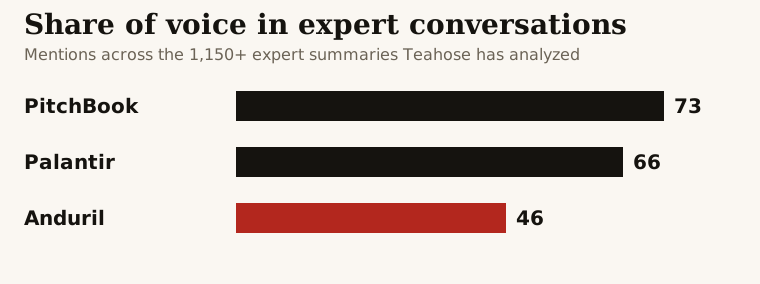
Each bar counts how many of Teahose's 1,150+ expert summaries mention it (word-boundary match across our podcast, newsletter, and paper corpus, June 2026).
Track the field: find the companies most similar to PitchBook and get their latest funding and product signals by email — Teahose Lookalikes.
At a glance
| Cluster | What it builds | Judged on |
|---|---|---|
| Autonomous systems & drones | Unmanned aerial, maritime, ground systems and the counter-drone layer | Cost-exchange and production scaling |
| Multi-domain AI & battle management | Software fusing sensors and coordinating assets across air, land, sea, space, cyber | Multi-domain integration and program wins |
| Dual-use infrastructure | Commercial-core, strategically-capable: space, secure compute, advanced manufacturing, critical minerals | Partnerships into defense rather than direct programs |
Defense is now a real share of expert conversation, not a footnote: the benchmark primes show up across the 1,150+ expert summaries we've analyzed — Palantir in 66 of them and Anduril in 46 — and "defense" comes up in 254. That is the comparison set most new entrants are measured against.
Mention counts from Teahose's analysis of 1,150+ expert podcast, newsletter & research summaries, June 2026.
The Shape of the New Defense Stack
Autonomous systems and drones. The most active cluster — unmanned aerial, maritime, and ground systems, plus the counter-drone layer they created demand for. The lesson of recent conflicts is that attritable autonomy beats exquisite platforms on cost-exchange, and startups can iterate hardware on commercial timelines. Live membership: autonomous defense vehicles theme.
Multi-domain AI and battle management. Software that fuses sensors, coordinates assets, and compresses decision loops across air, land, sea, space, and cyber — the "AI-native prime" pitch. This is where the Anduril/Palantir comparison gets made most often. See the defense AI multi-domain theme.
Dual-use infrastructure. Companies whose core market is commercial but whose capability is strategic: space and on-orbit services, secure compute, advanced manufacturing, and critical minerals. These often enter defense through partnerships rather than direct programs — browse the defense tech theme for the full set.
Defense Tech Startups by Signal Volume
Live membership of our defense-tech, autonomous-defense-vehicles, and defense-AI themes · ranked by extracted signals
- 01Anthropiclast seen OCT 211746 signals
- 02OpenAIlast seen OCT 211657 signals
- 03Googlelast seen OCT 21630 signals
- 04Palantirlast seen OCT 21122 signals
- 05Andurillast seen OCT 1581 signals
- 06Saroniclast seen OCT 1557 signals
- 07Rocket Lablast seen OCT 1946 signals
- 08Castelionlast seen SEP 3021 signals
- 09Boeinglast seen OCT 1518 signals
- 10Armadinlast seen OCT 2018 signals
- 11Lockheed Martinlast seen OCT 616 signals
- 12Mach Industrieslast seen OCT 1614 signals
- 13Saroniclast seen SEP 1114 signals
- 14Claros Technologieslast seen AUG 1413 signals
- 15In-Q-Tellast seen OCT 2012 signals
- 16Shield AIlast seen OCT 812 signals
- 17Section 32last seen SEP 2911 signals
- 18Helsinglast seen OCT 2110 signals
- 19Gravis Roboticslast seen AUG 2410 signals
- 20Cambridge Aerospacelast seen AUG 1610 signals
- 21Iceyelast seen OCT 159 signals
- 22Quantum Systemslast seen OCT 159 signals
- 23Red Cell Partnerslast seen JUL 169 signals
- 24Allen Control Systemslast seen JUL 28 signals
- 25Department of Defenselast seen SEP 198 signals
How to Read Defense Signals
Defense is the category where the gap between announcement and reality is widest. A few rules of thumb from watching the feed:
- Funding ≠ traction. Defense startups raise large rounds on narrative; the signals that predict survival are contract awards, production scaling, and allied-government expansion.
- Watch the hires. Cleared engineering leads, program managers from primes, and manufacturing executives signal a company gearing up for delivery rather than demos.
- Consolidation is constant. The primes and the new winners both acquire aggressively — M&A signals in this category often matter more than new entrants.
- Policy is a market force. Procurement reform and budget cycles move the whole category at once; the macro conversation on investor podcasts is part of the signal, not noise.
Keep Tracking the Category
Every company above links to a profile with its signal history; hit Watch on any profile or theme page to get new signals by email. Adjacent reading: the robotics startups guide (the autonomy talent and tech pool overlaps heavily) and the live top AI startups ranking. The free daily digest covers the defense deals as they land.
Bottom line: The defense tech startups worth watching are the ones generating fresh contract, production, and key-hire signals — not the ones coasting on a year-old round or an oldest brand — so track the live ranking above against the Anduril/Palantir benchmark rather than a static yearly roundup.
Frequently Asked Questions
Why is defense tech suddenly attracting venture capital?
Three forces converged: cheap autonomy (drones and AI made effective systems buildable by startups, not just primes), procurement reform that opened paths for non-traditional vendors, and geopolitical urgency that turned defense from a reputational liability into a thesis for many funds. The result is a generation of software-first companies competing directly with legacy primes on speed.
How is this list of defense tech startups ranked?
By signal count from the Teahose intel graph: funding rounds, contract and product announcements, M&A, and key hires extracted daily from investor podcasts, deal newsletters, and industry coverage. Companies are pulled live from our defense-tech, autonomous-defense-vehicles, and defense AI themes.
What should I look for when evaluating a defense tech startup?
Program-of-record progress beats press releases: pilot contracts, production awards, and allied-government sales are the signals that matter. Defense revenue is lumpy and gated by procurement cycles, so hiring patterns (program managers, manufacturing leads, cleared engineers) often reveal trajectory earlier than announcements do.
Who are the established players new defense startups get compared to?
Anduril and Palantir are the standard benchmarks — proof that a software-first newcomer can win real programs against incumbent primes like Lockheed Martin and RTX. Most new defense startups pitch some variation of "Anduril for X," which makes the comparison set a useful evaluation lens.
What are the fastest-growing defense tech startups right now?
The fastest-moving names are the ones generating fresh signal volume, not the ones with the oldest brand. Our live ranking above re-sorts the defense-tech, autonomous-defense-vehicles, and defense-AI themes by recently extracted funding, contract, product, and hiring signals — so a company landing a production award or a key prime-veteran hire climbs immediately, while a startup coasting on a year-old round drifts down. Check the list rather than a static yearly roundup, because the order changes as deals land.
How big is defense tech as a venture and AI topic in 2026?
It has gone from niche to mainstream in expert discussion. Across the 1,150-plus expert podcast, newsletter, and research summaries Teahose has analyzed, defense surfaces in 254 of them, with the category's two benchmark companies — Palantir in 66 and Anduril in 46 — appearing as the reference point most new startups are compared to. That is a share-of-voice signal that defense is now a standing thesis for many funds, not a one-off.
Are defense tech startups a good investment for venture funds?
They can be, but the diligence differs from consumer or SaaS AI. Defense revenue is gated by procurement cycles and is lumpy, so funding size alone is a weak predictor — program-of-record progress, production awards, and allied-government sales are the durable signals, and hiring patterns (cleared engineers, program managers from primes, manufacturing leads) often reveal trajectory before announcements do. The upside is that a software-first newcomer like Anduril or Palantir has now proven it can take real programs from incumbent primes.
What is the difference between an autonomy startup and an AI-native defense prime?
Autonomy startups build the unmanned systems themselves — aerial, maritime, or ground platforms and the counter-drone layer around them — where the edge is iterating attritable hardware on commercial timelines. An AI-native prime sells the software brain that fuses sensors and coordinates assets across air, land, sea, space, and cyber, compressing the decision loop. Many companies pitch both, but the evaluation criteria diverge: autonomy is judged on cost-exchange and production scaling, the prime layer on multi-domain integration and program wins.