
Key takeaways
- In cash, VCs earn less than the myth: ~$78K base for analysts up to ~$317K for partners — the real wealth is carried interest, which only meaningfully starts at principal level.
- Venture pay is bifurcating: 2025 survey data shows analyst base pay fell 26% year-over-year as AI tooling absorbed the junior sourcing-and-research work, even while partner cash rose.
- Salaries come from management fees (scale with fund size); wealth comes from carry (20% of fund profits, vesting over 4–5 years and paid out across years 7–12).
- Most guides quote a Glassdoor "average"; what matters is structured survey data — Glassdoor's $382K associate figure is triple the real survey median.
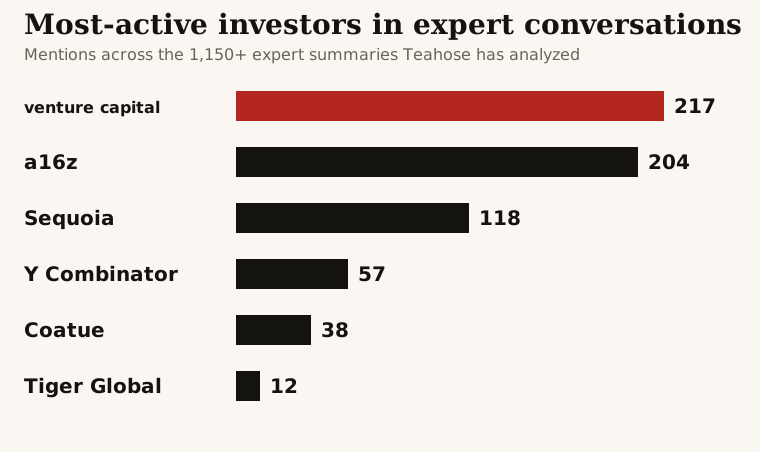
Each bar counts how many of Teahose's 1,150+ expert summaries mention it (word-boundary match across our podcast, newsletter, and paper corpus, June 2026).
Stay ahead: watch how these names move in our live signal feed — new funding, product, and hiring signals as our pipeline detects them.
Compensation figures from the 2025 Gannon/Venture5 survey (700+ respondents) and VC Beast 2026 report; dealflow context drawn from Teahose's analysis of 1,150+ expert podcast, newsletter & research summaries, June 2026.
The honest answer to "how much do VCs make": less in cash than you think, more in carry than you can see — and in 2026, less than last year if you're junior. The numbers below come from the 2025 Gannon/Venture5 survey (700+ respondents, 50+ firms) and the VC Beast 2026 report, not Glassdoor's 64-entry noise.
Compensation by Level (US, 2025–26)
| Level | Avg base (survey) | Total cash range | Carry points |
|---|---|---|---|
| Analyst | $78K (median $80K) | $90–170K | ~0 |
| Associate | $126K (median $130K) | $130–300K | 0–0.5 |
| Senior Associate | $154K | $170–370K | 0.25–2 |
| VP / Principal | $206K (median $200K) | $250–700K | 2–10 |
| Partner | $317K (median $300K) | $400K–$1.8M | 10–50 (of pool) |
Two structural facts explain the table. Salaries come from management fees (~2% of committed capital — bigger fund, bigger payroll), and wealth comes from carry (20% of fund profits). Below principal, you're paid a salary to learn a trade; the equity economics start when you can claim points.
Carry, Actually Explained
The fund returns investors' capital first; of the profit beyond that, the firm keeps ~20% — the carry pool (Carta). Unlike private equity, most VC funds have no preferred-return hurdle, so the pool starts at 1x. GPs keep 60–80% of it; the rest spreads thinly down the team. The worked math:
$500M fund → 3x return → $1B profit → $200M carry pool. A principal holding 2 points: $4M — vesting over 4–5 years, paid as exits happen in years ~7–12, forfeited if you leave early.
That timeline is the under-appreciated part: carry is a decade-long illiquid lottery ticket whose value depends on a fund you joined before its winners were obvious. (What those winners look like as they're priced: see our term sheet and ARR guides — the documents and metrics this job actually consists of.)
The 2026 Story: AI Ate the Analyst Job
The striking result in the 2025 survey: analyst base pay fell 26% (avg $105K → $78K), with every sub-partner level down — while partner pay rose 2% and partners at established firms (5+ funds) out-earned emerging-firm peers $512K to $350K (Newcomer's analysis). The attributed cause: off-the-shelf AI tooling now does the junior work — market maps, sourcing screens, competitive research.
The irony is sharp: the same boom deflating junior VC pay is inflating pay at the companies VCs fund (AI engineers command 10–20% equity premiums per SignalFire), and the fee income from record AI-era funds is raising partner cash at the mega-platforms. Venture is bifurcating into a fee-rich establishment and a carry-hungry emerging class — and the entry-level rung between them is thinning.
Who the Fees Come From
Management fees scale with AUM, which is why comp tracks the firm league table — the full ranking, with the 2025–26 mega-raises, is in our biggest VC firms guide. And the deals those salaries are paid to find:
Companies Moving This Week
Ranked by 7-day signal volume across the podcasts, newsletters & papers the Teahose pipeline reads — the dealflow this profession is paid to catch
- 01OpenAI41 signals · 7d
- 02Anthropic39 signals · 7d
- 03Yahoo28 signals · 7d
- 04Bessemer17 signals · 7d
- 05Vanta14 signals · 7d
- 06Ropedia14 signals · 7d
- 07Google12 signals · 7d
- 08Nvidia12 signals · 7d
- 09Mecka11 signals · 7d
- 10Tesla10 signals · 7d
Related
Biggest VC firms (where the fees are) · What is a term sheet? · ARR meaning · Liquidation preference.
Survey figures are 2025 data (the most recent full survey) reported 2026; ranges are US-market. As of June 11, 2026.
Bottom line: VCs make less in cash than the myth — roughly $78K base for analysts up to $317K for partners — and the real wealth is carried interest that only meaningfully starts at principal level; in 2026, junior pay is shrinking 26% as AI absorbs the entry-level work while partner cash rises.
Frequently Asked Questions
How much do VCs make?
From the 2025 Gannon/Venture5 survey (700+ respondents): average base salary is about $78K for analysts, $126K for associates, $154K for senior associates, $206K for VPs/principals, and $317K for partners. With bonuses, total cash runs roughly $90–170K (analyst), $130–300K (associate), $250–700K (principal), and $400K–$1.8M (partner/GP). The real money is carried interest, which only meaningfully exists from principal level up.
Is VC a high-paying job?
In cash it is comfortable rather than spectacular early on — analysts average ~$78K base and associates ~$126K, less than top-tier investment banking or big-tech engineering at the same stage. The wealth is carried interest, which only meaningfully begins at principal/partner level and pays out across years 7–12 as a fund's investments exit. So VC is high-paying mostly as a long-dated equity bet: modest-to-good salary now, potentially life-changing carry later if the fund performs — and, since 2026, a junior tier whose pay is actually falling as AI absorbs entry-level work.
Does VC or private equity pay more?
Private equity pays more in cash at almost every level, and usually in carry too. PE associates often clear $250–400K total cash versus roughly $130–300K in venture, because PE funds are larger, charge fees on more capital, and run leveraged-buyout economics. Venture's upside is concentration: a partner with points in a fund that returns a breakout winner can out-earn a PE counterpart on a single fund — but it is a lower base, a longer wait, and a higher-variance bet.
How does carry work in VC?
The fund keeps ~20% of profits after returning investors' capital (most VC funds have no preferred-return hurdle, unlike PE). The carry pool splits across the team: GPs keep roughly 60–80%, with associates getting 0–0.5 points, senior associates 0.25–2, principals 2–10, and new partners 7–9. Worked example: a $500M fund returning 3x generates a $200M carry pool; a principal with 2 points earns $4M — paid out as exits happen, typically years 7–12, and forfeited if you leave before vesting (4–5 years).
Why did VC analyst salaries drop in 2026?
The 2025 survey showed analyst base pay falling 26% year-over-year (from ~$105K to ~$78K average), with every sub-partner level down — while partner pay rose. The most-cited explanation (Newcomer's read of the data): AI and data tooling now does the work juniors were hired for — market mapping, competitive research, sourcing screens — compressing demand for entry-level investors even as the AI boom inflates engineer pay at the portfolio companies those VCs fund.
Do small funds or big funds pay more?
Cash scales with fund size, carry concentration runs the other way. Mega-funds ($2B+) pay ~25% above median cash; seed funds under $100M pay ~25–30% below — but hand out more carry per person, and seed-fund managing partners often deliberately take $75–150K salaries to maximize their carry. Partners at established firms (5+ funds) average $512K in cash versus $350K at younger firms.
Is Glassdoor accurate for VC salaries?
No. Glassdoor shows a $382K "average" for VC associates — three times the survey median — based on 64 self-reported entries that mix in growth-equity and corporate-development titles and conflate total pay with salary. Use structured surveys (Gannon/Venture5, Heidrick & Struggles) instead; small self-selected samples in a prestige industry skew badly upward.
What is a good VC salary for an associate?
A realistic associate target in 2026 is roughly $126K base (survey median around $130K), with total cash of $130K to $300K once bonus is included. Anything quoted far above that range usually conflates total compensation with base salary or borrows growth-equity numbers. Carry at the associate level is minimal — typically 0 to 0.5 points — so the cash figure is effectively your whole comp until you reach principal.
Do venture capitalists make more than investment bankers?
Early on, no. A first-year VC analyst or associate often earns less cash than an equivalent investment-banking analyst, because banking front-loads bonuses while venture front-loads learning and back-loads carry. The crossover comes later: a partner with meaningful carry in a fund that returns 3x can clear several million dollars per realized fund — well beyond a typical banking managing director — but only if the fund performs and only after a 7-to-12-year wait.
How long does it take to make carry in venture capital?
Carry is a long, illiquid payout. You generally do not hold meaningful points until principal level, the points vest over 4 to 5 years, and the cash only arrives as portfolio companies exit — usually concentrated in years 7 through 12 of the fund. Leaving before vesting forfeits most of it, which is why carry is best understood as a decade-long bet on a fund you joined before its winners were obvious.
Why is AI affecting venture capital salaries?
The 2025 survey attributed a 26% drop in analyst base pay to off-the-shelf AI tooling now handling the work juniors were hired to do — market mapping, sourcing screens, and competitive research. The same AI boom is simultaneously inflating engineer pay at the portfolio companies VCs fund and lifting fee income at the largest funds, so partner cash rose even as the entry-level rung thinned. The dealflow driving that boom is exactly what Teahose tracks across 1,150+ expert summaries.