
Key takeaways
- A liquidation preference is the right of investors to get their money back (or a multiple of it) before founders and employees see a cent when a startup sells — it decides who gets paid, and in what order.
- 1x non-participating is the 2026 founder-fair standard; participating ("double-dip") and multiples above 1x are structure you should resist harder than you fight headline valuation.
- Preferences stack across rounds into an "overhang" — a company that raised $300M can pay common stock zero on any sale below $300M, the quiet reason heavily-funded-startup options can be worth nothing in a "successful" exit.
- Most guides obsess over valuation; what actually decides your outcome is modeling the mediocre $50–150M exit, where preference — not valuation — is the whole game. The funding rounds adding to these stacks surface live across the 1,150+ expert podcast, newsletter and research summaries the Teahose pipeline analyzes.
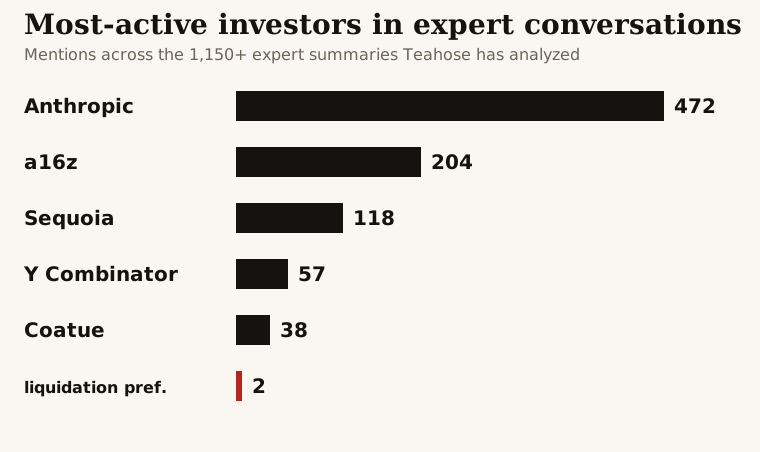
Each bar counts how many of Teahose's 1,150+ expert summaries mention it (word-boundary match across our podcast, newsletter, and paper corpus, June 2026).
Stay ahead: watch how these names move in our live signal feed — new funding, product, and hiring signals as our pipeline detects them.
Drawn from Teahose's analysis of 1,150+ expert podcast, newsletter & research summaries, June 2026.
Liquidation preference is the term-sheet clause that decides who gets paid, in what order, when a startup is sold. Valuation gets the headlines; preference decides the outcomes — because most startups don't exit at the dream number, and in every other scenario this clause is the whole game.
The Mechanics in One Table
Investor puts $10M at 20% ownership. What they take home, by structure:
| Exit price | 1x non-participating | 1x participating | 2x non-participating |
|---|---|---|---|
| $20M | $10M (preference) | $12M ($10M + 20% of rest) | $20M — common gets $0 |
| $50M | $10M (preference) | $18M | $20M |
| $100M | $20M (converts) | $28M | $20M (converts) |
| $500M | $100M (converts) | $108M | $100M (converts) |
Read the columns, not the rows: at big exits the structures converge (everyone converts to ownership); at small and medium exits they diverge violently. Preference is a tax on mediocre outcomes — and mediocre outcomes are the median.
The Three Dials
- Multiple. 1x is standard. Anything higher is structure — common in down rounds and late-stage deals done at flat "headline" valuations where the real price is hidden in the preference.
- Participating or not. Non-participating (choose: money back OR ownership) is the 2026 norm. Participating ("double-dip": money back AND ownership share) shifts meaningful value from common in every non-huge exit; a participation cap (e.g. 3x total return) is the historical compromise.
- Seniority. With multiple rounds, either the latest investors get paid first (senior/stacked — standard when late rounds price aggressively) or all preferred shares share pro-rata (pari passu — more founder- and early-investor-friendly).
The Overhang Problem
Add up every round and you get the preference stack — the exit price below which common stock receives nothing. A company that raised $300M carries (at least) a $300M overhang: a $250M acquisition that reads as a success in the press pays employees' options zero. This is the single most under-explained fact in startup compensation, and it's why sophisticated candidates ask "what's the preference stack?" alongside "what's my equity?" — and why the term sheet terms compound across rounds rather than existing in isolation.
The AI-era version of the problem: enormous rounds at enormous valuations mean enormous stacks. A company that raised $2B has effectively promised that any exit below $2B belongs entirely to investors — fine if you're compounding toward the S-1, existential if growth stalls.
What Founders Should Actually Do
Take the 1x non-participating, fight participation and multiples harder than you fight valuation, prefer pari passu when you have leverage, and model the $50–150M exit before signing anything — it's the scenario where today's structure decides whether your common stock is worth anything. A clean stack is also a hiring asset: your next hundred employees' options depend on it.
The Rounds Adding to Stacks This Week
Companies Raising This Week
Ranked by 7-day signal volume across the podcasts, newsletters & papers the Teahose pipeline reads — every round adds a layer to someone's preference stack
- 01OpenAI41 signals · 7d
- 02Anthropic39 signals · 7d
- 03Yahoo28 signals · 7d
- 04Bessemer17 signals · 7d
- 05Vanta14 signals · 7d
- 06Ropedia14 signals · 7d
- 07Google12 signals · 7d
- 08Nvidia12 signals · 7d
- 09Mecka11 signals · 7d
- 10Tesla10 signals · 7d
The Rest of the Vocabulary
What is a term sheet? · Pre-money vs post-money · ARR meaning · Burn rate · VC salary.
Bottom line: Liquidation preference, not valuation, decides who actually gets paid in the small and medium exits where most startups land — take the 1x non-participating standard, resist participation and higher multiples, and model the $50–150M outcome before you sign.
Structures described are 2026 US venture norms; specific deals vary. As of June 11, 2026.
Frequently Asked Questions
What is a liquidation preference?
The right of preferred shareholders (investors) to get their money back — or a multiple of it — before common shareholders (founders and employees) receive anything when the company is sold or wound down. A "1x preference" on a $10M investment means the first $10M of sale proceeds goes to that investor. It's downside protection: in big exits it usually doesn't bind; in mediocre ones it decides everything.
What does 1x non-participating mean?
The investor chooses one of two: take their money back (1x), or convert to common stock and take their ownership percentage — whichever pays more. They don't get both. This is the standard, founder-fair structure in 2026 US venture. "Participating" preferred takes both — money back first, then a share of the remainder — which is why it's called double-dipping and is mostly confined to down rounds and distressed deals.
How does a liquidation preference work in practice?
Example: investor puts $10M into a company at 20% ownership, 1x non-participating. Company sells for $30M. Option A: take the $10M preference. Option B: convert and take 20% = $6M. Investor takes A ($10M); the remaining $20M goes to common. Sell for $100M instead: 20% = $20M beats the $10M preference, so the investor converts. The crossover point is where preference stops mattering — which is why founders should model the mediocre exit, not the dream one.
What is preference stacking (overhang)?
Each round adds its own preference, and they pile up — usually "last money in, first money out" (senior stacking) or all rounds equal (pari passu). A company that raised $300M total carries a $300M preference stack: in any sale below that, common stock gets zero. This "overhang" is the quiet reason employees at heavily-funded startups can hold options worth nothing in an exit that made headlines.
Is a 2x or 3x liquidation preference bad?
It's expensive and non-standard. A 2x preference on $20M means the first $40M of any exit bypasses common entirely. Multiples above 1x signal either a distressed company accepting structure to get a round done, or an investor pricing real risk. The 2026 norm remains 1x non-participating; founders offered more should usually negotiate valuation down before accepting structure up — structure compounds, headline valuation doesn't.
How does liquidation preference affect employee stock options?
Employees hold common stock, which sits at the bottom of the payout waterfall — behind every preferred round. Your options only have value above the preference stack. If a company raised a $300M stack and exits at $250M, the headline reads "acquired," but common (your options) gets zero. This is why a candidate evaluating an offer should ask "what's the preference stack?" alongside "what's my equity percentage?" — a clean, low stack on a modest valuation can be worth more than a big equity grant sitting under a mountain of senior preference.
Does liquidation preference matter if the company has a huge exit?
Usually not. At a large enough exit, every investor converts to common and just takes their ownership percentage, because that beats the fixed preference amount — so the structures all converge. The clause does its real work in small and medium exits, which is where the median startup actually lands. Founders make the mistake of modeling the dream number, where preference is invisible, instead of the realistic $50–150M outcome, where it decides whether common stock is worth anything.
What is the difference between senior and pari passu liquidation preferences?
It governs the order preferred shareholders get paid relative to each other. Senior (stacked) means the most recent round is paid back first, then the round before it, and so on — "last money in, first money out," common when late rounds price aggressively. Pari passu means all preferred shares share the proceeds pro-rata at the same level, which is friendlier to founders and early investors. When you have leverage, push for pari passu; stacked seniority quietly subordinates everyone who funded the company earlier.