
Key takeaways
- Post-money valuation equals pre-money plus the new investment, and investor ownership is always investment ÷ post-money — so confusing the two silently moves real equity.
- Across the 1,150+ expert podcast, newsletter & research summaries the Teahose pipeline has analyzed, when a round is reported "at a $X valuation" it is almost always the post-money figure — the number that actually determines who owns what.
- The option-pool shuffle hides dilution inside the pre-money, so a headline pre-money can overstate the true valuation to existing holders by ~12%.
- Most guides stop at the definitions; what matters in practice is comparing offers on effective price per share, the one number the pool shuffle and convention games can't disguise.
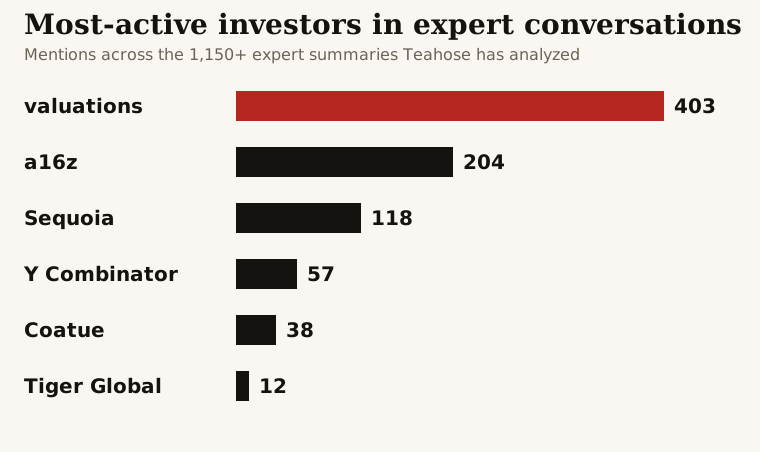
Each bar counts how many of Teahose's 1,150+ expert summaries mention it (word-boundary match across our podcast, newsletter, and paper corpus, June 2026).
Stay ahead: watch how these names move in our live signal feed — new funding, product, and hiring signals as our pipeline detects them.
Mention and convention counts from Teahose's analysis of 1,150+ expert podcast, newsletter & research summaries, June 2026.
Post-money = pre-money + the new investment. That one line is the whole concept — and yet the ambiguity between the two quietly moves more ownership than most term-sheet negotiations, because every other number in a deal keys off which one you meant.
The Arithmetic
A $5M investment, four ways of saying the same two deals:
| Quote | Pre-money | Post-money | Investor owns |
|---|---|---|---|
| "$5M at $20M pre" | $20M | $25M | 20.0% |
| "$5M at $25M post" | $20M | $25M | 20.0% |
| "$5M at $20M post" | $15M | $20M | 25.0% |
| "$5M at a $20M valuation" (ambiguous) | ? | ? | 20% or 25% |
The rule that resolves everything: ownership = investment ÷ post-money. Convert every offer to post-money before comparing. Founders default to quoting pre (bigger number, less dilution implied); the convention at seed has swung post (see SAFEs below); headlines use whichever is larger. When our pipeline reports "[Company] raised at a $2B valuation," that's almost always post-money — it's the number that determines what everyone owns.
The Option-Pool Shuffle
The reason pre-vs-post is a negotiation topic and not just vocabulary. The standard term sheet says: "$20M pre-money, including an option pool equal to 10% of the post-closing capitalization." Translation: before the investor's money counts, you create new employee options out of the existing shareholders' ownership. The investor's 20% is untouched; your effective pre-money just dropped by roughly the pool's value.
Worked: $5M at $20M pre with a 10% post-close pool. The pool (~$2.5M of value) comes out of the pre-money, so the "true" pre-money for existing holders is ~$17.5M. Same headline, ~12% worse founder outcome. The standard counters: size the pool from an actual hiring plan (not a round 10–15%), or push the pool creation post-money so the dilution is shared. Either way, compare offers on effective price per share — it's the only number the shuffle can't hide in. (The other clause that decides real outcomes is the liquidation preference; together they're most of what matters in a term sheet.)
Why SAFEs Made Post-Money the Default
Y Combinator's 2018 revision of the SAFE — the instrument most seed money now arrives on — switched its valuation cap from pre-money to post-money. The investor's ownership became exact (investment ÷ cap, no dependence on what other SAFEs exist), and the dilution from stacking multiple SAFEs moved onto founders alone. It's cleaner and it's a known trap: each additional post-money SAFE dilutes only the founders, so a company that raises $1M, then $1.5M, then $2M on caps it never tracked can arrive at its Series A with far less founder ownership than anyone realized. If you're stacking SAFEs, maintain a live cap table model — the priced round will build one whether you did or not.
Where These Numbers Come From This Week
Every valuation in the feed below is a post-money print someone negotiated from a pre-money anchor.
Companies Raising This Week
Ranked by 7-day signal volume across the podcasts, newsletters & papers the Teahose pipeline reads
- 01OpenAI41 signals · 7d
- 02Anthropic39 signals · 7d
- 03Yahoo28 signals · 7d
- 04Bessemer17 signals · 7d
- 05Vanta14 signals · 7d
- 06Ropedia14 signals · 7d
- 07Google12 signals · 7d
- 08Nvidia12 signals · 7d
- 09Mecka11 signals · 7d
- 10Tesla10 signals · 7d
The Rest of the Vocabulary
What is a term sheet? · Liquidation preference · ARR meaning · Burn rate · VC salary.
Bottom line: Pre-money and post-money differ only by timing — post-money is pre-money plus the new investment — but the difference silently moves real ownership, so convert every offer to post-money and compare on effective price per share, the one number the option-pool shuffle and convention games can't disguise.
Conventions described are 2026 US venture norms. As of June 11, 2026.
Frequently Asked Questions
What is the difference between pre-money and post-money valuation?
Timing. Pre-money is what the company is valued at before the new investment goes in; post-money is that value plus the new money. Raise $5M at a $20M pre-money and the post-money is $25M — the investor owns $5M ÷ $25M = 20%. The same deal quoted as "$5M at $25M post" is identical. The error to avoid: hearing "$20M valuation," assuming it's post-money, and discovering you sold 25% ($5M ÷ $20M) instead of 20%.
How do you calculate investor ownership?
Always: investment ÷ post-money. That's the one formula to memorize. $2M into a $10M post-money = 20%. $2M at a "$10M pre" = $2M ÷ $12M = 16.7%. When negotiating, founders should convert every offer to post-money terms first — it's the number dilution actually comes from, and it's why the convention you quote in changes the deal by several points of ownership.
What is the option-pool shuffle?
The standard term-sheet move where the investor requires the employee option pool to be created or expanded before the round — inside the pre-money. The dilution from the new pool then lands entirely on existing shareholders rather than being shared with the new investor. A "$20M pre-money with a 10% post-closing pool" is economically a materially lower valuation than the headline suggests. The counter: negotiate the pool size against a real 12–18-month hiring plan, and evaluate offers on effective price per share, not headline pre-money.
Are SAFEs pre-money or post-money?
Post-money, since Y Combinator revised the standard SAFE in 2018 — and that's now the dominant seed instrument. A post-money SAFE's valuation cap defines the investor's ownership precisely (investment ÷ cap), with dilution from multiple SAFEs falling on founders rather than being mutually shared as under the old pre-money SAFE. It made ownership math clean for investors and made it founders' job to track cumulative SAFE dilution — stack several post-money SAFEs carelessly and you can give away a third of the company before a priced round.
Is a reported startup valuation pre-money or post-money?
When the press or a funding tracker says a company "raised at a $X valuation," it is almost always the post-money figure — pre-money plus the new check. That is the convention you should assume across the 1,150+ expert summaries the Teahose pipeline has analyzed: the post-money is the number that fixes what every shareholder owns, so it is the one the market quotes. If a number is described as a "pre," it will usually say so explicitly. When in doubt, ask which one is meant before doing any ownership math.
How do I convert a pre-money valuation to post-money?
Add the new investment. Post-money equals pre-money plus the amount being raised, so a $20M pre-money with a $5M round is a $25M post-money. To go the other way, subtract: a $25M post-money on a $5M raise implies a $20M pre-money. Once you have the post-money, ownership is just investment divided by post-money — $5M ÷ $25M = 20%. Doing this conversion first is the single habit that prevents the most common term-sheet mistake.
Why does pre-money vs post-money matter so much for founders?
Because the same headline number can hand an investor very different ownership depending on which convention is meant, and a few points of ownership compound across every later round. Quoting "$5M at a $20M valuation" can mean the investor takes 20% (if it is a pre-money) or 25% (if it is a post-money) — a quarter of the difference in what you sell. Layer in the option-pool shuffle, which buries dilution inside the pre-money, and the headline can overstate your true valuation by roughly 12%. Founders who convert every offer to post-money and compare effective price per share avoid giving away ownership they did not intend to.