
Key takeaways
- Burn rate is how fast a company spends cash each month; runway is how many months until that cash hits zero (cash ÷ net burn).
- Burn and runway come up in 51 of the 1,150+ expert podcast, newsletter & research conversations we've analyzed — and the recurring lesson is that the metric founders misread isn't burn, it's the burn multiple.
- Gross burn = total cash out; net burn = cash out minus revenue; the burn multiple (net burn ÷ net new ARR) is what investors actually price.
- Most guides obsess over cutting burn; what matters is burn productivity — high burn with a sub-1.5x multiple is a growth machine, high burn with a 3x multiple is a countdown timer.
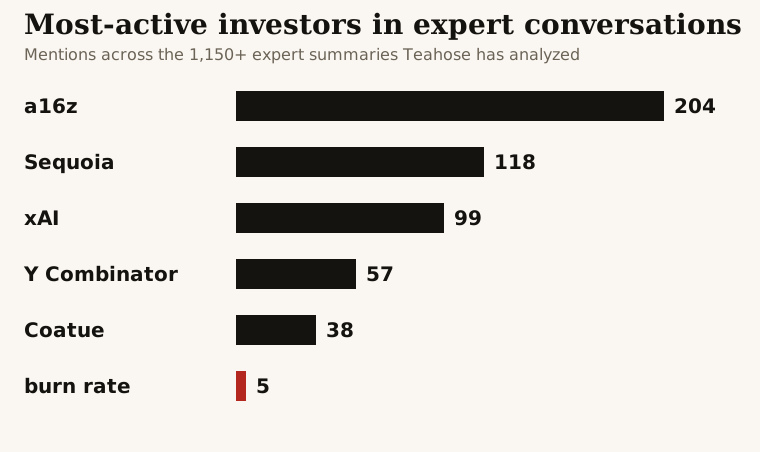
Each bar counts how many of Teahose's 1,150+ expert summaries mention it (word-boundary match across our podcast, newsletter, and paper corpus, June 2026).
Stay ahead: watch how these names move in our live signal feed — new funding, product, and hiring signals as our pipeline detects them.
Mention counts from Teahose's analysis of 1,150+ expert podcast, newsletter & research summaries, June 2026.
Burn rate is how fast a company spends cash; runway is how long until the cash is gone. Two numbers, one division, and yet misreading them is still among the most common ways startups die — because the inputs move and the deadline is invisible until it's close.
The Definitions
| Term | Formula | What it tells you |
|---|---|---|
| Gross burn | total monthly cash out | your cost structure |
| Net burn | cash out − cash in | what the bank balance loses monthly |
| Runway | cash ÷ net burn | months until zero |
| Burn multiple | net burn ÷ net new ARR | what each dollar of growth costs |
Investors quote all four, but they price the last one. A company burning $1M/month while adding $1M of new ARR monthly (burn multiple 1x) is efficient at any scale; a company burning $200K to add $50K (4x) has a problem no cost cut fixes.
The Runway Math Founders Get Wrong
- Burn is a forecast, not a history. Last month's burn understates next year's if you're hiring. Model the planned team, not the current one.
- The real deadline is fundraise-start, not zero. A round takes 3–6 months; raising with under six months of cash is negotiating under duress, and term sheets price that. Treat "runway minus nine months" as the date that matters — and what happens at that table is the term sheet.
- Revenue quality changes the math. Usage-based revenue can fall as fast as it rose; contracted subscriptions can't. Two companies with identical net burn can have very different real runway — the ARR guide covers exactly this distinction.
What "Good" Looks Like in 2026
The post-2022 efficiency religion still holds for ordinary software: burn multiples under 1.5x, default-alive as the goal, growth funded increasingly from revenue. Then there's AI, which runs on different physics: compute spend turned burn into something closer to a manufacturing cost, and the top of the market normalized numbers that would have been obituaries in 2019 — frontier labs burn billions a quarter (xAI's S-1 disclosure: a $6.4B operating loss in 2025 — the full story) against revenue ramps fast enough to keep the multiple defensible.
The reconciliation: burn rate was never the metric — burn productivity is. High burn with a low burn multiple is a machine converting capital into a compounding asset. High burn with a high multiple is a countdown timer. The same logic explains which AI startups keep raising and which quietly stop appearing in funding feeds.
Who's Converting Burn Into Growth Right Now
Companies Moving This Week
Ranked by 7-day signal volume across the podcasts, newsletters & papers the Teahose pipeline reads — fresh rounds = fresh runway
- 01OpenAI41 signals · 7d
- 02Anthropic39 signals · 7d
- 03Yahoo28 signals · 7d
- 04Bessemer17 signals · 7d
- 05Vanta14 signals · 7d
- 06Ropedia14 signals · 7d
- 07Google12 signals · 7d
- 08Nvidia12 signals · 7d
- 09Mecka11 signals · 7d
- 10Tesla10 signals · 7d
The Rest of the Vocabulary
ARR meaning · What is a term sheet? · Pre-money vs post-money · Liquidation preference · VC salary.
Bottom line: Burn rate is just how fast you spend cash and runway is how long until it's gone, but the number that decides survival is burn productivity — high burn with a sub-1.5x burn multiple is a growth machine, while high burn with a 3x multiple is a countdown timer.
Formulas are stable; benchmarks reflect 2026 norms. As of June 11, 2026.
Frequently Asked Questions
What is burn rate?
The speed at which a company spends cash, usually quoted monthly. Gross burn is total monthly cash outflow (payroll, infrastructure, rent, everything); net burn is outflow minus revenue — the number that actually drains the bank account. A startup with $400K of monthly costs and $250K of monthly revenue has a $400K gross burn and a $150K net burn.
How do you calculate runway?
Cash in the bank ÷ monthly net burn. $3M in the bank with $150K net burn = 20 months of runway. Two honesty adjustments: use projected burn (you're probably hiring), not last month's, and treat the practical fundraising deadline as 6–9 months before zero — raising with under six months of cash visibly weakens your negotiating position.
What is a good burn multiple?
Burn multiple = net burn ÷ net new ARR over the same period — how much you pay for each dollar of growth. Under 1x is elite, 1–1.5x is great, 1.5–2x is acceptable, over 2–3x means growth is being bought expensively. It became the standard efficiency metric (popularized by David Sacks) precisely because it's hard to game: it catches teams that grow fast only by spending faster.
What is default alive vs default dead?
Paul Graham's framing: a startup is "default alive" if, on current growth and burn, it reaches profitability before the cash runs out — and "default dead" if it doesn't. The point of the question is that most founders don't know their answer. Default-dead isn't fatal (most venture-backed companies are, by design), but it means your survival depends on someone else's decision to fund you, and you should know that while you still have time to change it.
Why do AI startups have such high burn rates?
Compute. Training runs and inference costs put a COGS-like cash drain on top of payroll that SaaS never had — the extreme case being frontier labs burning billions a quarter on clusters. The market tolerates it when revenue growth is even faster (the burn multiple can be healthy at enormous absolute burn), but it's re-learning the old lesson: high burn is a bet that the next dollar always arrives, and funding windows close faster than cost structures do.
What's the difference between gross burn and net burn?
Gross burn is every dollar that leaves the company in a month — payroll, cloud, rent, tools, all of it — and it tells you your cost structure. Net burn subtracts the cash coming in (revenue), and it's the number that actually drains the bank account, so it's what you divide into your cash balance to get runway. A team with 400K of monthly costs and 250K of monthly revenue has a 400K gross burn but only a 150K net burn. Watch gross burn to understand your spending and net burn to understand your survival clock.
How many months of runway should a startup keep before raising?
Plan to start fundraising while you still have roughly 9 to 12 months of cash, because the round itself eats 3 to 6 months and a process run with under six months in the bank is negotiated under duress — and term sheets price that weakness. The practical deadline is fundraise-start, not zero. Also model burn as a forecast: if you're hiring, next year's burn is higher than last month's, so size the cushion off projected spend, not the trailing number.
Is a high burn rate always bad for a startup?
No — absolute burn is the wrong thing to fixate on. What matters is burn productivity, captured by the burn multiple (net burn divided by net new ARR). A company burning a lot while converting it into faster-compounding revenue can be far healthier than a frugal company whose growth has stalled. The danger isn't spending; it's spending without a proportional, durable return. High burn plus a low multiple is a growth engine; high burn plus a high multiple is a countdown timer.