
Key takeaways
- AI infrastructure companies sell the five layers under every AI product — chips, compute clouds, inference/serving, data infrastructure, and tooling — and through the 2024–2026 boom they captured the most dependable revenue regardless of which model or app won.
- AI infrastructure is one of the most-discussed themes in our corpus: it surfaces in 356 of the 1,150+ expert conversations we've analyzed, a sign of how central the picks-and-shovels layer is to the AI buildout.
- Nvidia is effectively the base layer — most of the sector resells access to its chips — with neoclouds (CoreWeave, Lambda), inference specialists (Together AI, Groq, Cerebras), and the data layer (Databricks, Snowflake) stacked above.
- Most lists rank by size or hype; what actually matters is where margin lives — switching costs (chips, data) survive, while raw GPU resale and thin inference markups erode as prices fall roughly 10x a year.
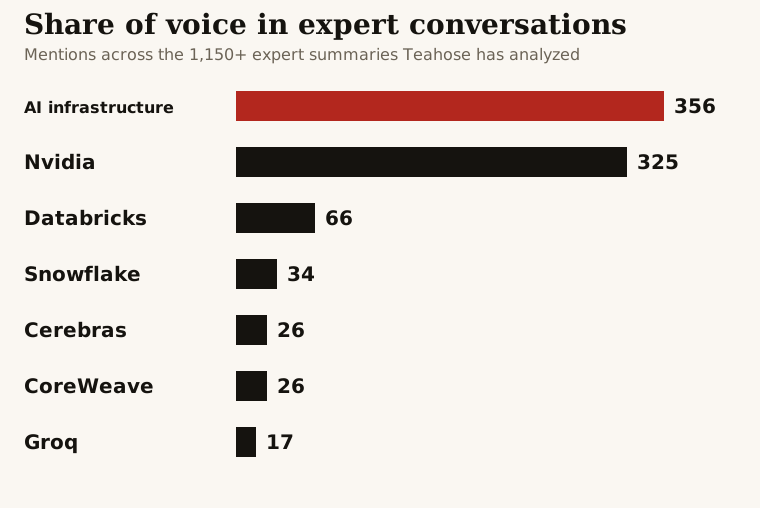
Each bar counts how many of Teahose's 1,150+ expert summaries mention it (word-boundary match across our podcast, newsletter, and paper corpus, June 2026).
Track the field: find the companies most similar to Nvidia, CoreWeave, or any infra name and get their latest funding and product signals by email — Teahose Lookalikes.
Mention counts from Teahose's analysis of 1,150+ expert podcast, newsletter & research summaries, June 2026.
At a glance
| Stack layer | Representative companies |
|---|---|
| Chips & accelerators | Nvidia, AMD, Cerebras, Groq |
| Compute clouds | AWS, Azure, GCP, CoreWeave, Lambda |
| Inference & serving | Together AI, Groq, Cerebras, Baseten, Fireworks |
| Data infrastructure | Databricks, Snowflake, Scale AI |
| Tooling & operations | Observability, evals, orchestration, fine-tuning platforms |
| Data centers & power | CoreWeave, hyperscaler buildouts, Vertiv, GE Vernova, energy & cooling |
Every AI product you can name — the chatbots, the coding agents, the robot brains — runs on the same five layers underneath. "AI infrastructure" is those layers as a market, and through the 2024–2026 boom it's where the most dependable revenue lived. Here's the stack, layer by layer, with the live company map at the bottom.
Layer 1: Chips & Accelerators
Nvidia is the layer. Everything else positions relative to it: AMD's MI series as the credible second source, custom hyperscaler silicon (Google TPU, Amazon Trainium, Microsoft Maia) as the in-house hedge, and the specialist architectures — Cerebras (wafer-scale), Groq (deterministic low-latency inference) — attacking inference economics from first principles. The private-chip story is covered in our valuation guides; the semiconductors theme and chip-design theme track the field daily.
Layer 2: Compute Clouds
The hyperscalers (AWS, Azure, GCP) sell AI compute as part of everything else; the neoclouds sell only that. CoreWeave's 2025 IPO validated the category; Lambda, Nebius, and Crusoe ride the same shortage. The open question for the layer is utilisation when GPU supply normalizes — a neocloud is a leveraged bet that scarcity persists.
Layer 3: Inference & Serving
The fastest-moving layer, because inference price-performance improves ~10x/year and every improvement reshuffles the table. Together AI (open-model serving), Groq and Cerebras (speed as the product), Baseten and Fireworks (deployment platforms), plus the LLM inference theme full of routing, caching, and kernel-optimization startups. Falling prices make this layer's revenue grow and its margins compress simultaneously — the customer's gain is the investor's risk.
Layer 4: Data Infrastructure
Training data, vector storage, and the lakehouse. Databricks and Snowflake anchor the enterprise end (see Palantir competitors for how that fight maps); the training-data market — Scale AI, Surge, Mercor — got violently reshuffled by the Meta deal (the full story); vector and semantic data is its own theme in our graph.
Layer 5: Tooling & Operations
Observability and evals (theme), orchestration, fine-tuning platforms, and the ML-infrastructure platforms cohort. Individually small, collectively the layer that decides whether enterprise AI deployments actually work — which is why the forward-deployed-engineering land grab (OpenAI, Anthropic, Palantir) is ultimately aimed here.
The Foundation Under the Stack: Data Centers, Power & Cooling
The five layers above are the software-and-silicon stack — but in 2026 the binding constraint moved underneath them, to the physical buildout. Chips need data centers, data centers need power, and power has become the gating input for the entire boom. This is why "AI infrastructure" increasingly returns names that aren't AI companies at all: the GPU neoclouds (CoreWeave, Lambda, Nebius, Crusoe) racking accelerators by the gigawatt, power-and-thermal suppliers (Vertiv, GE Vernova, the gas-turbine and grid names), and the hyperscalers' tens-of-billions in capex. The investment thesis here is different from the layers above: it's a bet on the shortage — that demand for compute, and the electricity to run it, outstrips supply long enough to earn back the build. When people ask whether AI infrastructure is overbuilt, this is the layer they're really arguing about, because it's the one writing the largest checks.
The Live Map
Static lists of this market age in weeks. The ranking below is computed from live theme membership in the Teahose intel graph, ordered by extracted signal volume — new infrastructure companies sweep in automatically as our pipeline reads their funding announcements.
AI Infrastructure Companies by Signal Volume
Live membership of the ai-infrastructure, llm-inference-infrastructure, and ai-ml-infrastructure-platforms themes · ranked by extracted signals
- 01Anthropiclast seen OCT 211746 signals
- 02OpenAIlast seen OCT 211657 signals
- 03Nvidialast seen OCT 211005 signals
- 04Googlelast seen OCT 21630 signals
- 05SpaceXlast seen OCT 21548 signals
- 06Metalast seen OCT 21522 signals
- 07Amazonlast seen OCT 21347 signals
- 08Microsoftlast seen OCT 21340 signals
- 09Applelast seen OCT 20270 signals
- 10Stripelast seen OCT 21225 signals
- 11Physical Intelligencelast seen OCT 19201 signals
- 12Hugging Facelast seen OCT 21198 signals
- 13xAIlast seen OCT 21179 signals
- 14PitchBooklast seen OCT 21165 signals
- 15Cursorlast seen OCT 21163 signals
- 16Y Combinatorlast seen OCT 21149 signals
- 17Harveylast seen OCT 21139 signals
- 18DeepSeeklast seen OCT 21138 signals
- 19OpenRouterlast seen OCT 19132 signals
- 20Databrickslast seen OCT 19131 signals
- 21Our World in Datalast seen OCT 20124 signals
- 22Google DeepMindlast seen OCT 20118 signals
- 23Uberlast seen OCT 20117 signals
- 24Bending Spoonslast seen OCT 20115 signals
- 25Ramplast seen OCT 24109 signals
How to Read This Market
- Margin lives where switching costs live. Chips and data have them; raw GPU resale and thin inference markups don't.
- Watch the price curve, not the demand curve. Inference falling 10x/year means a company can double usage and shrink revenue — unit economics beat growth stories here.
- The capex question hangs over everything. The layer's revenue is other people's spend; the day AI application revenue disappoints, infrastructure feels it first.
Related: AI chip companies, ranked · nuclear fusion companies (the datacenter-power endgame) · Cerebras valuation · Groq valuation · Together AI competitors · top AI startups, live-ranked · how to invest through technology cycles (why a $17B fund calls infrastructure the best way to play AI).
Structure is stable; the live ranking above updates continuously. As of June 11, 2026.
Bottom line: The AI infrastructure companies that matter own one of five layers — chips, compute clouds, inference/serving, data, and tooling — but the durable winners are the ones whose margin sits behind real switching costs (chips and data), not the GPU resellers and thin inference markups that erode as prices fall roughly 10x a year.
Frequently Asked Questions
What are AI infrastructure companies?
Companies that sell the picks and shovels under AI products: chips and accelerators, GPU clouds, inference and serving platforms, training-data and vector-data systems, and the observability/orchestration tooling around them. The category exists because every AI application — chatbot, coding agent, robot — buys the same five layers underneath, making infrastructure the most reliable revenue in the boom.
Who are the biggest AI infrastructure companies?
Nvidia towers over everything — most of the sector is, one way or another, reselling access to its chips. Below it: the hyperscalers (AWS, Azure, Google Cloud), the GPU neoclouds (CoreWeave, which went public in 2025; Lambda; Nebius; Crusoe), inference specialists (Together AI, Groq, Cerebras, Baseten, Fireworks), and the data layer (Databricks, Snowflake, plus vector-database players). The live list below ranks the private side by current signal volume.
What is a neocloud?
A cloud provider built specifically for GPU workloads rather than general computing — racks of accelerators, fast interconnect, and per-hour pricing, without the hyperscalers' services sprawl. CoreWeave is the category-defining example. They exist because AI demand outran hyperscaler GPU supply, and their risk is exactly that origin: utilization and pricing depend on a shortage persisting.
Is AI infrastructure a good investment theme?
It's the "sell shovels in a gold rush" argument, and through 2024–2026 it worked: infrastructure captured revenue regardless of which model or app won. The standing risks: capex cycles (the spend assumes AI revenue downstream eventually justifies it), Nvidia dependence (most of the layer marks up Nvidia silicon), and inference prices falling ~10x/year — great for users, brutal for anyone whose margin is a markup on compute.
What are the five layers of the AI infrastructure stack?
The stack has five layers: chips and accelerators (Nvidia, AMD, plus specialists like Cerebras and Groq), compute clouds (the hyperscalers and the GPU neoclouds), inference and serving platforms (Together AI, Baseten, Fireworks), data infrastructure (Databricks, Snowflake, and the training-data and vector-data players), and tooling and operations (observability, evals, orchestration, fine-tuning). Every AI application buys the same five layers underneath, which is what makes infrastructure the most reliable revenue in the boom.
How often is AI infrastructure discussed in expert podcasts and newsletters?
It is one of the most-discussed themes we track. The AI infrastructure layer surfaces in 356 of the 1,150-plus expert podcast, newsletter, and research summaries Teahose has analyzed as of June 2026, reflecting how central the picks-and-shovels story has become to the AI buildout. The live ranking on this page is computed from that same intel graph, so new infrastructure companies sweep in automatically as our pipeline reads their funding announcements.
What are the best AI infrastructure stocks in 2026?
The public AI-infrastructure trade spans the same layers as the private one. At the base is Nvidia, plus AMD and Broadcom (custom-silicon and networking). The clouds include CoreWeave (the listed neocloud) and the hyperscalers Microsoft, Amazon, and Google. But the 2026 twist is that the fastest-moving infrastructure stocks are often the physical-layer names — power and thermal suppliers like Vertiv and GE Vernova, plus data-center and grid plays — because electricity, not chips, became the gating input. This is competitive and market context, not investment advice; the private side of the same market is ranked live further down this page.
Which AI infrastructure companies have the strongest momentum right now?
Rather than name a frozen list, this page ranks the private side of the market by current signal volume in the Teahose intel graph — extracted from funding rounds, product launches, and hires across the ai-infrastructure, llm-inference-infrastructure, and ai-ml-infrastructure-platforms themes. Because the ranking updates as new signals land, it reflects momentum today rather than a snapshot that ages in weeks. Check the live map below for the current order.