
Key takeaways
- The top AI chip companies in 2026 are Nvidia (still ~80% of the data-center GPU market and near a $4.9T cap), followed by Broadcom, AMD, the newly public Cerebras, hyperscaler custom silicon, and a wave of inference startups (Etched, d-Matrix, Positron, Fractile).
- Nvidia is mentioned in 325 of the 1,150+ expert conversations we've analyzed — more than any other chipmaker — a real measure of how thoroughly it still dominates the discussion.
- Shipping beats specs: a chip in volume production with named customers (d-Matrix, AMD MI400, Microsoft Maia 200) outranks faster chips that exist only in demos (Etched's Sohu has no third-party benchmarks).
- Most static lists rank by hype; what matters is signal volume — the live table below ranks by funding, product, M&A, and hiring activity, so momentum like Fractile's surfaces before editorial lists catch up.
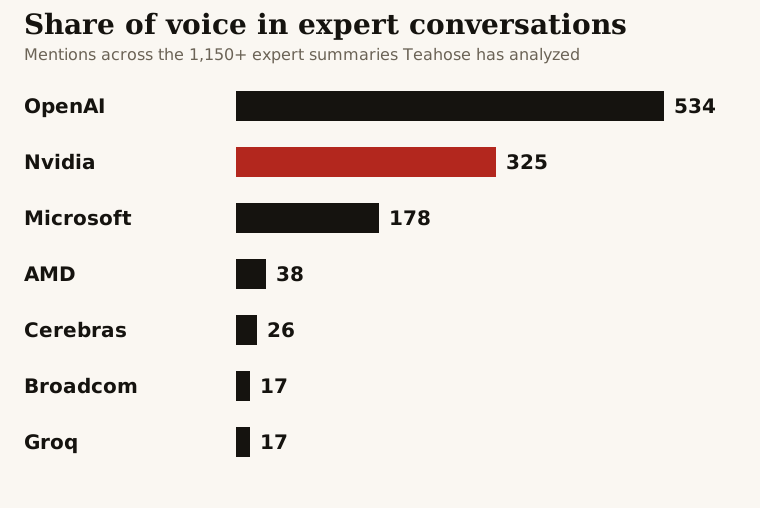
Each bar counts how many of Teahose's 1,150+ expert summaries mention it (word-boundary match across our podcast, newsletter, and paper corpus, June 2026).
Track the field: find the companies most similar to OpenAI and get their latest funding and product signals by email — Teahose Lookalikes.
Mention counts from Teahose's analysis of 1,150+ expert podcast, newsletter & research summaries, June 2026.
At a glance
| Company | Angle of attack | Status (June 2026) |
|---|---|---|
| Nvidia | Incumbent GPU | ~$4.9T market cap, ~80% data-center GPU share |
| Broadcom | Custom hyperscaler ASICs | Designs Google TPUs & OpenAI Titan |
| AMD | Merchant GPU alternative | MI400 series lands H2 2026 |
| Cerebras (CBRS) | Wafer-scale, public | ~$52B market cap after May 2026 IPO |
| d-Matrix | In-memory inference | Corsair in volume production |
The AI chip market in 2026 is no longer a one-company story — but it is still a one-company scoreboard. Nvidia sits near a $4.9 trillion market cap, and everyone else on this list is defined by their angle of attack against it: AMD with rival GPUs, Broadcom by arming the hyperscalers, Cerebras by going public on wafer-scale, and a wave of inference startups by betting that the economics of running models will diverge from the economics of training them.
Static "top AI chip companies" lists rot fast in this market — Groq was an independent challenger in November 2025 and an Nvidia asset by Christmas. So this page pairs a ranked editorial list (verified as of June 2026) with a live company table pulled from the Teahose intel graph, which extracts funding, product, M&A, and hiring signals daily from industry podcasts, VC newsletters, and research papers.
One number for scale: the Teahose intel graph currently tracks 53 semiconductor companies live — and as of this writing, Nvidia alone is the sector's most active strategic investor, with 7 deals in the past 28 days.
How We Ranked
- Market position first. Public market caps and verified share beat press-release performance claims.
- Shipping beats specs. A chip in volume production with named customers outranks a faster chip in a demo video. We flag which is which.
- Confirmed vs. rumored, explicitly. Funding rounds and acquisitions below are dated and sourced; anything reported-but-unconfirmed is labeled as such.
- The live table is its own ranking. It orders companies by extracted signal volume, not our editorial judgment — useful precisely because the two disagree at the margins.
The Top AI Chip Companies in 2026
1. Nvidia — the $4.9 trillion incumbent
Still roughly 80% of the data-center AI GPU market, and now playing offense on inference: Nvidia acquired Groq's assets and licensed its LPU technology for about $20 billion in December 2025, absorbing founder Jonathan Ross and his team, and shipped the Groq 3 LPX inference accelerator within a quarter. Nvidia is also the sector's most active strategic investor in our signal feed. The real question for everyone below is covered in our Nvidia competitors deep dive: not "who beats Nvidia," but "who carves out a defensible slice."
2. Broadcom — the custom-ASIC arms dealer
Broadcom doesn't sell an "AI chip" under its own brand; it designs everyone else's. It is Google's primary TPU design partner (a supply relationship publicly confirmed in April 2026 as running through 2031), co-develops the OpenAI Titan accelerator, and reportedly carries an AI backlog in the tens of billions with a stated ambition of $100 billion in annual AI revenue by 2027. If custom hyperscaler silicon is the structural threat to Nvidia, Broadcom is the company monetizing that threat today.
3. AMD — the only merchant GPU alternative
AMD remains the one company selling a general-purpose GPU roadmap against Nvidia at scale. The MI400 series lands in H2 2026 on TSMC 2nm — anchored by AMD's multi-gigawatt OpenAI compute deal — with the Helios rack packing 72 MI455X GPUs. AMD's share of AI accelerators is still small relative to Nvidia's, but it is the default second source for anyone who refuses a single-vendor AI stack.
4. Cerebras Systems (NASDAQ: CBRS) — wafer-scale, newly public
The biggest AI chip event of 2026 so far: Cerebras went public on May 14, 2026, raising $5.55 billion — the largest US tech IPO since Uber in 2019. Shares priced at $185, opened at $350, and closed day one up 68%; the stock has been volatile since, with a market cap around $52 billion as of June 11, 2026. Its wafer-scale engine is the most architecturally distinct approach on this list. Full breakdown in our Cerebras valuation guide.
5. Hyperscaler in-house silicon — Google, Amazon, Microsoft, OpenAI
Treat the hyperscaler programs as one collective "company," because together they are the second-largest force in AI compute:
- Google TPU — the seventh-generation Ironwood TPU (announced April 2025, in preview since late 2025) is the most mature custom-silicon program, co-developed with Broadcom and MediaTek on TSMC N3P.
- Amazon Trainium — Trainium3, AWS's first 3nm chip, went generally available at re:Invent in December 2025; Trainium4 is already announced for late 2026 or early 2027.
- Microsoft Maia 200 — unveiled January 2026 as an inference accelerator on TSMC 3nm with 216GB of HBM3e; in mass production and serving Microsoft 365 Copilot, with Anthropic reportedly in talks (May 2026, unconfirmed) to become its first major external customer.
- OpenAI Titan — the Broadcom-co-developed accelerator behind OpenAI's 10-gigawatt compute initiative; reportedly slipped from a Q2 2026 rollout target to Q3 at the earliest.
6. Tenstorrent — Jim Keller's open-standards bet
The RISC-V-based challenger led by legendary chip architect Jim Keller. Confirmed: a ~$693 million Series D in December 2024 at a roughly $2.6 billion post-money valuation, backed by Samsung, Bezos Expeditions, Fidelity, and LG. Reported but unconfirmed: a subsequent ~$800 million raise at a $3.2 billion valuation, and early-stage takeover interest from both Intel and Qualcomm in 2026. Tenstorrent's differentiator is licensing — it sells IP and chiplets, not just systems.
7. SambaNova Systems — the survivor's pivot
A cautionary tale that refused to end: after a 15% workforce cut in 2025 and a collapsed ~$1.6 billion acquisition approach from Intel, SambaNova closed a $350 million Series E in February 2026 led by Vista Equity Partners and Cambium Capital at roughly a $2.2 billion valuation — down from its $5.1 billion peak in 2021. Intel stayed on as a ~9% strategic investor with a multiyear collaboration deal. The company has fully pivoted from training hardware to an inference cloud.
8. Etched — the transformer-only gamble
The purest architectural bet in the field: Sohu, an ASIC that runs only transformer models, fabbed on TSMC 4nm with 144GB of HBM3E. Etched raised a $500 million round led by Stripes and Peter Thiel at a $5 billion valuation. The caveat belongs in bold: as of mid-2026, Sohu has not shipped to customers, and its headline performance claims (500K tokens/sec on Llama 70B) have no third-party benchmarks. Highest risk-reward profile on this list.
9. d-Matrix — in-memory compute, actually shipping
The credibility counterpoint to Etched: d-Matrix raised a $275 million Series C in November 2025 at a $2 billion valuation (Temasek, BullhoundCapital, Triatomic, Qatar Investment Authority, and Microsoft's M12), and its Corsair inference platform entered volume production in June 2026. Its digital in-memory compute architecture targets the memory-bandwidth wall that dominates inference economics.
10. Lightmatter — the photonics wildcard
The MIT spinout computing with light instead of electrons. Last confirmed mark: a $400 million Series D led by T. Rowe Price in October 2024 at a $4.4 billion valuation, with about $850 million raised in total — no newer round disclosed as of June 2026. Photonic interconnect (its Passage product line) may reach the market before photonic compute does; either way, Lightmatter owns the deepest moat in optical I/O for AI clusters.
11. Positron AI — the energy-efficiency play
A newly minted unicorn: Positron raised an oversubscribed $230 million Series B in February 2026 at a post-money valuation above $1 billion, with backing from Jump Trading, Qatar Investment Authority, and Arm. Its Atlas inference systems are shipping today, with next-generation Asimov silicon targeting tape-out in late 2026. Stated goal: 50,000 units shipped by end of 2026 — a verifiable number worth holding them to.
12. Fractile — the UK challenger climbing our live rankings
London-based Fractile raised a $220 million Series B in May 2026, co-led by Accel and Peter Thiel's Founders Fund, to build in-memory inference chips. It earns the last slot for a data-driven reason: it is one of the most signal-active startups in our live semiconductors theme below — a useful reminder that the live table surfaces momentum before editorial lists do.
AI Chip & Semiconductor Companies by Signal Volume
Live membership of the semiconductors theme · ranked by funding, product, M&A, and hiring signals extracted daily
- 01Nvidialast seen OCT 211005 signals
- 02Applelast seen OCT 20270 signals
- 03Intellast seen OCT 2191 signals
- 04AMDlast seen OCT 1565 signals
- 05Samsunglast seen OCT 956 signals
- 06Broadcomlast seen OCT 1344 signals
- 07TSMClast seen OCT 2040 signals
- 08SK Hynixlast seen OCT 939 signals
- 09Etchedlast seen OCT 2029 signals
- 10Micronlast seen OCT 928 signals
- 11Qualcommlast seen OCT 1927 signals
- 12SemiAnalysislast seen OCT 2125 signals
- 13ASMLlast seen OCT 1624 signals
- 14Intel Capitallast seen OCT 2020 signals
- 15AMD Ventureslast seen OCT 1620 signals
- 16Cerebraslast seen OCT 920 signals
- 17Huaweilast seen OCT 1519 signals
- 18d-Matrixlast seen OCT 917 signals
- 19Etchedlast seen OCT 2416 signals
- 20Sonylast seen OCT 1914 signals
How to Evaluate an AI Chip Company
Three filters separate the contenders from the science projects:
- Software ecosystem beats raw FLOPS. Nvidia's real moat is CUDA, not silicon — a decade of libraries, kernels, and developer habit. Any challenger's spec sheet should be discounted by the maturity of its compiler and software stack; this is why AMD's ROCm progress matters more than MI400 benchmarks, and why "transformer-only" bets like Etched trade ecosystem breadth for a narrower, simpler software problem.
- Inference economics, not training economics. Training rewards peak throughput and interconnect scale; inference rewards cost and latency per token, which is where memory bandwidth — not compute — is usually the binding constraint (the same memory wall that turned Micron's record Q3 2026 earnings into an AI-memory super-cycle story). Nearly every startup on this list (d-Matrix, Positron, Fractile, Etched, post-pivot SambaNova) is an inference company because that is the market that grows with AI usage. The Groq competitors landscape shows how crowded — and how validated — that thesis has become since Nvidia paid $20 billion for Groq's assets.
- Customer concentration is the silent killer. A chip startup with one anchor customer is one procurement decision from a down round; hyperscaler silicon exists precisely to internalize that demand. Watch for named, repeat, external customers — Anthropic's reported Maia talks matter because external adoption is the hardest test custom silicon faces. In our signal feed, partnership and production signals are worth more than funding signals for exactly this reason.
The chips are also only half the story — the data centers, networking, and power behind them are covered in our AI infrastructure companies guide.
Keep This List Coming to You
Every company above links to a profile with its full signal history — hit Watch on any profile for an email digest when something new lands, or follow the semiconductors theme to catch new chip companies as they emerge. The Nvidia competitors and Cerebras valuation guides go deeper on the two ends of the market, and the free daily digest delivers the day's chip signals in one email.
Bottom line: Nvidia is still the AI chip company that matters most in 2026 at a near-$4.9T market cap and ~80% of the data-center GPU market, but the asymmetric bets sit downstream — Broadcom and AMD as the at-scale challengers, the newly public Cerebras on wafer-scale, and inference startups like d-Matrix, Positron, and Fractile whose shipping status and live signal momentum, not specs, separate contenders from science projects.
Frequently Asked Questions
What is the biggest AI chip company in 2026?
Nvidia, by a wide margin — roughly a $4.9 trillion market cap as of June 2026 and an estimated ~80% of the data-center AI GPU market. Its closest public challengers attack from different angles: AMD with the MI400 GPU series, and Broadcom as the design partner behind most hyperscaler custom chips, including Google TPUs and the OpenAI Titan program.
What happened to Groq?
Nvidia announced a roughly $20 billion acquisition of Groq’s assets in December 2025 — a licensing-and-acquihire deal that transferred the LPU technology and key engineers (including founder Jonathan Ross) to Nvidia while leaving Groq a nominally independent shell. Nvidia unveiled the Groq 3 LPX inference accelerator within months. The independent low-latency inference mantle has passed to startups like Etched, d-Matrix, Positron, and Fractile.
Is Cerebras a public company?
Yes. Cerebras Systems listed on Nasdaq under the ticker CBRS on May 14, 2026, raising $5.55 billion — the largest US tech IPO since Uber in 2019. Shares priced at $185, opened at $350, and closed the first day up 68%. The stock has been volatile since; its market cap sat around $52 billion as of June 11, 2026.
What is the difference between training chips and inference chips?
Training chips optimize for raw throughput and massive memory bandwidth across thousands of interconnected accelerators — that market is dominated by Nvidia GPUs and hyperscaler silicon like Google TPUs and Amazon Trainium. Inference chips optimize for cost and latency per generated token, which rewards specialization — that is where nearly every credible startup (Etched, d-Matrix, Positron, Fractile, SambaNova post-pivot) now competes, because the inference market grows with AI usage rather than with model development budgets.
How is this list of AI chip companies ranked?
Editorially, by strategic weight: market position, verified funding and shipping status as of June 2026, and the credibility of each company’s path against Nvidia. The live table below is different — it is pulled from the Teahose intel graph, ranked by funding, product, M&A, and hiring signals extracted daily from podcasts, VC newsletters, and research papers, so it updates as the sector moves.
How can I track AI chip companies over time?
Open any company profile from the live list below and hit Watch for an email digest of its new signals, or follow the semiconductors theme page, which tracks live membership as new chip companies emerge from stealth.
Which AI chip startup is the best bet against Nvidia?
There is no single answer — the credible challengers attack different slices. For a merchant GPU alternative, AMD is the only at-scale option. For custom hyperscaler silicon, Broadcom monetizes the structural threat today. Among startups, the split is between shipping-now plays (d-Matrix's Corsair in volume production, Positron's Atlas systems) and high-risk architectural gambles (Etched's transformer-only Sohu, which has no third-party benchmarks yet). The data-driven tell is signal momentum: Fractile is one of the most signal-active startups in our live semiconductors theme, which often surfaces a rising challenger before editorial lists do.
Are AI chip companies a good investment in 2026?
That depends entirely on which layer you mean. Nvidia remains the discussed leader — it appears in 325 of the 1,150+ expert conversations Teahose has analyzed — but its near-$4.9T market cap already prices in dominance. The more asymmetric bets sit in inference silicon, where the market grows with AI usage rather than model-development budgets, and where shipping status separates contenders (d-Matrix, AMD, Microsoft Maia 200) from science projects. Customer concentration is the silent killer: a startup with one anchor customer is one procurement decision from a down round, so watch for named, repeat, external customers before reading a valuation as validation.
What are the newest AI chip startups to watch?
The freshest momentum in our live data is concentrated in inference startups: Fractile (a London in-memory inference challenger that raised a Series B in May 2026, co-led by Accel and Founders Fund), Positron AI (a 2026 unicorn shipping its Atlas systems), and d-Matrix (whose Corsair platform reached volume production in June 2026). Because the live table below ranks by extracted funding, product, M&A, and hiring signals, it surfaces newly emerging chip companies as they leave stealth — follow the semiconductors theme to catch them automatically.