
Key takeaways
- Nvidia's most credible competitors split four ways: AMD (like-for-like GPUs), Broadcom plus the hyperscalers (custom silicon), Huawei (China), and Cerebras (the one independent startup that reached scale) — no single rival, but four distinct fronts.
- Nvidia is mentioned in 325 of the 1,150+ expert conversations we've analyzed — more than any chipmaker rival — yet the same corpus shows the competitive pressure migrating to the inference layer where custom ASICs compete hardest.
- The real leading indicators are gigawatt commitments (6GW AMD-OpenAI, 6GW AMD-Meta, 10GW Broadcom-OpenAI), not benchmark wins — capacity deals re-rank the field faster than spec sheets.
- Most "Nvidia killer" coverage chases startups; what actually matters is that Nvidia holds ~zero percent of China by its own CEO's accounting, so the market is bifurcating into two stacks the global-share headlines never describe.
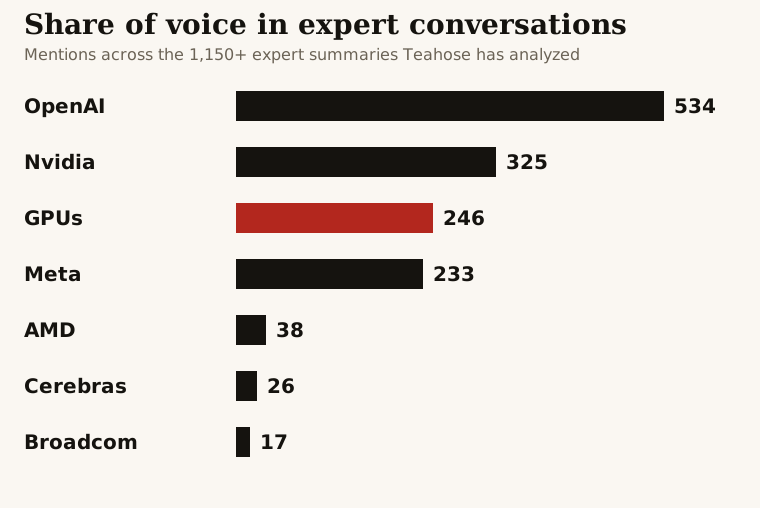
Each bar counts how many of Teahose's 1,150+ expert summaries mention it (word-boundary match across our podcast, newsletter, and paper corpus, June 2026).
Track the field: find the chipmakers and AI-accelerator companies most similar to Nvidia and get their latest funding and product signals by email — Teahose Lookalikes.
Mention counts from Teahose's analysis of 1,150+ expert podcast, newsletter & research summaries, June 2026.
At a glance
| Front | Challenger | Where it stands |
|---|---|---|
| Like-for-like GPUs | AMD | Real second source; data-center quarter $5.8B (<8% of Nvidia), 6GW deals with OpenAI and Meta |
| Custom silicon | Broadcom + hyperscalers | $8.4B AI quarter (+106%), ~$73B backlog; aimed at inference |
| China | Huawei | Nvidia at ~0% share; Ascend tracking toward ~60% domestic |
| Startups | Cerebras | Only independent challenger to reach public scale (CBRS, >$66B cap) |
Nvidia is a ~$5 trillion company that just reported a record $81.6B quarter (+85%), $75.2B of it data center (Q1 FY27 8-K) — and simultaneously holds zero percent of China, by its own CEO's accounting. Both facts are the competitive map: dominance almost everywhere, a vacuum where policy drew a line, and an arms race to commoditize its margin at the inference layer. Scored front by front, as of June 11, 2026:
Front 1: Like-for-Like GPUs — AMD
AMD is finally a real second source: the MI400 line shipped, MI455X/Helios racks ship Q3 2026, and — the part that matters — the anchor customers signed: a 6GW agreement with OpenAI (first gigawatt on MI450, H2 2026) and a 6GW Meta deal (press-valued ~$60B; the gigawatts are confirmed, the dollars are estimates — ServeTheHome). Scale check: AMD's data-center quarter is $5.8B (+57%) vs Nvidia's $75.2B (AMD 8-K) — under 8% of the leader, growing fast from far behind. Intel, for completeness: Falcon Shores cancelled, Gaudi marginal, the inference-only Crescent Island samples late 2026 — a 2027 story at best. Qualcomm, newer to the fight, has announced the AI200 (2026) and AI250 (2027) data-center inference accelerators — an inference-only entrant leaning on its mobile-NPU efficiency story, not yet a training threat.
Front 2: The Custom-Silicon Counterweight — Broadcom & the Hyperscalers
The structural threat isn't a rival GPU; it's customers becoming chipmakers, with Broadcom as the arms dealer: AI revenue $8.4B in Q1 FY26 (+106%), guiding $10.7B next quarter, ~$73B backlog, and management claiming line-of-sight to >$100B in 2027 (guidance, not actuals — Futurum). The customer list is the story: Google (TPU Ironwood GA — "the first TPU for the age of inference" — with Anthropic running ~1GW of TPU compute scaling toward 3GW+), Amazon (Trainium3 GA, >1M units deployed and supply-constrained), Microsoft (Maia 200), Meta (a four-generation MTIA roadmap), and OpenAI (a 10GW co-designed program, first deployments H2 2026).
Today's honest share math: custom ASICs are still single-digit percent of accelerator revenue. The bookings say that's the intent, not the ceiling — and they're aimed at inference, ~two-thirds of all AI compute.
Front 3: China — the Market Nvidia Lost by Law
Jensen Huang: Nvidia's China share went "from ~95% to zero" (Tom's Hardware). Into the vacuum: Huawei Ascend — the 950PR shipped Q1 2026 with self-developed HBM, the 950DT training part lands Q4, ByteDance committed ~$5.6B in orders, and DeepSeek V4 trains and serves on Ascend. Projections (estimates, not disclosures) put Huawei near ~$12B of 2026 AI chip revenue and ~60% of the Chinese market. The strategic upshot: the AI hardware world is bifurcating into two stacks, and the global-share headlines only describe one of them.
Front 4: The Challenger Class — Mostly Resolved
2026 cleaned out this tier, in three directions:
- Groq → neutralized. Nvidia's ~$20B asset deal (Dec 2025), its largest ever — licensing-plus-acquihire, with ongoing Senate scrutiny over the structure. Our Groq guide has the full story.
- Cerebras → public. Nasdaq CBRS, May 2026: $5.55B raised, +68% day one, >$66B market cap, a $10B OpenAI contract — the flagship independent challenger (details).
- SambaNova → cautionary tale. From $5.1B (2021) to a $2.2B down round (Feb 2026, Vista-led) after Intel acquisition talks collapsed. Tenstorrent pivoted to developer/IP licensing. The lesson: subscale training-chip startups didn't survive contact with Blackwell; inference niches and exits did.
The Scoreboard
| Front | Challenger | Status |
|---|---|---|
| GPUs | AMD | Real second source; <8% of Nvidia's DC revenue, 6GW × 2 anchor deals |
| Custom silicon | Broadcom + hyperscalers | $8.4B/qtr and compounding; aimed at inference |
| China | Huawei | Effectively won the market Nvidia was barred from |
| Startups | Cerebras (public) | The one challenger that made it to scale independently |
What keeps Nvidia at ~$5T despite all four: CUDA's two-decade software moat, networking (its DC networking line grew +199% to $14.8B), and a roadmap cadence nobody has matched. The chip-layer companies below re-rank as our pipeline reads each new deal:
Chip & Accelerator Companies by Signal Volume
Live membership of the semiconductors and ai-chip-accelerator-design themes · ranked by extracted signals
- 01Anthropiclast seen OCT 211746 signals
- 02OpenAIlast seen OCT 211657 signals
- 03Nvidialast seen OCT 211005 signals
- 04Googlelast seen OCT 21630 signals
- 05Metalast seen OCT 21522 signals
- 06Amazonlast seen OCT 21347 signals
- 07Microsoftlast seen OCT 21340 signals
- 08Applelast seen OCT 20270 signals
- 09a16zlast seen OCT 21254 signals
- 10DeepSeeklast seen OCT 21138 signals
- 11Google DeepMindlast seen OCT 20118 signals
- 12Intellast seen OCT 2191 signals
- 13AMDlast seen OCT 1565 signals
- 14Groqlast seen OCT 957 signals
- 15Samsunglast seen OCT 956 signals
How to Read This Market
- Track gigawatts, not benchmarks. The 6GW/10GW commitments (AMD-OpenAI, AMD-Meta, Broadcom-OpenAI) are the leading indicators; performance claims re-rank monthly.
- Inference is where share actually moves. Every custom chip targets it; Nvidia's training-frontier grip is not currently contested.
- Watch the China stack mature. If Ascend + DeepSeek proves a full non-Western stack at the frontier, the bifurcation becomes permanent — with pricing power consequences on both sides.
Related: Cerebras valuation · Groq valuation (the $20B deal) · AI infrastructure companies · Databricks competitors.
All figures as of June 11, 2026, sourced inline. The live ranking above updates continuously.
Bottom line: There is no single Nvidia killer — the company still dominates a ~$5T market — but it now faces four distinct pressures at once: AMD on like-for-like GPUs, Broadcom and the hyperscalers on custom inference silicon, Huawei inside China, and Cerebras as the lone independent startup to reach scale.
Frequently Asked Questions
Which Nvidia competitors are publicly traded stocks?
Most of the credible rivals are listed. AMD (AMD) and Broadcom (AVGO) are the two pure-play public challengers; Intel (INTC) is a distant third. The hyperscalers building custom silicon trade publicly too — Alphabet (GOOGL, TPU), Amazon (AMZN, Trainium), Microsoft (MSFT, Maia) and Meta (META, MTIA) — though chips are a small slice of each. Cerebras (CBRS) went public in May 2026 as the one independent accelerator startup to reach the market. Huawei is the major exception: it dominates inside China but is not publicly traded.
Who is Nvidia's biggest competitor?
By current revenue threat, Broadcom — its AI chip business hit $8.4B in a quarter (+106%), with a ~$73B backlog and six custom-silicon customers including Google, Meta, OpenAI (a 10GW deal), and Anthropic. By like-for-like GPUs, AMD — whose MI400 line won 6GW commitments from both OpenAI and Meta, though its data-center quarter ($5.8B) is still under 8% of Nvidia's. And in China, Nvidia's competitor is everyone: Jensen Huang puts Nvidia's share there at zero, with Huawei's Ascend filling the vacuum.
What market share does Nvidia have in AI chips?
Roughly 75–90% of AI accelerators outside China, depending on definition — IDC pegs the data-center AI chip share at 81%, with projections of ~75% by end-2026 as AMD and custom silicon scale. Inside China the answer is effectively 0%: export controls removed Nvidia from the market (Huang's own words: "zero percent"), and Huawei is tracking toward ~60% domestic share. The global average masks a full bifurcation.
What happened to Groq and Cerebras?
Opposite exits, three months apart. Nvidia paid ~$20B — its largest deal ever — for Groq's assets in December 2025, structured as a licensing-plus-acquihire (founder Jonathan Ross and key engineers joined Nvidia; senators have questioned whether the structure dodged merger review). Cerebras went the other way: a May 2026 Nasdaq IPO (CBRS) raising $5.55B, closing its first day up ~68% past a $66B market cap, carrying a $10B OpenAI contract — now the flagship public Nvidia challenger.
Will custom chips replace Nvidia GPUs?
At inference, increasingly; at training, not yet. Google's TPU Ironwood, Amazon's Trainium3 (over a million units deployed), Microsoft's Maia 200, and Meta's MTIA line all target inference — about two-thirds of AI compute — where workloads are predictable enough for fixed silicon. Custom ASICs are still single-digit percent of revenue share today, but the bookings (Broadcom's $73B backlog, OpenAI's 10GW program) say the hyperscalers intend the mix to shift. Nvidia's moat at the frontier remains CUDA plus networking plus the fastest roadmap.
Is there a real "Nvidia killer" in 2026?
Not a single one — and that framing misleads. No company is positioned to take the whole market; instead Nvidia faces four separate pressures: AMD on like-for-like GPUs (under 8 percent of Nvidia’s data-center revenue but with 6GW anchor deals from OpenAI and Meta), Broadcom and the hyperscalers on custom inference silicon, Huawei inside China, and Cerebras as the lone independent startup that reached public-company scale. Across the 1,150+ expert summaries Teahose has analyzed, Nvidia is still the most-discussed chipmaker by a wide margin, which itself tells you the dominance is intact even as the edges erode.
Why does Nvidia have no market share in China?
US export controls, not competition, removed Nvidia from the Chinese market. CEO Jensen Huang has described the company’s China share collapsing from roughly 95 percent to effectively zero. Huawei’s Ascend line moved into that vacuum, with its 950PR shipping in early 2026 and projections putting Huawei near 60 percent of the domestic Chinese AI-chip market. The practical result is a bifurcated industry: a Western stack built on Nvidia and CUDA, and a parallel Chinese stack built on Ascend and models like DeepSeek that train and serve on it.
AMD vs Nvidia for AI: which should I watch in 2026?
Watch both, but for different signals. Nvidia remains the default for frontier training thanks to CUDA, its networking lead, and an unmatched roadmap cadence. AMD is now a genuine second source for buyers who want supply diversity: its MI400 line shipped, Helios racks arrive in Q3 2026, and it locked 6GW commitments from each of OpenAI and Meta. The number that matters is capacity contracted in gigawatts, not raw benchmark deltas — that is where share actually changes hands, and it is the metric our pipeline re-ranks against as new deals land.