
Key takeaways
- Databricks' closest competitor is still Snowflake, but the more structural threat is Microsoft Fabric, which competes on Azure bundling rather than head-to-head product evaluations.
- Databricks is one of the most-discussed data platforms in our corpus — mentioned in 66 of the 1,150+ expert conversations we've analyzed, often alongside Snowflake and the hyperscalers.
- The 2026 story is consolidation, not feature parity: IBM bought Confluent ($11.59B), Fivetran merged with dbt, and the hyperscalers bundled harder around the lakehouse.
- Most guides rank rivals by feature checklist; what actually moves enterprise deals is distribution — which is why a no-disclosed-revenue product like Fabric belongs near the top of this list.
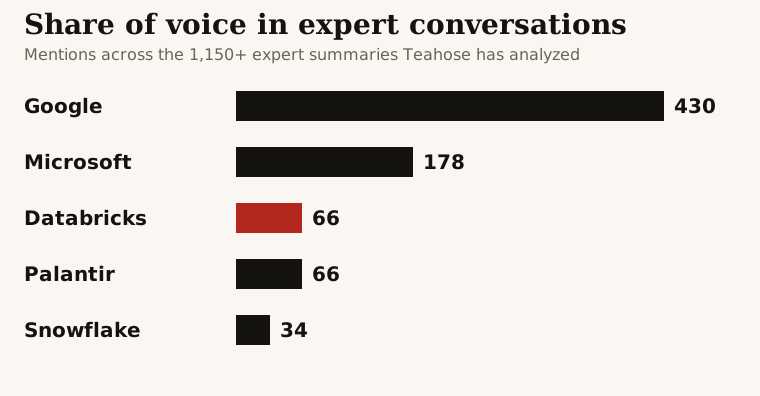
Each bar counts how many of Teahose's 1,150+ expert summaries mention it (word-boundary match across our podcast, newsletter, and paper corpus, June 2026).
Track the field: find the companies most similar to Databricks and get their latest funding and product signals by email — Teahose Lookalikes.
Mention counts from Teahose's analysis of 1,150+ expert podcast, newsletter & research summaries, June 2026.
At a glance
| Rival | Role vs Databricks | 2026 scale |
|---|---|---|
| Snowflake | Direct like-for-like data platform | ~$4.5B FY26 product revenue, FY27 guide $5.84B |
| Microsoft Fabric | Structural threat via Azure bundling | Revenue undisclosed |
| AWS / Google | Hyperscaler-native bundlers | SageMaker stack / BigQuery |
| Palantir | Decision/ontology layer above | Q1 2026 +85% to $1.633B |
| ClickHouse | Real-time OLAP specialist | $6.35B (May 2025) |
The "Databricks competitors" question changed shape in 2026: it's no longer a feature comparison but a consolidation map. IBM bought Confluent for $11.59B; Fivetran and dbt merged; the hyperscalers bundled harder; and the two independents at the top — Databricks ($134B, $5.4B run-rate) and Snowflake — both accelerated. Layer by layer, with June 2026 numbers:
The Direct Rival: Snowflake
The only true like-for-like. Q1 FY27 (April 2026): product revenue $1.33B, +34% YoY — its strongest sequential dollar growth ever, NRR 126%, FY27 guide raised to $5.84B (8-K). The scoreboard honestly read: Databricks is now bigger on run-rate ($5.4B vs ~$4.5B FY26 product revenue) and grows ~2x faster; Snowflake is public, profitable on an adjusted basis, and re-accelerating — 13,600+ accounts use its AI features, and it just signed a $6B multi-year AWS commitment. This rivalry stopped being zero-sum; the budget line is growing faster than either company.
The Bundlers: Microsoft, AWS, Google
- Microsoft Fabric — the structural threat: OneLake + Power BI + analytics bundled into E5/Azure agreements. Revenue undisclosed; the tell is that Microsoft now names Databricks a competitor in its annual report. Fabric doesn't have to win evaluations — it has to be good enough at a marginal price of approximately zero.
- AWS — SageMaker Unified Studio is the lakehouse answer (EMR + Glue + Redshift + Bedrock in one surface); the default for AWS-defined shops.
- Google BigQuery — the serverless warehouse anchor of GCP.
The heuristic enterprise buyers actually use: Microsoft-heavy → Fabric; AWS-native → SageMaker stack; multi-cloud or AI-forward → Databricks/Snowflake.
The Layer Above: Palantir
Not a lakehouse substitute — Palantir's AIP/Foundry sells the decision and ontology layer on top of data platforms (it can literally run on Databricks). But both now bid for the same "enterprise AI platform" budget, and Palantir's Q1 2026 (+85% to $1.633B, FY guide ~$7.65B) makes it the fastest-growing claimant. Full map: Palantir competitors.
The Consolidated Middle
- Confluent → IBM ($11.59B, closed Mar 2026): streaming/Kafka now competes from inside IBM's portfolio against Databricks' ingest ambitions.
- Fivetran + dbt (merger completed Jun 1, 2026): ELT plus transformation under one roof — "data infrastructure for trusted AI agents," 100K+ data teams. Partner and rival simultaneously: dbt runs on Databricks while the combined company competes with Databricks' own pipeline tooling.
The Challengers
- ClickHouse — $6.35B (May 2025, Khosla-led); real-time OLAP and observability workloads where lakehouses are too slow. The credible specialist.
- MotherDuck / DuckDB — the architectural counter-narrative: most data is small, single-node is enough, and DuckLake's open-format play nibbles the low end (~$400M valuation — a thesis, not yet a threat).
The Live View
Companies Most Similar to Databricks
Vector similarity against the Teahose company graph · same engine as the /similar lookalikes tool
- 01MosaicMLAI89% match
- 02DremioData88% match
- 03Databricks VenturesData/AI88% match
- 04SnowflakeData83% match
- 05ClouderaData82% match
- 06DBT LabsData78% match
- 07PhoenixAIAI77% match
- 08Microsoft AzureCloud Computing77% match
- 09FivetranData Infrastructure76% match
- 10ClickHouseData76% match
- 11Kumo AIAI76% match
- 12GRAIAI Music / Generative Audio / Consumer Social75% match
- 13RowZeroData infrastructure75% match
- 14Sigma ComputingAI / Analytics75% match
- 15ReactorAI75% match
How to Read This Market
- Watch guides, not feature launches. Snowflake's raised FY27 guide and Databricks' accelerating run-rate are the scoreboard; product announcements are noise between prints.
- The Databricks S-1 reprices everyone. Public comps for "AI data platform" currently rest on Snowflake alone; a second data point changes every multiple in this guide.
- Bundling beats benchmarks at the margin. Fabric's growth without a disclosed revenue line is the quiet trend to respect — distribution always is.
Related: Databricks valuation · Palantir competitors · AI infrastructure companies.
All figures as of June 11, 2026, sourced inline. The live ranking above updates continuously.
Bottom line: Snowflake remains Databricks' only true like-for-like rival, but the more structural threat is Microsoft Fabric, which competes on Azure bundling rather than head-to-head product — so the real 2026 story is consolidation and distribution, not feature parity.
Frequently Asked Questions
Who is Databricks' biggest competitor?
Snowflake, still — the only company selling a comparable multi-cloud data platform at comparable scale. The 2026 twist is that both are winning: Databricks' $5.4B run-rate now exceeds Snowflake's ~$4.5B FY26 product revenue and grows twice as fast (65% vs ~31–34%), but Snowflake just posted its best sequential dollar growth ever and raised its FY27 guide to $5.84B. The deeper threat is Microsoft Fabric, which competes on bundling rather than product.
Databricks vs Snowflake — what's the actual difference?
Architecture and origin. Databricks is lakehouse-first (open formats, ML/AI-native, born from Spark); Snowflake is warehouse-first (SQL analytics, governed simplicity) now layering AI on top (Cortex, Snowflake Intelligence). In practice both converged toward the same "AI data platform" — the choice usually follows workload mix (data science and AI lean Databricks, BI and analytics lean Snowflake) and which sales motion got there first. Multi-cloud requirements favor both over hyperscaler-native stacks.
Is Microsoft Fabric a threat to Databricks?
The most structural one. Fabric bundles a Databricks-shaped product (OneLake, analytics, Power BI) into Azure agreements enterprises already sign — Microsoft named Databricks a direct competitor in its annual report for the first time. Microsoft doesn't disclose Fabric revenue, and the awkward nuance is that a large share of Databricks workloads run on Azure: partner on infrastructure, predator on product.
What happened to Confluent and dbt?
Consolidation took both off the board as independents within three months. IBM closed its $11.59B Confluent acquisition (delisted March 17, 2026), moving the Kafka streaming layer inside IBM's portfolio. Fivetran and dbt Labs completed their all-stock merger June 1, 2026, forming a combined ELT-plus-transformation company serving 100,000+ data teams. The middle of the data stack is consolidating into platforms — which is the same thesis Databricks' valuation rides on.
What are the best alternatives to Databricks in 2026?
It depends on the workload, not a single ranking. For a like-for-like multi-cloud data platform, Snowflake is the direct alternative. For Microsoft-heavy shops, Fabric is the default bundled option; AWS-native teams reach for SageMaker Unified Studio and Redshift, and GCP shops use BigQuery. Real-time OLAP and observability workloads often go to ClickHouse, while small-data and single-node use cases are increasingly served by MotherDuck and DuckDB. The decision usually follows your existing cloud commitment and whether the workload leans analytics or AI/ML.
What are the open-source or on-premise alternatives to Databricks?
If you want to avoid a managed lakehouse vendor entirely, the open building blocks now exist: Apache Spark plus an open table format (Apache Iceberg or Delta Lake) on your own storage is the closest like-for-like, with a query engine like Trino or Presto (commercialized by Starburst) for federated SQL, and Dremio for a self-managed lakehouse with a semantic layer. For real-time OLAP, ClickHouse is the specialist; for small-to-medium single-node analytics, DuckDB (and DuckLake's open-format play) is increasingly enough. The trade-off is the usual one: you trade Databricks' integrated tooling and managed ops for control, portability, and lower license cost — which is exactly why on-premise and open-source swaps are a recurring question among data engineers rather than enterprise buyers.
Databricks vs Snowflake vs Microsoft Fabric — which should you choose?
The 2026 heuristic enterprise buyers actually use: go Microsoft Fabric if you're a Microsoft-heavy shop and "good enough" analytics bundled into Azure/E5 agreements you already pay for wins on price and default. Go Snowflake if your center of gravity is SQL analytics, BI, and governed simplicity — it's re-accelerating (FY27 guide $5.84B) and easiest to operate. Go Databricks if you're AI/ML-forward or multi-cloud and want lakehouse openness and data-science depth; it's bigger on run-rate ($5.4B) and growing ~2x faster. The tell is that many enterprises run two of the three — Fabric for the Microsoft estate, Databricks or Snowflake for the serious data work — because the platforms converged on the same "AI data platform" pitch from different starting points.
How often do experts mention Databricks compared with other data platforms?
Across the 1,150+ expert summaries Teahose tracks (June 2026), Databricks appears in 66 of them — a heavy concentration for an enterprise data company, and it almost always shows up next to Snowflake and the hyperscalers rather than alone. That co-mention pattern is itself a signal: the market treats the lakehouse-versus-warehouse race as the frame, with Microsoft Fabric increasingly entering the conversation as the bundled wildcard.
Is Snowflake or Databricks growing faster in 2026?
Databricks is growing faster on a percentage basis — roughly 65% versus Snowflake's ~31-34% — and its $5.4B run-rate now exceeds Snowflake's ~$4.5B FY26 product revenue. The nuance is that Snowflake is re-accelerating off a larger public base: its Q1 FY27 product revenue grew 34% YoY (its strongest sequential dollar growth ever) and it raised its FY27 guide to $5.84B. Both are winning because the underlying data-platform budget is expanding faster than either company.