
Key takeaways
- No single rival comps Palantir cleanly: Anduril is the closest defense-software peer (and partner), Databricks and Snowflake attack the commercial data layer from below, and in May 2026 OpenAI and Anthropic both launched billion-dollar forward-deployed-engineering units copying Palantir's deployment playbook.
- Palantir surfaces in 66 of the 1,150+ expert conversations we've analyzed — a high-frequency name in operator and investor discussion, but always framed as a category of one rather than a head-to-head incumbent.
- The two-front structure (classified-network defense software plus commercial AI deployment) is the moat no competitor spans; clearance barriers, ontology lock-in, and forward-deployed-engineer muscle keep rivals fenced to one side.
- Most guides ask "who beats Palantir?"; what actually matters is which front you're buying for — the answer is a different company on defense, on data platforms, and on the new FDE land grab.
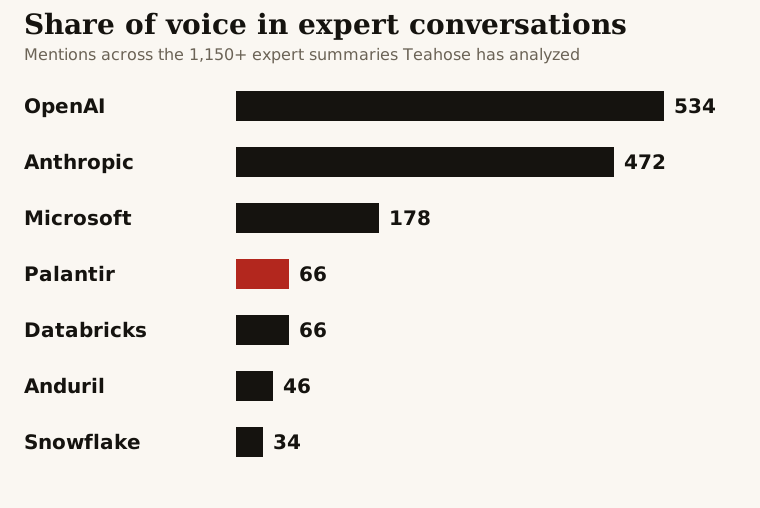
Each bar counts how many of Teahose's 1,150+ expert summaries mention it (word-boundary match across our podcast, newsletter, and paper corpus, June 2026).
Track the field: find the companies most similar to Palantir and get their latest funding and product signals by email — Teahose Lookalikes.
Mention count from Teahose's analysis of 1,150+ expert podcast, newsletter & research summaries, June 2026.
At a glance
| Front | Closest rival | Where it stands |
|---|---|---|
| Defense software | Anduril | $61B (May 2026), $20B/10-yr Army deal; partner and rival |
| Commercial data & AI | Databricks | ~$134B valuation, ~$5.4B run-rate, IPO expected H2 2026 |
| FDE land grab | OpenAI & Anthropic | Billion-dollar forward-deployed units launched May 2026 |
Palantir (~$315B market cap, June 2026) is hard to comp because it fights a two-front war no rival spans: classified-network defense software on one side, commercial AI deployment on the other. Q1 2026 made the point loudly — $1.633B revenue, US commercial +133% YoY, Rule of 40 at 145 (Q1 8-K), FY guidance raised to ~$7.65B. Here's who's actually attacking each front, as of June 10, 2026.
Front 1: Defense Software
Anduril — the peer, the partner, the eventual rival. Marked at $61B in May 2026, holder of a $20B/10-year Army enterprise agreement built on its Lattice platform. The relationship is structured coopetition: a formal 2024 alliance (Lattice tactical + Palantir Maven/AIP theater), shared membership on the NGC2 command-and-control prototype team — and separate ~$100M NGC2 awards each, because the Army wants both. Long-term, the two are converging on the same prize: the defense software stack. Map: Anduril competitors.
The displaced incumbents — Booz Allen, Leidos, CACI. Palantir's product model (software licenses, forward-deployed engineers) attacks labor-hour federal IT consulting at exactly the moment DOGE-era contract scrutiny squeezes it. Palantir's US government revenue grew 45% in Q1 while the consulting complex played defense; the Maven ceiling was raised to ~$1.3B through 2029 (Investing.com).
The niche players — Govini (defense-acquisition analytics; NGC2 partner, budget rival), Sierra Nevada (Palantir's own TITAN teammate), Elbit America (won the parallel SBMC helmet track). In defense, almost everyone is partner on one vehicle and competitor on the next.
Front 2: Commercial Data & AI Platforms
- Databricks — the biggest private rival: ~$134B valuation, ~$5.4B run-rate growing ~65%, IPO expected H2 2026. Owns the lakehouse/data-engineering layer; competes with Palantir for enterprise AI budgets from below.
- Snowflake — $4.47B FY2026 product revenue, 30% Q4 growth, 125% NRR. The "reset" comp: slower growth, far lower multiple, same buyers.
- Microsoft Fabric — the bundling threat: Fabric + Copilot ride existing Azure agreements into every enterprise. Microsoft is also a Palantir partner (Azure gov cloud, the NGC2 consortium) — coopetition again.
- Salesforce & ServiceNow — the agentic land grab (Agentforce, ServiceNow agents) competes for the "AI that does work" budget line without Palantir-style ontology depth.
- C3.ai — the cautionary comp. FY2026 revenue −35% to $250M, $470M net loss, founder Tom Siebel back as CEO after a sale exploration (Motley Fool). Same category branding as Palantir, none of the moats — and the market priced the difference brutally.
Front 3: The New One — the FDE Land Grab
The most interesting 2026 development isn't a product, it's a go-to-market: in May 2026, OpenAI and Anthropic each launched billion-dollar forward-deployed-engineering units within days of each other, explicitly modeled on Palantir's playbook (Marktechpost). OpenAI's "Frontier Alliance" pairs its FDEs with BCG, McKinsey, and Accenture. The driver: MIT's NANDA finding that ~95% of enterprise AI projects show no P&L impact — deployment, not models, is the bottleneck, which is the thesis Palantir has monetized for a decade.
Read it both ways: the imitation validates Palantir's model at the exact moment the deepest-pocketed companies in AI start attacking the same "make AI actually work" budget.
Why the Comp Is Hard (the actual answer)
Defense rivals have no commercial platform; data-platform rivals have no IL5/IL6 accreditations, no twenty years of government ontology, no Maven/TITAN/NGC2 primes. The moats are real: clearance barriers, ontology lock-in, deployment muscle. The bear case is the price of those moats — ~41x forward sales — not their existence, and the stock's 36% drawdown from its high while revenue accelerated shows the market actively re-litigating it.
The Live View
Palantir Signals, Live
Extracted live from podcasts, newsletters & primary coverage by the Teahose intel pipeline
- 01MENTIONTheory Ventures borrowed Palantir's forward-deployment model for portfolio support, sending operators to work inside companies as an extra pair of hands.OCT 21 · Data Driven VCOCT 21
- 02MENTIONCacioppo criticizes Forward Deployed Engineers as mislabeled professional services with upside-down economics, working only at Palantir-scale (eight-figure) contract sizes. PalantiOCT 20 · Invest like the bestOCT 20
- 03MENTIONPalantir CTO Shyam Sankar referenced claim that some AI researchers have taken up smoking to signal their faith in AI's ability to cure cancerOCT 16 · Axios Pro RataOCT 16
- 04MENTIONAlex Karp's interview on sovereignty helped bring AI sovereignty back into fashion.OCT 12 · SourceryOCT 12
- 05MENTIONThe military had relied on Claude for months for classified research, intelligence analysis and operations, including through Palantir's Maven system.OCT 6 · StrictlyVCOCT 6
- 06MENTIONNarrative and vibes are a real economic asset driving valuation, fundraising, hiring and retention; example is Palantir and Alex Karp; prescription: founders must own the narrativeOCT 4 · The a16z ShowOCT 4
- 07MENTIONLessons from Alex Karp's Palantir are cited as a source of operating lessons for European defense builders.OCT 3 · Sourcery NewsletterOCT 3
- 08MENTIONAlex Karp of Palantir has warned that foundation model companies will move into customers' businesses.OCT 3 · The a16z ShowOCT 3
- 09HIREPalantir's 2nd employee in Europe, Aistis Šimaitis…OCT 3 · Sourcery NewsletterOCT 3
- 10MENTIONMENTION signalOCT 1 · Uncapped with Jack AltmanOCT 1
How to Read This Market
- Track vehicles, not vendors. NGC2's summer-2026 bake-off, Maven task orders, and the Army's next OTA rounds re-rank the defense front; the Databricks S-1 re-prices the commercial one.
- The FDE war is the leading indicator. If OpenAI/Anthropic deployment units start winning Fortune-500 "make AI work" budgets, Palantir's commercial growth comps get hard in 2027.
- Separate the business from the multiple. Almost every bear argument is about 41x; almost every bull argument is about Rule-of-40-at-145. Both are true today.
Related: Anduril valuation · Anduril competitors · Anthropic valuation · defense tech startups, live-ranked.
Bottom line: No single company comps Palantir cleanly because no rival spans both fronts — Anduril is the closest peer (and partner) on defense software, Databricks and Snowflake attack the commercial data layer from below, and OpenAI and Anthropic now copy its forward-deployed playbook; so the real question isn't "who beats Palantir?" but which front you're buying for.
All figures as of June 10, 2026, sourced inline. The signal feed above updates continuously.
Frequently Asked Questions
Who is Palantir's biggest competitor?
No single company fights it on both fronts — which is the entire Palantir thesis. In defense software, Anduril is the closest peer (and simultaneously a formal partner on NGC2 and SBMC). In commercial data/AI platforms, Databricks ($134B, IPO-bound) and Snowflake compete for the same enterprise AI budgets a layer below Palantir's ontology/decision layer. The newest threat is different: OpenAI and Anthropic both launched billion-dollar forward-deployed-engineering units in May 2026, explicitly copying Palantir's deployment playbook.
Is Anduril a competitor or partner of Palantir?
Both, by design. They formed a consortium in late 2024 (Anduril's Lattice for tactical/edge, Palantir's AIP and Maven for theater/enterprise), and Palantir sits inside Anduril's NGC2 prototype team. But each also wins its own nine-figure Army awards (both hold ~$100M NGC2 contracts), and both are expanding toward the full defense software stack. Analysts read Anduril's $20B Army deal as a positive read-through for Palantir — coopetition where rising defense-software budgets lift both.
How is Palantir different from Databricks and Snowflake?
Layer. Databricks (~$5.4B run-rate, ~$134B private valuation, H2-2026 IPO expected) and Snowflake ($4.47B FY26 product revenue) own data engineering and warehousing; Palantir sells the operational layer above it — an ontology of the business plus apps and agents that act on it, installed by forward-deployed engineers. They compete for the same "make AI work" budget while technically being integrable. The cleaner comp question is C3.ai — which marketed the same promise without the moat and saw revenue fall 35% in FY2026.
What happened to C3.ai?
The cautionary tale of the category. FY2026 (ended April 2026) revenue fell 35% to $250M with a $470M net loss, guidance pointed to further decline, and founder Tom Siebel returned as CEO in May 2026 after the company explored a sale. The lesson buyers took: "enterprise AI platform" is a label, not a moat — the moats are accreditations, embedded ontology, and deployment muscle, which is what separates Palantir's 2026 from C3's.
Is Palantir overvalued in 2026?
The bear case is valuation, not competition: ~$315B market cap against ~$7.65B of guided FY2026 revenue is ~41x forward sales — and the stock sat ~36% below its 52-week high in June 2026 despite accelerating fundamentals (US commercial +133% in Q1, Rule of 40 at 145). The market is repricing the multiple while the business compounds; whether that's opportunity or warning is the whole debate.
Are OpenAI and Anthropic really competing with Palantir now?
On go-to-market, yes — and it is the most-watched 2026 development. In May 2026 OpenAI and Anthropic each stood up billion-dollar forward-deployed-engineering units within days of each other, explicitly modeled on Palantir's deployment playbook (OpenAI even pairs its FDEs with BCG, McKinsey, and Accenture under a Frontier Alliance). They are not yet selling an ontology or a decision layer, so today it is competition for the same enterprise make-AI-work budget rather than a feature-for-feature product fight. The imitation also validates Palantir's decade-old thesis that deployment, not models, is the bottleneck.
Which company is the best Palantir alternative for commercial enterprise AI?
It depends on what you are replacing. If you need data engineering and a lakehouse, Databricks (roughly 134B private valuation, IPO expected in the second half of 2026) is the natural pick; for warehousing and analytics, Snowflake. If you want the bundled-into-Azure route, Microsoft Fabric plus Copilot. None of those replace Palantir's operational ontology-and-agents layer one-for-one — they sit below it — which is exactly why buyers often run them alongside Palantir rather than instead of it. The cleaner cautionary comp is C3.ai, which marketed the same promise without the moat.
What tools can actually replace Palantir Foundry or Gotham?
No single product is a clean drop-in, because Foundry bundles data integration, an ontology, and operational apps that most stacks split across several tools. The practical replacement is usually a combination: a data/lakehouse platform (Databricks or Snowflake) for the engineering layer, a semantic/metrics layer and BI tool on top, and bespoke apps or an agent framework for the "act on it" part. Niche direct-comparison vendors (DataWalk for investigations, Gartner-listed decision-intelligence platforms) market themselves as Foundry alternatives for specific use cases. The catch buyers keep rediscovering is that re-assembling Foundry's deployment muscle — the forward-deployed engineers who wire it into a messy org — is the part no tool sells, which is exactly Palantir's moat.
How often is Palantir discussed by industry experts?
Frequently for a single company. Across the 1,150+ expert podcast, newsletter, and research summaries Teahose has analyzed as of June 2026, Palantir is named in 66 of them — putting it among the more cited enterprise-software and defense-tech names in operator and investor conversation. That share-of-discussion is a signal of mindshare, not market share, but it tracks why the stock and the company draw outsized debate relative to revenue.