
Cerebras is no longer a startup valuation story — it's a stock. The wafer-scale chipmaker listed on Nasdaq (CBRS) on May 14, 2026, raising $5.55 billion at $185 a share in the biggest tech IPO since Uber (CNBC), and traded near a $50 billion market cap as of early June 2026.
Key takeaways
- Public since May 14, 2026 (Nasdaq: CBRS); priced above range, day-one close ~$67B standard-count (fully diluted figures up to ~$86–95B were quoted), since cooled to ~$50B.
- Final private mark: $8.1B (Series G, Sept 2025, $1.1B led by Fidelity and Atreides) — public investors marked it up ~6x.
- 2025 revenue $510M (+76% YoY); the multiple (~98x trailing) prices the $20B / 750MW OpenAI compute agreement, not the trailing numbers.
- Known risks: ~86% revenue concentration in UAE-linked entities (G42), single-customer forward dependence, Nvidia's roadmap.
- Cerebras is one of the most-discussed alternative-silicon names in our corpus: it's mentioned in 26 of the 1,150+ expert conversations we've analyzed.
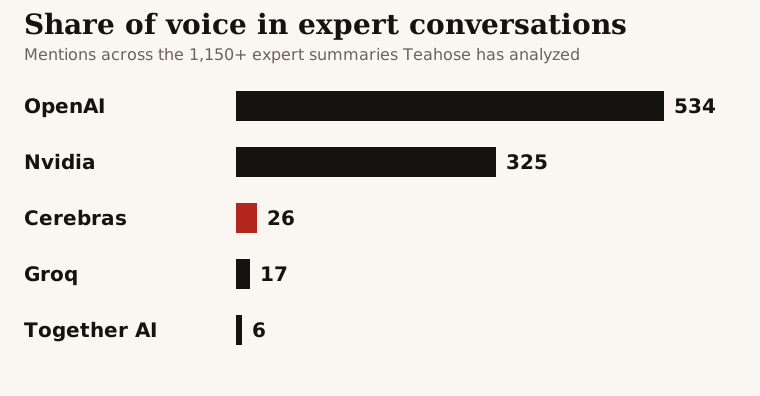
Each bar counts how many of Teahose's 1,150+ expert summaries mention it (word-boundary match across our podcast, newsletter, and paper corpus, June 2026).
Track the field: find the companies most similar to OpenAI and get their latest funding and product signals by email — Teahose Lookalikes.
Mention counts from Teahose's analysis of 1,150+ expert podcast, newsletter & research summaries, June 2026.
Valuation History
| Date | Event | Raised | Valuation |
|---|---|---|---|
| Jun 2026 | Trading (CBRS) | — | ~$50B market cap |
| May 2026 | IPO @ $185/share | $5.55B | ~$67B day-one close (standard count) |
| Apr 2026 | Second S-1 | — | targeted ~$23B |
| Sep 2025 | Series G (final private) | $1.1B | $8.1B |
| Sep 2024 | First S-1 — stalled by CFIUS review of G42 ties | — | — |
Sources: IPO coverage · TechCrunch · Series G.
Why the Market Pays ~98x Trailing Revenue
One contract: the Master Relationship Agreement with OpenAI — reported at $20 billion across 750MW of inference compute. It converts Cerebras from "interesting alternative silicon" into booked demand at hyperscale, and it's the cleanest public-market expression of the thesis that inference workloads will diversify beyond Nvidia. The bear case is the mirror image: one customer, one architecture bet, and a G42 concentration the filings say is unresolved.
It's also a market-structure moment: Cerebras going public within six months of Nvidia buying Groq's chip assets (see our Groq valuation explainer) effectively ended the independent-inference-silicon era — what remains is Cerebras, the hyperscalers' in-house chips, and a next wave of ASIC startups.
Latest Cerebras Signals, Live
What to Watch Next
- OpenAI ramp milestones. Each disclosed tranche of the 750MW agreement is the earnings story; slippage is the risk story.
- Revenue diversification. The percentage of revenue not tied to G42 or OpenAI is the number that re-rates the multiple.
- The inference-price war. Cerebras competes on speed-per-dollar against Nvidia's roadmap and the inference clouds — see our Groq competitors map for the field.
Hit Watch on Cerebras' company profile for new signals by email. Related: Groq valuation & the Nvidia deal · Together AI competitors · top AI startups, live-ranked.
Editorial figures as of June 10, 2026 — for the live market cap, check the ticker. The signal feed above updates continuously.
Bottom line: Cerebras is now a public stock (Nasdaq: CBRS) trading near a ~$50B market cap — about 6x its $8.1B final private mark — but at ~98x trailing 2025 revenue that valuation prices the $20B / 750MW OpenAI compute agreement and revenue diversifying away from G42, not the current business.
Frequently Asked Questions
What is Cerebras worth now?
Cerebras is a public company (Nasdaq: CBRS) as of May 14, 2026. Its market capitalization was roughly $50 billion as of early June 2026 — well below its first-day pop (it closed day one around $67B on standard share count, with fully diluted figures quoted as high as $86–95B) but about 6x its final private valuation of $8.1B. For the current number, check the live quote; this page explains how it got here.
When was the Cerebras IPO and how big was it?
May 14, 2026, on Nasdaq — priced above range at $185 per share, raising $5.55 billion, the largest tech IPO since Uber in 2019. The stock popped 68% on day one and has traded in a wide range ($185–$386) since.
What revenue does Cerebras have?
Per its S-1: $510 million in 2025 revenue (up 76% from $290M in 2024), split roughly $358M hardware and $152M cloud. The market cap is priced not on those trailing numbers (~98x) but on the ramp of its $20 billion / 750-megawatt Master Relationship Agreement with OpenAI for inference compute.
What are the main risks to the Cerebras valuation?
Concentration, twice over. The S-1 disclosed roughly 86% of revenue tied to UAE-linked entities (G42) — the same relationship that triggered the CFIUS review that delayed its first IPO attempt — and the forward story leans heavily on a single OpenAI contract. Execution against Nvidia's roadmap is the structural risk behind both.
Is Cerebras stock a good buy at a ~$50B valuation?
This page is not investment advice, but here is the framing the numbers force: at roughly 98x trailing 2025 revenue of 510 million dollars, Cerebras stock prices the future contract book, not the current business. The bull case is the 20 billion dollar, 750-megawatt OpenAI inference agreement ramping on schedule and revenue diversifying away from G42. The bear case is single-customer dependence plus the 86 percent UAE-linked concentration plus competing against Nvidia's roadmap. Watch the live signal feed above for tranche milestones and new customers before deciding.
How does Cerebras compare to Nvidia and Groq?
Cerebras builds wafer-scale chips optimized for fast inference rather than the general-purpose GPUs Nvidia sells, so the comparison is speed-per-dollar on inference workloads, not raw training share. Its public listing landed within six months of Nvidia acquiring Groq's chip assets, which effectively ended the independent-inference-silicon era; Cerebras is now the largest standalone bet against Nvidia in that niche. See our Groq valuation explainer and Groq competitors map for the surrounding field.
Why did the Cerebras IPO take so long to happen?
Cerebras first filed to go public in September 2024 but the offering stalled for roughly 18 months under a CFIUS national-security review of its ties to G42, the UAE-linked entity behind about 86 percent of its revenue. The company raised a 1.1 billion dollar Series G in September 2025 to stay funded while still private, refiled in April 2026, and finally listed on Nasdaq in May 2026 at 185 dollars per share.