
Key takeaways
- Together AI's closest competitors are Fireworks AI and Baseten (like-for-like open-model inference), with GroqCloud, Modal, Replicate, the GPU neoclouds (CoreWeave, Nebius, Lambda), and the hyperscalers (AWS Bedrock, Google Vertex) all converging on the same layer.
- This map is grounded in Teahose's analysis of 1,150+ expert summaries (~1M+ words tracking 1,800+ operators and thousands of companies), plus a live vector-similarity ranking that re-sorts as new inference startups and funding rounds land.
- The competition spans four layers — like-for-like platforms, developer-experience players, the compute layer below, and the convenience layer above — not a single flat list.
- Most "competitor" lists name the same five brands; what actually matters is which layer a rival attacks from, because open weights collapse differentiation to speed, price, reliability, and who's still raising capital.
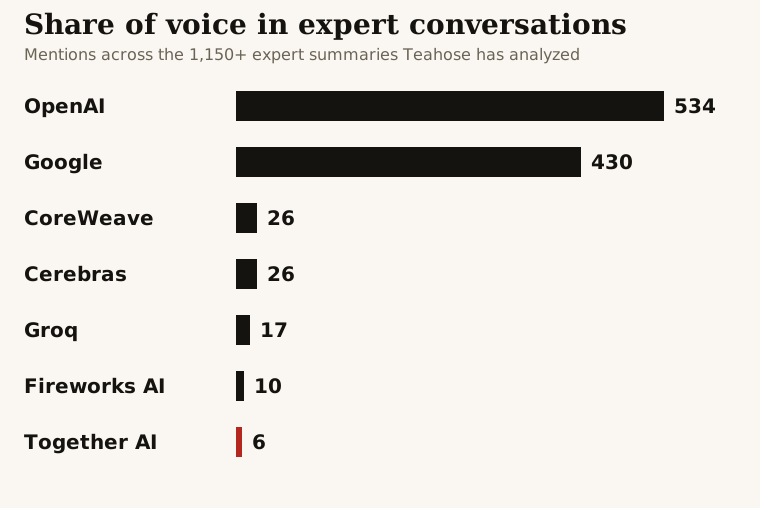
Each bar counts how many of Teahose's 1,150+ expert summaries mention it (word-boundary match across our podcast, newsletter, and paper corpus, June 2026).
Track the field: find the companies most similar to OpenAI and get their latest funding and product signals by email — Teahose Lookalikes.
At a glance
| Layer | Representative rivals | Competes on |
|---|---|---|
| Like-for-like platforms | Fireworks AI, Baseten, GroqCloud | Open-model serving speed & developer tooling |
| Developer-experience players | Modal, Replicate, Hugging Face | Developer experience & model catalog |
| Compute layer below | CoreWeave, Nebius, Lambda, Cerebras | Raw GPU capacity & speed-per-dollar |
| Convenience layer above | AWS Bedrock, Google Vertex, Azure AI Foundry | Procurement inside existing cloud contracts |
Mention counts and rankings from Teahose's analysis of 1,150+ expert podcast, newsletter & research summaries, June 2026.
Together AI sits in the middle of the most contested layer in AI infrastructure: serving open-weight models to developers, faster and cheaper than you could yourself. Everyone above, below, and beside that layer is converging on it — which makes "Together AI competitors" a four-way map.
Below it: a live similarity ranking from the Teahose intel graph, the same vector engine behind our company lookalikes tool, re-ranked continuously as new companies and funding rounds land.
The Like-for-Like Platforms
- Fireworks AI — the most direct rival: speed-obsessed open-model inference with strong production tooling.
- Baseten — inference with a developer-experience wedge; the choice for teams deploying custom and fine-tuned models.
- GroqCloud (Groq 2.0) — post-Nvidia-deal, a pure inference cloud competing on latency; see the full story in our Groq competitors map.
Developer-Experience Players
- Modal — serverless GPU compute for arbitrary Python workloads; wins when inference is one piece of a bigger pipeline.
- Replicate — the long tail of models, one API call away; strongest for prototyping and media models.
- Hugging Face — the model hub's inference endpoints: unbeatable catalog gravity, competing on convenience.
The Compute Layer Below
- CoreWeave, Nebius, Lambda — GPU neoclouds moving up the stack into managed inference as raw capacity commoditizes.
- Custom silicon — Cerebras (now public) and the ASIC wave (Etched, d-Matrix) compete on speed-per-dollar for the same tokens.
The Convenience Layer Above
- AWS Bedrock, Google Vertex, Azure AI Foundry — many-model catalogs inside existing cloud contracts. They rarely win on speed; they win on procurement.
- Frontier lab APIs — OpenAI and Anthropic cap the open-model value proposition from above: every price cut on frontier models squeezes the "good enough for less" pitch.
The Live Map: Together AI's Nearest Neighbors
Companies Most Similar to Together AI
Vector similarity against the Teahose company graph · same engine as the /similar lookalikes tool
- 01Nous Researchai-infrastructure83% match
- 02Alibaba / Qwen TeamAI81% match
- 03iwantai-infrastructure81% match
- 04CoreWeaveAI81% match
- 05NebiusAI80% match
- 06FireworksAI80% match
- 07vLLMAI Infrastructure80% match
- 08LiteLLMAI Infrastructure80% match
- 09TensorWaveAI Infrastructure78% match
- 10BasetenAI78% match
- 11FeatherlessAI78% match
- 12GroqAI78% match
- 13Eigen AIAI78% match
- 14InferactAI Infrastructure / LLM Inference Engine78% match
- 15CerebrasAI78% match
How to Watch This Market
- Speed and price are public; margins aren't. Benchmark providers on your workload, but read the funding signals for who's actually winning — capital keeps flowing to the layer's leaders and abandoning the rest.
- Watch vertical integration from both ends — neoclouds adding inference, labs cutting API prices. Each move squeezes the middle layer this market lives in. The daily signal feed catches them early.
- Follow Together AI's own trajectory at its live company profile — hit Watch for email updates when new signals land.
Related: Groq competitors · Cerebras valuation · OpenAI competitors · top AI startups, live-ranked.
Bottom line: Together AI's real competitors fan out across four layers, but Fireworks AI and Baseten are its closest like-for-like rivals — and because open weights collapse differentiation, the right alternative is whichever wins on speed, price, reliability, and enterprise features for your specific workload.
Frequently Asked Questions
Who are Together AI's main competitors?
Fireworks AI and Baseten are the closest like-for-like rivals — developer-first platforms serving open-weight models fast. GroqCloud competes on raw speed, Modal and Replicate on developer experience for custom workloads, and the hyperscalers (AWS Bedrock, Google Vertex) on procurement convenience. The GPU neoclouds (CoreWeave, Nebius, Lambda) compete one layer down but increasingly bundle inference.
What is the difference between Together AI and a GPU cloud like CoreWeave?
Layer. CoreWeave sells raw GPU capacity — you bring the serving stack. Together sells tokens and fine-tuning — the serving stack is the product, with research-grade optimization (FlashAttention lineage) underneath. Some workloads migrate down the stack as they scale; the bet on platforms like Together is that most teams never want to own inference plumbing.
How is the live list on this page generated?
We embed a description of Together AI's business with the same vector pipeline that powers our company lookalikes tool, then rank companies in the Teahose intel graph by cosine similarity. New inference startups and funding rounds surface here automatically as our pipeline detects them.
Is open-model inference a good business?
It's a knife fight: open weights mean every provider serves the same models, so differentiation collapses to speed, price, reliability, and enterprise features — while frontier labs' own APIs cap what customers will pay. The funding signals below are the best tell on which providers are winning that fight; margins are the thing nobody publishes.
What is the best Together AI alternative for serving fine-tuned open models?
Baseten is the most common pick when the workload is custom or fine-tuned models, thanks to its developer-experience wedge, while Fireworks AI is the go-to when raw serving speed on open weights is the priority. Modal fits when inference is one stage inside a larger Python pipeline rather than a standalone endpoint. Benchmark all three on your own model and traffic shape — the live ranking on this page surfaces newer entrants as our pipeline detects them.
How does Together AI compare to Fireworks AI and Baseten?
All three are developer-first platforms serving open-weight models, so they overlap heavily. Together leans on research-grade optimization (its FlashAttention lineage) and offers both training and inference; Fireworks is the most speed-obsessed of the three; Baseten differentiates on deployment experience for custom and fine-tuned models. Across the 1,150+ expert conversations Teahose has analyzed, the recurring theme is that open weights flatten model differences, so the real decision is speed, price, reliability, and enterprise features for your specific workload.
Are GPU clouds like CoreWeave and Lambda competitors to Together AI?
They compete one layer down today but are moving up. CoreWeave, Nebius, and Lambda sell raw GPU capacity, where you bring your own serving stack — whereas Together sells tokens and fine-tuning with the serving stack as the product. As raw capacity commoditizes, these neoclouds increasingly bundle managed inference, which is exactly the vertical-integration pressure that squeezes the middle layer Together occupies.