
Key takeaways
- OpenAI's real competition splits across four layers: frontier labs (Anthropic, Google DeepMind, xAI), open-weight challengers (Meta, Mistral, DeepSeek), enterprise/API rivals (Cohere, the cloud incumbents), and application-layer threats (Perplexity, AI coding tools).
- OpenAI is the single most-discussed company in our corpus — mentioned in 535 of the 1,150+ expert conversations we've analyzed, ahead of Anthropic — so the competitive set below is drawn from where operators actually focus.
- Anthropic is the closest like-for-like rival; Google is the biggest by resources, owning the full stack from TPUs to Search-and-Android distribution.
- Most listicles freeze a static top-ten; what matters is the absorption frontier — which application-layer category OpenAI ships into ChatGPT next — so this page pairs the editorial map with a live, vector-ranked neighbor list.
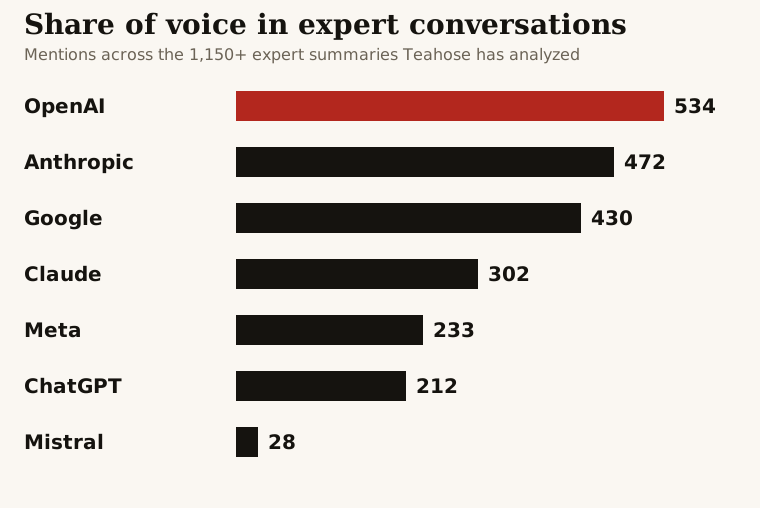
Each bar counts how many of Teahose's 1,150+ expert summaries mention it (word-boundary match across our podcast, newsletter, and paper corpus, June 2026).
Track the field: find the companies most similar to OpenAI and get their latest funding and product signals by email — Teahose Lookalikes.
At a glance
| Layer | Key players | Why they matter |
|---|---|---|
| Frontier labs | Anthropic, Google DeepMind, xAI | Compete on raw model capability; Anthropic is the closest twin, Google the deepest-pocketed |
| Open-weight challengers | Meta, Mistral, DeepSeek | Commoditize the model layer and cap API pricing with good-enough free models |
| Enterprise & API rivals | Cohere, cloud incumbents | Win the same enterprise budgets by turning model choice into a procurement detail |
| Application-layer threats | Perplexity, AI coding tools | Compete for ChatGPT's users until OpenAI absorbs the category |
Mention counts from Teahose's analysis of 1,150+ expert podcast, newsletter & research summaries, June 2026.
"Who competes with OpenAI?" has a short answer that's mostly wrong — everyone — and a useful answer that requires splitting the market into layers. OpenAI competes in at least four distinct arenas: frontier model capability, the developer API business, the consumer assistant, and the enterprise platform. Different rivals attack each layer, and almost nobody attacks all four at once.
This guide maps the field layer by layer. Then, below the editorial map, you'll find something static articles can't do: a live similarity ranking computed from the Teahose intel graph — the same vector engine behind our company lookalikes tool — that re-ranks OpenAI's nearest neighbors as new companies and signals enter the graph.
The Frontier Labs
The companies competing on raw model capability, training frontier-scale systems:
- Anthropic — the closest structural twin: API + assistant (Claude), enterprise-heavy go-to-market, safety-forward positioning. The two labs trade benchmark leads and increasingly compete on agentic coding, where Claude has carved out a strong developer franchise. Full competitive breakdown: Anthropic competitors map.
- Google DeepMind — the deepest-pocketed rival, with the Gemini family, custom TPU silicon, and unmatched distribution (Search, Android, Workspace). Google can subsidize at a scale no startup can match.
- Meta AI — competes asymmetrically by releasing open-weight Llama models, commoditizing the model layer that OpenAI monetizes, while folding AI into its consumer surfaces.
- xAI — Grok plus enormous self-built compute, distributed through X; less enterprise presence, more consumer-and-compute play.
- Mistral — Europe's frontier champion: efficient open and commercial models with a sovereignty pitch that wins regulated European enterprises.
- DeepSeek — the cost-efficiency shock: frontier-adjacent capability trained at a fraction of reported costs, with aggressive open releases that reset pricing expectations globally.
The Enterprise & API Rivals
Below the frontier, a tier competes for the same enterprise budgets without chasing capability records: Cohere (enterprise-first, deployment-flexible models), AI21 Labs, and cloud incumbents bundling models into existing contracts — Microsoft (OpenAI's partner and rival via its own models), Amazon (Bedrock's many-model catalog), and Google Cloud. For buyers, the multi-model platforms turn model choice into a procurement detail — structurally bad for any single lab's pricing power.
The Application-Layer Threats
Companies that don't train frontier models but compete for ChatGPT's users and use cases: Perplexity in answer-engines and search, AI coding tools (Cursor, GitHub Copilot, and Claude-powered agents) in OpenAI's most valuable usage category, and a long tail of vertical assistants in legal, health, and finance that win on workflow depth rather than model quality. The strategic question for each: can they stay ahead of the capabilities OpenAI absorbs into ChatGPT itself?
The Live Map: OpenAI's Nearest Neighbors
The list below is computed, not curated — companies from our graph ranked by vector similarity to OpenAI's business profile, the same engine that powers /similar. Expect the famous names plus emerging labs you haven't read a listicle about yet.
Companies Most Similar to OpenAI
Vector similarity against the Teahose company graph · same engine as the /similar lookalikes tool
- 01Meta AIAI82% match
- 02Nous Researchai-infrastructure80% match
- 03QwenAI80% match
- 04Zhiyuan InstituteAI Research79% match
- 05Zhipu AIAI78% match
- 06MiniMaxAI78% match
- 07Alibaba / Qwen TeamAI78% match
- 08TuringAI77% match
- 09Together AIAI77% match
- 10Mistral AIAI77% match
- 11Thinking Machines LabAI76% match
- 12GoModeldeveloper-tools76% match
- 13Google DeepMindai-infrastructure76% match
- 14LifeArchitect.aiAI75% match
- 15TypingMindai-productivity-work-management75% match
How to Watch This Race
- Track signals, not benchmarks. Benchmark leads change monthly; enterprise deals, pricing moves, and talent flows decide the business outcome. Each company above links to a profile with its live signal history — hit Watch to follow one by email.
- Watch the absorption frontier. The most important recurring event in this market is OpenAI (or a rival) shipping a feature that erases an application-layer category. The daily signal feed catches these the day they're discussed.
- Map any competitor's neighborhood. This page covers OpenAI; for any other company, paste its website into the lookalikes tool and get the same vector-ranked map on demand.
Related reading: Claude vs ChatGPT · Anthropic competitors · Top AI startups, live-ranked · the full company graph.
Bottom line: No single company competes with OpenAI across all four layers — Anthropic is the closest like-for-like rival and Google the biggest by resources, but the real contest is the absorption frontier, which is why this page pairs the editorial map with a live, vector-ranked neighbor list.
Frequently Asked Questions
Who is OpenAI’s biggest competitor?
Anthropic is the closest like-for-like competitor — a frontier lab selling models through an API and a consumer/enterprise assistant, competing for the same developers, enterprises, and researchers. Google is the biggest competitor by resources: it owns the full stack from TPUs to distribution through Search, Android, and Workspace.
Is open-source a real threat to OpenAI?
Yes, at the margins that matter commercially. Open-weight models from Meta, Mistral, DeepSeek, and others are good enough for a large share of production workloads, which caps API pricing and gives enterprises a credible exit path. OpenAI competes against "free and good enough" as much as against any single lab.
How is the live similarity list on this page generated?
We embed a description of OpenAI’s business with the same vector pipeline that powers our company lookalikes tool, then rank companies in the Teahose intel graph by cosine similarity. It updates as new companies enter the graph and as their signal histories evolve — so it surfaces emerging challengers, not just the household names.
Does OpenAI compete with its own customers?
Increasingly — and it’s a defining dynamic of the market. Each capability OpenAI ships into ChatGPT (search, agents, coding, document work) collides with application-layer companies built on its API. Watching which categories OpenAI absorbs next is one of the most useful signals in the feed.
How can I track OpenAI’s competitors over time?
Every company named here links to a live profile with its extracted signal history. Hit Watch on any profile for email updates, or paste any AI company’s website into our lookalikes tool to map its competitive neighborhood on demand.
Which AI company is mentioned most by experts right now?
OpenAI is the most-discussed company in the Teahose corpus, appearing in 535 of the 1,150+ expert podcast, newsletter, and research summaries we have analyzed as of June 2026 — narrowly ahead of Anthropic. That share of expert discussion is a measure of mindshare, not market share, but it tells you where the people building and funding this market are spending their attention.
Who are OpenAI's open-source competitors?
The main open-weight challengers are Meta (Llama), Mistral, and DeepSeek. They do not need to beat OpenAI on raw capability to matter — being good enough for a large share of production workloads caps API pricing and gives enterprises a credible exit path. DeepSeek in particular reset cost expectations by training frontier-adjacent models at a fraction of reported costs.
Is Anthropic or Google the bigger threat to OpenAI?
They threaten OpenAI differently. Anthropic is the closest structural twin — same API-plus-assistant model, same enterprise buyers, and a strong agentic-coding franchise with Claude. Google is the bigger threat by sheer resources: it owns custom TPU silicon and distribution through Search, Android, and Workspace, letting it subsidize at a scale no startup can match. Watch Anthropic for like-for-like product competition and Google for structural pricing pressure.