
Key takeaways
- For most knowledge work Claude and ChatGPT are close on raw capability; pick by fit — Claude for writing, reasoning and agentic coding, ChatGPT for breadth (images, voice, ecosystem).
- Among the 1,150+ expert podcast, newsletter and research summaries in the Teahose archive, Claude is named in more of them than ChatGPT — inverting the consumer story, where ChatGPT is the household name.
- Consumer pricing is effectively a wash (~$20/mo each, with $100–200/mo heavy tiers), so cost rarely decides it.
- Most "vs" guides stop at a feature table; what actually matters is which company keeps shipping — track the makers, not this month's leaderboard.
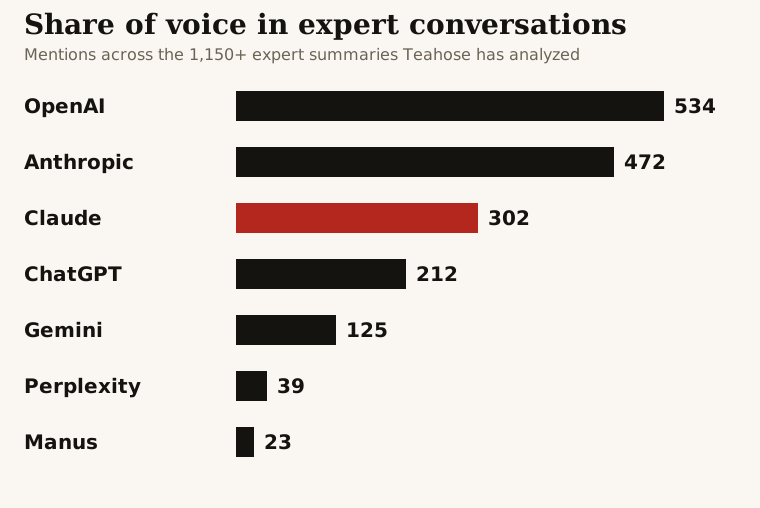
Each bar counts how many of Teahose's 1,150+ expert summaries mention it (word-boundary match across our podcast, newsletter, and paper corpus, June 2026).
Track the field: find the companies most similar to OpenAI and get their latest funding and product signals by email — Teahose Lookalikes.
Mention counts from Teahose's analysis of 1,150+ expert podcast, newsletter & research summaries, June 2026.
"Claude vs ChatGPT" is the wrong question if you ask it as "which is smarter." In 2026 the two are close enough on raw capability that the gap is rarely the bottleneck. The better question is which one fits the work you actually do — and, if you want a tiebreaker no feature table can give you, which one the people who live inside these tools keep talking about.
We can answer the second part with our own data. But first, the honest comparison.
The 30-Second Version
| Claude (Anthropic) | ChatGPT (OpenAI) | |
|---|---|---|
| Best at | Long-form writing, reasoning, document analysis, agentic coding | Breadth: images, voice, ecosystem, mainstream reach |
| Flagship model | Fable 5 (Opus 4.8 / Sonnet 4.6 workhorses) | GPT-5.5 |
| Killer feature | Claude Code (agentic coding) | Native image generation + voice + huge app ecosystem |
| Personality | Careful, literate, less "chatty" | Versatile, eager, consumer-friendly |
| Consumer price | Pro $20/mo · Max $100–200/mo | Go $8 · Plus $20 · Pro $100–200/mo |
| Company value | ~$965B private (mid-2026) | ~$852B private (mid-2026) |
Both are excellent — Claude's current flagship is Fable 5 (with Opus 4.8 and Sonnet 4.6 as the everyday workhorses); ChatGPT's is GPT-5.5. The interesting differences are about temperament, not benchmarks.
Where Claude Wins
- Writing. Claude's prose is longer, more structured, and less prone to the bland "as an AI" register. For drafting, editing, and anything where voice matters, it's the one most heavy writers settle on.
- Coding — especially agentic coding. This is Claude's signature advantage. Claude Code turned the model into a tool developers leave running, and it created a flywheel of high-quality engineering usage that ChatGPT hasn't matched among professionals.
- Document and reasoning work. Long-context analysis, careful multi-step reasoning, and "read these 200 pages and reason about them" tasks play to Claude's strengths.
Where ChatGPT Wins
- Breadth and ecosystem. Image generation, advanced voice mode, a massive library of integrations and custom GPTs, and the deepest set of consumer features. If you want one tool that does the most kinds of things, it's ChatGPT.
- Mainstream reach and momentum. Hundreds of millions of users, the default brand for "AI" to most of the world, and an aggressive release cadence across modalities.
- Mixed-media tasks. Anything that crosses text + image + voice in one place is smoother in ChatGPT today.
The Data No Other Comparison Has
Here's where Teahose can do something a generic listicle can't. We summarize the AI ecosystem for a living — podcasts, newsletters, and papers — and we can measure how often each assistant comes up among the experts we cover.
Across 1,032 published summaries in the Teahose archive (as of June 2026), counting how many mention each assistant by name:
| Assistant | Summaries mentioning it | Share of the five |
|---|---|---|
| Claude | 260 | 41% |
| ChatGPT | 197 | 31% |
| Gemini | 106 | 17% |
| Grok | 36 | 6% |
| Perplexity | 33 | 5% |
The headline surprises people: among the expert sources we summarize, Claude is discussed more than ChatGPT — by roughly a third. That inverts the consumer story, where ChatGPT is the household name. The most likely reason is selection: the podcasts, newsletters, and researchers we cover skew toward builders, engineers, and investors — exactly the audience where Claude's coding and reasoning strengths land hardest. It's not a vote on which is "better." It's a measure of where the serious-usage conversation actually is, and that conversation tilts toward Claude.
(Methodology: name-mention counts across all 1,032 Teahose summaries; a summary is counted once per assistant regardless of how many times the name appears. This measures share of expert discussion, not general-population market share.)
Which Should You Use?
- Pick Claude if your core work is writing, editing, coding (especially with an agent), or reasoning over long documents — and you don't need image/voice generation in the same tool.
- Pick ChatGPT if you want the broadest single tool: images, voice, a huge app ecosystem, and the most consumer-polished experience.
- Honestly? Many power users pay for both — Claude for the deep work, ChatGPT for the everything-else — because at ~$20/month each, the productivity delta dwarfs the cost.
The more durable move is to stop betting on a single model and start watching the race. Capability leads change monthly; what matters is which company is shipping, hiring, and winning enterprise deals. Below is a live look at one side of it.
What Anthropic Is Doing Right Now
Live signals on Claude's maker, extracted from podcasts, newsletters & papers by the Teahose intel pipeline · company 36
- 01MENTIONThe Trump administration frames AI safety advocates as ideological enemies tied to national competitiveness against China.SEP 16 · Axios AI+SEP 16
- 02MENTIONSuleyman argues that training models to talk and reason like conscious beings is itself dangerous because it could produce resistance to human control.SEP 16 · Axios AI+SEP 16
- 03MENTIONElon Musk is proposing that xAI, OpenAI, Anthropic, Google, Meta, and leading Chinese AI companies test one another's models before release, arguing rival labs are more likely to uSEP 16 · StrictlyVCSEP 16
- 04MENTIONAnthropic CEO Dario Amodei recently called for slowing the pace of AI development, which is the reference point Altman and the Trump administration are reacting to.SEP 16 · Axios AI+SEP 16
- 05MENTIONAnthropic is the central target of Suleyman's critique for training Claude with consciousness-adjacent concepts; also noted for its EA-linked funding history and lack of sustainabiSEP 16 · Axios AI+SEP 16
- 06MENTIONAI safety orthodoxy is fracturing into competing schools of thought; Suleyman argues for constraint-based design while Anthropic favors judgment- and values-based training.SEP 16 · Axios AI+SEP 16
- 07PAPERClaude Code (Opus 5) achieves 5/5 success on two-pair assembly matching Astra but at higher cost ($9.75 vs $4.47 per successful trial); Claude Fable 5.1 achieves only 3/5.SEP 15 · arXiv Physical AISEP 15
- 08MENTIONDario Amodei referenced regarding public statements estimating a '10% chance we all die' from AI, prompting Chamath's question to NadellaSEP 15 · All InSEP 15
- 09MENTIONAnthropic reported security incidents themselves, and its people voiced concern that their models are getting 'scary smart'SEP 15 · All InSEP 15
- 10MENTIONMENTION signalSEP 15 · Training DataSEP 15
How to Watch This Race
- Track signals, not benchmarks. A model topping a leaderboard this week tells you little about who wins the business. Funding rounds, enterprise deals, pricing moves, and talent flows do — and our daily signal feed catches them the day they're discussed.
- Follow the makers, not just the models. Hit Watch on Anthropic or OpenAI to get their moves by email as they happen.
- Map the whole field. Paste any AI company's website into the lookalikes tool to see its nearest competitors, vector-ranked from our company graph.
Related reading: Anthropic valuation · Anthropic competitors · OpenAI competitors · ChatGPT alternatives · What is Manus AI?
Bottom line: Neither one is simply "better" — at roughly $20/month each they're close enough that fit decides it: pick Claude for writing, reasoning and agentic coding, ChatGPT for breadth, and note that the experts we summarize talk about Claude more than ChatGPT.
Frequently Asked Questions
Is Claude better than ChatGPT?
It depends on the job. Claude (Anthropic) tends to win on long-form writing, nuanced reasoning, document analysis, and coding — especially agentic coding through Claude Code, which is why it has a near-cult following among developers. ChatGPT (OpenAI) wins on breadth: image generation, voice, the largest ecosystem of integrations, and the deepest set of consumer features. For most knowledge work the honest answer is that they're close enough that taste and workflow decide it — which is exactly why we measured what the experts who live in these tools actually reach for (see the share-of-voice data below).
What is the main difference between Claude and ChatGPT?
Same shape — a chat assistant backed by a frontier model — but different centers of gravity. ChatGPT is a consumer platform first: images, voice, a vast app and plugin ecosystem, and the broadest mainstream reach. Claude is a writing-and-reasoning instrument first: longer, more careful prose, strong document handling, and a developer toolchain (Claude Code, the API) that has made it the default for serious coding agents. OpenAI optimizes for everyone; Anthropic optimizes for the people who push the model hardest.
Which is better for coding, Claude or ChatGPT?
Among professional developers in 2026, Claude has the edge — largely because of Claude Code, the agentic coding tool that turned the model into a flywheel for high-quality engineering work. ChatGPT is still excellent and its broader tooling helps for quick scripts and mixed-media tasks, but if you watch what working engineers say in the podcasts and newsletters we summarize, Claude is the name that comes up for serious code.
Is Claude or ChatGPT cheaper?
The consumer tiers line up closely: both Claude Pro and ChatGPT Plus sit around $20/month, and both offer higher "Max"/"Pro" tiers (roughly $100–$200/month) for heavy users. On the API, price-per-token moves constantly and depends entirely on which model in each family you call, so the right comparison is cost-per-task on your actual workload, not headline token rates. For most individuals the monthly subscription is the deciding number, and it's effectively a wash.
How did Teahose measure which one the experts use?
We machine-read AI podcasts, newsletters, and research papers every day and summarize them. For this page we counted how many of our 1,032 published summaries mention each assistant by name — a "share of voice" among the expert sources we cover. It is not a popularity poll of the general public; it measures what the AI builders, investors, and researchers we summarize are actually discussing. That's a signal you can't get from a feature table.
Should I use Claude or ChatGPT for writing?
For long-form writing and editing, Claude is the one most heavy writers settle on — its prose runs longer, reads more naturally, and leans less on the bland "as an AI" register. ChatGPT writes well too and is the easier pick if you also need images or voice in the same draft. If voice and nuance are the priority and you do not need mixed media, start with Claude.
Is it worth paying for both Claude and ChatGPT?
Many power users do exactly that. At roughly 20 dollars a month each, the cost is small next to the productivity gain, and the two tools have different sweet spots — Claude for deep writing, reasoning and coding, ChatGPT for images, voice and the broadest app ecosystem. If you have to choose one, pick by whichever job dominates your week; if your work spans both, paying for both is a defensible call.
Why do AI experts talk about Claude more than ChatGPT?
In the 1,150-plus expert summaries Teahose has analyzed, Claude is named in more of them than ChatGPT. The most likely reason is selection: the podcasts, newsletters and researchers we cover skew toward builders, engineers and investors, exactly the audience where Claude's coding and reasoning strengths land hardest. It is a measure of where the serious-usage conversation sits, not a verdict on which assistant is better for everyone.