
Key takeaways
- The strongest ChatGPT alternative depends on the job: Claude (Fable 5) for coding and long agentic work, Gemini for value and Google-ecosystem reach, Perplexity for cited research, Grok for real-time signal, and DeepSeek V4 for free open weights.
- ChatGPT still leads on scale but is the most-discussed assistant in our data: ChatGPT appears in 213 of the 1,150+ expert podcast, newsletter and research summaries we've analyzed — a useful read on which tools practitioners actually debate switching to.
- Price is now a real lever: Gemini AI Plus ($7.99), ChatGPT Go ($8), SuperGrok Lite ($10) and Le Chat Pro ($14.99) broke the old $20 standard.
- Most guides rank a single "winner"; what matters is matching the tool to your actual workload — heavy users increasingly run two assistants, not one.
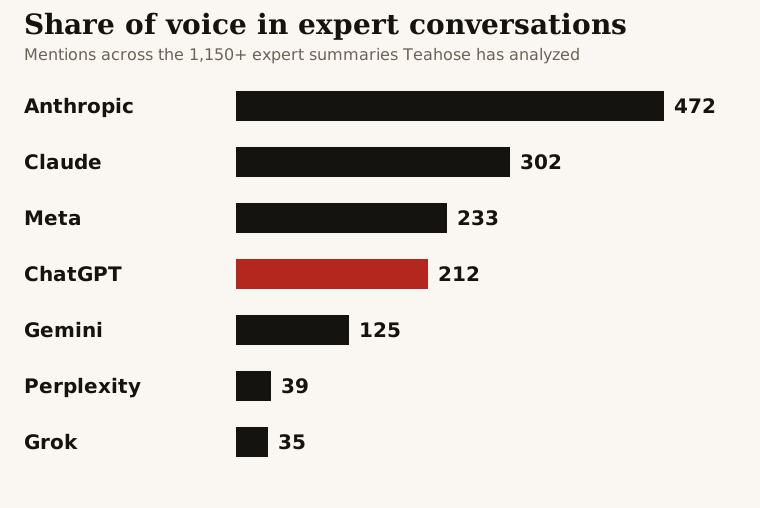
Each bar counts how many of Teahose's 1,150+ expert summaries mention it (word-boundary match across our podcast, newsletter, and paper corpus, June 2026).
Track the field: find the companies most similar to OpenAI and get their latest funding and product signals by email — Teahose Lookalikes.
Mention counts from Teahose's analysis of 1,150+ expert podcast, newsletter & research summaries, June 2026. All models and prices verified June 10, 2026.
A year ago "ChatGPT alternatives" was a listicle genre about also-rans. In June 2026 it's a real decision: ChatGPT's share of AI-chatbot web visits fell from ~77% to ~55% while Gemini quintupled to ~27% (FirstPageSage; Similarweb's methodology shows the same direction). ChatGPT is still enormous — 900M weekly active users and 50M paying subscribers (TechCrunch) — but the gap closed. Everything below is verified as of June 10, 2026; this market re-prices monthly, which is why this page carries a date and most don't.
The Direct Swaps
Claude (Anthropic) — the power-user pull, strongest at coding, long documents, and agentic work. Flagship: Fable 5, released June 9, 2026 — the first "Mythos-class" model offered publicly (Anthropic), free on paid plans through June 22. Free tier; Pro $20; Max $100/$200 (which is what heavy Claude Code use needs).
Gemini (Google) — the value-and-ecosystem play. Gemini 3.5 generation rolling out since I/O 2026; AI Plus at $7.99/mo is the cheapest paid tier from any major lab, and Ultra was cut from $249.99 to $99.99 (Engadget). If your life is in Gmail/Docs/Search, this is the default alternative.
Grok (xAI) — real-time X data, fewer content restrictions, and aggressive pricing (SuperGrok Lite $10; API $1.25/$2.50 per M tokens with 1M context). Grok 4.3 shipped April 30 (x.ai docs). Now part of SpaceX — that story here.
Perplexity — not a chatbot clone but the best cited-research tool; routes across frontier models, free Comet agentic browser, Pro $20. The right swap if most of your ChatGPT use is actually search.
Microsoft Copilot — GPT-5-family models (plus Microsoft's MAI) wrapped in Windows/Office. Pro $20; M365 Copilot $30/seat. Choose it for Excel/Outlook integration, not model quality.
Meta AI (Muse Spark) — free at enormous scale inside WhatsApp/Instagram/Messenger. Muse Spark (April 2026) is Meta Superintelligence Labs' first model — and marks Meta's pivot away from open-source Llama (TechCrunch). Ubiquitous; not a power tool.
DeepSeek (V4) — the open-weights frontier: V4 (April 2026) ships MIT-licensed weights and an API an order of magnitude cheaper than Western labs ($0.435/$0.87 per M) (Fortune). Free app. The standard caveat: China-based data handling.
Mistral Le Chat — the European answer: GDPR-friendly, open-weights heritage, and Pro at $14.99 undercuts the $20 standard. Le Chat's Work Mode and Mistral Large 3 shipped this spring.
Qwen (Alibaba) — free chat with no sign-up, a deep open-weights family (Apache 2.0), dominant in APAC. Same data-residency caveat as DeepSeek.
Pricing at a Glance (verified June 2026)
| Product | Free tier | Standard paid | Power tier | Flagship model |
|---|---|---|---|---|
| ChatGPT | ✓ | Go $8 / Plus $20 | Pro $100–200 | GPT-5.5 |
| Claude | ✓ | Pro $20 | Max $100/$200 | Fable 5 |
| Gemini | ✓ | AI Plus $7.99 / Pro $19.99 | Ultra $99.99/$200 | Gemini 3.5 Pro |
| Grok | ✓ | Lite $10 / SuperGrok $30 | Heavy $300 | Grok 4.3 |
| Copilot | ✓ | Pro $20 | M365 $30/seat | GPT-5.4 + MAI |
| Perplexity | ✓ | Pro $20 | Max $200 | multi-model |
| Meta AI | ✓ (everything) | — | — | Muse Spark |
| DeepSeek | ✓ | — (API-funded) | — | V4 (open, MIT) |
| Le Chat | ✓ | Pro $14.99 | — | Mistral Large 3 |
| Qwen | ✓ (no sign-up) | — | — | Qwen3.7-Max |
By Use Case
- Coding: Claude Code (via Claude Pro/Max), Cursor ($20–200), GitHub Copilot (free–$39, now usage-based billing as of June 1). The common pro stack is Cursor + Claude Code — mapped fully in our Cursor alternatives guide.
- Research with citations: Perplexity, then Gemini's AI Mode.
- Open-source / self-hosted: DeepSeek V4 (MIT) leads open rankings, with Kimi K2.6, GLM-5.1, and Qwen 3.7 behind it — note the torch passed from Meta to Chinese labs when Llama went quiet. Run them with Ollama or LM Studio; Gemma 4 26B is the best practical local model.
- Privacy: Proton Lumo (zero-access encryption) → Duck.ai (anonymized proxy) → fully local via Ollama.
When ChatGPT Is Still the Right Call
Every other page on this search assumes you're leaving — honesty requires the other column. Stay on ChatGPT if you live in its ecosystem (Sora, custom GPTs, the desktop app, Operator) and switching costs outweigh the gains; if you want the widest third-party integration surface, since most "connect your AI" features ship for ChatGPT first; or if you'd rather have one good-at-everything default than assemble a two-tool stack. GPT-5.5 is still a frontier model — the case for alternatives is fit and price, not that ChatGPT got worse. The honest rule that falls out of the data above: switch a workload, not your whole life — move coding to Claude or search to Perplexity while keeping ChatGPT as the generalist. That is what "most heavy users run two" means in practice.
The Companies Behind the Tools, Live
This page compares products; the competitive war behind them — valuations, funding, who's gaining — moves weekly. The feed below tracks it.
The ChatGPT Competitive Field, Ranked by Similarity
Vector similarity against the Teahose company graph · same engine as the /similar lookalikes tool
- 01ChatGPTAI81% match
- 02Meta AIAI77% match
- 03Zhipu AIAI76% match
- 04TypingMindai-productivity-work-management76% match
- 05Tune AIAI76% match
- 06QwenAI74% match
- 07Alibaba / Qwen TeamAI74% match
- 08China Telecom (TeleAI)AI74% match
- 09AnthropicAI73% match
- 10Nous Researchai-infrastructure73% match
- 11DeepSeekAI72% match
- 12Mistral AIAI72% match
How to Choose
- Audit what you actually use ChatGPT for. Mostly search → Perplexity. Mostly code → Claude. Mostly Gmail-adjacent → Gemini. Mostly casual → the free tiers are now good enough.
- Exploit the $8–15 tier. ChatGPT Go, Gemini AI Plus, SuperGrok Lite, and Le Chat Pro made "paid AI" a sub-$20 decision; the $20 default is no longer automatic.
- Re-check quarterly. Every model in the table above shipped within the last ten weeks. Whatever you pick, the ranking will look different by fall — the live feed above is the early-warning system.
Related: Claude vs ChatGPT (with our share-of-voice data) · Grok vs ChatGPT (Grok 4.3 vs GPT-5.5, head to head) · OpenAI competitors (the company view) · Anthropic competitors · Claude/Cursor coding-tool map · ElevenLabs alternatives (voice AI) · xAI valuation.
New to all this? Start with the fundamentals: how does ChatGPT work? · what are AI agents? (the systems that act, not just answer) · what is Manus? (the breakout autonomous agent).
All models and prices verified June 10, 2026. The live ranking above updates continuously.
Bottom line: There's no single best ChatGPT alternative — match the tool to the job: Claude for coding and long agentic work, Gemini for value and Google-ecosystem reach, Perplexity for cited research, Grok for real-time signal, and DeepSeek V4 for free open weights — and like most heavy users, expect to run two rather than one.
Frequently Asked Questions
What is the best alternative to ChatGPT?
Depends on the job. For coding and long agentic work, Claude (Anthropic's Fable 5 shipped June 9, 2026). For living inside Google's ecosystem at the lowest price, Gemini — the $7.99 AI Plus tier undercuts everyone. For cited, real-time research, Perplexity. For real-time social signal, Grok. For free-and-open, DeepSeek V4. Most heavy users now run two: about one in five AI users uses multiple platforms.
Which AI is better than ChatGPT?
None is universally better — each leads a different axis. Claude (Fable 5) beats ChatGPT for coding and long agentic work; Gemini wins on price and Google-ecosystem integration; Perplexity wins for cited, real-time research; Grok wins for live social signal; DeepSeek V4 wins for free open weights. ChatGPT remains the most capable generalist at the largest scale (900M weekly users), which is why most heavy users keep it and add a specialist rather than fully switching.
What chatbot does Elon Musk use?
Grok, the assistant from his own company xAI — now part of SpaceX after the February 2026 merger. Grok is built into X, leans on real-time social data, and applies fewer content restrictions than most rivals; SuperGrok Lite runs $10/month and the flagship is Grok 4.3. It is the natural ChatGPT alternative if you want real-time signal and live X context over polished long-form output.
Is there a free alternative to ChatGPT?
Several, and they're strong. DeepSeek V4 is free in-app with open MIT-licensed weights; Qwen chat needs no sign-up; Meta AI (Muse Spark) is free across WhatsApp, Instagram, and Messenger; Gemini, Claude, Grok, Perplexity, and Copilot all have real free tiers. For privacy-first free options, Duck.ai proxies frontier models anonymously, and local runtimes like Ollama keep everything on your machine.
What is the cheapest paid AI assistant?
Google AI Plus at $7.99/month is the cheapest paid tier from a major lab, followed by ChatGPT Go at $8 and SuperGrok Lite at $10. Mistral's Le Chat Pro at $14.99 is the cheapest full premium tier — below the $20 standard that ChatGPT Plus, Claude Pro, Copilot Pro, Gemini AI Pro, and Perplexity Pro all converged on.
Why are people leaving ChatGPT?
The reported pattern: capability parity (Gemini and Claude closed the quality gap, so ecosystem and price break ties), specialization (Claude for code, Perplexity for citations, Grok for real-time), safety-filter frustration on benign requests, upsell fatigue, and privacy. ChatGPT is still the biggest assistant by far — 900M weekly users — but its share of chatbot web traffic fell from roughly 77% to 55% in about a year.
Which ChatGPT alternative is best for privacy?
Three tiers. Hosted-but-private: Proton Lumo (zero-access encryption, EU hosting, no training on your data). Anonymized access to big models: Duck.ai. Maximum privacy: run open weights locally with Ollama or LM Studio — DeepSeek V4 and Qwen 3.7 are MIT/Apache-licensed, and Gemma 4 26B is the best practical local model. European data residency without self-hosting: Mistral Le Chat.
What is the best ChatGPT alternative for coding?
For coding and long agentic work, Claude (Anthropic's Fable 5, the current flagship) is the consistent power-user pick, usually run through Claude Code on a Pro or Max plan. The common professional stack pairs Cursor with Claude Code; GitHub Copilot is the cheapest on-ramp but trails on harder agentic tasks. Across the 1,150+ expert summaries we've analyzed, Claude and the model debate behind these tools come up constantly — coding is where switching off ChatGPT is most common.
Is Claude or Gemini a better ChatGPT replacement?
It depends on your priority. Choose Claude if you want the strongest coding and long-document quality and don't mind the $20 Pro tier. Choose Gemini if price and Google-ecosystem integration matter most — its AI Plus tier at $7.99/month is the cheapest paid plan from any major lab, and it lives natively inside Gmail, Docs and Search. For most people the deciding factor is where their work already happens, not raw benchmark scores.
How many ChatGPT alternatives are worth using in 2026?
Roughly nine are genuinely competitive: Claude, Gemini, Grok, Perplexity, Microsoft Copilot, Meta AI, DeepSeek, Mistral Le Chat and Qwen. You don't need all of them — most heavy users settle on two, typically one frontier assistant plus a specialized tool like Perplexity for cited research. The market re-prices monthly, so re-check your pick each quarter.