
Key takeaways
- AI agents are systems that take a goal, plan the steps, use tools (a browser, code, APIs), and act autonomously — the shift from chatbots that answer to systems that act.
- The category is real and crowded: "AI agents" come up in 303 of the 1,150+ expert conversations we've analyzed, and we track 175+ companies in the AI Agents theme alone.
- The stack has four layers — model, tools, memory/orchestration, and interface/guardrails — and orchestration is the layer where most agents quietly break.
- Most guides hype the demo; what actually matters is reliability. Chain ten 90%-reliable steps and the task succeeds end-to-end only ~35% of the time, so the signal is who deploys an agent that survives real users, not who demos one.
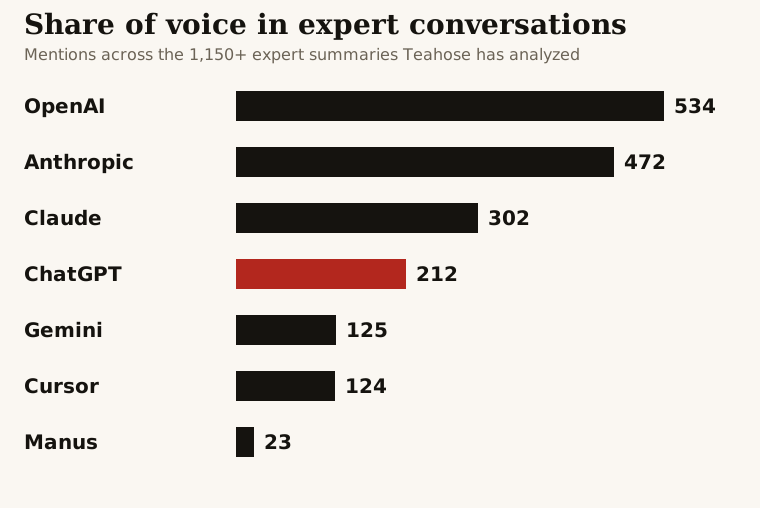
Each bar counts how many of Teahose's 1,150+ expert summaries mention it (word-boundary match across our podcast, newsletter, and paper corpus, June 2026).
Track the field: find the companies most similar to OpenAI and get their latest funding and product signals by email — Teahose Lookalikes.
Mention counts from Teahose's analysis of 1,150+ expert podcast, newsletter & research summaries, June 2026.
AI agents are systems that pursue goals on their own — they plan, use tools, and take actions, rather than simply answering a question. If the chatbot era put intelligence behind a text box, the agent era puts it behind a to-do list. You stop prompting turn by turn and start delegating outcomes.
That shift — from answering to acting — is the most important thing happening in software right now, and it's why capital and talent are pouring into the layer above the foundation models. We track it daily across the AI Agents theme, the podcasts where these founders explain themselves, and the papers pipeline.
Agent vs. Chatbot vs. Copilot
| Chatbot | Copilot | Agent | |
|---|---|---|---|
| You provide | A question | A task, in context | A goal |
| It returns | An answer | A suggestion you approve | A completed outcome |
| Autonomy | None | Low — you stay in the loop | High — acts on its own |
| Can work unattended? | No | Barely | Yes (that's the point) |
| Example | ChatGPT Q&A | GitHub Copilot inline | Manus, Claude Code, Devin |
The line that matters is the last row: can it do useful work while you're not watching? That single property is what separates a genuinely agentic product from a chatbot wearing the word "agent" in its marketing.
The Four-Layer Agent Stack
1. The model — the reasoning core. Every agent runs on a foundation model (GPT, Claude, Gemini, open models) doing the planning and decision-making. Notably, most agent companies don't train their own — they orchestrate someone else's. That's why a small team could ship Manus without a billion-dollar training run. How a model like ChatGPT works is the foundation under this whole stack.
2. Tools & actions. What turns a model into an agent: a browser, code execution, file access, APIs, and the ability to call them. "Tool use" and "function calling" are the plumbing; the open standard most teams now build against is the Model Context Protocol (MCP).
3. Memory & orchestration. The loop that keeps an agent coherent across many steps — short-term scratchpads, long-term memory, retries, and the planner that decides what to do next. This is the hardest and least-solved layer, and where most agents quietly break.
4. The interface & guardrails. How you delegate and supervise — approvals for consequential actions, sandboxing, scoped permissions. The companies that win enterprise will win here, because trust, not raw capability, is the bottleneck.
Why Agents Took Off in 2025–2026
Three things converged. Models got good enough at reasoning and tool use to chain steps reliably-ish. The standards matured (function calling, MCP) so agents could plug into real systems. And the economic logic clicked: if a chatbot is worth $20/month, an agent that does the work itself is priced against labor — a vastly larger market. That's why the agent layer attracted the funding it did, and why our AI Agents theme now spans 175+ tracked companies, from general agents to vertical ones in browser automation and app development.
The Honest Counterweight
The demos are intoxicating; the deployments are harder. The core problem is compounding error: chain ten steps that are each 90% reliable and the whole task succeeds only ~35% of the time. Add prompt-injection risk, the cost of autonomous wrong actions, and uneven tool reliability, and you get the real 2026 status: agents are production-ready for narrow, supervised, well-instrumented tasks — and oversold for everything else. The interesting signal isn't who demos an agent; it's who deploys one that survives contact with real users. That's what the live map below is for.
The Live Map
AI Agent Companies by Signal Volume
Live membership of the ai-agents, agentic-browser-automation & ai-agentic-app-development themes · ranked by extracted signals
- 01Anthropiclast seen OCT 211746 signals
- 02OpenAIlast seen OCT 251657 signals
- 03Nvidialast seen OCT 211005 signals
- 04Googlelast seen OCT 21630 signals
- 05Metalast seen OCT 21522 signals
- 06Amazonlast seen OCT 21347 signals
- 07Microsoftlast seen OCT 21340 signals
- 08Applelast seen OCT 20270 signals
- 09a16zlast seen OCT 21254 signals
- 10Stripelast seen OCT 21225 signals
- 11xAIlast seen OCT 21179 signals
- 12Salesforcelast seen OCT 20172 signals
- 13Cursorlast seen OCT 21163 signals
- 14Y Combinatorlast seen OCT 21149 signals
- 15Harveylast seen OCT 21139 signals
- 16DeepSeeklast seen OCT 21138 signals
- 17Moonshot AIlast seen OCT 13116 signals
- 18Cursorlast seen OCT 12108 signals
- 19Metalast seen OCT 19102 signals
- 20Perplexitylast seen OCT 1982 signals
Going Deeper
- The breakout agent: What is Manus? — the viral general agent, with our live signal feed on it.
- The model layer underneath: How does ChatGPT work? — the reasoning core agents orchestrate.
- The adjacent frontier: What is physical AI? — agents that act in the physical world, not just the browser.
- The alternatives & competitors: ChatGPT alternatives · OpenAI competitors · Anthropic competitors.
- The research: our papers pipeline summarizes the top agent and reasoning papers daily.
The agent field moves weekly — who shipped, who raised, who quietly stalled. The free Teahose daily digest tracks every agent launch, funding round, and deal across 40+ podcasts, 20+ newsletters, and the day's research, distilled into one morning email. Subscribe free and watch the category move in real time.
Definitions are stable; the live company map is as of June 14, 2026, and updates continuously.
Bottom line: AI agents are systems that take a goal, plan the steps, use tools, and act on their own — the shift from chatbots that answer to systems that work unattended — but in 2026 they're dependable only on narrow, supervised tasks, so the real signal is who deploys an agent that survives real users, not who demos one.
Frequently Asked Questions
What are AI agents?
AI agents are software systems that pursue a goal autonomously. Instead of returning a single answer like a chatbot, an agent takes an objective ("book this trip," "triage these tickets," "research these companies"), breaks it into steps, uses tools — a web browser, code execution, APIs, a file system — and loops through plan-act-observe-correct until the task is done. The defining trait is agency: it decides what to do next, not just what to say next.
What is the difference between an AI agent and a chatbot?
A chatbot is reactive and conversational — you ask, it answers, you steer every turn. An agent is goal-directed and autonomous — you delegate an outcome and it takes multiple actions on its own to reach it. A useful test: if the system can do something while you're not watching (browse 30 sites, run code, send requests, then hand you a finished deliverable), it's acting as an agent. If it only produces text in response to each prompt, it's a chatbot, even a very smart one.
What are the best examples of AI agents?
Consumer-facing: Manus (general task agent), OpenAI's and Anthropic's computer-use and "operator"-style agents, and browser agents that navigate the web for you. Developer-facing: coding agents like Claude Code, Cursor's agent mode, and Devin-style autonomous engineers. Enterprise: customer-support agents (Sierra), workflow and back-office agents, and agentic search. Teahose tracks 175+ companies in the AI Agents theme alone — the live map below ranks them by current signal volume.
Do AI agents actually work yet?
On narrow, well-scoped tasks with good tools — coding, structured research, repetitive web workflows — yes, increasingly well. On long, ambiguous, high-stakes tasks, not reliably. The honest failure mode is compounding error: a 90%-reliable step run ten times in a chain succeeds end-to-end only about a third of the time. That gap between an impressive demo and a dependable deployment is the central engineering problem of the category in 2026, and it's exactly what to watch when a company claims its agent is production-ready.
Are AI agents safe?
They introduce genuinely new risk. An agent with a browser, your credentials, and the ability to act can be steered by malicious content it reads on the web (prompt injection), can take costly wrong actions autonomously, and expands the data it touches. The mitigations — sandboxing, human-in-the-loop approval for consequential actions, scoped permissions — are improving but not solved. Treat an agent like a fast, capable, occasionally-overconfident new hire: useful with supervision, not yet trustworthy unattended.
How do I choose an AI agent for my use case?
Start from the task, not the brand. For coding, look at agents built around code execution and a repo (Claude Code, Cursor agent mode, Devin-style tools). For web research or repetitive online workflows, look at browser agents that can navigate and act. For customer support or back-office work, look at vertical enterprise agents with approval steps and audit trails. Then weigh reliability over demo polish: ask how the vendor handles failures, whether consequential actions require human sign-off, and what it costs when the agent is wrong. The live map below ranks 175+ tracked agent companies by current signal volume so you can see who is actually shipping.
Will AI agents replace jobs or just tasks?
In 2026 the honest answer is tasks, not whole jobs. Agents are priced against labor because they can do work rather than just suggest it, which is why so much capital flowed into the layer above the foundation models. But the compounding-error problem caps how much they can run unattended, so the near-term pattern is people delegating bounded, well-scoped tasks and supervising the output — closer to managing a fast junior worker than removing a role outright. Watch which companies move from impressive demos to durable production deployments; that transition, not the marketing, is what signals real displacement.
Are AI agents the same as agentic AI?
They point at the same idea from different angles. "AI agent" usually names the product — a specific system that pursues a goal with tools. "Agentic AI" is the broader adjective for the capability: software that plans, acts, and self-corrects toward an objective instead of only responding. A copilot can be somewhat agentic without being a full agent, and a chatbot with a clever wrapper is often marketed as agentic without actually acting on its own. The useful test is unchanged: can it do useful work while you are not watching?