
Key takeaways
- ChatGPT works by repeatedly predicting the next chunk of text (a "token") using a transformer neural network, then layering human-feedback training on top to make that raw predictor helpful, on-topic, and safe.
- It is a plausibility engine, not a truth engine — which is exactly why it can hallucinate; ChatGPT shows up in 213 of the 1,150+ expert conversations we've analyzed, more than any model except its underlying lab OpenAI itself.
- Four moving parts run the whole show: tokens, the transformer's attention mechanism, large-scale pretraining, and reinforcement learning from human feedback (RLHF).
- Most explainers stop at "it's a chatbot"; what actually matters now is that this same prediction engine, wrapped in tools and a planning loop, becomes an autonomous AI agent.
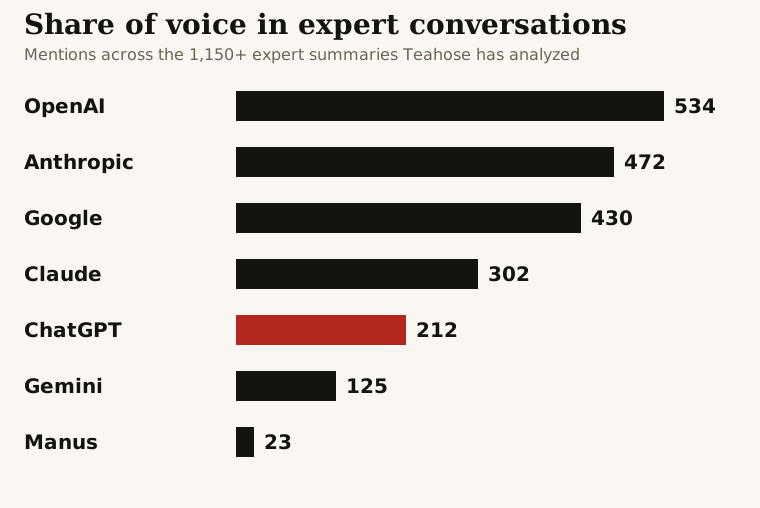
Each bar counts how many of Teahose's 1,150+ expert summaries mention it (word-boundary match across our podcast, newsletter, and paper corpus, June 2026).
Track the field: find the companies most similar to OpenAI and get their latest funding and product signals by email — Teahose Lookalikes.
Mention counts from Teahose's analysis of 1,150+ expert podcast, newsletter & research summaries, June 2026.
Here's the whole secret: ChatGPT predicts the next chunk of text, extremely well, again and again. That's it. Everything that feels like understanding, reasoning, or personality is built on top of that one deceptively simple engine — a system trained to answer "given everything so far, what's the most plausible next piece of text?"
Once you internalize that, ChatGPT stops being magic and starts being legible — including its weaknesses. Let's build it up in four plain-English steps.
Step 1: Your Words Become Tokens
The model can't read letters or words. It reads tokens — pieces of words, roughly four characters of English each. "Newsletter" might be one token; "Teahose" might be two or three. Your message gets chopped into a sequence of these tokens, each represented as a number.
This is why everything in the AI world is priced and measured in tokens, not words — including the context window, the maximum amount of text the model can consider at once (your prompt + the conversation + its reply). Run out of context and the model literally can't "see" the start of a long chat anymore.
Step 2: The Transformer Does the Thinking
The tokens flow through a transformer — the neural-network architecture (the "T" in GPT) introduced in 2017 that made all of this possible. Its breakthrough mechanism is attention: for every token, the model weighs how much every other token should influence it.
That's how it tracks that "it" refers to the company three sentences ago, or that a question at the end relates to a detail at the beginning. Attention is the difference between a model that loses the thread and one that holds a long, complex thought together. The model has billions of internal parameters — dials tuned during training — that encode the statistical patterns of language, code, and reasoning.
Step 3: Pretraining — Learning From a Huge Pile of Text
Before ChatGPT could chat, the raw model was pretrained: shown staggering amounts of text and made to play one game billions of times — predict the next token, check, adjust, repeat. Do that at enough scale and something remarkable emerges: to predict text well, the model has to absorb grammar, facts, styles, code, and reasoning patterns. Capabilities nobody explicitly programmed emerge from pure prediction at scale.
But a raw pretrained model is a brilliant, unhelpful autocomplete. Ask it a question and it might continue with more questions, because that's a plausible continuation. It needs manners.
Step 4: RLHF — Turning Autocomplete Into an Assistant
The polish that made ChatGPT a phenomenon is RLHF — reinforcement learning from human feedback. Humans rate model responses; the model learns to produce the kind humans prefer — helpful, on-topic, appropriately cautious. This is the layer that gives ChatGPT its assistant personality, its willingness to follow instructions, and its refusals. Newer systems add a reasoning step too — the model is trained to "think" through intermediate steps before answering, which sharply improves math, code, and logic.
So the full pipeline: tokens → transformer with attention → pretraining (raw capability) → RLHF + reasoning (helpfulness). Predict-the-next-token at the bottom; a helpful assistant at the top.
Why It Confidently Lies
Now the weaknesses make sense. ChatGPT is a plausibility engine, not a truth engine. It outputs the most likely continuation — and a fluent, confident, wrong answer is often more statistically plausible than an honest "I'm not sure." It has no internal fact-checker, which is why it can fabricate citations or dates that sound authoritative. Giving it real sources (retrieval) and tools helps, but the root cause — it predicts plausibility, not truth — never fully goes away. The fix is yours: verify anything that matters.
From Chatbots to Agents
ChatGPT is one product built on this engine — but the same engine now powers a whole field. Wrap a model in tools and a planning loop and a chatbot becomes an AI agent: software that doesn't just answer but acts — browsing, coding, completing tasks. Products like Manus are exactly this: the prediction engine above, given hands. The model layer is the foundation; the agent layer is what's being built on top of it right now.
Below is the live map of the companies building the foundation models that power ChatGPT and its rivals — ranked by how much they're moving in our signal feed:
The LLM Labs Behind the Chatbots
Live membership of the LLMs theme · ranked by signals extracted across podcasts, newsletters & papers
- 01Anthropiclast seen OCT 211746 signals
- 02OpenAIlast seen OCT 251657 signals
- 03Googlelast seen OCT 21630 signals
- 04Metalast seen OCT 21522 signals
- 05Microsoftlast seen OCT 21340 signals
- 06xAIlast seen OCT 21179 signals
- 07Cursorlast seen OCT 21163 signals
- 08Harveylast seen OCT 21139 signals
- 09DeepSeeklast seen OCT 21138 signals
- 10Google DeepMindlast seen OCT 20118 signals
- 11Moonshot AIlast seen OCT 13116 signals
- 12Metalast seen OCT 19102 signals
- 13Perplexitylast seen OCT 1982 signals
- 14ElevenLabslast seen OCT 2372 signals
- 15Mistral AIlast seen OCT 2271 signals
Going Deeper
- The category above it: What are AI agents? — what happens when you give a model like this tools and a goal.
- The breakout agent: What is Manus? — a model orchestrated into an autonomous worker.
- The alternatives: ChatGPT alternatives — Claude, Gemini, Perplexity, and the rest, compared.
- The companies: OpenAI competitors · Anthropic competitors · the live LLMs theme.
The models behind ChatGPT change every few weeks — new versions, new rivals, new capabilities. The free Teahose daily digest tracks every model release, lab funding round, and research breakthrough across 40+ podcasts, 20+ newsletters, and the day's papers — one email each morning. Subscribe free and stop refreshing Twitter to keep up.
The explanation is stable; the live lab map is as of June 14, 2026, and updates continuously.
Bottom line: ChatGPT works by predicting the next token extremely well, again and again, with large-scale pretraining and human-feedback training (RLHF) layered on top to turn that raw predictor into a helpful assistant — which is exactly why it can be brilliant and confidently wrong, and why the same engine wrapped in tools becomes an AI agent.
Frequently Asked Questions
How does ChatGPT work, in simple terms?
ChatGPT predicts the next chunk of text, over and over, very well. It breaks your message into tokens (pieces of words), runs them through a giant neural network called a transformer that has learned statistical patterns from enormous amounts of text, and outputs the most plausible next token — then repeats, feeding its own output back in, until the answer is complete. Everything else (its helpfulness, its tone, its refusals) is a layer of training on top of that core "predict the next token" engine.
What is a token in ChatGPT?
A token is the unit of text the model actually reads and writes — roughly a word or a piece of a word (about 4 characters of English on average). "Newsletter" might be one token; an unusual name might be three. The model never sees letters or words directly; it sees sequences of token IDs and predicts the next one. Pricing, speed, and the context-window limit are all measured in tokens, not words.
What is a transformer and what is attention?
The transformer is the neural-network architecture (introduced by Google researchers in 2017) behind ChatGPT — the "T" in GPT. Its key mechanism, attention, lets the model weigh how much every word in the input should influence every other word, so it can track context, references, and meaning across a long passage. Attention is why modern models handle long, complex prompts coherently where older approaches lost the thread.
Why does ChatGPT make things up (hallucinate)?
Because it is a plausibility engine, not a fact database. It generates the most statistically likely continuation of your text, and a confident, well-formed wrong answer is often more "plausible" than an honest "I don't know." It has no built-in sense of truth — only patterns. That's why it can invent citations, dates, or details that sound authoritative. Retrieval (giving it real sources), tool use, and careful prompting reduce hallucinations but don't eliminate the underlying cause.
What is the difference between GPT and ChatGPT?
GPT is the underlying model — the Generative Pre-trained Transformer that does the prediction. ChatGPT is the product: the app, the chat interface, the memory, the safety layer, and the tools wrapped around the model. OpenAI builds both, but they're different layers — and the same GPT models also power thousands of other apps through the API.
Does ChatGPT actually understand what I say, or is it just predicting words?
Mechanically, it is predicting the next token — it has no beliefs, intentions, or understanding in the human sense. But because predicting text well at massive scale forces the model to absorb grammar, facts, and reasoning patterns, the output can be indistinguishable from understanding for many tasks. A useful mental model: treat it as an extraordinarily capable pattern-matcher that simulates understanding, not a mind that possesses it. That distinction is why it can be brilliant on one question and confidently wrong on the next.
Is ChatGPT the same as an AI agent?
No — but they share the same core engine. ChatGPT is a chatbot: you ask, it answers. An AI agent wraps that same prediction model in tools (a browser, code execution, APIs) and a planning loop so it can take multiple steps to complete a goal on its own. Products built around autonomous workflows are the same next-token predictor given hands. If you understand how ChatGPT works, you already understand the foundation every AI agent is built on.
How can I stop ChatGPT from making things up?
You cannot fully eliminate hallucinations, because plausibility — not truth — is what the model optimizes for. But you can sharply reduce them: give it real source material to work from (retrieval), ask it to cite or quote rather than recall from memory, enable tools or web search for anything time-sensitive, and prefer reasoning-capable modes for math and logic. The non-negotiable habit is verification — independently confirm any fact, citation, or number that actually matters before you rely on it.