
Key takeaways
- There's no single winner in 2026 — Grok 4.3 is the cheaper, faster, real-time-data play; GPT-5.5 (ChatGPT) is the more reliable coding and broader-platform play, and on benchmarks they're close.
- ChatGPT is the center of gravity in the AI conversation: across the 1,150+ expert podcast, newsletter & research summaries Teahose has analyzed, ChatGPT is mentioned in 213 and Grok in just 41 — a ~5:1 share-of-voice split as of June 2026.
- On the API, Grok 4.3 is roughly 4× cheaper on input, 12× cheaper on output, and ~3× faster — so high-volume builders should default to Grok and reach for GPT-5.5 only where coding reliability or enterprise tooling matters.
- Most comparisons get this wrong by pitting Grok 4 against GPT-5; what matters is the current flagships, Grok 4.3 (Apr 30, 2026) vs GPT-5.5 (Apr 23, 2026), with every benchmark labeled by its run config.
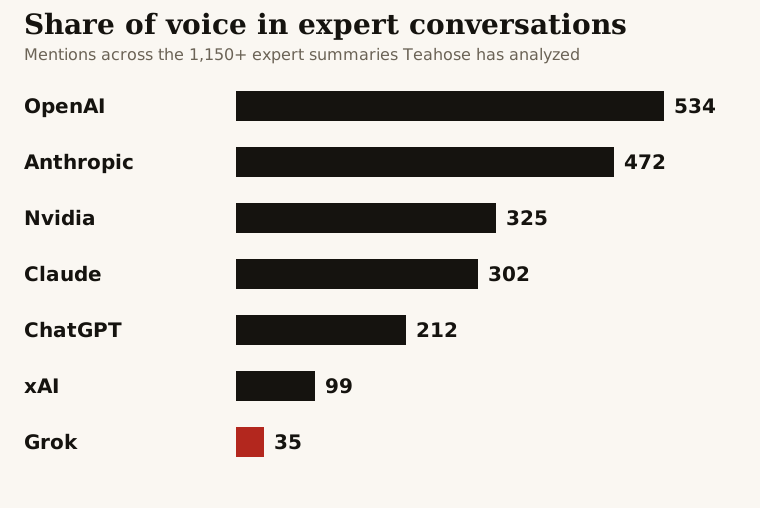
Each bar counts how many of Teahose's 1,150+ expert summaries mention it (word-boundary match across our podcast, newsletter, and paper corpus, June 2026).
Track the field: find the companies most similar to OpenAI and get their latest funding and product signals by email — Teahose Lookalikes.
Mention counts from Teahose's analysis of 1,150+ expert podcast, newsletter & research summaries, June 2026.
Search "grok vs chatgpt" today and almost every result makes the same mistake: it compares Grok 4 against GPT-5 — models from mid-2025 — and quotes benchmark scores that mix model generations. As of June 2026 both labs have shipped several versions past that. The honest comparison is Grok 4.3 (April 30, 2026) vs GPT-5.5 (April 23, 2026) — the current flagships (x.ai docs; Artificial Analysis). This page compares those, labels every benchmark with the config it was run in, and ends with proprietary data on which model the AI world actually talks about. Verified June 18, 2026 — which is why this page carries a date and most don't.
ChatGPT vs Grok in One Paragraph
Grok 4.3 is the value-and-speed play: ~4× cheaper input, ~12× cheaper output, ~3× faster generation, a 1M-token context window, and native real-time X data. GPT-5.5 (ChatGPT) is the platform-and-reliability play: stronger production coding, a deeper feature ecosystem (Codex, Canvas, Custom GPTs, Sora 2), and the safer enterprise default. On pure intelligence benchmarks they're within arm's reach of each other — and both trail Claude Opus 4.8 overall, a fact most "which AI reigns supreme" pieces quietly omit.
The version problem (why most comparisons are already wrong)
Model versioning is the single biggest factual liability in this category. Here's the real timeline:
| Quarter | Grok (xAI) | ChatGPT (OpenAI) |
|---|---|---|
| Q3 2025 | Grok 4 / Grok 4 Heavy (Jul 9) | GPT-5 (Aug 7) |
| Q4 2025 | Grok 4 Fast → Grok 4.1 (Nov 17) | GPT-5.2 (Dec) |
| Q1 2026 | Grok 4.20 | GPT-5.4 |
| Q2 2026 | Grok 4.3 (Apr 30) ← current | GPT-5.5 (Apr 23) ← current |
If a comparison cites "Grok 4 has a 256K context window" or "GPT-5 scores 74.9% on SWE-bench," it's describing 2025. Grok 4.3 now runs a 1M-token context (up from 256K), and GPT-5.5 pushed agentic coding well past the GPT-5 baseline.
Benchmarks: Grok 4.3 vs GPT-5.5
Scores below are the strongest published figures for each family, with the run configuration labeled — because that label is where 20–60 points hide.
| Benchmark | GPT-5.5 (ChatGPT) | Grok 4.3 / Grok 4 Heavy | Notes |
|---|---|---|---|
| GPQA Diamond (PhD science) | ~93.5% | ~87.5–88.9% (Grok 4) | GPT-5.5 leads |
| SWE-bench Verified (coding) | ~82–88% | competitive, cheaper | Production-coding edge: GPT-5.5 |
| SWE-bench Pro (hard agentic) | 58.6% (2026 SOTA) | not published | GPT-5.5 |
| AIME 2025 (math, with tools) | ~100% | ~100% (Heavy) | Effectively tied |
| Humanity's Last Exam (w/ tools) | ~42% (Pro) | 44.4% (Heavy) | Grok led at its launch |
| ARC-AGI-2 (abstract reasoning) | strong | 15.9% (Grok 4, closed-model SOTA at launch) | Grok's standout |
| GDPval-AA (agentic, ELO) | leads by ~276 | 1500 (+321 vs 4.20) | GPT-5.5 |
| Hallucination rate | low | lowest among frontier models (xAI) | Grok 4.3 |
Sources: OpenAI and Vellum for the GPT-5 family; x.ai and aggregated launch reporting for Grok. Where a clean Grok 4.3 standardized score isn't published, the table falls back to Grok 4 / Heavy launch figures and says so — xAI reported Grok 4.3 mostly via agentic evals (GDPval-AA ELO, τ²-Bench Telecom 98%, IFBench 81%) rather than a full classic benchmark sheet.
How to read those numbers (the part everyone skips)
A benchmark score is meaningless without its config. Three traps that ranking articles fall into:
- "Grok scores 100% on AIME" means with Python tools. Base, no-tools AIME for GPT-5 is ~71%; "with thinking" is 99.6%; the 100% is the Pro tier running code. Same model, ~30-point swing. Grok Heavy's perfect score carries the same asterisk.
- ChatGPT's app context ≠ its API context. The API takes ~1M tokens; inside the ChatGPT app the practical window is closer to 272K–400K. Quoting one for the other is the most common error in this category.
- "With tools" vs "no tools" vs "with thinking" can move a single model 20–60 points. If a table doesn't label the config, treat its head-to-head as decorative.
API economics: the comparison nobody runs
This is the biggest gap in the entire "chatgpt vs grok" SERP — and where Grok's case is strongest. Per Artificial Analysis:
| Metric | GPT-5.5 (high) | Grok 4.3 | Grok advantage |
|---|---|---|---|
| Input / 1M tokens | $5.00 | $1.25 | ~4× cheaper |
| Output / 1M tokens | $30.00 | $2.50 | ~12× cheaper |
| Cached input | $0.50 (90% off) | — | GPT-5.5 perk |
| Output speed | 51.7 tok/s | 161.7 tok/s | ~3× faster |
| Time to first token | ~40.0s | ~11.9s | far lower latency |
| Context window | ~1M (≈922K–1.1M) | 1.0M | parity |
The takeaway competitors bury: at high volume, Grok 4.3 is one of the cheapest frontier-class models per unit of intelligence, and it's faster. If your workload is thousands of API calls a day — classification, extraction, summarization, agents — that 12× output-cost gap dominates everything else. GPT-5.5's cached-input discount narrows it for repetitive prompts, but Grok still wins on raw throughput and first-token latency.
Consumer pricing
| Tier | ChatGPT | Grok |
|---|---|---|
| Free | ✓ | ✓ (gated through X) |
| Entry | Go $8/mo | SuperGrok Lite $10/mo |
| Standard | Plus $20/mo | SuperGrok $30/mo |
| Power | Pro $200/mo | SuperGrok Heavy $300/mo |
| Business | ~$25/user/mo | ~$30/user/mo |
ChatGPT is cheaper at the entry and standard tiers; Grok bundles into X Premium ($8) and Premium+ ($40) if you already pay for X.
Feature & capability differences
- Real-time data: Grok's moat. Native first-party access to the live X firehose — it reads breaking posts as they happen. ChatGPT browses and cites, but has no privileged social-network feed.
- Ecosystem: ChatGPT's moat. Codex (coding agent), Canvas, Custom GPTs, Projects, scheduled tasks, Sora 2 video, and Team/Enterprise admin. Grok is far more X-centric.
- Coding: GPT-5.5 leads on reliability for large, multi-file changes; Grok is competitive and much cheaper, with "Grok Code Fast" for quick loops.
- Image & video: Both generate images; Grok Imagine does image + video, and ChatGPT pairs with Sora 2.
- Persona & safety: Grok markets a "maximally truth-seeking," less-filtered voice; ChatGPT is more grounded and predictable — the safer pick for regulated and enterprise contexts.
- Compute story: xAI trained Grok 4 on the Colossus supercluster in Memphis at roughly 10× Grok 3's RL compute; OpenAI consolidated its old o3/4o/4.1 lineup into one adaptive-reasoning GPT-5 family.
ChatGPT vs Grok: which wins, by workload
| If your priority is… | Pick | Why |
|---|---|---|
| Cheap, high-volume API | Grok 4.3 | 12× cheaper output, 3× faster |
| Live social / breaking-news monitoring | Grok 4.3 | native X firehose |
| Largest context at lowest cost | Grok 4.3 | 1M tokens at $1.25/M in |
| Production coding & agents | GPT-5.5 | SWE-bench Pro SOTA, Codex |
| Enterprise safety & compliance | GPT-5.5 | predictable filters, admin tooling |
| Broadest feature ecosystem | GPT-5.5 | Canvas, GPTs, Sora 2, Projects |
| Fewest factual errors | Grok 4.3 | lowest reported hallucination rate |
The honest caveat: neither is #1 overall
Most "which AI is best" pieces frame this as a two-horse race. It isn't. On the Artificial Analysis Intelligence Index, Claude Opus 4.8 leads at ~61, while GPT-5.5 and Grok 4.3 sit around 53. ChatGPT and Grok are the two most talked-about assistants, not the two most capable on every axis — which is the perfect segue to data only Teahose has.
Who the AI world actually talks about (Teahose data)
Teahose tracks every mention of these companies across the AI podcasts, newsletters, and research papers it summarizes. As of June 18, 2026, the mindshare gap is stark:
That's roughly a 6:1 mindshare advantage for ChatGPT's parent — wider than any benchmark gap between the two. For context in the same media set, Nvidia draws 231 mentions and Microsoft 107.
The same gap holds at the product level. Across our 1,032 published episode and newsletter summaries, ChatGPT is named in 197 and Grok in 36 — a ~5:1 split (for reference, Claude leads both at 260; full breakdown in Claude vs ChatGPT). Company mindshare and product mindshare tell the same story: ChatGPT is the center of gravity, Grok the fast-moving challenger.
The feed below is the live xAI signal stream behind that number — funding, product, and strategy moves as our pipeline extracts them. Hit Watch on the xAI or OpenAI profile to get each new move emailed to you as it lands.
Live xAI Signals — the Data Behind Grok, Tracked in Real Time
Funding, product, and strategy signals for xAI (Grok's parent), extracted live from podcasts, newsletters & papers by the Teahose intel pipeline
- 01MENTIONElon Musk is proposing that xAI, OpenAI, Anthropic, Google, Meta, and leading Chinese AI companies test one another's models before release, arguing rival labs are more likely to uSEP 16 · StrictlyVCSEP 16
- 02MENTIONSpaceX's AI/compute business revenue now rivals or exceeds its traditional space revenue; Shotwell confirmed 'It's by revenue'SEP 15 · All InSEP 15
- 03LAUNCHnext year we will be launching... AI compute satellites. So next year is a big yearSEP 15 · All InSEP 15
- 04FUNDINGrecently completed a $75 billion IPO debuting at a $1.7 trillion valuationSEP 15 · All InIPO · $75B
- 05MENTIONMusk's central AI safety policy proposal: leading AI labs should test each other's models rather than self-certify, implemented immediately ahead of formal regulation — 'the thing SEP 15 · All InSEP 15
- 06MENTIONxAI recently completed a $75 billion IPO debuting at a $1.7 trillion valuationSEP 15 · All InSEP 15
- 07MENTIONMENTION signalSEP 12 · The a16z ShowSEP 12
- 08MENTIONxAI posted its fastest growth since July 2025, up 0.94 points to 4%, as fastest-growing AI subscription provider contrasted with OpenAI's slower growth.SEP 10 · The AI CornerSEP 10
- 09MENTIONGrokbot (xAI) uses Google search in violation of ToS to generate answers; spins up isolated VMs/browsers per user.SEP 10 · 20VCSEP 10
- 10MENTIONGrok (xAI) was a surprising top performer on Legora's internal benchmark for cost given performance, despite Legora not yet having a data processing agreement to offer it to customSEP 9 · The AI CornerSEP 9
The verdict
There is no single winner in 2026 — and any "grok vs chatgpt" piece that declares one is selling you a vibe. The decision is a workload question:
- Building on the API at volume? Grok 4.3. The 12× output-cost gap and 3× speed advantage swamp every other consideration.
- Need live social signal? Grok 4.3. Nothing else has the X firehose.
- Shipping production software or running agents? GPT-5.5. SWE-bench Pro leadership plus Codex.
- Buying for an enterprise? GPT-5.5. Predictable safety, admin tooling, broadest platform.
- Just want the best chat for $20-ish a month? ChatGPT Plus is the safe default; SuperGrok is worth it if you live on X or want the cheapest big context.
And re-check often — every model in the tables above shipped within the last eight weeks. Grok 5 and the next GPT-5.x point release are both expected before fall, and this comparison will look different by then. Rather than re-checking by hand, let the free daily digest do it: one email distilling every funding, product, and model move our pipeline pulls from 25+ AI podcasts, the major newsletters, and the day's research papers. It's free, and it's the fastest way to see whether Teahose's coverage fits how you track AI — the same live data behind this page, in your inbox each morning.
Related reading: Claude vs ChatGPT (the other flagship matchup) · ChatGPT alternatives, every serious option compared · OpenAI competitors (the company view) · Anthropic competitors · Groq competitors (the inference-speed angle) · xAI valuation, now inside SpaceX.
Models, prices, and benchmarks verified June 18, 2026. The live xAI feed and the mention counts above update continuously.
Bottom line: There's no outright winner in 2026 — pick Grok 4.3 for cheap, fast, high-volume API work and live X data, and GPT-5.5 (ChatGPT) for production coding, enterprise safety, and the broader ecosystem; on raw benchmarks they're close, and both trail Claude Opus 4.8.
Frequently Asked Questions
Is Grok better than ChatGPT?
Neither wins outright in 2026 — it depends on the workload. Grok 4.3 is roughly 4× cheaper on input tokens, 12× cheaper on output, ~3× faster, and has native real-time access to X/Twitter, which makes it the better pick for high-volume API work and live social data. GPT-5.5 (ChatGPT) is stronger on production coding reliability, has a deeper feature ecosystem (Codex, Canvas, Custom GPTs, Sora 2), and is the safer enterprise default. On raw intelligence benchmarks the two are close, and both trail Claude Opus 4.8 overall.
What is the difference between Grok and ChatGPT?
Grok (by xAI, Elon Musk) is built around real-time data from X and trained on the Colossus supercomputer in Memphis; it ships a cheaper, faster API and a less-filtered persona. ChatGPT (by OpenAI) is a broader product platform — web, mobile, API, the Codex coding agent, Sora 2 video, Canvas, Custom GPTs and Projects — with more polished, grounded output and stronger enterprise safety tooling. Grok lives mostly inside X; ChatGPT is everywhere.
Is Grok cheaper than ChatGPT?
On the API, dramatically. Grok 4.3 costs $1.25 per million input tokens and $2.50 per million output, versus $5.00 / $30.00 for GPT-5.5 (high) — about 4× cheaper input and 12× cheaper output. On consumer plans they are closer: ChatGPT Plus is $20/month and SuperGrok is $30/month, though ChatGPT Go ($8) undercuts SuperGrok Lite ($10) at the entry tier.
Grok 4.3 vs GPT-5.5: which model is smarter?
On the Artificial Analysis Intelligence Index, GPT-5.5 (high) sits around 53 and Grok 4.3 lands in the high-30s-to-low-50s depending on reasoning configuration — close enough that benchmark choice and "with tools / with thinking" settings decide the winner. GPT-5.5 leads on agentic coding (SWE-bench Pro ~58.6%, a 2026 SOTA) and on GDPval-AA, where Grok 4.3 trails by roughly 276 ELO. Grok 4.3 counters with the lowest reported hallucination rate among frontier models and near-perfect math (AIME 2025 ~100% with tools).
Which is better for coding, ChatGPT or Grok?
For production software work, ChatGPT/GPT-5.5 — it leads SWE-bench Verified (~82–88%) and SWE-bench Pro (~58.6%) and ships a dedicated coding agent (Codex). Grok is competitive and far cheaper per token, and "Grok Code Fast" targets quick iterations, but most engineering teams reach for GPT-5.5 or Claude for reliability on large, multi-file changes. If you are searching "chat gpt vs grok" for a coding tool specifically, also compare dedicated agents in our Cursor alternatives guide.
Does Grok have real-time data that ChatGPT does not?
Yes — that is Grok's defining advantage. Grok has native, first-party access to the live X/Twitter firehose, so it reads breaking posts and trends as they happen. ChatGPT can browse the web and cite sources, but it does not have privileged real-time access to a major social network. For live social monitoring, sentiment, and breaking-news reaction, Grok is the stronger tool.
Which AI does the industry talk about more, ChatGPT or Grok?
ChatGPT, by a wide margin. Across the 1,150+ expert podcast, newsletter, and research summaries Teahose has analyzed, ChatGPT is named in 213 and Grok in just 41 — roughly a 5:1 share-of-voice split as of June 2026. At the company level the gap is similar: OpenAI draws far more mentions than xAI. That mindshare lead is wider than any single benchmark gap between the two models, and it is a measure of share of expert discussion, not market share or model quality.
Should I switch from ChatGPT to Grok in 2026?
Only if your use case lines up with Grok's strengths. Switch if you build on the API at high volume (Grok 4.3 is about 4× cheaper on input, 12× cheaper on output, and roughly 3× faster), if you need live X/Twitter data, or if you want the largest context window at the lowest price. Stay on ChatGPT if you ship production software, run multi-file coding agents, need enterprise safety and admin tooling, or rely on the broader ecosystem (Codex, Canvas, Custom GPTs, Sora 2). Many teams run both and route each task to the cheaper or stronger model.
Is Grok or ChatGPT better for a startup on a budget?
For programmatic, high-volume work a startup will usually save the most with Grok 4.3 on the API, where the roughly 12× output-cost advantage compounds fast across thousands of daily calls. For everyday team chat, ChatGPT is cheaper at the entry and standard consumer tiers (Go at 8 dollars per month, Plus at 20). A common budget pattern is ChatGPT Plus for hands-on work plus Grok on the API for batch jobs like classification, extraction, and summarization.