
Key takeaways
- The best ElevenLabs alternative depends on the lane: Cartesia for low-latency realtime voice, Hume for emotionally expressive agents, OpenAI's Realtime stack if you're already on its API, and Murf or PlayAI for studio voiceover — no single rival matches ElevenLabs' full breadth.
- ElevenLabs is mentioned in 24 of the 1,150+ expert conversations we've analyzed, putting it among the most-discussed names in AI voice — but the live ranking below tracks every challenger our pipeline detects, not a frozen vendor list.
- Developer-first APIs (Deepgram, Cartesia) and self-hosted open-weight TTS typically undercut ElevenLabs on per-character cost; you trade away cloning fidelity and surrounding tooling.
- Most "best alternative" guides hand you a static top-10; what actually matters is funding and launch trajectory, since the frontier labs keep absorbing voice as a feature — watch which challengers stay independent and improving.
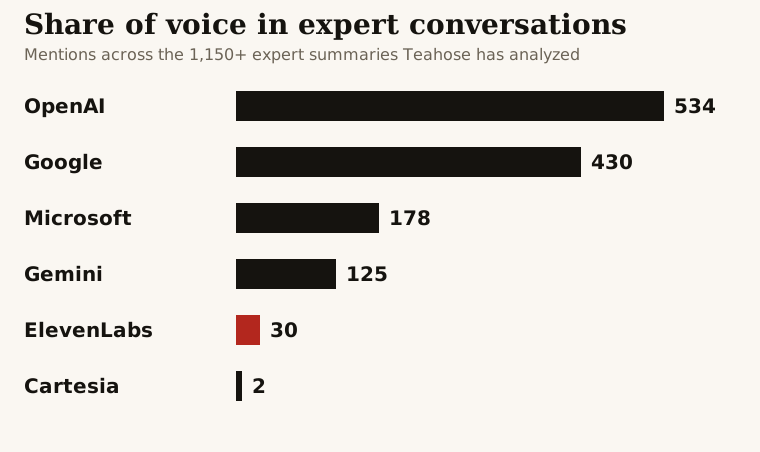
Each bar counts how many of Teahose's 1,150+ expert summaries mention it (word-boundary match across our podcast, newsletter, and paper corpus, June 2026).
Track the field: find the companies most similar to OpenAI and get their latest funding and product signals by email — Teahose Lookalikes.
Mention counts from Teahose's analysis of 1,150+ expert podcast, newsletter & research summaries, June 2026.
ElevenLabs turned AI voice from a demo into an industry, and "ElevenLabs alternatives" is now one of the most-searched questions in the category. But the alternatives question splits by what you're building: a realtime voice agent, a developer API integration, studio voiceover, or dubbing at scale. Different rivals win each lane.
Below is the map by use case — followed by a live similarity ranking from the Teahose intel graph, the same vector engine behind our company lookalikes tool, which keeps re-ranking ElevenLabs' neighborhood as new voice AI companies and funding rounds enter the graph.
Realtime & Developer Voice APIs
- Cartesia — the latency leader's challenger: state-space-model voice built for realtime production use; the default ElevenLabs alternative for engineers building voice agents.
- Deepgram — speech-to-text incumbent that expanded into TTS; attractive when you want the full speech loop (STT + TTS) from one vendor with usage-based pricing.
- Rime — fast, conversational TTS aimed squarely at high-volume agent deployments.
Voice Agents & Expressive AI
- Hume AI — the empathy specialist: voice models trained around emotional expression and conversational nuance, strong for companionship, coaching, and support agents.
- OpenAI (Realtime API + voice) — the gravitational threat: if you're already building on OpenAI, its native speech-to-speech stack removes a vendor. Quality keeps climbing with each model generation.
- Google (Gemini voice stack) — same dynamic on the Google side, with distribution through Android and Workspace.
Studio, Voiceover & Dubbing
- Murf — prosumer/enterprise voiceover studio for marketing, e-learning, and presentations.
- PlayAI (PlayHT) — voice cloning and voiceover with a developer API; long-time direct rival.
- Resemble AI — cloning plus deepfake-detection positioning for enterprises that need both generation and security.
- WellSaid — enterprise-safe, consent-based voice for corporate content.
The Live Map: ElevenLabs' Nearest Neighbors
Companies Most Similar to ElevenLabs
Vector similarity against the Teahose company graph · same engine as the /similar lookalikes tool
- 01Voisgenerative-ai-audio84% match
- 02DeepgramAI76% match
- 03Bolcho AIai-voice-agent-platforms76% match
- 04Sarvam AIAI76% match
- 05Speechifyai-voice-conversation-interfaces76% match
- 06SmalleastAI74% match
- 07SoundHound AIAI74% match
- 08SynthesiaAI73% match
- 09Spekoai-infrastructure73% match
- 10Narration Roomgenerative-ai-audio73% match
- 11Phonicnull72% match
- 12ai-cousticsai72% match
- 13QwenAI72% match
- 14AssemblyAIai71% match
- 15Tough Tongue AIai-agents71% match
How to Choose
- Match the tool to the lane — realtime agents, developer API, studio voiceover, or dubbing. Cross-lane comparisons waste eval time.
- Benchmark latency and cost on your own scripts. Published demos are everyone's best case; your domain vocabulary and traffic pattern are what matter.
- Watch the funding and launch signals. Voice AI is consolidating fast and the labs keep absorbing features — a vendor's signal trajectory tells you whether it'll still be independent and improving in a year. Hit Watch on any company above to follow it by email.
Related: top AI startups, live-ranked · OpenAI competitors · the full company graph.
Bottom line: There is no single best ElevenLabs alternative — pick by lane: Cartesia for low-latency realtime voice, Hume for emotionally expressive agents, OpenAI's Realtime stack if you're already on its API, Murf or PlayAI for studio voiceover, and Deepgram or self-hosted open-weight TTS when cost is the priority.
Frequently Asked Questions
What is the best alternative to ElevenLabs?
By use case: Cartesia for low-latency realtime voice in production apps; OpenAI's Realtime/voice stack if you're already on its API; Hume for emotionally expressive conversational agents; Murf or PlayAI for studio-style voiceover work; Deepgram if you want speech-to-text and text-to-speech from one vendor. ElevenLabs' breadth is the thing no single rival matches — most alternatives beat it in one lane.
Is there a cheaper alternative to ElevenLabs?
Usually yes, per character or per minute — developer-first APIs like Deepgram and Cartesia tend to undercut ElevenLabs at volume, and open-weight TTS models can drop marginal cost near zero if you self-host. The trade is voice quality consistency, cloning fidelity, and the polish of the surrounding tooling (dubbing, voice library, agents platform).
How is the live list on this page generated?
We embed a description of ElevenLabs' business with the same vector pipeline that powers our company lookalikes tool, then rank companies in the Teahose intel graph by cosine similarity. New voice AI startups surface here as soon as our pipeline detects them in podcasts, newsletters, and funding announcements.
Do the big AI labs compete with ElevenLabs?
Increasingly. OpenAI, Google, and Microsoft all ship native voice generation, and frontier multimodal models keep absorbing voice quality as a feature. ElevenLabs' bet is that a voice-specialist — with cloning, dubbing, agents, and a voice marketplace — stays ahead of voice-as-a-checkbox. That race is the most important thing to watch in this category.
Which ElevenLabs alternative is best for building a realtime voice agent?
For low-latency realtime voice agents, Cartesia is the most common ElevenLabs alternative engineers reach for — its state-space-model architecture is built for production realtime use. Hume is the pick when emotional expressiveness matters (companionship, coaching, support), and OpenAI's Realtime API removes a vendor entirely if your stack is already there. Benchmark all three on your own scripts and traffic pattern before committing, since published latency demos are everyone's best case.
What is the cheapest text-to-speech API compared to ElevenLabs?
Developer-first APIs like Deepgram and Cartesia generally undercut ElevenLabs on a per-character or per-minute basis at volume, and self-hosting an open-weight TTS model can push marginal cost close to zero. The trade-off is voice-quality consistency, cloning fidelity, and the polish of the surrounding tooling — dubbing, the voice library, and the agents platform — that ElevenLabs bundles in.
How many companies compete with ElevenLabs in AI voice?
Dozens, and the set keeps growing. The live ranking on this page surfaces ElevenLabs' nearest neighbors by vector similarity from the Teahose company graph, and new voice AI startups appear as soon as our pipeline detects them in podcasts, newsletters, and funding announcements. For context, ElevenLabs itself comes up in 24 of the 1,150+ expert conversations we've analyzed, which is why its competitive neighborhood is so densely tracked.