
Key takeaways
- The leading nuclear fusion companies in 2026 are Commonwealth Fusion Systems (the capital leader at ~$3B raised), Helion (highest valuation at $15.5B and the first fusion PPA), Pacific Fusion, TAE Technologies, and Proxima Fusion — spanning tokamaks, FRCs, stellarators, and pulsed machines.
- Fusion has only recently entered expert discourse: "nuclear fusion" appears in just 7 of the 1,150+ expert podcast, newsletter, and research summaries we have analyzed — a small but fast-rising signal as AI power demand pulls fusion into the mainstream.
- No private company has yet demonstrated net energy gain (Q>1); the milestones that matter cluster in 2026–2027, led by CFS's SPARC.
- Most listicles rank fusion companies by hype or last headline; what actually separates them is signed offtakes (PPAs with delay penalties) and proximity to a physics milestone — not the size of the latest round.
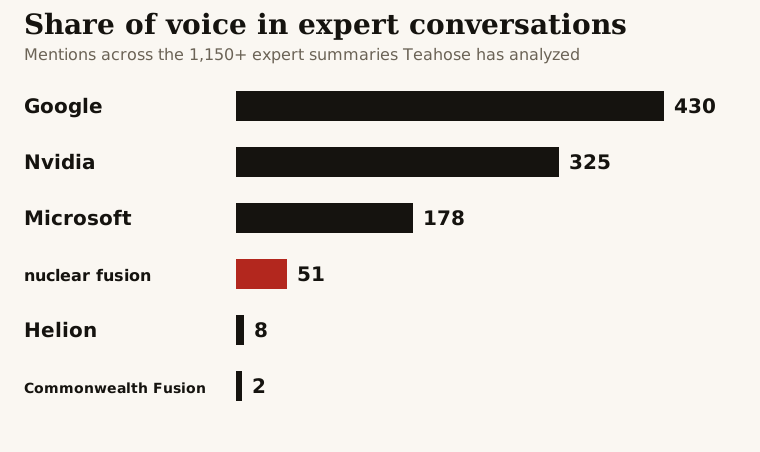
Each bar counts how many of Teahose's 1,150+ expert summaries mention it (word-boundary match across our podcast, newsletter, and paper corpus, June 2026).
Track the field: find the companies most similar to nuclear fusion and get their latest funding and product signals by email — Teahose Lookalikes.
Mention counts from Teahose's analysis of 1,150+ expert podcast, newsletter & research summaries, June 2026.
At a glance
| Company | Approach | Capital raised | Key milestone |
|---|---|---|---|
| Commonwealth Fusion Systems | Tokamak (HTS magnets) | ~$3B | SPARC targets Q>1 in early 2027 |
| Helion | Pulsed field-reversed configuration | $1.5B+ | First fusion PPA (50 MW for Microsoft, ~2028) |
| Pacific Fusion | Pulsed magnetic inertial fusion | $900M Series A | Net facility gain targeted ~2030 |
| TAE Technologies | Beam-driven field-reversed configuration | $1.3B+ | Copernicus targets net-energy validation by end of decade |
| Proxima Fusion | Quasi-isodynamic stellarator | €185M+ | Stellarator Model Coil in 2027 |
For fifty years fusion was a science project. What changed isn’t just the physics — it’s the customer. AI datacenter buildouts have created the first buyers willing to sign power purchase agreements for electrons that don’t exist yet: Microsoft contracted Helion for 50 MW, Google signed a 200 MW offtake with Commonwealth Fusion Systems’ first ARC plant, and Nvidia, Google, and Sam Altman all hold positions in the leaders. Hyperscaler power demand is the new fusion catalyst, and the capital followed: Helion nearly tripled its valuation to $15.5B in June 2026, and the sector’s largest-ever rounds all closed within the last 20 months.
The numbers underneath this page move weekly. Teahose tracks 27 fusion and next-gen energy companies live — and in one recent 28-day window the theme logged 11 deals totaling $1.196B in deployed capital. Static fusion listicles rot; the table further down is pulled live from the fusion & next-gen energy theme in our intel graph.
How We Ranked
The top 10 below is editorial, ranked on four factors as of June 2026: total confirmed capital, proximity to a net-energy (Q>1) demonstration, customer validation (signed PPAs and offtakes beat press releases), and technical credibility of the stated timeline. Funding figures are verified against primary sources; where a claim is company-reported or still pending, we say so. The live table below the ranking is different — it ranks by extracted signal volume and updates daily.
The Top 10 Nuclear Fusion Companies in 2026
1. Commonwealth Fusion Systems — Tokamak (HTS magnets). The capital leader: roughly $3B raised as of June 2026, about a third of all private fusion funding, including an $863M Series B2 in 2025 with Nvidia and Google participating. Its SPARC tokamak in Massachusetts begins operations in 2026 with net fusion energy (Q>1) targeted for early 2027 — the single most consequential milestone on the sector’s calendar. The ARC power plant in Chesterfield County, Virginia targets grid power in the early 2030s, anchored by Google’s confirmed 200 MW offtake, the largest corporate fusion power deal signed to date.
2. Helion — Pulsed field-reversed configuration. The commercialization bet. Raised a $465M Series G in June 2026 at a $15.5B valuation — nearly triple its prior mark — led by Thrive Capital, taking total funding past $1.5B; Sam Altman remains its highest-profile backer. Helion holds the world’s first fusion PPA: 50 MW for Microsoft, with financial penalties for delay, from its Orion plant under construction in Malaga, Washington since mid-2025, targeting power around 2028. Its Polaris prototype reported the first deuterium-tritium fusion on a privately built machine in early 2026 (company-reported). The 2028 date is the sector’s most aggressive — confirmed contract, unproven physics.
3. Pacific Fusion — Pulsed magnetic inertial fusion. Came out of stealth in late 2024 with a $900M Series A led by General Catalyst — one of the largest first rounds in venture history, structured in milestone-based tranches (so not all capital is drawn). Building a pulser-driven demonstration system targeting net facility gain around 2030, with a $1B research and manufacturing campus in New Mexico announced in September 2025. Founded by Eric Lander and backed by Eric Schmidt, Patrick Collison, and Reid Hoffman, among others.
4. TAE Technologies — Beam-driven field-reversed configuration. The longest-running private fusion company, with over $1.3B raised, including a ~$150M round in mid-2025 joined by Google, Chevron, and NEA. Its sixth-generation machine, Copernicus, targets validation of net-energy capability before the end of the decade, en route to its long-term goal of aneutronic hydrogen-boron fusion — the hardest fuel cycle, but the cleanest if it works.
5. Proxima Fusion — Quasi-isodynamic stellarator. Europe’s flagship. The Max Planck Institute spinout raised a €130M Series A in June 2025 — the largest private fusion round in Europe — bringing total funding past €185M. Roadmap: a Stellarator Model Coil in 2027 to de-risk high-temperature superconducting magnets, then the Alpha demonstrator, then a power plant in the 2030s. Stellarators run continuously and sidestep the plasma instabilities that plague tokamaks, at the cost of brutal engineering complexity.
6. Thea Energy — Planar-coil stellarator. The Princeton spinout closed a $100M Series B (as of June 2026) and announced Eos, a fusion neutron source it intends to sell as a first product — revenue before the power plant, a strategy most rivals lack. Its software-controlled flat-coil architecture replaces the twisted magnets that make conventional stellarators nearly unbuildable. Grid-scale operation targeted for the 2030s.
7. Focused Energy — Laser inertial fusion. The Darmstadt- and Austin-based startup closed a $240M Series A — the largest laser-fusion round on record as of June 2026 — with backing from utility RWE, Germany’s SPRIND innovation agency, and the European Innovation Council Fund. It is the most direct private descendant of the National Ignition Facility’s 2022 ignition result, the only fusion approach with a demonstrated scientific gain to build on.
8. Zap Energy — Sheared-flow-stabilized Z-pinch. The cheap-and-simple bet: no superconducting magnets, no lasers — the plasma’s own current confines it. Raised a $130M Series D in October 2025 led by Soros Fund Management, taking total funding past $330M, as its Century platform began operations to demonstrate repetitive pulsing with liquid-metal cooling. If Z-pinch scales, Zap’s plants would be radically smaller and cheaper than anyone else’s.
9. Tokamak Energy — Spherical tokamak (HTS magnets). The UK’s leading private fusion company, with roughly $375M raised to date including a $125M round in late 2024 backed in part by the British Business Bank. Its ST80-HTS prototype — the first high-field spherical tokamak with HTS magnets at scale — has build completion planned for 2026, informing the ST-E1 pilot plant targeting up to 200 MW of grid power in the early 2030s. Also monetizes its HTS magnet technology as a standalone business line.
10. General Fusion — Magnetized target fusion. The cautionary tale, listed because its trajectory is instructive. The Bezos-backed Canadian company laid off about 25% of staff in May 2025 amid what its CEO called an urgent financing constraint, then secured a $22M insider lifeline in a pay-to-play round that August. In January 2026 it announced a definitive agreement to go public via SPAC with Spring Valley Acquisition Corp — a listing still pending completion as of June 2026. Its LM26 machine has hit real compression milestones; the company is proof that in fusion, physics progress and financial survival are separate problems.
Also watch: Marathon Fusion (tritium fuel-cycle processing — the picks-and-shovels play; $5.9M seed led by 1517 Fund, plus a 2025 claim that its fuel systems can transmute mercury into gold as a by-product) and Avalanche Energy (compact fusion devices, ~$175M raised with an IPO mandate reportedly filed with Jefferies — per our intel graph).
Fusion & Next-Gen Energy Companies by Signal Volume
Live membership of the fusion & next-gen energy theme · ranked by funding, product, and hiring signals extracted daily
- 01Google DeepMindlast seen OCT 20118 signals
- 02Valar Atomicslast seen OCT 1626 signals
- 03Lowercarbon Capitallast seen OCT 1516 signals
- 04SB Energylast seen OCT 216 signals
- 05Breakthrough Energy Ventureslast seen OCT 1414 signals
- 06Commonwealth Fusionlast seen AUG 612 signals
- 07Endurance Energylast seen JUN 179 signals
- 08Thea Energylast seen JUN 29 signals
- 09Apollo Atomicslast seen OCT 208 signals
- 10Radiantlast seen OCT 88 signals
- 11Helionlast seen OCT 28 signals
- 12Blue Energylast seen SEP 98 signals
- 13Quaise Energylast seen AUG 288 signals
- 14Prime Movers Lablast seen JUL 278 signals
- 15Panthalassalast seen SEP 197 signals
How to Evaluate a Fusion Company
Fusion diligence has its own failure modes. Four filters separate the contenders from the science projects:
- Which Q>1 do they mean? Scientific gain (fusion output exceeds energy deposited in the plasma) is what NIF demonstrated in 2022. Engineering gain (output exceeds everything the facility consumes, including inefficient lasers and magnets) is much harder and is what actually matters for a power plant. Commercial gain — electricity cheap enough to sell — is harder still. When a company says "net energy," ask which one. Most 2026–2027 milestone targets, including SPARC’s, are scientific gain.
- Supply chain is destiny. Tokamaks and stellarators live or die on high-temperature superconducting (HTS) tape, which remains supply-constrained; laser approaches need optics at NIF scale but power-plant repetition rates. Companies that make their own critical components (CFS and Tokamak Energy build HTS magnets in-house) carry less existential supplier risk — and have a fallback business if the reactor slips.
- PPAs are the new validation. A signed power purchase agreement with delay penalties (Helion–Microsoft) or a firm offtake (Google–CFS) means a sophisticated counterparty diligenced the roadmap and put contract terms on it. It is the strongest external signal available in a pre-revenue industry — far stronger than a funding round, which can reflect narrative as much as progress.
- Watch hiring and deployment signals over press releases. Manufacturing leads, regulatory hires, and site construction reveal where a company actually is. That is what the live feed above extracts daily — the same logic we apply in our robotics startups guide, where deployment beats demo.
The AI Power Connection
The datacenter power crunch is the demand-side story that makes fusion investable on venture timelines, and it cuts both ways: fusion companies court hyperscalers for offtakes, while AI infrastructure players treat energy as their binding constraint. For the other side of that trade — the datacenter, chip, and grid companies racing to absorb AI demand — see our AI infrastructure companies guide, and follow the fusion & next-gen energy theme for the live deal flow. The free daily digest delivers new fusion signals — rounds, PPAs, milestones — the morning they surface.
Bottom line: Commonwealth Fusion Systems and Helion lead the 2026 field — CFS on capital (~$3B) and its early-2027 SPARC milestone, Helion on valuation ($15.5B) and the first fusion PPA — but with no private company yet at net energy gain, signed offtakes with delay penalties and proximity to a Q>1 demonstration matter more than the size of the latest round.
Frequently Asked Questions
When will fusion actually power the grid?
The most aggressive confirmed commitment is Helion, contractually obligated to deliver 50 MW to Microsoft from its Orion plant around 2028. Commonwealth Fusion Systems targets grid power from its ARC plant in Virginia in the early 2030s, and most credible roadmaps cluster in the early-to-mid 2030s. The honest answer: no private company has yet demonstrated net energy gain (Q>1), so every grid date is conditional on physics milestones expected in 2026–2027 — which is exactly why this period is worth watching.
Why are AI companies investing in fusion?
AI datacenters are the first customer class in decades whose power demand is growing faster than grids can supply it, and hyperscalers want firm, carbon-free generation they can contract for directly. That is why the biggest fusion commitments now come from tech: Microsoft holds the first fusion power purchase agreement (with Helion), Google signed a 200 MW offtake with Commonwealth Fusion Systems and invests in both CFS and TAE, Nvidia participated in CFS’s Series B2, and Sam Altman is Helion’s largest individual backer. Fusion has become an AI-infrastructure bet as much as an energy bet.
Which fusion approach is winning — tokamak, stellarator, or something else?
Tokamaks (CFS, Tokamak Energy) have the most physics validation behind them; stellarators (Proxima Fusion, Thea Energy) trade harder engineering for intrinsically stable plasmas; field-reversed configurations and pulsed machines (Helion, TAE, Pacific Fusion, Zap Energy) promise cheaper, smaller plants if the physics cooperates. Capital is hedging across all of them — the top of this list includes at least five distinct confinement approaches, which tells you the technical race is genuinely unresolved.
Which nuclear fusion company has raised the most money?
Commonwealth Fusion Systems, with roughly $3 billion raised as of June 2026 — about a third of all private fusion capital — after its $863M Series B2 in 2025. Helion is next at more than $1.5 billion (and the highest valuation, $15.5B after its June 2026 Series G), followed by TAE Technologies at over $1.3 billion and Pacific Fusion, whose $900M Series A was one of the largest first rounds in venture history.
Has any fusion company achieved net energy gain?
No private company has yet. The US government’s National Ignition Facility demonstrated scientific gain from a fusion reaction in 2022 using lasers, but that excludes the energy cost of running the facility. The nearest private attempts: CFS’s SPARC begins operations in 2026 with net fusion energy targeted in early 2027, and Helion’s Polaris reported the first deuterium-tritium fusion on a privately built machine in early 2026. Treat Q>1 announcements carefully — see the evaluation guide below for the difference between scientific, engineering, and commercial gain.
How can I track fusion companies from this list?
Every company in the live table links to a profile with its full signal history — funding rounds, launches, hires, and expert mentions extracted daily from podcasts, newsletters, and research papers. Hit Watch on a profile or on the fusion & next-gen energy theme page to get an email when something new lands.
What are the best nuclear fusion companies to watch in 2026?
On capital, customer validation, and proximity to a net-energy milestone, the companies to watch are Commonwealth Fusion Systems (SPARC targets Q>1 in early 2027), Helion (holds the first fusion power purchase agreement, with Microsoft), Pacific Fusion, TAE Technologies, and Proxima Fusion in Europe. Below that tier, Thea Energy, Focused Energy, Zap Energy, and Tokamak Energy each represent a distinct confinement bet. The live table on this page re-ranks the full set daily by extracted signal volume, so newcomers surface as soon as they raise, hire, or ship.
How much is the nuclear fusion industry talked about by experts?
Fusion is still an emerging topic in expert conversation rather than a saturated one. Across the 1,150-plus podcast, newsletter, and research summaries Teahose has analyzed as of June 2026, "nuclear fusion" appears in only 7 — a deliberately narrow phrase match. That scarcity is the opportunity: mentions are climbing as AI datacenter power demand drags fusion from the lab into investor and operator discussion, and the live theme feed below captures each new signal the day it lands.
Are nuclear fusion companies a good investment in 2026?
Fusion remains a high-risk, long-duration bet: no private company has demonstrated net energy gain, and every grid-power date is conditional on physics milestones still ahead. What has genuinely changed is the demand side — hyperscalers signing power purchase agreements and offtakes (Microsoft with Helion, Google with Commonwealth Fusion Systems) means sophisticated counterparties have diligenced these roadmaps. Treat signed PPAs with delay penalties as the strongest external signal, fund concentration as a risk flag, and use the live signal feed on this page to separate real deployment progress from press releases.