
Quantum computing stopped being a science project and became a capital-markets story. In the twelve months before this guide published, Quantinuum raised $1.68 billion in a Nasdaq IPO at a $14.2 billion fully diluted valuation, PsiQuantum closed a $1 billion Series E, Pasqal signed a $2 billion SPAC agreement, and IonQ kept rolling up the supply chain. The problem: most "top quantum computing companies" lists were written before any of that happened.
This one wasn't. The Teahose intel graph currently tracks 19 quantum computing companies live — and in the ten days before publication alone, it logged Quantinuum's IPO and an NVIDIA NVentures check into Alice & Bob, the sector's two freshest signals. The live table below updates daily; the ranked editorial list is current as of June 2026.
Key takeaways
- The public tier is real now: Quantinuum's June 2026 IPO joined IonQ, Rigetti, and D-Wave, with Pasqal's SPAC expected to close in H2 2026.
- Revenue is still tiny relative to valuations — IonQ's ~$260M 2026 guidance is the biggest pure-play number; most others are sub-$50M.
- Logical qubits, not physical qubit counts, are the metric that matters in 2026. Judge every company by its error-correction results.
- Quantum is a fast-rising but still-niche topic in the expert conversation: it surfaced in 67 of the 1,150+ podcast, newsletter, and research summaries Teahose has analyzed — small next to AI, large for a field that was a science project two years ago.
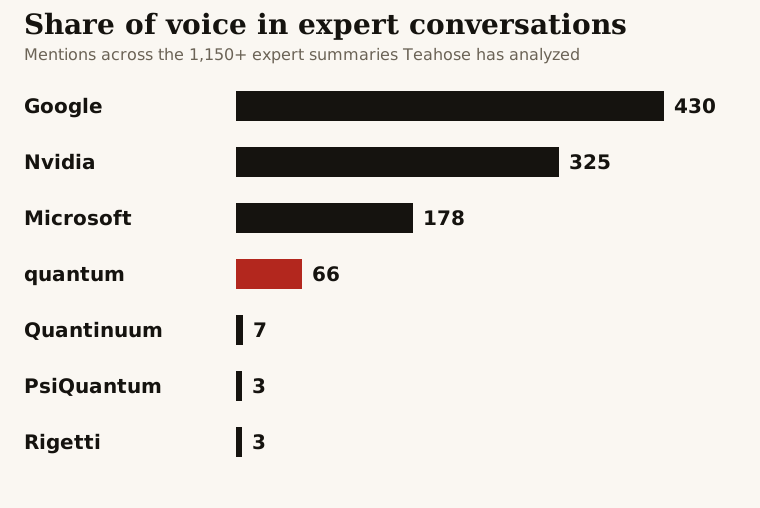
Each bar counts how many of Teahose's 1,150+ expert summaries mention it (word-boundary match across our podcast, newsletter, and paper corpus, June 2026).
Track the field: find the companies most similar to quantum and get their latest funding and product signals by email — Teahose Lookalikes.
At a glance
| Company | Modality | Standout fact (June 2026) |
|---|---|---|
| IBM | Superconducting | Most credible public roadmap; Starling 200-logical-qubit system targeted for 2029 |
| Google Quantum AI | Superconducting | Willow's "below threshold" error correction; verified quantum speed-up |
| Quantinuum | Trapped-ion | Nasdaq IPO June 2026; $30.9M 2025 revenue vs. ~$15B valuation |
| IonQ | Trapped-ion | Largest pure-play by revenue; $260–270M 2026 guidance |
Mention counts from Teahose's analysis of 1,150+ expert podcast, newsletter, and research summaries, June 2026.
How We Ranked
Five criteria, in order of weight:
- Demonstrated hardware milestones. Peer-reviewed or independently verified error-correction and advantage results outrank roadmap slides.
- Revenue today vs. roadmap. Real bookings and government contracts beat total-addressable-market math.
- Balance sheet and capital access. Fault tolerance is a decade-scale capex problem; companies that can't fund the next five years don't get to play.
- Strategic position. Cloud distribution, government design wins, and ecosystem partnerships (NVIDIA, hyperscalers) compound.
- Live signal volume. What the intel graph extracted from podcasts, newsletters, and papers over the trailing window — a proxy for real momentum vs. PR.
Confirmed facts are dated; anything not independently confirmed is flagged as reported.
The Top 12 Quantum Computing Companies in 2026
1. IBM — Superconducting. The most credible public roadmap in the industry: the 120-qubit Nighthawk processor shipped in late 2025, and IBM's published path to fault tolerance targets verified quantum advantage by the end of 2026 and the Starling system — 200 error-corrected logical qubits running 100-million-gate circuits — by 2029. No company has more accumulated quantum engineering, cloud distribution, or roadmap accountability. Ranked first because IBM publishes dates and then hits them.
2. Google Quantum AI — Superconducting. The milestone machine. Willow was the first chip to demonstrate "below threshold" error correction — logical error rates falling as the code scales up — and in October 2025 Google reported a verified quantum speed-up on a physics simulation. Google also quietly shapes the startup tier: it co-led QuEra's $230 million round. Ranked second on raw scientific output; it trails IBM only on commercial packaging.
3. Quantinuum — Trapped-ion. The sector's defining 2026 event: a Nasdaq debut (ticker QNT) on June 4, 2026 that priced at $60, raised $1.68 billion, and closed its first day around a $15.7 billion market value. The Honeywell-backed company posts the industry's best two-qubit gate fidelities and paired its Helios hardware with a serious software stack. The caveat is the multiple: $30.9 million of 2025 revenue against a ~$15 billion valuation, with a Q1 2026 net loss of $136.6 million. Confirmed as of June 2026.
4. IonQ — Trapped-ion. The most aggressive consolidator in quantum: Oxford Ionics ($1.075 billion, completed September 2025), ID Quantique, Lightsynq, Capella Space, Vector Atomic, and an agreement to acquire chip manufacturer SkyWater Technology. Q1 2026 revenue of $64.7 million (up 755% year over year) and full-year guidance of $260–270 million make it the largest pure-play quantum business by revenue. The bear case: much of that growth is acquired, not organic, and the integration risk is real.
5. PsiQuantum — Photonic. The best-funded private quantum company in the world: a $1 billion Series E in September 2025 led by BlackRock-affiliated funds at a $7 billion valuation, with Temasek, Baillie Gifford, and NVIDIA's NVentures participating. PsiQuantum skips intermediate machines entirely, building utility-scale, fault-tolerant sites in Brisbane and Chicago using photonics manufactured in standard semiconductor fabs. Highest ceiling on this list, and the least intermediate evidence — it's a binary bet, by design.
6. Microsoft — Topological (plus an ecosystem position). The contrarian science bet: Majorana-based topological qubits, unveiled in early 2025, which would be intrinsically error-resistant if they scale — a big if that parts of the physics community still debate. But Microsoft ranks this high mostly for its ecosystem position: Azure Quantum distributes nearly every other vendor's hardware, and its logical-qubit program with Atom Computing produced some of the field's notable entangled-logical-qubit results. It's the second-most-active company in our quantum signal feed.
7. QuEra Computing — Neutral-atom. The logical-qubit leader among startups: 96 logical qubits encoded from 448 physical qubits using a high-rate code, published in Nature in January 2026 — a dramatic improvement in encoding efficiency. Raised a $230 million round in February 2025 led by Google Quantum AI and SoftBank Vision Fund 2, later expanded with NVentures, for more than $507 million in total funding. The Harvard/MIT-rooted team is converting academic dominance into commercial systems.
8. Pasqal — Neutral-atom. Going public via a $2 billion pre-money SPAC with Bleichroeder Acquisition Corp. II, announced March 4, 2026 and expected to close in H2 2026 with more than $600 million of gross proceeds. Co-founded by Nobel laureate Alain Aspect, with roughly $80 million in booked and awarded business and ~100% 2025 revenue growth — unusually commercial for this tier. Confirmed agreement; the listing itself is pending close.
9. Rigetti Computing — Superconducting. The comeback story: written off in 2023, trading at a $6.5–7 billion market cap as of June 2026. Rigetti owns its own fab — rare vertical integration — and sells on-premise systems. The gap to close is commercial: roughly $7 million of 2025 revenue means the valuation is almost entirely roadmap. Ranked above D-Wave on architecture optionality, below everything else on revenue evidence.
10. D-Wave Quantum — Quantum annealing (with a gate-model program). The contrarian inclusion: annealing isn't universal quantum computing, and purists discount it. But D-Wave's Advantage2 systems serve paying optimization customers today — about $24 million of 2025 revenue, more than triple Rigetti's — and the stock's market cap swung from roughly $5.3 billion to $8.6 billion within the first two weeks of June 2026, a fair snapshot of how speculative this whole public tier still trades. Real customers, capped theoretical ceiling.
11. Atom Computing — Neutral-atom. First to break the 1,000-physical-qubit mark in 2023, and in June 2026 it demonstrated the first continuous, multi-round quantum error correction on a neutral-atom architecture. Its deepest moat is the Microsoft partnership: Atom's hardware plus Microsoft's qubit-virtualization software produced jointly announced logical-qubit milestones, with systems sold through that channel. Less capitalized than QuEra or Pasqal in this modality, which is what holds it at #11.
12. Alice & Bob — Superconducting cat qubits. The Paris-based fault-tolerance specialist closed a Series B extension backed by NVIDIA's NVentures in May 2026, expanding the €100 million (~$105 million) round it raised in January 2025. Its cat-qubit architecture suppresses bit-flip errors in hardware, which the company argues cuts the physical qubits needed for fault tolerance from millions to thousands. Smallest war chest on this list, highest theoretical leverage per dollar.
Also tracked: Oxford Quantum Circuits, QuantWare, Quobly, Nord Quantique, and Photonic Inc. all carry live signals in the theme — the long tail below is where the next entries to this list come from.
Quantum Computing Companies by Signal Volume
Live membership of the quantum-computing theme · ranked by signals extracted from podcasts, newsletters, and papers
- 01Nvidialast seen OCT 211005 signals
- 02Googlelast seen OCT 21630 signals
- 03Microsoftlast seen OCT 21340 signals
- 04IBMlast seen OCT 1434 signals
- 05Quantinuumlast seen OCT 215 signals
- 06Quintessentlast seen AUG 3014 signals
- 07Oratomiclast seen OCT 1410 signals
- 08Quoblylast seen SEP 79 signals
- 09Atom Computinglast seen JUL 89 signals
- 10Oxford Quantum Circuitslast seen SEP 38 signals
- 11Universal Quantumlast seen OCT 156 signals
- 12PsiQuantumlast seen OCT 146 signals
- 13Pasqallast seen OCT 24 signals
- 14Dirac Labslast seen SEP 14 signals
- 15Multiverse Computinglast seen AUG 24 signals
- 16IonQlast seen OCT 133 signals
- 17IQMlast seen OCT 23 signals
- 18QNu Labslast seen SEP 153 signals
- 19S-Transistorslast seen SEP 13 signals
- 20Quantum Motionlast seen JUL 83 signals
How to Evaluate a Quantum Computing Company
Quantum diligence has its own failure modes. Four filters that separate substance from press releases:
- Logical qubits over physical qubits. A 1,000-physical-qubit machine with no error correction is less useful than 50 good logical qubits. Ask for the encoding ratio and the demonstrated logical error rate — and whether the result was peer-reviewed (QuEra's Nature paper) or a blog post.
- Error-correction milestones are the real roadmap. "Below threshold" (Google, 2024) and continuous multi-round correction (Atom Computing, 2026) are the checkpoints that matter; qubit-count announcements are marketing.
- Revenue today vs. roadmap revenue. Quantinuum's IPO filing made it concrete: $30.9M of revenue, ~$15B valuation. That gap is the sector's defining risk. Companies with government bookings and cloud usage now (IonQ, D-Wave, Pasqal) carry a different risk profile than pure utility-scale bets (PsiQuantum).
- Watch who NVIDIA and the hyperscalers back. NVentures appears in PsiQuantum, QuEra, and Alice & Bob; Google co-led QuEra's round; Microsoft chose Atom Computing. Strategic checks from companies that see everyone's hardware are the strongest third-party signal available.
The capital story also rhymes with the AI compute buildout — quantum vendors increasingly position against the same data-center budgets the AI chip companies compete for, and NVIDIA is hedging into both.
Keep This List Current
Static quantum rankings rot in months — this year alone produced an IPO, a $2B SPAC, and a billion-dollar acquisition. Every company above links to a profile with its full signal history; the Watch button on any profile or the quantum computing theme emails you when something new lands. For the broader venture picture, see the top AI startups ranking, and the free daily digest delivers the day's signals in one email.
Bottom line: There is no single winning quantum computing company in 2026 — IBM leads on roadmap accountability, Google on scientific milestones, Quantinuum as the marquee public name, and IonQ on revenue — so weight the modality and the metric (logical qubits and real bookings, not physical-qubit counts) that matter most to you.
Frequently Asked Questions
What is the difference between physical and logical qubits?
Physical qubits are the raw hardware devices — noisy and error-prone. A logical qubit bundles many physical qubits together with error correction so computations survive long enough to be useful. The ratio is the whole game: QuEra demonstrated 96 logical qubits from 448 physical qubits in early 2026, while less-protected superconducting designs may need a thousand physical qubits per logical one. When a company quotes a qubit count, always ask which kind.
Which qubit modality is winning — superconducting, trapped-ion, photonic, or neutral-atom?
None has won yet, and that is the honest answer. Superconducting (IBM, Google, Rigetti) leads on gate speed and ecosystem maturity; trapped-ion (Quantinuum, IonQ) leads on fidelity; neutral-atom (QuEra, Pasqal, Atom Computing) is scaling qubit counts fastest and posting striking logical-qubit results; photonic (PsiQuantum) skips intermediate machines entirely and bets on utility-scale from day one. The 2025–2026 capital flood funded all four lanes precisely because the modality question is still open.
Do quantum computing companies make real revenue in 2026?
Some, and not much relative to their valuations. IonQ guided to $260–270 million for 2026 — the largest pure-play revenue base. Quantinuum reported $30.9 million of 2025 revenue against a roughly $15 billion market value at its June 2026 IPO; D-Wave booked about $24 million in 2025 and Rigetti about $7 million. Most quantum revenue today is government programs, research access, and cloud credits — the commercial-advantage revenue everyone is pricing in has not arrived yet.
Why did quantum computing stocks and funding explode in 2025–2026?
Three compounding catalysts: Google’s Willow chip crossed the "below threshold" error-correction line and later showed a verified speed-up on a physics simulation; IBM put a dated, public path to fault tolerance on the table (Starling, 2029) and a verified quantum-advantage target for end of 2026; and the capital markets opened — PsiQuantum’s $1 billion Series E, Quantinuum’s $1.68 billion IPO, and Pasqal’s $2 billion SPAC agreement all landed within ten months. NVIDIA’s venture arm writing checks into PsiQuantum, QuEra, and Alice & Bob added a strong credibility signal.
How is this list of quantum computing companies ranked?
On a blend of demonstrated hardware milestones (error-correction results beat press releases), revenue today versus roadmap promises, balance-sheet durability, and signal volume in the Teahose intel graph, which extracts funding, product, M&A, and hiring events daily from 25+ podcasts, VC newsletters, and research papers. The live table below this article updates continuously; the editorial ranking is revisited as facts change.
How can I track quantum computing companies going forward?
Follow the quantum computing theme page, which tracks live membership as new companies emerge, or open any company profile and hit Watch for an email digest of its new signals — funding rounds, launches, partnerships, and hires as they are extracted.
Who is the leading quantum computing company in 2026?
There is no single leader — the field splits by what you weight. IBM has the most credible public roadmap and ranks first on roadmap accountability and cloud distribution; Google Quantum AI leads on raw scientific milestones like Willow's below-threshold error correction; Quantinuum posts the best gate fidelities and is now the marquee public name after its June 2026 Nasdaq IPO; and IonQ is the largest pure-play by revenue with 2026 guidance of 260 to 270 million dollars. The honest answer in 2026 is that leadership is modality-specific, not absolute.
Which quantum computing stocks can I actually buy in 2026?
The publicly traded pure-plays as of June 2026 are IonQ, Rigetti Computing, D-Wave Quantum, and Quantinuum, which debuted on Nasdaq under ticker QNT on June 4, 2026. Pasqal is going public via a SPAC expected to close in the second half of 2026. Beyond the pure-plays, IBM, Google, Microsoft, and NVIDIA all carry quantum programs inside much larger businesses, so a position in them is overwhelmingly a bet on something other than quantum. Treat the pure-play tier as speculative: valuations are pricing roadmaps, not current revenue.
How many quantum computing companies are there, and how do I keep up with the field?
Dozens of credible hardware companies exist across superconducting, trapped-ion, photonic, neutral-atom, and annealing approaches, with new entrants emerging every quarter. Quantum already surfaces in 67 of the 1,150-plus expert summaries Teahose has analyzed, and the live table on this page tracks the quantum-computing theme as membership changes. The fastest way to keep up is to follow that theme page or hit Watch on any company profile for an email digest of new funding, product, M&A, and hiring signals as they are extracted.