
Key takeaways
- The 2026 BCI leaders, ranked by patients and FDA stage: Neuralink (21 enrolled, penetrating threads), Synchron (10 implanted, furthest along regulatorily), and Precision Neuroscience (first 510(k) clearance) — with Merge Labs, Science Corp, and Paradromics close behind.
- Neuralink is mentioned in 10 of the 1,150+ expert conversations we've analyzed — the most-discussed name in the category and the clearest proxy for where operator attention sits.
- Fewer than 70 people worldwide have ever used an implanted decoding BCI (GAO, April 2026), so patient count — not funding — is the milestone that can't be faked.
- Most guides rank these companies by money raised; what actually matters is FDA pathway stage, because a pivotal trial is a different asset class from a research-stage round, however large.
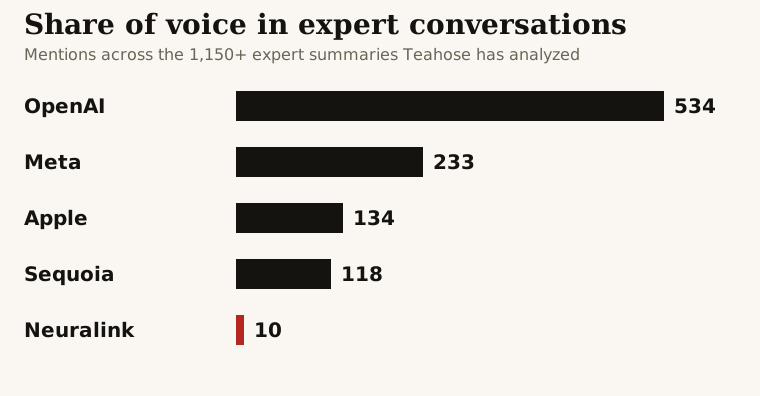
Each bar counts how many of Teahose's 1,150+ expert summaries mention it (word-boundary match across our podcast, newsletter, and paper corpus, June 2026).
Track the field: find the companies most similar to OpenAI and get their latest funding and product signals by email — Teahose Lookalikes.
Mention counts from Teahose's analysis of 1,150+ expert podcast, newsletter & research summaries, June 2026.
At a glance
| Company | Patients | Regulatory stage |
|---|---|---|
| Neuralink | 21 enrolled (penetrating threads) | Early feasibility |
| Synchron | 10 implanted (endovascular stent) | Pivotal trial planned for 2026 |
| Precision Neuroscience | 37 tested intraoperatively (surface array) | 510(k) clearance, April 2025 |
| Paradromics | First human implant, May 2025 | FDA IDE, trial enrolling 2026 |
| Merge Labs | None in humans yet | Pure research phase |
Brain-computer interfaces stopped being science fiction somewhere around 2024 and became a clinical-stage industry with patients, FDA filings, and nine-figure rounds. The unlock wasn’t electrodes — those existed for decades — it was AI decoding: the same model families that learned to transcribe speech learned to translate neural activity into cursor movement, text, and synthesized voice. As of June 2026, people with paralysis are using implants to control iPads, and the sector raised more than $1.3 billion in the trailing twelve months across the Neuralink, Synchron, Merge Labs, and Science Corp rounds alone.
This guide ranks the companies that matter — every figure verified as of June 2026, with confirmed-versus-rumored called out explicitly. The table further down is pulled live from the Teahose intel graph, which extracts signals daily from industry podcasts, newsletters, and research papers. One stat from that graph worth quoting: our neural interface & bioelectronics theme tracks 6 companies live, and Neuralink and CTRL-Labs lead it on extracted signal volume (3 signals each).
How We Ranked
Funding is the loudest signal in neurotech but the least meaningful. We weighted four things, in order: patients (humans actually using the device — the milestone that can’t be faked), regulatory stage (FDA clearance, IDE, or pivotal trial beats a press release), capital (as of June 2026, confirmed rounds only), and signal momentum from our live theme data. Company-reported numbers are labeled as such.
The Top 10 Neurotech & BCI Companies in 2026
1. Neuralink. The category leader by capital and ambition. Elon Musk’s company reported 21 enrolled patients by January 2026 (company-reported, up from 12 in September 2025), using the N1 implant’s robot-inserted penetrating threads — the highest-bandwidth approach in human use. Confirmed: a $650M Series E in June 2025 at a $9B pre-money valuation (ARK, Sequoia, Founders Fund, Thrive). Musk says 2026 is the year of "high-volume production" and a near-fully-automated surgery — treat that timeline as aspiration, not guidance.
2. Synchron. The pragmatist’s Neuralink. Its Stentrode reaches the motor cortex through a blood vessel — no craniotomy — which is why it leads the regulatory race: 10 patients implanted across U.S. trials, a $200M Series D in November 2025 ($345M total; Bezos Expeditions, ARCH, Khosla, QIA), and a pivotal trial planned for 2026 — the final step before FDA premarket approval. Also the first BCI with native Apple integration: an ALS patient controlling an iPad, iPhone, and Vision Pro by thought via Apple’s BCI-HID protocol, announced May 2025.
3. Precision Neuroscience. Founded by Neuralink alumnus Ben Rapoport on the opposite bet: 1,024 electrodes on a film thinner than a hair that rests on the brain’s surface without penetrating tissue. Confirmed: FDA 510(k) clearance in April 2025 for implantations up to 30 days — the first full regulatory clearance for a next-generation BCI company — 37 patients tested intraoperatively, and a $102M Series C (December 2024, ~$500M post-money; ~$180M total as of January 2026). Johns Hopkins surgeons reported real-time cursor control and speech classification with the Layer 7 in a February 2026 study.
4. Merge Labs. The OpenAI connection is confirmed, and bigger than rumored: OpenAI wrote the largest check in a roughly $250M seed at an $850M valuation (announced January 2026), instantly the second-best-funded U.S. BCI effort. Co-founders include Caltech’s Mikhail Shapiro, BCI researchers Sumner Norman and Tyson Aflalo, Alex Blania, and Sam Altman in a personal capacity. The approach — talking to neurons via engineered molecules and ultrasound, no implanted electrodes — is the most radical on this list. Also the earliest: pure research phase, nothing in humans yet.
5. Science Corp. Max Hodak co-founded Neuralink; his second act may commercialize first. Science’s PRIMA retinal implant restored form vision in patients blinded by late-stage macular degeneration — 80% showed meaningful visual-acuity improvement in the NEJM-published trial, reading letters and words again. Confirmed: a $230M Series C in March 2026 (~$490M total; Lightspeed, Khosla, IQT) with a CE mark expected mid-2026. If that holds, Science becomes the first BCI company with a product on the market — in Europe, before the FDA decides.
6. Paradromics. The bandwidth maximalist. Its Connexus implant packs 420+ microelectrodes recording individual neurons, aimed squarely at speech restoration. Confirmed: first human implantation (brief, intraoperative) at the University of Michigan in May 2025, FDA IDE approval for the Connect-One speech-restoration study enrolling in 2026, $105M+ in venture funding plus $18M in NIH and DARPA grants. A strategic partnership with Saudi Arabia’s Neom is confirmed; its size is not public — treat any dollar figure you see as unverified.
7. Blackrock Neurotech. The infrastructure incumbent. Its Utah Array has been the workhorse of academic BCI research for two decades — the company says its technology has been used in 40+ humans, more than anyone else, powering thought-to-text and robotic-limb milestones long before the current hype cycle. Confirmed: a $200M investment from stablecoin issuer Tether in 2024 to fund commercialization. The open question is whether a research-tools company can become a products company.
8. Motif Neurotech. The therapeutic dark horse. Its DOT — a blueberry-sized, wirelessly powered stimulator implanted over the brain in a ~20-minute outpatient procedure — targets treatment-resistant depression rather than paralysis. Confirmed: FDA IDE approval in April 2026 for its RESONATE trial, enrolling this year, on an $18.75M Series A plus a UK ARIA award — the fastest founding-to-IDE run for a novel implantable BCI. Psychiatry, not motor control, may be neurotech’s biggest market.
9. Meta (CTRL-Labs). The only neural interface you could buy in a store as of June 2026. Meta’s Neural Band — built on its 2019 CTRL-Labs acquisition — reads motor-nerve signals at the wrist (sEMG) rather than brain activity, and shipped to consumers in September 2025 alongside Meta’s display glasses, after a Nature paper demonstrated air-writing at roughly 21 words per minute. Not a brain implant, but it’s the existence proof that neural input can be a mass-market product. CTRL-Labs is one of the live-tracked companies in our theme below.
10. The non-invasive long tail. Below the headliners sits a cluster betting that adoption beats bandwidth: Wispr AI (tracked live in our theme — shipped its Flow voice-input product as the commercial wedge while pursuing neural wearables), Kernel (optical brain measurement), and EEG veterans like Emotiv and OpenBCI. None has the clinical milestones of the implant companies; all have a shorter path to a customer. Watch which of them converts hardware into a habit.
Neural Interface & Bioelectronics Companies by Signal Volume
Live membership of the neural-interface-bioelectronics theme · ranked by signals extracted daily from podcasts, newsletters, and papers
- 01Nvidialast seen OCT 211005 signals
- 02Metalast seen OCT 21522 signals
- 03Amazonlast seen OCT 21347 signals
- 04Neuralinklast seen OCT 1416 signals
- 05Lambdalast seen OCT 208 signals
- 06Science Corporationlast seen AUG 208 signals
- 07LiMAlast seen SEP 237 signals
- 08MintNeurolast seen OCT 153 signals
- 09Sabilast seen OCT 143 signals
- 10Precision Neurosciencelast seen SEP 273 signals
- 11World.orglast seen JUL 283 signals
- 12CTRL-Labslast seen MAY 53 signals
- 13Gestalalast seen AUG 282 signals
- 14BrainColast seen AUG 42 signals
- 15World Foundationlast seen JUL 252 signals
How to Evaluate a Neurotech Company
Neurotech diligence is its own discipline — software metrics don’t transfer, and the failure modes are clinical, not commercial:
- The invasiveness-bandwidth tradeoff is the whole industry. Penetrating electrodes (Neuralink, Paradromics) read the most neurons and carry the most surgical risk; surface arrays (Precision) and endovascular stents (Synchron) trade signal for safety; wearables (Meta, Wispr) trade almost all of it for adoption. There is no "best" point on this curve — ask which tradeoff matches the company’s target market, and whether its decoding software can compensate for what its hardware gives up.
- FDA pathway stage is the real valuation driver. The ladder runs: preclinical → investigational device exemption (IDE) → early feasibility study → pivotal trial → premarket approval. Each rung de-risks years of timeline. A company in a pivotal trial (Synchron, 2026) is a different asset class from one with an IDE (Paradromics, Motif) or one in pure research (Merge Labs) — even if the research-stage company raised more money.
- Patient count is the milestone that can’t be faked. Funding rounds are negotiated; demos are edited; a human using a device for months is neither. Fewer than 70 people worldwide have used an implanted decoding BCI (GAO, April 2026), so every single patient moves the field. Weight a company’s implant count — and how long devices stay in — above its valuation.
- Watch the signals, not the press cycle. Hiring surgeons and field-clinical staff says a trial is real; a partnership with a device giant says distribution is being built. Our neural interface theme extracts exactly these signals daily, and the broader healthtech theme catches the companies approaching BCI from the medical-device side.
Keep Tracking the Field
Every company in the live table above links to a profile with its full signal history — hit Watch on any of them for an email when something new lands. For the wider market view, the top AI startups ranking covers every segment we track, and the free daily digest delivers the day’s signals in one email.
Bottom line: No single company leads on every axis — Neuralink leads on capital and bandwidth, Synchron on the regulatory path with its 2026 pivotal trial, and Precision Neuroscience on the first 510(k) clearance — so follow FDA pathway stage and patient count rather than funding, because those are the milestones that can't be faked.
Frequently Asked Questions
How many people have brain implants today?
Depends what you count. Fewer than 70 people worldwide have ever used an implanted decoding brain-computer interface — a device that reads neural signals and translates them into commands — per a U.S. Government Accountability Office count published in April 2026. Therapeutic stimulation implants are a much bigger population: more than 200,000 people have received deep brain stimulation devices for conditions like Parkinson’s and epilepsy. The decoding-BCI number is the one growing fastest: Neuralink alone reported 21 enrolled patients by early 2026, up from 12 in September 2025.
Neuralink vs Synchron — what’s the actual difference?
Surgical approach and bandwidth. Neuralink’s N1 uses robot-inserted threads that penetrate brain tissue — highest signal resolution, most invasive, 21 patients enrolled as of early 2026. Synchron’s Stentrode is delivered through a blood vessel like a cardiac stent — no open-brain surgery, lower bandwidth, 10 patients implanted, and the first native integration with Apple’s BCI Human Interface Device protocol. Synchron is also furthest along the regulatory path, with a pivotal trial planned for 2026 — the step before FDA premarket approval.
Has the FDA approved any brain-computer interface?
No decoding BCI has full FDA premarket approval yet. The closest milestones: Precision Neuroscience received 510(k) clearance in April 2025 for its Layer 7 cortical array (implantations up to 30 days), Paradromics and Motif Neurotech both hold investigational device exemptions for trials enrolling in 2026, and Synchron’s 2026 pivotal trial is the industry’s first run at premarket approval. Science Corp may beat everyone to market — via Europe, where it expects a CE mark for its PRIMA retinal implant in mid-2026.
What is Merge Labs and how is OpenAI involved?
Merge Labs is a BCI research lab co-founded by scientists Mikhail Shapiro, Sumner Norman, and Tyson Aflalo alongside Alex Blania and Sam Altman (in a personal capacity). OpenAI wrote the largest check in its roughly $250 million seed round at an $850 million valuation, announced January 2026 — making it the second-best-funded U.S. BCI effort after Neuralink. The approach is deliberately non-invasive: connecting to neurons with engineered molecules and ultrasound rather than implanted electrodes. It is still in an early research phase with no device in humans.
Are non-invasive BCIs real products or research projects?
One shipped in 2025: Meta’s Neural Band, the sEMG wristband built on its CTRL-Labs acquisition, launched alongside its display glasses after a peer-reviewed Nature paper showed air-writing at roughly 21 words per minute. It reads motor-nerve signals at the wrist rather than brain activity directly — a different tradeoff than EEG headsets, which remain mostly research and wellness devices. The honest framing: non-invasive wins on adoption, implants win on bandwidth, and the field is racing to close that gap from both ends.
How can I track these neurotech companies over time?
The live table on this page pulls from our neural interface & bioelectronics theme, which extracts funding, product, and hiring signals daily from podcasts, newsletters, and research papers. Open any company profile and hit Watch for an email digest when new signals land, or follow the theme page itself — new companies sweep in automatically as they start generating signals.
Which brain-computer interface company is the most advanced in 2026?
It depends on which yardstick you use, and the honest answer is that no single company leads on all three. Neuralink leads on capital and bandwidth, with 21 enrolled patients and the highest-resolution penetrating-thread approach. Synchron leads on the regulatory path, with a 2026 pivotal trial that is the industry's first run at FDA premarket approval. Precision Neuroscience leads on clearance, holding the first 510(k) for a next-generation BCI. If you only get to pick one number to follow, follow FDA pathway stage rather than valuation — it de-risks years of timeline that money alone cannot buy.
Are neurotech and brain-computer interface stocks worth investing in right now?
Most of the leaders are still private, so direct exposure is limited. Neuralink, Synchron, Precision Neuroscience, Merge Labs, Science Corp, and Paradromics are all venture-funded as of June 2026, not publicly traded. Public-market exposure tends to come through larger medical-device and tech companies adjacent to the field, including Meta, which shipped its wrist-based Neural Band to consumers in September 2025. Before reading any valuation as a signal of progress, separate confirmed rounds from rumored ones and weight patient count and regulatory stage above the headline dollar figure.
What is the difference between invasive and non-invasive brain-computer interfaces?
It is the central tradeoff of the whole field: bandwidth versus adoption. Invasive implants like Neuralink's penetrating threads and Paradromics' microelectrodes read individual neurons and carry the most signal but require surgery and clinical trials. Non-invasive options like Meta's sEMG wristband and EEG headsets read nerve or surface activity, win on safety and shelf availability, and lose resolution. Surface arrays such as Precision's and endovascular stents like Synchron's sit in between. There is no best point on that curve — the right answer depends on the target condition and how good the decoding software is at compensating for what the hardware gives up.