
Key takeaways
- There is no single drop-in replacement for PitchBook — match the alternative to the one job you actually use it for: deal/company research (CB Insights, Tracxn), sourcing (Harmonic, Specter), occasional lookups (Crunchbase Pro + LinkedIn), or live tracking (Teahose, free).
- Teahose builds a free company graph from 1,150+ expert summaries (~1M+ words of expert analysis, tracking 1,800+ operators and thousands of companies) — strongest exactly where databases lag: what happens to a company between funding announcements.
- The famous budget stack — Crunchbase Pro + LinkedIn Sales Navigator at roughly $150/month — covers most non-institutional queries against PitchBook's $1,000+/month.
- What nothing cheaper replaces: fund performance, deal terms, and LP-grade analytics. Most guides chase a feature-for-feature clone; what matters is that most buyers only use ~20% of PitchBook, and that 20% is covered far below $30K.
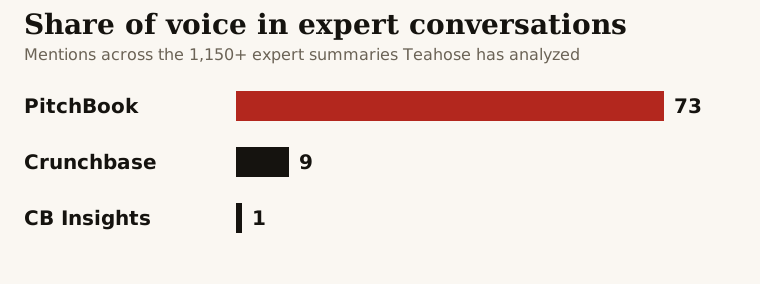
Each bar counts how many of Teahose's 1,150+ expert summaries mention it (word-boundary match across our podcast, newsletter, and paper corpus, June 2026).
Stay ahead: watch how these names move in our live signal feed — new funding, product, and hiring signals as our pipeline detects them.
Mention counts and corpus figures from Teahose's analysis of 1,150+ expert podcast, newsletter & research summaries, June 2026.
At a glance
| The job you use PitchBook for | Best alternative | Reported price |
|---|---|---|
| Deal & company research | CB Insights / Tracxn | $50–85K/yr / from ~$550/mo |
| Sourcing emerging companies | Harmonic / Specter | quote-gated, mid-five-figures |
| Occasional company lookups | Crunchbase Pro + LinkedIn Sales Navigator | ≈ $150/month |
| Live tracking between rounds | Teahose | Free |
| Fund performance, deal terms, LP analytics | PitchBook (or Preqin) | no cheap substitute |
PitchBook is the institutional default for private-market data, and its reported median contract of ~$30K/year (with quote-only sales and auto-renew escalators — Vendr, Failory) is exactly why this search term exists. The substitution question has a clean answer once you name which PitchBook you actually use.
If You Use It for Deal & Company Research
- CB Insights — the closest paid substitute in spirit: market intelligence, scouting reports, maps. Reported $50–85K/yr — sideways on cost, different on shape (research vs terminal).
- Tracxn — the practical downgrade that mostly works: 2M+ tracked companies, deep sector taxonomies, published pricing from ~$550/mo (Tracxn) — an order of magnitude cheaper, lighter on financials.
- Dealroom — €12.6–17K/yr, the pick if your geography is Europe.
If You Use It for Sourcing
Harmonic (35M companies, headcount/stealth signals) and Specter (50M companies, real-time funding events) are purpose-built sourcing engines — fresher than PitchBook on emerging companies, with none of its fund-performance depth. Both quote-gate pricing; budget mid-five-figures.
If You Use It Occasionally
The famous budget stack: Crunchbase Pro + LinkedIn Sales Navigator ≈ $150/month — versus PitchBook at $1,000+/month (VC Beast's comparison). It answers "who is this company, who runs it, roughly what have they raised" — which, honestly, is most queries most non-institutional users run. Add the free primary sources (SEC EDGAR Form D, company blogs) for verification. Our full Crunchbase alternatives guide covers that tier.
The Free Option We'd Say Even If It Weren't Ours
Teahose tracks private companies the way news actually flows: our pipeline reads the podcasts, newsletters, and papers where rounds get discussed, extracts the signals daily, and builds a free company graph — each company with its live signal history — plus a competitor finder that runs vector similarity over the graph (paste a URL, get the lookalikes). It's strongest exactly where databases are weakest: what's happening to a company between funding announcements.
What Nothing on This Page Replaces
Honesty section: fund performance data, deal terms, and LP analytics have no cheap substitute. If your work is LP diligence, comps for transaction documents, or fund benchmarking, PitchBook (or Preqin) is the cost of doing that business — negotiate the seat count and the renewal escalator instead, ideally at quarter-end. Everyone else is paying $30K for the 20% of the product the cheaper stack covers.
The Live Graph, Demonstrated
Companies ranked by 7-day extracted-signal volume — coverage between the funding announcements databases wait for
- 01OpenAI41 signals · 7d
- 02Anthropic39 signals · 7d
- 03Yahoo28 signals · 7d
- 04Bessemer17 signals · 7d
- 05Vanta14 signals · 7d
- 06Ropedia14 signals · 7d
- 07Google12 signals · 7d
- 08Nvidia12 signals · 7d
- 09Mecka11 signals · 7d
- 10Tesla10 signals · 7d
Related
Crunchbase alternatives · The free competitor finder · AI unicorns, tracked live · Biggest VC firms.
Pricing figures are reported via procurement trackers (vendors quote-gate); as of June 11, 2026.
Bottom line: There's no drop-in PitchBook replacement — match the alternative to the one job you actually use it for, and most non-institutional buyers can cover their ~20% of PitchBook far below $30K (often the ~$150/month Crunchbase Pro + LinkedIn stack, or Teahose for free); only fund performance, deal terms, and LP-grade analytics still require PitchBook or Preqin.
Frequently Asked Questions
How much does PitchBook cost?
PitchBook doesn't publish pricing; reported figures from procurement data: median annual contract ~$30K (average ~$56K across larger deals), solo seats around $15–20K/year, a common base of ~$25K for three users, and enterprise discounts bringing volume seats to $7–12K. The recurring contract complaints: quote-only sales, multi-year terms, and auto-renewal with 5–10% annual increases.
What is the best cheap alternative to PitchBook?
The classic budget stack is Crunchbase Pro (~$49–99/month) plus LinkedIn Sales Navigator (~$99/month) — under $150/month against PitchBook's $1,000+. It covers prospecting and basic company research; it does not cover fund performance, deal terms, or analyst-built financials. Tracxn (from ~$550/month, published pricing) is the middle option with real sector depth.
Is there a free alternative to PitchBook?
For fragments of it. SEC EDGAR gives you Form D raises for free; OpenVC covers investor discovery; LinkedIn covers people and headcount; Teahose covers private-company tracking — a free live company graph with funding/product signals extracted daily from podcasts, newsletters, and papers, plus a vector-similarity competitor finder. What has no free substitute: fund returns data, deal terms, and LP-grade analytics. If your job needs those, you need PitchBook or a Preqin-class product.
PitchBook vs CB Insights — which one?
PitchBook is a data terminal (deals, funds, valuations — strongest for transaction work: VC, PE, M&A, banking). CB Insights ($50–85K/year reported) is a research product (market maps, scouting reports, theses — strongest for corporate strategy and innovation teams). Diligence shops pick PitchBook; corp-dev teams deciding which market to enter pick CBI. Buying both is common at institutions and overkill everywhere else.
Which PitchBook alternative is best for tracking startups between funding rounds?
Traditional databases only update when a round is announced, so they go quiet for months at a time. If your real need is knowing what is happening to a company day to day — product launches, hires, strategy shifts, leadership commentary — a signal-extraction tool fits better than a deals terminal. Teahose builds a free, live company graph from its analysis of 1,150+ expert podcast, newsletter, and research summaries, surfacing those between-announcement moves automatically, and it costs nothing to start.
Do I really need PitchBook, or am I overpaying for features I never use?
Most non-institutional users run a narrow set of queries: who is this company, who runs it, and roughly what have they raised. That is the cheap 20 percent of PitchBook — covered by a roughly 150 dollar per month Crunchbase Pro plus LinkedIn Sales Navigator stack, plus free primary sources like SEC EDGAR Form D filings. You only genuinely need PitchBook (or Preqin) if your work touches fund performance, deal terms, or LP-grade analytics, which have no cheap substitute. If you are paying 30K a year mainly for company lookups, you are overpaying.
What free tools can replace parts of PitchBook in 2026?
No single free product matches PitchBook, but several cover slices of it: SEC EDGAR gives Form D fundraising filings, OpenVC helps with investor discovery, LinkedIn covers people and headcount, and Teahose provides a free company graph with daily funding and product signals plus a vector-similarity competitor finder. The unavoidable gaps in any free stack are fund returns, deal terms, and LP analytics.