
Key takeaways
- There's no single best Crunchbase alternative — pick by job: PitchBook/CB Insights for diligence depth, Harmonic/Specter for fresh sourcing, Apollo/ZoomInfo for contacts, and OpenVC/Teahose for free.
- Every database here shares one flaw — private-company data only re-prices on announcements; Teahose hedges it with continuous signal flow, extracted from 1,150+ expert summaries (~1M+ words of analysis) covering 1,800+ operators and thousands of companies.
- Crunchbase is the budget option (~$348–1,200/yr reported), so "Crunchbase vs something better" is almost always a question about a specific gap, not price.
- Most guides rank these tools by row count; what actually matters is data freshness — whether the facts refresh between funding rounds, not just when one is announced.
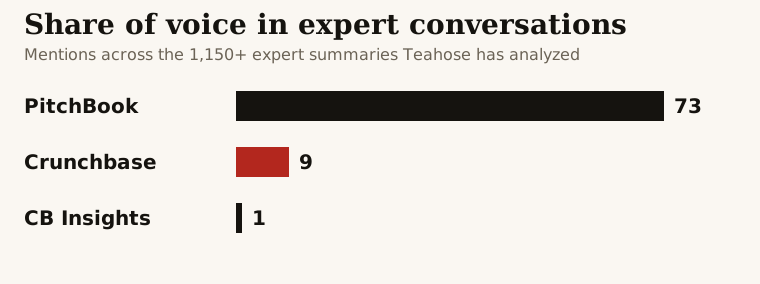
Each bar counts how many of Teahose's 1,150+ expert summaries mention it (word-boundary match across our podcast, newsletter, and paper corpus, June 2026).
Stay ahead: watch how these names move in our live signal feed — new funding, product, and hiring signals as our pipeline detects them.
Corpus figures from Teahose's analysis of 1,150+ expert podcast, newsletter & research summaries, June 2026.
At a glance
| Job | Pick(s) | Reported cost |
|---|---|---|
| Investor-grade research | PitchBook, CB Insights | ~$30K/yr median; $50–85K/yr |
| Deal sourcing | Harmonic, Specter | Sales-quoted |
| Sales & contact data | Apollo, ZoomInfo, Clay | Apollo ~$119/user/mo |
| Free | OpenVC, SEC EDGAR + LinkedIn, Teahose | Free |
Crunchbase is the default startup database, and its weaknesses are well-documented by everyone who churns: self-reported data that goes stale between rounds, no contact layer, and paywalled depth. The right alternative depends entirely on which of those is your actual complaint. Sorted by job:
For Investor-Grade Research → PitchBook, CB Insights
- PitchBook — analyst-curated deal data, fund performance, valuations; the institutional standard. Reported cost: median ~$30K/yr (solo seats ~$15–20K; auto-renewals with 5–10% annual increases are the recurring complaint — Vendr). Full breakdown: PitchBook alternatives.
- CB Insights — research reports, market maps, scouting; reported $50–85K/yr, quote-only (easyVC). You're buying the analysis, not just the rows.
- Tracxn — the value pick of the paid tier: publishes pricing (rare here), from roughly $550/mo, with deep sector taxonomies (Tracxn pricing).
- Dealroom — the European specialist: €12.6–17K/yr, strongest for EU ecosystem coverage.
For Deal Sourcing → Harmonic, Specter
The "Crunchbase but fresh" category — built on scraped + inferred signals rather than self-reporting:
- Harmonic — 35M+ companies, 195M people profiles; tracks headcount and stealth signals VCs source from. Sales-quoted pricing.
- Specter — 50M companies, 500M people, real-time funding/M&A events. Same model. Both fix Crunchbase's staleness; neither is cheap, and both still inherit the core limitation — see below.
For Sales & Contact Data → Apollo, ZoomInfo, Clay
If your real complaint is "Crunchbase has no emails": Apollo (free tier, then ~$119/user/mo), ZoomInfo (enterprise), or Clay for enrichment workflows (repriced March 2026: Launch $185/mo, Growth $495/mo, credit-based). These are GTM tools wearing the database costume — compare them against each other, not against Crunchbase.
The Free Stack
- OpenVC — free, founder-first directory of 3,000+ opt-in investor profiles. The fundraising-specific answer.
- SEC EDGAR (Form D) + LinkedIn — the primary sources most databases repackage. Free, current, tedious.
- Teahose — our own entry, free by design: a live company graph built by extracting signals daily from the podcasts, newsletters, and papers where funding news actually breaks — every company gets a page with its full signal history (browse the graph), and the competitor finder runs vector similarity over it: paste any URL, get the lookalikes, no seat license.
The Honest Caveat About All of Them
Every database in this guide — paid or free — shares one structural flaw: private-company data only re-prices on announcements. A valuation is "current" until the next round; a headcount is a quarterly scrape. The only hedge is signal flow rather than snapshots: tracking what's being said about companies continuously instead of what was filed about them quarterly. That's the design thesis behind our signal feed, and you can judge it live:
The Live Graph, Demonstrated
Companies ranked by 7-day extracted-signal volume — the freshness a static database can't have
- 01OpenAI41 signals · 7d
- 02Anthropic39 signals · 7d
- 03Yahoo28 signals · 7d
- 04Bessemer17 signals · 7d
- 05Vanta14 signals · 7d
- 06Ropedia14 signals · 7d
- 07Google12 signals · 7d
- 08Nvidia12 signals · 7d
- 09Mecka11 signals · 7d
- 10Tesla10 signals · 7d
Related
PitchBook alternatives · The free competitor finder · AI unicorns, tracked · Top AI startups, live-ranked.
Bottom line: There's no single best Crunchbase alternative — pick by the gap you're fixing: PitchBook or CB Insights for diligence depth, Harmonic or Specter for fresh sourcing, Apollo or ZoomInfo for contacts, and OpenVC or Teahose for free. Since every database only re-prices private-company data on announcements, the real edge is continuous signal flow, not row count.
Pricing figures are reported (most vendors quote-gate); as of June 11, 2026.
Frequently Asked Questions
What is the best free alternative to Crunchbase?
Depends on the job. For finding investors: OpenVC (a free, opt-in directory of 3,000+ investor profiles). For raw primary data: SEC EDGAR Form D filings plus LinkedIn. For tracking private AI companies specifically: Teahose — a free, live company graph built by extracting funding and product signals daily from podcasts, newsletters, and papers, with a vector-similarity competitor finder. None replicates Crunchbase's breadth; each beats it on its specific job.
Why do people switch away from Crunchbase?
Three recurring complaints: data staleness (much of it is self-reported, so funding totals and headcounts age between updates), no verified contact data (GTM teams leave for ZoomInfo or Apollo), and paywalled depth — the free tier shows just enough to confirm the data exists. The structural issue all database products share: private-company facts only refresh when a round is announced, so anything between rounds is guesswork.
How much does Crunchbase cost in 2026?
Reported pricing (the official page is quote-gated): Starter around $29/user/month and Pro around $49–99/user/month on annual billing, with a Business tier near $199/month. That makes it the budget option of the category — PitchBook's median contract runs ~$30K/year and CB Insights starts around $50K — which is exactly why "Crunchbase vs something better" is usually a question about a specific gap, not cost.
Is Crunchbase or PitchBook better?
Different leagues, different prices. Crunchbase (~$348–1,200/year) is fine for quick lookups, basic prospecting, and confirming a company exists. PitchBook (~$15–30K+/year, reported) has analyst-curated financials, fund performance, and deal terms that Crunchbase simply doesn't collect — it's the institutional tool. If you have to ask whether you need PitchBook, Crunchbase plus targeted free sources usually covers you.
What is the best Crunchbase alternative for tracking private AI startups?
For private AI companies specifically, the gap is freshness, not breadth. Teahose is a free, live company graph built by extracting funding and product signals daily from podcasts, newsletters, and papers — the channels where AI funding news actually breaks first. Every company gets a page with its full signal history, plus a vector-similarity competitor finder you can run by pasting any URL. It draws on an analysis of 1,150+ expert summaries covering 1,800+ operators and thousands of companies, so the data moves between rounds, not just on announcement day.
Are there any free Crunchbase alternatives that actually stay current?
Yes, but they trade breadth for freshness. SEC EDGAR Form D filings plus LinkedIn give you primary, current data if you do the legwork. OpenVC keeps a free, opt-in directory of investor profiles for fundraising. Teahose stays current automatically by tracking what is being said about companies continuously across expert podcasts, newsletters, and research rather than waiting for a self-reported database update. None matches Crunchbase's total row count, but each beats it on its narrow job.
Which Crunchbase alternative is best for finding company contact and email data?
Crunchbase has no real contact layer, so this is the most common reason teams switch. Apollo offers a free tier then paid plans around 119 dollars per user per month, ZoomInfo is the enterprise option, and Clay handles enrichment workflows (Launch at 185 dollars per month, Growth at 495 dollars per month after its March 2026 repricing). These are go-to-market tools, so compare them against each other on data accuracy and credit pricing, not against Crunchbase's database depth.