
Key takeaways
- The strongest Perplexity alternative for most people is ChatGPT with search; Google's AI Mode is the zero-switching-cost default, Kagi the private power-user pick, and Exa the developer-facing search API.
- Perplexity was mentioned in 39 of the 1,150+ expert conversations we've analyzed — real demand, but a fraction of OpenAI's footprint, which is why "the giants absorbing search" leads this map.
- The market splits into three layers: consumer answer engines, the assistants folding search into themselves, and search infrastructure sold to developers.
- Most "alternatives" lists rank products in isolation; what actually matters is the absorption frontier — every ChatGPT or Gemini search upgrade redraws Perplexity's moat, so watch funding and product signals, not feature checklists.
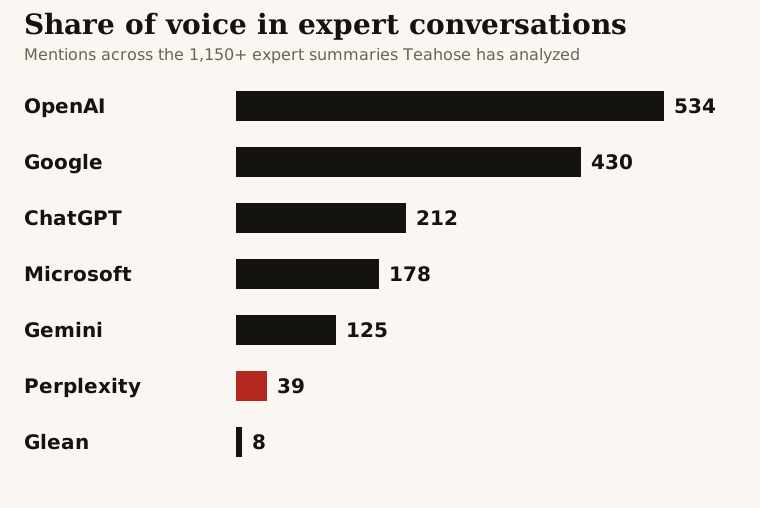
Each bar counts how many of Teahose's 1,150+ expert summaries mention it (word-boundary match across our podcast, newsletter, and paper corpus, June 2026).
Track the field: find the companies most similar to OpenAI and get their latest funding and product signals by email — Teahose Lookalikes.
Mention counts from Teahose's analysis of 1,150+ expert podcast, newsletter & research summaries, June 2026.
Perplexity made "AI search" a product category — and then the two biggest companies in AI made it a feature. Today "Perplexity alternatives" really means three different markets: consumer answer engines, the assistants absorbing search, and search infrastructure for developers.
Here's the map, layer by layer — then a live similarity ranking from the Teahose intel graph, the same vector engine behind our company lookalikes tool, which keeps Perplexity's competitive neighborhood current as new companies and rounds land.
The Giants Absorbing Search
- OpenAI (ChatGPT search) — the biggest single threat: search woven into the assistant hundreds of millions already use, plus a browser-shaped agenda of its own.
- Google (AI Mode + Gemini) — the incumbent's counterattack: AI answers fused into the search box with unmatched index, distribution, and ad economics.
- Microsoft (Copilot + Bing) — enterprise distribution play; strongest where Microsoft 365 already owns the workflow.
- xAI (Grok) — realtime-flavored answers with X's data exhaust and distribution.
The Independents
- Kagi — paid, private, power-user search; the anti-ad-model thesis executed well.
- You.com — pivoted from consumer search toward enterprise AI and agent infrastructure; a case study in how hard the consumer lane is.
- Brave Search — independent index plus privacy positioning, AI answers layered on top.
Search Infrastructure & Research Tools
- Exa — search built for AI agents rather than humans: an API serving LLMs structured, high-quality retrieval. (It also powers part of our own investor-scout pipeline.)
- Glean — enterprise internal search: the "Perplexity for your company's own knowledge" lane.
- Elicit / Consensus — academic and scientific literature answer engines, a defensible vertical Perplexity only grazes.
The Live Map: Perplexity's Nearest Neighbors
Companies Most Similar to Perplexity
Vector similarity against the Teahose company graph · same engine as the /similar lookalikes tool
- 01Citoai77% match
- 02EntireAI Applications76% match
- 03SearchableAI/Marketing75% match
- 04Superlinkednull75% match
- 05ExaAI75% match
- 06Scrunch AIAI74% match
- 07Luneai-scientific-research-platforms74% match
- 08QdrantAI74% match
- 09Preferai-native-marketing-intelligence74% match
- 10Breadcrombai-productivity-work-management73% match
- 11Webhoundai73% match
- 12SeltzAI Agent Search73% match
- 13AnySearchai-agents73% match
- 14DeepSeekAI73% match
- 15KimiAI73% match
How to Watch This Race
- Track the absorption frontier. Every ChatGPT or Gemini search upgrade redraws Perplexity's moat. The daily signal feed catches these moves the day the industry discusses them.
- Follow the money, not the takes. Perplexity's valuation history and the funding flowing to search-API startups tell you what sophisticated capital believes — see Perplexity's live company profile and hit Watch for email updates.
- Map any rival's neighborhood. Paste any company's website into the lookalikes tool for the same vector-ranked map on demand.
Related: Perplexity valuation, tracked · OpenAI competitors · top AI startups, live-ranked.
Bottom line: There's no single Perplexity killer — ChatGPT with search is the pick for most people, Google's AI Mode the zero-switching-cost default, Kagi the private power-user choice, and Exa the developer search API; the real question isn't which product to switch to but whether a focused answer engine survives the giants absorbing search into their assistants.
Frequently Asked Questions
What is the best alternative to Perplexity?
For most people, ChatGPT with search — it answers the same questions inside an assistant you may already pay for. Google's AI Mode is the zero-switching-cost option. For power users who want control and no ads, Kagi. For developers who want search as an API rather than a product, Exa. Perplexity's remaining edge is being purpose-built for cited, current-events research with fast model switching.
Is Perplexity better than ChatGPT for search?
For citation-first research on current topics, Perplexity still feels purpose-built: sources up front, tighter retrieval, less chat persona. For everything around the search — follow-up reasoning, document work, code — ChatGPT's breadth wins. The honest answer is that the products are converging fast, which is exactly why this market is worth watching from the funding-signal side.
How is the live list on this page generated?
We embed a description of Perplexity's business with the same vector pipeline that powers our company lookalikes tool, then rank companies in the Teahose intel graph by cosine similarity. It re-ranks continuously as new companies and signals enter the graph.
Can Perplexity survive Google and OpenAI both building AI search?
That is the existential question, and it's why Perplexity pushed into browsers (Comet) and agentic computing rather than staying a pure answer engine. The bear case: search is a feature of the assistant you already use. The bull case: a focused, citation-first product with its own distribution survives the way DuckDuckGo did — but at AI economics. Watch its funding and product signals below rather than anyone's prediction.
What is the best free alternative to Perplexity?
Google's AI Mode is the strongest free option — AI answers live in the search box you already use, with no signup and no switching cost. Brave Search layers AI answers on an independent index with a privacy stance, and ChatGPT's free tier includes web search. If you want unlimited, ad-free results you'll eventually hit a paywall: Kagi is paid by design, and Perplexity itself gates its best models behind Pro.
Which Perplexity alternative is best for developers building AI search?
Exa is built for this — it serves LLMs and agents structured, high-quality retrieval through an API rather than a consumer product (it also powers part of our own investor-scout pipeline). For internal-company knowledge, Glean is the enterprise lane; for academic and scientific literature, Elicit and Consensus are purpose-built. The choice comes down to whether you need open-web retrieval, your own corpus, or a research vertical.
How often do experts actually talk about Perplexity?
Across the 1,150+ expert podcast, newsletter, and research summaries Teahose has analyzed (as of June 2026), Perplexity comes up in 39 of them. That is meaningful traction for a company its size, but it trails the giants absorbing AI search — a share-of-voice gap that mirrors the competitive pressure described throughout this guide.