
Key takeaways
- TLDR is worth subscribing to for awareness, not understanding: a free, five-minute weekday digest of 10–15 tech links that tells you what happened but never why it matters.
- This review is grounded in scale, not vibes — Teahose machine-reads the newsletter category daily, and our archive now spans 1,150+ expert summaries (~1M+ words of analysis) across podcasts, newsletters, and papers.
- The vertical system (TLDR AI, Web Dev, InfoSec and more) is the real edge: subscribe only to the editions that match your role.
- Most guides tell you to pick one newsletter; what actually matters is pairing an awareness source like TLDR with a single depth source — and dropping a digest entirely if your real problem is synthesis across many sources.
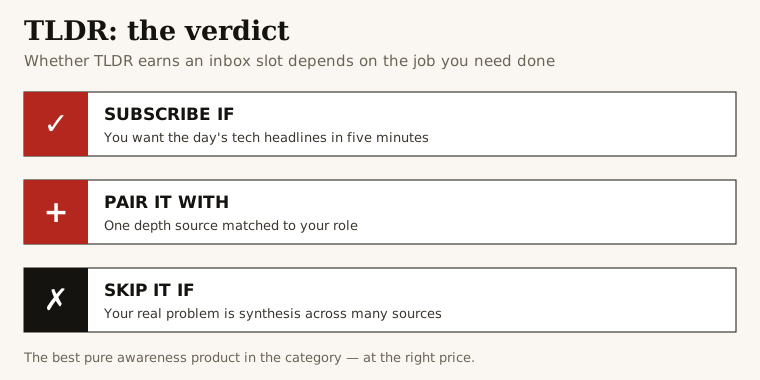
The verdict in one frame — subscribe for fast headlines, pair it with a depth source, and skip it if your real problem is synthesis.
If synthesis is your problem: the free Teahose daily digest reads across podcasts, newsletters, and papers and sends one distilled email a day.
Corpus figure from Teahose's analysis of 1,150+ expert podcast, newsletter & research summaries, June 2026.
TLDR is probably the most successful tech newsletter ever built: a daily, weekday email of 10–15 links with one-to-two-sentence summaries, read by millions of developers and tech professionals, spawning vertical editions across AI, web dev, information security, DevOps, crypto, and more. This review is the honest version of the question everyone asks before subscribing: is it actually worth an inbox slot in 2026?
Short answer: yes for awareness, no for understanding — and knowing which one you need is the whole decision.
(Who's reviewing: Teahose machine-reads tech and AI newsletters daily as part of our summarization pipeline, so this review is grounded in continuous reading of the category. We're ecosystem-adjacent, not a head-to-head competitor — calibrate accordingly.)
What TLDR Is
The format is the product: every weekday, each TLDR edition delivers a tight stack of links — headlines, research, tools, quick-fire items — each compressed to one or two sentences with a read-time estimate. No essays, no takes, no throat-clearing. The flagship edition covers general tech; the verticals apply the same template to their niches. Everything is free, funded by sponsored placements that sit inline with the content.
What It Does Brilliantly
- Speed-to-coverage ratio. Five minutes genuinely covers the day's tech headlines. Nothing else in the category is this efficient per minute.
- Consistency. Every weekday, same shape, no skipped days, no 3,000-word detours. The reliability is the moat.
- Curation quality. The link selection is consistently good — TLDR rarely misses a story that mattered and rarely pads with filler.
- The vertical system. Subscribing to exactly your verticals (just AI + InfoSec, say) is a better targeting mechanism than any single-editor newsletter can offer.
Where It Falls Short
- Summaries describe; they don't explain. "Company X released model Y, which beats benchmark Z" tells you something happened, not whether it matters. Context is entirely outsourced to your own background knowledge.
- No analysis, by design. TLDR has no voice or thesis. Readers who want judgment — should I care, is this real, what's the second-order effect — need a second source.
- Sponsor blending. Sponsored items are labeled but formatted nearly identically to editorial links; skimmers will click ads believing they're news.
- Headline overlap. If you already follow tech Twitter/X or Hacker News, expect 60%+ of items to be things you've seen. TLDR replaces feed-checking; it doesn't supplement it well.
Verdict: Who Should Subscribe
Subscribe if you want the day's tech or AI headlines handled in five minutes and you don't already live in feeds. It's the best pure awareness product in the category, and the price is right.
Pair it with one depth source matched to your role — that's the stack most serious readers converge on. Our best AI newsletters guide maps the depth options (AlphaSignal, Import AI, Stratechery and others).
Skip it if your actual problem is synthesis across too many sources — another digest won't fix that. That's the problem Teahose was built for: our pipeline summarizes 25+ podcasts, 15+ newsletters, and the day's AI papers, extracts every funding, product, and hiring signal into a live company graph, and sends one free daily email with the distillation. Different shape, different job: TLDR makes the firehose skimmable; Teahose turns it into structured signal.
Related: best AI newsletters · best VC newsletters · best Substack newsletters.
Bottom line: TLDR is worth a free inbox slot if you want the day's tech headlines in five minutes — but pair it with one depth source for understanding, and skip it entirely if your real problem is synthesis across many sources.
Frequently Asked Questions
Is the TLDR newsletter free?
Yes. TLDR and all of its vertical editions are free, monetized through sponsored placements inside each issue. There's no paywall or premium tier for the core newsletters.
How often does TLDR send, and how long does it take to read?
Each edition arrives every weekday. A single issue is genuinely a five-minute read: roughly 10–15 links, each with a one-to-two-sentence summary and a read-time estimate.
Is TLDR AI good enough to keep up with AI news?
For awareness, yes — TLDR AI reliably catches the day's significant model releases, product launches, and research headlines. For understanding, no — two-sentence summaries can't explain why something matters. Most technical readers pair it with a depth source like AlphaSignal or Import AI.
What are the best TLDR alternatives?
The Rundown AI and The Neuron compete directly in the daily-AI-brief category with more narrative voice. AlphaSignal serves engineers who want research and repo signal. Teahose takes a different shape entirely: instead of another inbox digest, it summarizes the podcasts, newsletters, and papers themselves and extracts company signals into a searchable graph.
Who is this review written by?
Teahose — a summarization service whose pipeline machine-reads tech and AI newsletters daily. We're adjacent to TLDR rather than a direct competitor (we summarize the ecosystem TLDR is part of), but factor that in as you read.
Is TLDR worth it if I already read Hacker News and tech Twitter?
Probably not as your main source. If you already live in feeds, expect well over half of TLDR's items to be things you have already seen — it replaces feed-checking rather than supplementing it. The better fit in that case is a synthesis source that distills across podcasts, newsletters, and papers instead of mirroring the same headline stream.
What is the difference between TLDR and Teahose?
TLDR is a curated daily list of tech links with one-to-two-sentence summaries — it makes the firehose skimmable. Teahose summarizes the underlying podcasts, newsletters, and papers themselves and extracts every funding, product, and hiring signal into a searchable company graph drawn from 1,150-plus expert summaries. TLDR makes the news fast to scan; Teahose turns it into structured signal.
How many editions of the TLDR newsletter are there?
TLDR runs a flagship general-tech edition plus a growing set of verticals — including TLDR AI, Web Dev, Information Security, DevOps, and Crypto — each applying the same weekday, link-plus-summary template to its niche. Subscribing only to the editions that match your role is the most effective way to use it.