
Substack turned the newsletter into a career, and the result is a two-tier ecosystem: a handful of independent writers producing the best analysis in tech — and a long tail of recycled takes with paywalls. Since Teahose machine-reads and summarizes newsletters across this ecosystem daily, we have a decent empirical view of which writers consistently produce original information versus commentary on commentary. That read draws on 1,150+ expert summaries — roughly 1M+ words of analysis across newsletters, podcasts and research papers — so the picks below are weighted toward the writers whose work shows up again and again as genuinely original signal.
Methodology: assessments below reflect Teahose's analysis of 1,150+ expert podcast, newsletter and research summaries (~1M+ words), June 2026.
This guide covers the AI / tech / investing corner of Substack (and Substack-style independents), organized by what each writer is the source for.
Key takeaways
- AI research & policy: Import AI (free) is the single highest-authority AI Substack.
- Using AI practically: One Useful Thing.
- Engineering: The Pragmatic Engineer — the most-justified paid sub in tech.
- AI infrastructure & semis: SemiAnalysis.
- Product & growth: Lenny's Newsletter.
- Venture: Newcomer — covered fully in our VC newsletters guide.
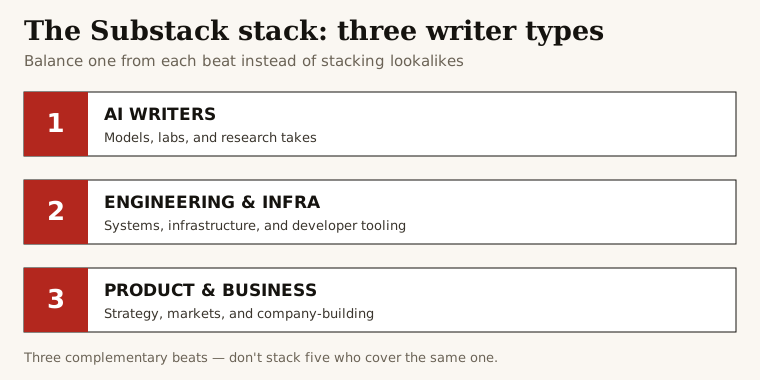
Three writer beats to balance when you build a Substack stack — AI, engineering and infrastructure, and product and business.
Stay ahead: the free Teahose daily digest reads across the AI and tech ecosystem so you get one distilled email instead of a dozen overlapping ones.
At a glance
| Category | Top pick | Free or paid |
|---|---|---|
| AI research & policy | Import AI | Free |
| Using AI practically | One Useful Thing | Free |
| Engineering | The Pragmatic Engineer | Paid |
| AI infrastructure & semis | SemiAnalysis | Paid |
| Product & growth | Lenny's Newsletter | Paid |
| Venture | Newcomer | Paid |
The AI Writers
Import AI — Jack Clark co-founded Anthropic and writes the weekly that researchers and policymakers actually read: paper summaries wrapped in serious analysis of where capability is heading. Free, and probably the highest insight-per-issue ratio on this list. We summarize it in our Import AI archive.
One Useful Thing — Ethan Mollick (Wharton) runs the experiments everyone else theorizes about: what current AI models can actually do for real work, documented with rigor and humility. The best newsletter to forward to non-technical colleagues.
Last Week in AI — The comprehensive free weekly roundup; the right answer if you want one email that catches everything that mattered.
Latent Space — For AI engineers: technical essays and interviews about building with LLMs in production. Niche and proud of it.
The Engineering & Infrastructure Writers
The Pragmatic Engineer — Gergely Orosz built the largest paid tech Substack by reporting what actually happens inside engineering orgs — compensation, layoffs, how Big Tech ships. If you work in software, this is the paid subscription that pays for itself.
SemiAnalysis — Dylan Patel's deeply technical analysis of semiconductors, datacenters, and AI economics. It moved from niche to essential when GPUs became the world's scarcest resource; frequently cited by the labs themselves. Paid tiers are aimed at professionals and priced accordingly.
The Product & Business Writers
Lenny's Newsletter — Lenny Rachitsky's product/growth newsletter is the default professional-development subscription for PMs, with a podcast (which we summarize) whose guest list doubles as a who's-who of product leadership.
Newcomer — The strongest independent venture journalism on the platform; scoops and fund analysis the institutional digests can't match. Our archive.
The Generalist — Long-form profiles of companies and investors; closer to a quarterly strategy journal delivered weekly. Our archive.
How to Build a Substack Stack Without Going Broke
- Start free. Import AI, One Useful Thing, and the free tiers of everything above cover 80% of the value.
- Pay for your profession. One paid sub matched to your role (Pragmatic Engineer / Lenny's / SemiAnalysis / Newcomer) beats three generalist ones.
- Search the archive before paying. A newsletter whose back catalog you'd actually search is worth money; one you'd only skim on arrival isn't.
- Let a machine read the rest. The honest problem with this whole ecosystem is volume — which is the problem Teahose solves. Our pipeline summarizes the newsletters, 25+ podcasts, and daily AI papers, extracts the signals, and sends one free daily digest. Keep the two writers you love; outsource the firehose.
Related: the best AI newsletters · the best VC newsletters · our TLDR review.
Bottom line: Start with the free standouts — Import AI and One Useful Thing — then add one paid subscription matched to your profession (Pragmatic Engineer, SemiAnalysis, Lenny's, or Newcomer); the writers worth paying for sell original analysis, never aggregation.
Frequently Asked Questions
Which Substack newsletters are worth paying for?
The ones selling expertise you can't get from news coverage: The Pragmatic Engineer for software engineering careers and org reality, SemiAnalysis for semiconductor and AI-infrastructure analysis, Lenny's Newsletter for product and growth, and Newcomer for venture scoops. The common thread is original analysis or reporting, not aggregation — never pay for aggregation.
What are the best free Substacks for AI?
Import AI (Jack Clark's research-and-policy weekly) and One Useful Thing (Ethan Mollick's practical AI experiments) are the standouts — both free, both written by people with first-hand authority. Last Week in AI is the best free comprehensive roundup.
Substack newsletters vs. big media newsletters — what's the actual difference?
Accountability direction. A Substack writer answers only to subscribers, which selects for strong viewpoints, narrow expertise, and long-form depth; institutional newsletters answer to editors and advertisers, which selects for breadth and consistency. A good stack uses institutional dailies for coverage and two or three independent writers for judgment.
How many paid Substacks should I subscribe to?
Two or three, re-audited quarterly. Paid newsletter spend creeps: $15/month each across five subscriptions is $900/year, which should buy you something you act on. Keep the ones whose archive you actually search; that's the tell of real value.
What are the best AI Substack newsletters in 2026?
For 2026, the highest-authority free pick is Import AI, written by Anthropic co-founder Jack Clark — weekly paper summaries plus serious capability and policy analysis. Pair it with Ethan Mollick's One Useful Thing for practical, tested AI use cases and Last Week in AI for a comprehensive roundup. These three rank highest in originality across the 1,150+ expert summaries Teahose analyzes, where the writers who break new ground rather than aggregate are the ones that keep surfacing.
Are paid Substack newsletters worth it for software engineers?
Yes, for most working engineers one paid subscription pays for itself: The Pragmatic Engineer by Gergely Orosz reports what actually happens inside engineering orgs — compensation, layoffs, and how Big Tech ships. If your role touches AI infrastructure or chips, SemiAnalysis is the other one worth the professional tier. Skip generalist tech digests you would only skim; pay for the narrow, reported, role-specific writers instead.
How can I keep up with too many newsletters without reading them all?
Keep the two or three writers whose judgment you trust and outsource the rest to a summarizer. Teahose machine-reads newsletters, 25+ podcasts and daily AI research papers — over 1,150 expert summaries and counting — extracts the signals, and sends one free daily digest. The point is not to read everything; it is to never miss the few things that mattered while reading far less.