
Key takeaways
- SpaceX is the largest space company in 2026 by orders of magnitude, but the most interesting growth is in newer layers: on-orbit servicing, mega-class satellite buses, and space-based missile defense.
- SpaceX dominates the conversation too — it surfaces in 247 of the 1,150+ expert podcast, newsletter, and research summaries we've analyzed, more than any other space name in our corpus.
- The defensible inputs are confirmed valuation, demonstrated flight capability, and contracted backlog — slipped launch dates and secondary-market marks are deliberately discounted.
- Most "top space companies" lists rank on hype or last-known valuation; what actually matters is flights flown per year and government-contract concentration, which is why this page pairs an editorial top 12 with a live, signal-ranked table.
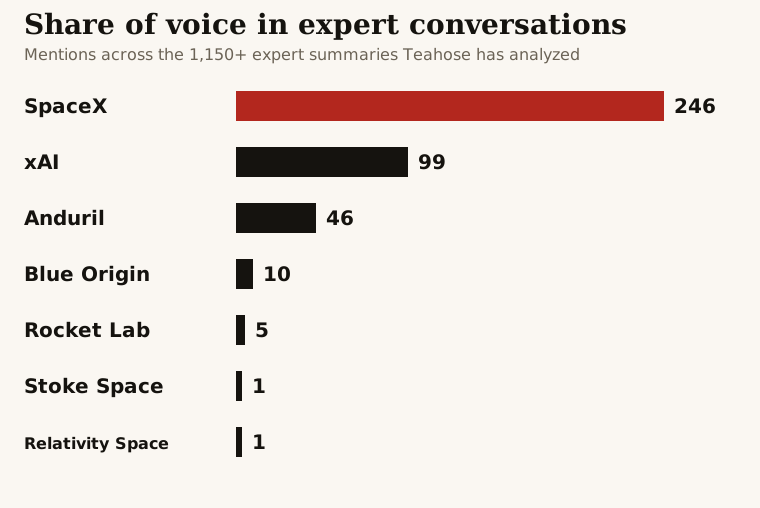
Each bar counts how many of Teahose's 1,150+ expert summaries mention it (word-boundary match across our podcast, newsletter, and paper corpus, June 2026).
Track the field: find the companies most similar to SpaceX and get their latest funding and product signals by email — Teahose Lookalikes.
Mention counts from Teahose's analysis of 1,150+ expert podcast, newsletter & research summaries, June 2026.
At a glance
| Company | Valuation (as of June 2026) | Status |
|---|---|---|
| SpaceX | ~$1.75 trillion (June 2026 IPO) | Public |
| Anduril | $61 billion (May 2026) | Private |
| Rocket Lab | ~$45–70 billion market cap | Public |
| Blue Origin | No confirmed valuation | Private |
| K2 Space | $3 billion (Dec 2025 Series C) | Private |
June 2026 is the strangest possible week to rank space companies — and the best. SpaceX just priced the largest IPO in history, Blue Origin's only New Glenn launch pad is a repair site, and the most interesting funding rounds are happening in segments that barely existed three years ago: on-orbit servicing, mega-class satellite buses, and space-based missile defense. Static "top space companies" lists rot fast in a market like this.
This page handles that the same way our robotics startups guide does: an editorial top 12 with confirmed valuations as of June 2026, then a list pulled live from the Teahose intel graph, which extracts funding, product, M&A, and hiring signals daily from industry podcasts, newsletters, and research papers. Our space infrastructure & on-orbit services theme currently tracks 33 companies live — with Blue Origin and SpaceX topping the signal rankings.
How We Ranked
Three inputs, in order:
- Confirmed valuation or market cap. Latest priced round, IPO, or public market cap as of June 2026 — rumored marks are labeled as rumored, never blended in.
- Demonstrated capability. Orbital flights flown, satellites operating, dockings completed. A qualified engine outranks a rendered one.
- Contracted backlog. Signed launch agreements and government awards — the space economy runs on multi-year contracts, and backlog is the honest demand signal.
What we deliberately discount: launch dates that have slipped twice, valuations from secondary-market trackers, and any number that only exists in a pitch deck.
The Top 12 Space Companies in 2026
1. SpaceX — Launch, satellite internet, and now AI. The defining corporate event of 2026: xAI was folded into SpaceX in February via an all-stock merger valuing the combined company at $1.25 trillion (SpaceX at $1 trillion, xAI at $250 billion), with orbital data centers as the stated rationale. In June 2026 SpaceX priced a record $75 billion IPO at $135 per share — roughly a $1.75 trillion valuation. Confirmed: merger terms and IPO pricing. Still unproven: whether the AI-plus-rockets thesis compounds or just concatenates. Full analysis in our SpaceX valuation and xAI valuation guides.
2. Anduril — Defense tech with a fast-growing space arm. Raised $5 billion in May 2026 at a $61 billion valuation, double its prior mark, on 2025 revenue of $2.2 billion (up 100% year over year). The space story: Anduril leads a Golden Dome space-based interceptor consortium (with Impulse Space, Inversion Space, K2 Space, Sandia, and Voyager) under the Space Force's April 2026 prototype awards — up to $3.2 billion across 12 companies. More in our defense tech startups guide.
3. Rocket Lab — The proven pure-play challenger. Q1 2026 revenue of $200.3 million (up 64%), backlog above $2.2 billion, and a market cap that early-June 2026 trackers put anywhere from roughly $45 billion to $70 billion depending on the week — the stock has been volatile around the SpaceX IPO. Neutron, its reusable medium-lift rocket, targets a first flight in Q4 2026 with five launch contracts already signed; the schedule has slipped before, so treat the date as a target, not a fact.
4. Blue Origin — The wounded giant. New Glenn reached orbit, but a May 28, 2026 static-fire explosion destroyed a vehicle and severely damaged Launch Complex 36 — its only operational New Glenn pad — with repairs estimated at over a year. It remains eligible for national security launch bidding (about $2.4 billion across seven projected missions awarded in 2025) and is funded by Jeff Bezos rather than priced by a market: no confirmed valuation exists. Rank reflects capability and capital, heavily discounted for the pad outage.
5. K2 Space — Mega-class satellite buses for the proliferated era. Raised a $250 million Series C at a $3 billion valuation in December 2025, led by Redpoint, and sits inside Anduril's Golden Dome consortium. The bet: satellite demand is shifting from bespoke billion-dollar birds to high-power buses built like products.
6. Firefly Aerospace — Launch plus lunar. Went public in August 2025 at roughly a $6.3 billion valuation after raising nearly $900 million, riding both the Alpha launch business and its lunar lander program. The first new-generation launch startup to convert into a public currency — which now matters for consolidation.
7. Stoke Space — The full-reusability purist. Extended its Series D to $860 million in February 2026, bringing total capital raised to about $990 million at a valuation reported near $2 billion. Nova, designed to be fully reusable on both stages, targets a first orbital flight in 2026 — unflown as of June, so this rank is a bet on engineering, not revenue.
8. Relativity Space — Reset and refocused. Eric Schmidt took a controlling stake and the CEO seat in March 2025; Terran R targets a first launch in late 2026 against a $2.9 billion contracted backlog, and the company is openly exploring orbital data centers — the same thesis that drove the SpaceX-xAI merger. No post-Schmidt valuation has been publicly confirmed.
9. Planet Labs — The Earth-observation incumbent. Public (NYSE: PL) with a market cap of roughly $11.5 billion as of early June 2026 (trackers vary between about $11.5 and $15 billion). The largest fleet of imaging satellites in orbit and a steady government revenue base — the unglamorous, cash-generating layer of the space economy.
10. Astranis — Small GEO communications satellites. Total funding of roughly $1.29 billion; its most recent confirmed valuation is $1.6 billion from a July 2024 round led by Andreessen Horowitz and BAM Elevate — no newer priced round has been confirmed as of June 2026. The contrarian play: dedicated small satellites in GEO while everyone else floods LEO.
11. Impulse Space — In-space mobility. Founded by SpaceX propulsion veteran Tom Mueller, building orbital transfer vehicles — its Mira vehicle hosted the target side of the first fully autonomous commercial rendezvous in LEO (December 2025, with Starfish Space) and the company sits in the Golden Dome interceptor consortium. We have not found a publicly confirmed current valuation, so its rank rests on demonstrated flight capability and consortium position.
12. Starfish Space — On-orbit servicing's first mover. Completed that autonomous rendezvous demonstration with Impulse in December 2025, holds a $54.5 million Space Force contract for a dedicated Otter servicing vehicle, and raised over $100 million in an April 2026 Series B led by Point72 Ventures. Its Otter Pup 2 spacecraft is now maneuvering toward a docking attempt with Gilmour Space's ElaraSat. Smallest company on this list; fastest-moving segment.
Worth watching just off the list: Vast (private space stations), Varda (in-space manufacturing and reentry), True Anomaly (space security), LeoLabs (space domain awareness), and Isar Aerospace (European launch) — all live in the tracked theme below.
Space Infrastructure & On-Orbit Services Companies by Signal Volume
Live membership of the space-infrastructure & on-orbit services theme · ranked by extracted signals
- 01Googlelast seen OCT 21630 signals
- 02SpaceXlast seen OCT 21548 signals
- 03Amazonlast seen OCT 21347 signals
- 04Figurelast seen OCT 1556 signals
- 05Rocket Lablast seen OCT 1946 signals
- 06Impulse Spacelast seen SEP 2246 signals
- 07Starcloudlast seen SEP 535 signals
- 08Blue Originlast seen OCT 2020 signals
- 09Starlinklast seen OCT 2118 signals
- 10Boom Supersoniclast seen SEP 2217 signals
- 11Northwood Spacelast seen AUG 3110 signals
- 12Iceyelast seen OCT 159 signals
- 13True Anomalylast seen SEP 279 signals
- 14Airbuslast seen SEP 178 signals
- 15Virgin Orbitlast seen AUG 286 signals
- 16Fortastralast seen OCT 155 signals
- 17Varda Space Industrieslast seen OCT 65 signals
- 18Stoke Spacelast seen SEP 185 signals
- 19Kapta Spacelast seen OCT 144 signals
- 20Linse Capitallast seen OCT 64 signals
How to Evaluate a Space Company
Space adds physics and procurement to the normal startup checklist. Three filters do most of the work:
- Launch cadence over launch promises. The real metric is flights flown per year, trending up. Every rocket on this page has slipped a debut at least once — Neutron, Nova, and Terran R all carry "2026" targets that should be read as engineering hopes. A company flying a smaller vehicle repeatedly (Rocket Lab's Electron, Firefly's Alpha) tells you more about its operations than a bigger vehicle on a render.
- Government contract concentration. Defense and civil space money is the revenue floor for most of this list — Golden Dome alone put up to $3.2 billion in prototype awards into the ecosystem in April 2026. That floor is also a ceiling risk: a company whose backlog is one agency's budget line inherits that agency's politics. Check whether commercial revenue is growing alongside the government base.
- Capex intensity and the path to reuse. Rockets, pads, and factories burn capital before they earn it — Blue Origin's pad explosion shows how a single facility can idle a program for a year. Reusability is the lever that turns capex into margin, which is why Stoke's full-reuse design and Neutron's first stage matter more than their payload numbers. Ask what fraction of each flight's hardware comes back.
The signal stream is how you keep score between funding announcements: pilots, dockings, contract awards, and hiring patterns show up in the feed months before they show up in a valuation. For the corporate-structure deep dives, see our SpaceX valuation and xAI valuation guides; for the defense overlap, the defense tech startups guide covers the Anduril-led consortium in depth.
Keep This List Coming to You
Every company above links to a profile with its full signal history, and the Watch button on any profile — or on the space infrastructure & on-orbit services theme — emails you when something new lands. The free daily digest delivers the day's signals, space included, in one email.
Bottom line: SpaceX is the biggest space company in 2026 by orders of magnitude after its record IPO, but the fastest-growing names sit in the newer layers — on-orbit servicing, mega-class satellite buses, and space-based missile defense — which is why this page pairs an editorial top 12 with a live, signal-ranked table.
Frequently Asked Questions
What is the biggest space company in 2026?
SpaceX, by a wide margin — and the gap widened in 2026. After absorbing xAI in February 2026 at a combined $1.25 trillion valuation, SpaceX priced a record-breaking $75 billion IPO in June 2026 at $135 per share, implying a valuation around $1.75 trillion. No other space company is within two orders of magnitude: Rocket Lab, the largest pure-play challenger, trades in the tens of billions.
Is SpaceX publicly traded now?
Yes — SpaceX priced its IPO in June 2026, raising about $75 billion, the largest IPO on record. The listed entity includes xAI (folded in via an all-stock merger in February 2026) and Starlink, so buying the stock is a bet on launch, satellite internet, and frontier AI simultaneously. See our SpaceX valuation guide for the full breakdown.
How is this list of space companies ranked?
The editorial top 12 is ranked by a blend of confirmed valuation or market cap (as of June 2026), demonstrated flight capability, and contracted backlog — with hype explicitly discounted. The live table below it is ranked separately by signal volume from the Teahose intel graph: funding, product, M&A, and hiring events extracted daily from podcasts, newsletters, and research papers.
What is on-orbit servicing and why does it matter?
On-orbit servicing means doing useful work on satellites after launch — docking, inspection, life extension, relocation, and deorbiting. It matters because the satellite population is exploding while debris rules tighten: Starfish Space completed the first fully autonomous commercial rendezvous in LEO with Impulse Space in December 2025 and holds a $54.5 million Space Force contract for a dedicated servicing vehicle. It is the youngest layer of the space economy and the one growing fastest in our signal feed.
Which space companies are still private, and can I invest in them?
Blue Origin, Stoke Space, Relativity Space, K2 Space, Astranis, Impulse Space, and Starfish Space remain private as of June 2026 — accessible mainly through secondaries or venture funds. The public on-ramps are SpaceX (IPO June 2026), Rocket Lab, Firefly Aerospace (IPO August 2025), and Planet Labs. The 2025–26 IPO window suggests more private names will follow.
How can I track these space companies over time?
Every company in the live table links to a profile with its full signal history — hit Watch on any profile or on the space infrastructure theme page to get an email digest when new signals land. The list updates continuously as the intel graph extracts new events.
Which space startups are growing fastest in 2026?
By signal momentum, the on-orbit servicing and in-space mobility layer is moving fastest — Starfish Space (autonomous rendezvous plus a $54.5 million Space Force servicing contract) and Impulse Space (orbital transfer vehicles inside the Golden Dome consortium) are the names showing up most often in our feed, alongside mega-class satellite maker K2 Space after its $250 million Series C at a $3 billion valuation. The live table below ranks all of them by extracted funding, product, M&A, and hiring signals so the order reflects current activity, not last year's headlines.
Who are the biggest competitors to SpaceX in 2026?
No single company rivals SpaceX's scale, but the credible challengers split by layer. In launch: Rocket Lab (the proven pure-play, with Neutron targeting a Q4 2026 debut), Blue Origin (capable but set back by its May 2026 pad explosion), and the full-reusability bets Stoke Space and Relativity Space. In satellites and defense space: Anduril, K2 Space, and Planet Labs. SpaceX appears in 247 of the 1,150+ expert summaries we track — far more than any of these, which is itself a useful read on relative mindshare.
Can retail investors buy space stocks in 2026?
Yes — the public on-ramps as of June 2026 are SpaceX (which priced its IPO in June 2026), Rocket Lab, Firefly Aerospace (public since August 2025), and Planet Labs (NYSE: PL). The rest of the editorial top 12 — Blue Origin, Stoke Space, Relativity Space, K2 Space, Astranis, Impulse Space, and Starfish Space — remain private and are reachable mainly through secondaries or venture funds. The 2025 to 2026 IPO window suggests more private names will list before long.