
Key takeaways
- An AI newsletter is a recurring email that compresses the daily flood of AI news — model releases, funding, launches, research — into a few readable minutes.
- The bigger problem is duplication: subscribe to four daily AI newsletters and you read the same story four times. Teahose was built to fix this by machine-reading the whole field — 1,150+ expert summaries (~1M+ words of analysis) across podcasts, newsletters, and research papers — and deduplicating every event into one signal.
- The practical stack is two or three with different jobs: one fast daily brief, one analytical weekly, and optionally one niche or synthesis source. Beyond that, returns drop fast.
- Most guides rank newsletters against each other; what actually matters is coverage across them — no single newsletter reads any source but itself.
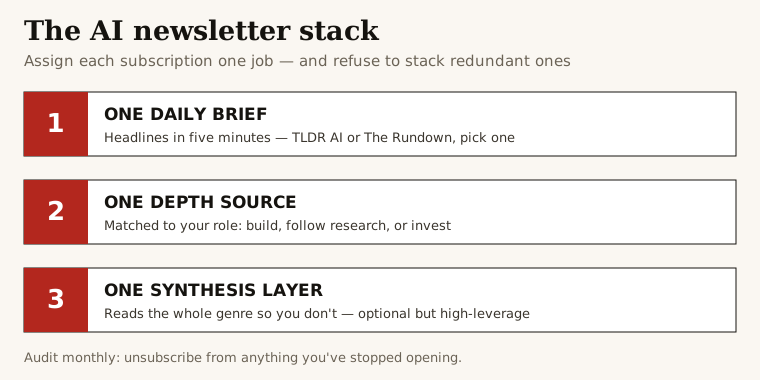
The stack most readers converge on — one daily brief, one depth source, and an optional synthesis layer — so subscriptions stop overlapping.
Try the synthesis layer: the free Teahose daily digest is one email that reads across the genre — funding, launches, deals, and research — so you don't have to.
Mention counts and corpus figures from Teahose's analysis of 1,150+ expert podcast, newsletter & research summaries, June 2026.
An AI newsletter is a recurring email that compresses the firehose of AI news into a few readable minutes. That's the whole pitch, and in 2026 it's a surprisingly hard one to deliver — because the firehose got faster than the newsletters did.
There are now hundreds of AI newsletters. Most of them open your inbox every morning to tell you roughly the same five things. Understanding why that happened is the key to picking one well — and to noticing what the entire genre is now quietly competing against.
What an AI Newsletter Actually Does
A good one does three jobs:
- Filters. Out of a few hundred daily AI stories, it picks the handful that matter.
- Compresses. It turns each into two or three sentences you can read between meetings.
- Contextualizes. The best ones tell you why a release or raise matters, not just that it happened.
The first two are now nearly commoditized — any competent editor (or model) can filter and compress. The third is where newsletters actually differ, and where most of them quietly fail: they relay the news without telling you what it means.
Why the Genre Exploded
The AI news cycle crossed a threshold around 2023–2024. Model releases that once came yearly started coming weekly; funding rounds that were quarterly news became daily. At the same time, starting a newsletter became free. So curation became a land grab at the exact moment the thing being curated became unmanageable.
The side effect: enormous overlap. Subscribe to four daily AI newsletters and you'll read the same OpenAI headline four times with four different intros. The genre solved "I can't find the news" and accidentally created "I'm reading the same news repeatedly."
How to Choose Without Drowning
The fix is to assign each subscription a distinct job and refuse to stack redundant ones:
- One daily brief — TLDR AI or The Rundown. Pick one. Not both.
- One depth source matched to your role — AlphaSignal if you build, Import AI if you follow research and policy, a strategy publication if you invest or run product.
- One niche source, optional — robotics, your vertical, or a synthesis layer (more on that below).
- Audit after a month — unsubscribe from anything you've stopped opening. Newsletter guilt is real and pointless.
For the honest, role-by-role ranking of specific publications, see our companion guide: the best AI newsletters in 2026 (reviewed by a service that reads them all), plus the best VC newsletters and AI investment newsletters for the money side, and the best AI podcasts if you'd rather listen.
The Firehose Problem — and What Sits Above the Genre
Here's the thing every "best newsletters" list dances around: even a perfect newsletter only reads one source — itself. It can't tell you that the same funding round showed up in three newsletters and two podcasts this week, or quietly connect a launch to the company that raised for it last month. Newsletters are inputs. They don't synthesize across each other.
That's the gap Teahose fills. We machine-read 40+ podcasts, 20+ newsletters (including most of the ones reviewed in our guides), and the day's AI research papers — every day — and extract every funding, product, M&A, and hiring signal into a live company graph. Instead of four overlapping digests, you get the cross-source synthesis: one signal per real event, deduplicated across everything we read.
Below is the live view — what the AI newsletters, podcasts, and papers are collectively talking about right now, ranked by how much signal each company is generating across all of them this week:
What the AI Newsletters Are Covering This Week
Companies ranked by signal volume extracted across 40+ podcasts, 20+ newsletters & the day's papers — last 7 days
- 01OpenAI13 signals · 7d
- 02Reducto7 signals · 7d
- 03Tesla7 signals · 7d
- 04SpaceX7 signals · 7d
- 05科沃斯6 signals · 7d
- 06Stratechery6 signals · 7d
- 07Anthropic6 signals · 7d
- 08General Catalyst5 signals · 7d
- 09Google5 signals · 7d
- 10Micro14 signals · 7d
- 11Stripe4 signals · 7d
- 12Nvidia4 signals · 7d
The Stack Most Readers End Up With
- One daily brief for headlines — TLDR AI or The Rundown.
- One depth source matched to your work.
- One synthesis layer — the free Teahose daily digest — if your real problem is "too many newsletters saying the same thing." It's one email that reads the whole genre (plus the podcasts and papers) so you don't have to.
An AI newsletter is the right tool when you want one voice's take. A synthesis layer is the right tool when you want to stop missing things across all of them. Most serious readers eventually want both.
Try the synthesis layer free. The Teahose daily digest is one email a day, distilled from everything we read across the AI ecosystem — funding, launches, deals, research. Subscribe here, unsubscribe anytime, no overlap with your existing newsletters by design.
Recommendations are editorial; the live coverage view above updates continuously. As of June 14, 2026.
Bottom line: An AI newsletter is just a recurring email that compresses the firehose of AI news into a few readable minutes — pick one fast daily brief and one depth source matched to your role, and add a synthesis layer when your real problem is the same story landing in four inboxes.
Frequently Asked Questions
What is an AI newsletter?
An AI newsletter is a recurring email — usually daily or weekly — that summarizes the most important developments in artificial intelligence: new model releases, funding rounds, product launches, research papers, and industry moves. The value proposition is compression: the AI news cycle now produces more headlines in a day than any person can read, so a good newsletter does the reading and hands you the 5% that matters in five minutes.
What is the best AI newsletter?
It depends on your job. For a fast daily headline brief, TLDR AI and The Rundown are the reliable defaults. For technical depth, AlphaSignal and Import AI carry more research signal. For investors, a deal-focused source beats a general one. We rank the whole field, honestly, in our companion guide to the best AI newsletters. The meta-answer most readers land on: one daily brief plus one deeper weekly, not five overlapping digests.
How many AI newsletters should I subscribe to?
Two or three with deliberately different jobs: one fast daily for headlines, one analytical weekly for depth, and optionally one specialized to your niche (research, investing, robotics). Beyond that you hit diminishing returns fast — the big daily AI newsletters overlap enormously, so a fourth subscription mostly buys you the same stories with a different intro.
Are AI newsletters free?
Most of the popular ones are free and ad-supported (TLDR, The Rundown, The Neuron). Some research- or analysis-grade publications charge a subscription (Stratechery is the classic example). Free is the right default for staying current; pay only when a specific newsletter consistently changes a decision you make.
Why are there suddenly so many AI newsletters?
Two forces collided. The AI news cycle accelerated past the point any individual can follow, creating real demand for curation. And email newsletters became trivially easy to start and monetize. The result is hundreds of AI newsletters — most of them summarizing the same handful of stories. Curation became a crowded category at exactly the moment the underlying firehose got too big to read, which is why a newer model has emerged above the genre.
What is the difference between an AI newsletter and an AI news aggregator?
An AI newsletter is a single editorial voice that reads a slice of the news and emails you its picks — you get one perspective, but only what that one source happened to see. An aggregator or synthesis layer reads across many sources at once and deduplicates. Teahose, for example, machine-reads 1,150+ expert podcast, newsletter, and research summaries and collapses the same event into a single signal, so you stop reading the same OpenAI headline in four different inboxes. The newsletter is best when you want one curator's take; the synthesis layer is best when you want to stop missing things across all of them.
How do I keep up with AI news without subscribing to a dozen newsletters?
Assign each subscription a distinct job and cap the count: one fast daily brief, one analytical weekly matched to your role, and at most one niche or synthesis source. Then audit monthly and unsubscribe from anything you no longer open. If your real problem is overlap rather than coverage, a synthesis layer that reads the whole genre for you — across podcasts, newsletters, and papers — replaces most of the stack with a single daily email.
Which AI newsletter is best for a venture capitalist or investor?
A deal-focused source beats a general headline brief for investors, because you care about funding rounds, valuations, and who is backing whom rather than consumer product launches. Pair one investor-oriented newsletter with a cross-source view of funding and M&A signals so you catch the same round wherever it surfaces. See our companion guides to the best VC newsletters and AI investment newsletters for the money-side ranking.