
Key takeaways
- The best AI investment newsletters trade raw feeds for thesis-annotated signals — fundraises, hires, open-source milestones, and partnerships you can act on in minutes, not hours.
- Teahose distills 1,150+ expert summaries (roughly 1M+ words of analysis across podcasts, newsletters, and research) into 30-second reads with funding, M&A, hire, and launch signals on top.
- Run a 14-day trial of two complementary newsletters and judge them on three things: share of mentions with primary-source links, leads added to pipeline, and conversion to first contact within 30 days.
- Most guides rank newsletters by audience size; what actually matters is signal density and source transparency — a small digest with original scoops beats a large one recycling press releases.
Corpus figures from Teahose's analysis of 1,150+ expert podcast, newsletter, and research summaries, June 2026.
AI investment newsletters are curated email products that surface deal signals, original research, hiring and open-source signals, and market syntheses that investors and operators use to find opportunities faster. For venture capitalists, angel investors, founders, product leads, and AI researchers, the promise is simple: replace raw feeds and scattershot alerts with a tight stream of high-signal items you can act on in minutes. This guide explains what to expect from AI investment newsletters, how to evaluate signal quality, which formats work for different roles, and how to plug them into a sourcing workflow that produces pipeline, not inbox noise.
Key takeaways
- AI investment has more than doubled since 2017, increasing the volume of companies and signals investors must screen (see the Stanford HAI AI Index) — subscribe to focused AI investment newsletters to surface early leads.
- Run a 14-day trial with 2 complementary newsletters and track 3–5 unique company mentions per week as a minimum signal threshold; tag and route actionable items to your CRM or Slack.
- Measure value with three KPIs: percentage of mentions with primary-source links, leads added to pipeline, and conversion to first contact within 30 days; aim to convert at least one newsletter-sourced lead in a 90-day window.
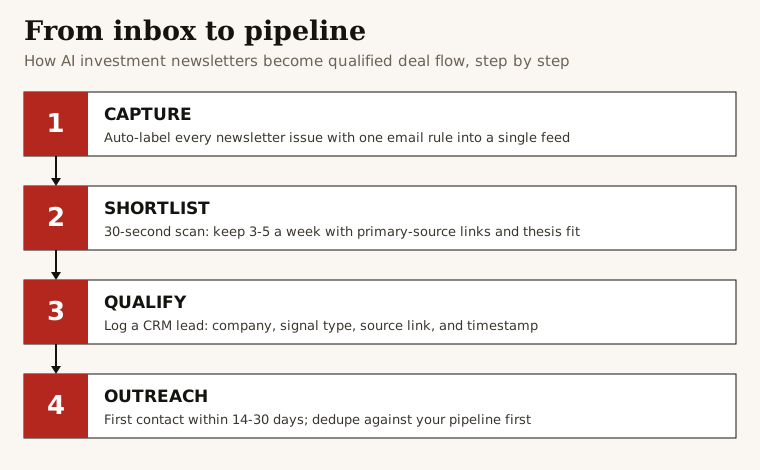
The four-step loop this guide details — capture, shortlist, qualify, outreach — for turning AI investment newsletter signals into qualified deal flow instead of inbox noise.
Stay ahead: Teahose runs the top of this loop for you — funding, M&A, hire, and launch signals distilled from 1,150+ expert summaries, delivered daily. Track the live signal feed.
What Are AI Investment Newsletters and Who Should Read Them?
Definition and Core Value Proposition
AI investment newsletters are curated or original-content email products that prioritize investment-relevant signals: fundraising announcements, hiring moves, open-source milestones, partnerships, patent filings, benchmark results, and research summaries. Unlike general tech newsletters that cover product launches and broad trends, these newsletters are tailored to sourcing and thesis development: they synthesize primary sources, annotate why an item matters for investment theses, and often include contactable leads. Formats vary from daily "dealflow" alerts to weekly long-form explainers.
Audience breakdown: VCs, angels, founders, operators, product leads, and AI researchers
- Venture capital partners: Use newsletters for early-stage deal discovery and top-of-funnel screening.
- Angel investors: Track sector-specific digests and founders' newsletters for syndication opportunities.
- Startup founders and operators: Monitor competitor moves, hiring shifts, and partnership flows that affect product strategy.
- Product and strategy leads at tech companies: Follow research explainers and tooling updates that influence roadmaps.
- AI researchers: Subscribe to long-form technical explainers and model-readout digests to keep abreast of evaluation practices.
Key points to scan quickly
- Cadence matters: Daily briefs catch speed; weekly digests offer context.
- Signal type: Look for original reporting vs. pure curation.
- Source transparency: Primary links and names increase verifiability.
For an overview of newsletter quality categories and financial newsletter benchmarking, see Wall Street Prep's roundup of the best financial newsletters, which provides framing for how editorial models vary by frequency and depth. Founders also often appear as sourced voices in newsletter issues — see the profile of Endra CEO Niklas Lindgren for the sort of primary-source perspective these issues draw on.
Why AI Investment Newsletters Matter for Dealflow, Strategy, and Research
Noise Reduction: Signal Aggregation vs. Raw Feeds
Investors face an explosion of AI-related noise: preprints, GitHub commits, company blog posts, regulatory filings, and job posts. Newsletters act as a second layer of filtering — human editors (or well-tuned algorithms) triage items and provide thesis-oriented annotations. That saves screening time and surfaces context: not just "X released a model" but "X released a 10B-parameter model that targets multimodal agent tasks; implications for tooling include door-openers for inference optimization."
Competitive Intelligence and Early Signals
Newsletters often surface the earliest public traces of important moves: first engineering hires, stealth fundraises, or small integrations that precede partnerships. Use these early signals for market-mapping and competitive preparedness. Institutional investors increasingly use AI to support research workflows; for evidence on AI's growing role in investment research and decision-making, see Axios's reporting on how institutional investors are using AI in investment research. For an example of how a company gets surfaced and tracked across AI coverage, see Ever's company profile. For broader context on interpreting macro AI trends, a complementary listen is Lenny Rachitsky's conversation with Benedict Evans on where AI is actually going.
Recommended data points to measure newsletter value
- Unique deal mentions per trial period
- Number of mentions with primary-source links
- Original scoops or interview-driven items
- Cadence and archive searchability
- Subscriber profile (investor-heavy vs generalist audience)
These metrics let you judge whether a newsletter is amplifying primary signals or just repackaging press releases.
Categories of AI Investment Newsletters — Reviews and What Each Delivers
Dealflow Digests and Curated Deal Lists
- Typical cadence: Daily to weekly.
- Ideal reader profile: Early-stage VCs and angels who need high-velocity signals.
- Sample issue: 6–12 short items, each with a one-line hook, source link, and suggested next step (intro, wait, watchlist).
- Strengths: Speed and signal density.
- Weaknesses: Can be noisy; may lack deep verification.
Research & Model Explainers
- Typical cadence: Weekly to monthly.
- Ideal reader profile: Product leads and AI researchers who need rigorous model analysis and evaluation notes.
- Sample issue: A deep dive into a recent model, evaluation caveats, and links to primary research.
- Strengths: Depth and reproducible references.
- Weaknesses: Slower cadence, sometimes paywalled.
Sector- or Vertical-Focused Newsletters
- Typical cadence: Weekly.
- Ideal reader profile: Investors and operators focused on healthcare, finance, security, or developer tools.
- Sample issue: 3–5 curated items tied to a vertical thesis with practical implications.
- Strengths: Signal relevance for thesis-aligned sourcing.
- Weaknesses: Narrow coverage misses cross-sector moves.
Signal-Focused and Ops Newsletters (Monitoring Hires, Open-Source Releases, Partnerships)
- Typical cadence: Real-time alerts to weekly digests.
- Ideal reader profile: Operators and partners tracking competitive moves and potential business development.
- Sample issue: Hiring map, recent repo commits, and partnership notices with links to public evidence.
- Strengths: Early operational signals.
- Weaknesses: Requires tooling to ingest at scale.
Short review-style bullets (what to watch for)
- Watch for the speed vs. depth trade-off: fast digests catch momentum but may need verification.
- Prioritize primary reporting: original interviews and links to source documents beat repeat curation.
- Paywall trade-offs: paid newsletters can offer exclusives, but archives and searchability matter.
Representative examples of research/explainer formats are useful; see The AI Corner's issue on agents hallucinating at scale. Investors and thought-leaders frequently appear in research-focused issues — for a sense of the voices that populate deep-dive newsletters, browse the people Teahose tracks across these issues.
How to Use AI Investment Newsletters for Sourcing, Trend-Spotting, and Competitive Signals
Sourcing Workflow: Inbox → Shortlist → Outreach
- Capture: Use email rules to tag all newsletter items with a "newsletter-signal" label.
- Shortlist: Triage using a 30-second scan checklist (below) and add 3–5 items/week to a "shortlist" board.
- Qualify: For shortlist items, add a CRM lead with source link, timestamp, and signal type.
- Outreach: Use warm intro templates or curator-sourced contact info; prioritize first contact within 14–30 days.
Signals to track consistently (hiring, partnerships, funding, open-source commits)
- Hiring: Senior hires (VP+, research leads) indicate roadmap shifts.
- Partnerships: Small integrations often precede broader GTM moves.
- Funding: Seed or pre-seed alerts are early funnel; note investors on the round.
- Open-source commits and benchmarks: Repositories with experimental results can signal real capability.
From Signal to Action: Triage, Qualification, and Follow-up
- 30-second scan checklist: Team size and stage hint; is there a primary source link? Is the item consistent with the firm's thesis? Is there a contact or investor listed?
- Fields to capture: company, signal type, source, timestamp, curator name, confidence level, next step.
- Templates: Short outreach sample — "Saw your team's recent model release via [newsletter name]. Interested in learning more about APIs and deployment plans; would love a 15-minute intro."
Role-specific checklists
- VC partner: Prioritize original scoops and mentions with early hires and funding signals.
- Operator: Monitor hiring maps and product release notes that affect integration.
- Researcher: Focus on model-readout explainers and reproducibility notes.
For examples of the kinds of people whose signals show up in newsletters — and who are reliable commentators worth following — see Marc Bhargava, partner at General Catalyst, and Ron Minsky of Jane Street.
Practical integrations to recommend
- Email rules to auto-label and forward to a private Slack channel.
- Clip-to-CRM (HubSpot, Affinity) for leads.
- Highlight-to-Notes (Readwise, Notion) for research items.
The Stanford AI Index report provides structured datasets and trend visualizations that can complement newsletter-sourced signals when prioritizing research-heavy items: The 2025 AI Index Report | Stanford HAI.
Best Picks: Curated AI Investment Newsletters and a Comparison Table
How the Recommendations Were Selected (Selection Criteria)
Selection criteria used across picks:
- Originality of reporting: Does the newsletter publish exclusive interviews or scoops?
- Signal density: How many actionable items per issue?
- Audience fit: Investor vs operator vs researcher emphasis.
- Frequency and pay model: Daily vs weekly; free archives vs paid.
- Archive and search quality: Ease of retrospective research.
Compact comparison table: cadence, focus, ideal reader, why subscribe
| Newsletter name | Typical cadence | Primary focus | Strength | Recommended for |
|---|---|---|---|---|
| Teahose | Daily | AI/tech podcast, newsletter & paper summaries plus a live intel graph | Breadth: 25+ podcasts, 15+ newsletters, and papers distilled to 30-second reads, with funding, M&A, hire, and launch signals | Investors and operators who want full-spectrum signal coverage |
| The AI Corner (example issue) | Weekly | Research explainers and model readouts | Deep technical analysis with source links | Product leads, researchers |
| Data Driven VC (market update sample) | Monthly | Market and private markets updates | Data-driven market context | Partners focusing on macro trends |
| Vertical-focused digest (example) | Weekly | Sector-specific dealflow | High relevance to thesis | Sector investors |
| Ops signals digest | Daily | Hiring and repos | Fast operational alerts | Corporate dev and BD teams |
(Disclosure: Teahose is our own product — it's listed because this guide lives on it, and the free daily digest is the fastest way to judge whether our signal coverage fits your workflow.)
Notes on named examples: Use Amundi's data-driven market update on AI in investment research as a model for newsletters that combine market context with signal aggregation. Also see how an industry body like the National Venture Capital Association appears in curated digests.
When selecting, weigh whether you need speed (dealflow newsletters) or depth (research explainers). Paid newsletters may offer exclusivity; free newsletters are useful for continuous coverage and broader reach.
How to Choose the Right AI Investment Newsletter for Your Role (Short Checklist + Playbook)
Decision factors: role, thesis alignment, cadence, signal type, paywall
- Role: Investors prioritize origination; researchers want reproducibility.
- Thesis alignment: Subscribe to newsletters that match your sector thesis.
- Cadence: Choose daily for immediate leads; weekly for synthesis.
- Signal type: Decide if hiring, funding, or technical evaluation is your priority.
- Paywall: Test paid options if they promise unique access or archives.
30-Second Checklist for Quick Vetting
- Does the latest issue include primary-source links?
- Are there 3–5 actionable items you would add to a pipeline?
- Is the author list credible and aligned with your thesis?
- Is there an accessible archive and search?
Subscription Playbook: Trialing, Tagging, and Unsubscribe Rules
- Trial: Subscribe to 2–3 complementary newsletters for 14 days each.
- Measure: Track unique company mentions, percentage with source links, and leads added to your CRM.
- Decide: Keep 1–2 that convert signals into at least one qualified lead in 90 days; unsub from duplicates.
If you want a research-heavy newsletter, prioritize voices who produce long-form analysis from operators and investors who actually build, like the commentators we track in our people index.
Practical Setup: Integrating AI Newsletters Into Your Sourcing and Research Stack
Tools and integrations: inbox rules, RSS, Slack, CRM, knowledge base
- Email filters: Auto-label incoming newsletters with a "newsletter-signal" tag.
- RSS + Reader: For non-email delivery or archiving.
- Slack: Forward high-signal items to a private channel for partner triage.
- CRM: Create a lead with fields for company, signal type, source, timestamp.
- Knowledge base: Save deep-dive explainers to Notion or Obsidian for long-term thesis evidence.
Automation and Enrichment: Scraping, Tagging, and Deduplication
Sample automation flow
- Email → Apply label "newsletter-signal" via Gmail (filter by sender).
- Zapier/Make → When new labeled email arrives, extract headline and URL.
- Slack → Post summary to #newsletter-signals with tags.
- CRM → If tagged "potential lead", create a CRM lead with metadata and curator link.
Recommended metrics to track
- Signal-to-deal ratio (number of signals that become active pipeline items).
- Time-to-first-contact after a signal appears.
- Duplicate rate (same company surfaced multiple times from different newsletters).
For practical discussions of tooling and workflows, a relevant podcast episode explores engineering and ops practices for developer tooling and workflow automation: No Priors with Warp co-founder and CEO Zach Lloyd. For tracking portfolio progress after newsletter mentions, see AegisAI Security's company page to model downstream monitoring.
Measuring Newsletter Signal Quality: Metrics and Red Flags Investors Should Know
Practical Metrics: Originality, Conversion to Actionable Leads, False Positive Rate
During a 30–90 day trial, measure these KPIs:
- Unique company mentions: Count per week; aim for 3–5 as a baseline for active digests.
- Primary-source linkage: Percentage of mentions that include direct links to filings, repos, or announcements.
- Leads added to pipeline: How many mentions became CRM leads.
- Conversion: Percent of leads converted to first meeting or meaningful outreach within 30 days.
Red Flags: Hype-Heavy, Recycled PR, Lack of Sourcing
- Heavy sponsored content or advertorials that dominate the issue.
- Recycled press releases without independent verification.
- No archive or search makes retrospective diligence hard.
- Over-reliance on anonymous tips with zero primary links.
Validate newsletter-sourced signals against outside data sources: funding databases, GitHub commit histories, and public job posts. For an example of reconciling newsletter claims with public evidence, see this company case reference.
The Bottom Line
AI investment newsletters condense large volumes of technical and commercial signals into actionable items that accelerate sourcing and research. Evaluate newsletters on originality, signal density, cadence, and archive quality; run a 14-day trial with two complementary newsletters and measure unique mentions, primary-source links, and leads added to your pipeline.
Bottom line: There's no single best AI investment newsletter — pair a high-velocity dealflow digest with one research explainer, judge them on signal density and source transparency rather than audience size, and keep only the one or two that convert signals into real pipeline.
Frequently Asked Questions
Are paid newsletters worth it?
Paid newsletters can be worth it when they deliver original reporting, exclusive interviews, or searchable archives that you use for due diligence. Test paid options on a short trial and measure whether they add unique leads or save enough time to justify the fee.
How many newsletters should an investor read?
Quality over quantity: start with 2–4 newsletters that cover complementary signal types (one dealflow digest and one research/explainer). If more are helpful, add them only if they increase unique signals or provide an exclusive angle for a specific thesis.
How do I avoid noise and duplicates?
Use email rules and a deduplication step in your automation: tag incoming issues, extract company names, and check against existing pipeline entries before creating a new lead. Prioritize issues that include primary-source links to reduce repeated PR amplification.
Can newsletters replace primary diligence?
No. Newsletters are a top-of-funnel signal source and synthesis layer. Primary diligence still requires direct conversations, code review, and validation against primary documents and data sources.
How should I track newsletter-sourced leads?
Capture newsletter-sourced leads in your CRM with fields for source (newsletter name and issue link), signal type, and timestamp. Track time-to-first-contact and whether the lead converts to a meeting; use these metrics to evaluate newsletter ROI over a 30–90 day period.
What is the best AI investment newsletter for venture capitalists?
There is no single best pick — the right newsletter depends on your stage and thesis. Early-stage VCs usually want a high-velocity dealflow digest paired with one research explainer for context. Optimize for signal density and source transparency over subscriber count: a focused digest with original scoops and primary-source links beats a large list that recycles press releases. Teahose distills 1,150+ expert summaries into 30-second reads with funding, hire, and M&A signals, which works well as the dealflow layer of that pairing.
Are free AI investment newsletters good enough, or do I need a paid one?
Free newsletters are often enough for continuous top-of-funnel coverage and broad market awareness. Pay only when a newsletter delivers something you cannot get for free — exclusive interviews, original scoops, or a searchable archive you actively use for diligence. Run a short trial first and measure whether the paid tier adds unique leads or saves enough screening time to justify the fee.
How do I turn AI newsletter signals into actual deal pipeline?
Build a four-step loop: capture (auto-label incoming issues with an email rule), shortlist (a 30-second scan for primary-source links and thesis fit), qualify (create a CRM lead with company, signal type, source, and timestamp), and outreach (first contact within 14 to 30 days). Deduplicate against existing pipeline before creating a new lead so the same company surfacing in multiple newsletters does not clutter your funnel.
How many AI investment newsletters should I actually subscribe to?
Start with two to four that cover complementary signal types — for example one dealflow digest and one research or explainer issue — rather than a long list you skim. Add another only if it increases unique signals or gives you an exclusive angle for a specific thesis. Quality and non-overlap matter far more than volume; overlapping newsletters mostly inflate your inbox without adding new leads.